
What to Pack in Your Baby's Hand Luggage (2026 Checklist)
By BabyTravel UK Editorial Team · Last updated September 2026
Your carry-on is your survival kit at 35,000 feet. If it's not in the bag, it doesn't exist until you land.
Not sure what to pack for the whole trip? Our free Baby Travel Packing Calculator builds a personalised full-holiday list based on your baby's age, destination, and trip length — this checklist then covers the hand luggage layer in detail.
When you're flying with a baby, your hand luggage is the only thing standing between you and a very bad few hours. Hold luggage gets delayed, checked bags get lost, and airport shops at the gate don't stock the specific formula your baby will actually drink. Pack your carry-on as if your hold luggage won't arrive — because sometimes it doesn't.
This checklist is built around worst-case scenarios: delayed flight, hold luggage missing, no shops for hours. It works for short-haul and long-haul alike, with a section at the end covering how to adjust quantities by flight length. For the broader picture of flying with your baby — from check-in to landing — our first flight with a baby guide covers the full journey. This page focuses purely on what goes in the bag. For everything else you're bringing on holiday, see the ultimate baby holiday packing list.
Quick Rules of Thumb
- 1. Nappies: 3 per every 5 hours of total travel time (airport + flight, not just the flight).
- 2. Feeding: Enough for the full journey plus a 3-hour delay buffer.
- 3. Clothes: One full change for baby, one spare top for you.
- 4. Comfort: Dummy plus a spare, familiar comforter, sleeping bag for long-haul.
- 5. Entertainment: 2 familiar toys plus 1 brand new "secret weapon" — save it for the moment everything falls apart.
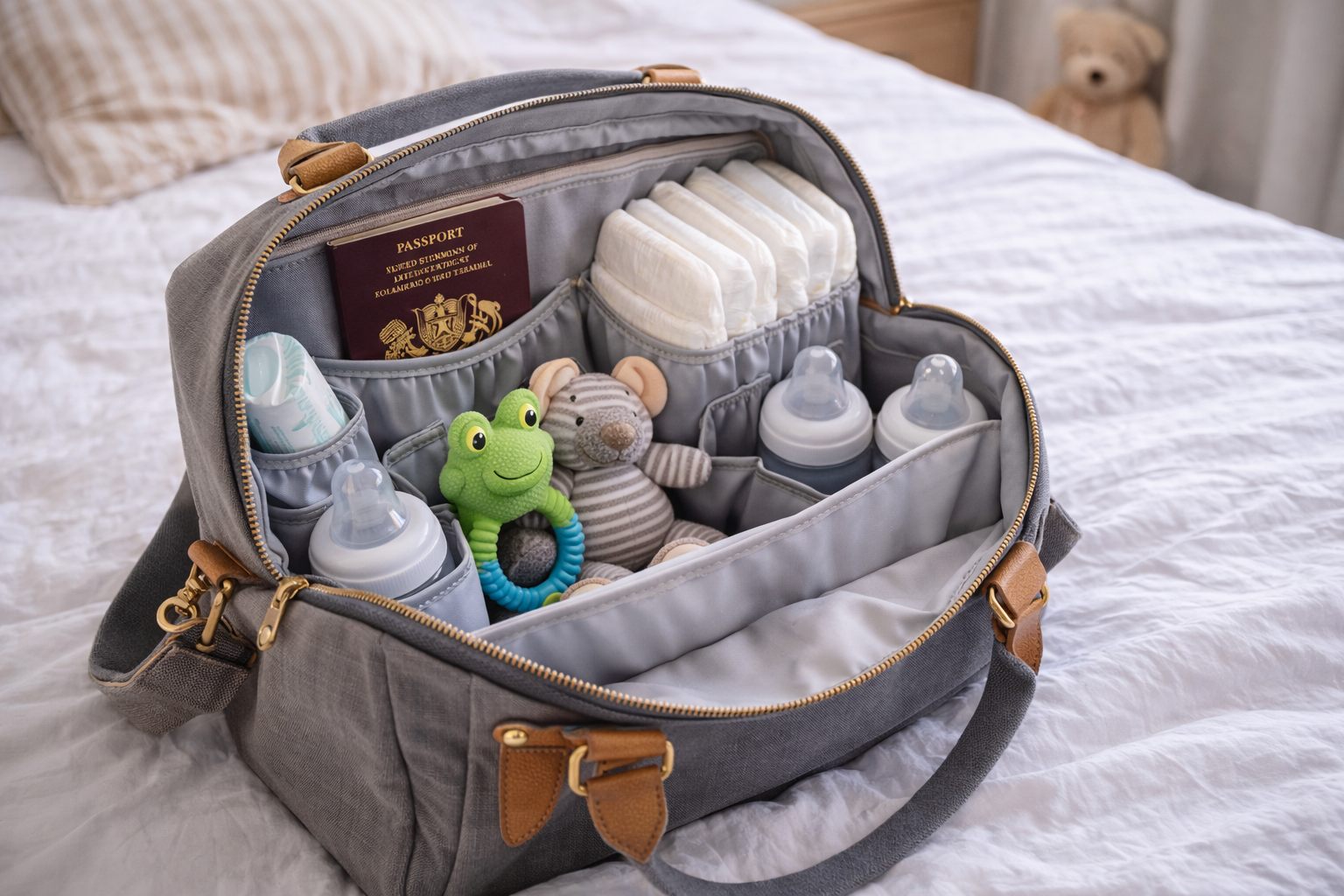
1. The Master Baby Hand Luggage Checklist
Use this as your pre-flight packing list. Quantities are for a medium-haul flight (3–6 hours) — see Section 4 to scale up or down. For additional holiday travel essentials and travel accessories, those hub pages cover the full range of baby gear for any trip.
🧷 Nappy Station
- Nappies — 6–8 for a medium-haul flight (3 per 5 hours total travel time)
- Travel wipes — 1 compact resealable pack
- Nappy disposal bags — scented; 6–8 to match nappy count
- Travel changing mat — plane toilet fold-down tables are hard plastic, cold, and often wet
- Nappy cream — in a 100ml or less tube
🍼 Feeding
- Bottles (pre-sterilised) or breastfeeding cover if needed
- Pre-measured formula in a dispenser, or expressed milk in a sealed bag
- Sterile water for formula mixing (you CAN take this through UK security — see Section 2)
- Age-appropriate snacks — rice cakes, fruit pouches, breadsticks for older babies
- Leak-proof cup or bottle for babies on solids
- Silicone bib — easy to wipe clean, no soggy fabric bibs mid-flight
- 2 muslin cloths
👕 Clothing
- 1 full change of clothes for baby (bodysuit, leggings, socks)
- 1 spare top for you — spit-up, blowout splashback, and spilled formula are all real risks
- 1 extra pair of socks for baby — they always come off and it always gets cold
- Lightweight cardigan or sleepsuit — cabin air conditioning can be aggressive
😴 Comfort & Sleep
- Dummy — plus at least 1 spare (keep one clipped to baby or you, never loose in the bag)
- Comforter, taggie, or "anchor" toy — familiar smell is a powerful sleep cue
- Baby sleeping bag — for long-haul flights; the familiar cue can make a real difference
- Lightweight muslin or blanket for covering during naps
🎲 Entertainment
- 2 small familiar toys — board books, soft rattles, texture balls
- 1 brand new toy kept sealed until the flight — this is your secret weapon for the difficult patch
- A small board book (doubles as entertainment and a comforting routine)
- Sticker book or chunky crayons for toddlers (12m+)
- Tablet with pre-downloaded content and toddler headphones for 12m+ — download everything in advance, never rely on in-flight WiFi
Need fresh options? Our roundup of the best travel toys for babies and toddlers covers what actually earns its space in a carry-on.
📋 Documents & Essentials
- Baby's passport — double-check it's current before you leave for the airport
- Boarding passes — digital or printed; both, if possible
- Travel insurance documents (or the app downloaded offline)
- Emergency contact numbers written down, not just saved on your phone
- Any prescription medication — exempt from the 100ml rule
🛒 Extras Worth Including
- 2–3 resealable plastic bags — dirty clothes, used nappies in a nappy bag, wet muslins
- Hand sanitiser (100ml or under)
- Lip balm or baby-safe moisturiser — cabin air is extremely dry; baby's lips and your hands will both need it on anything over 3 hours
- A small snack for you — you will not eat a proper meal if your baby is awake

Skip Hop Pronto Changing Station
Our Take: Plane toilet changing tables are small, hard, and often damp. This fold-flat changing station has an integrated pocket for wipes and a nappy, meaning your entire changing kit comes out in one piece rather than requiring you to excavate the bag while holding a baby over a toilet bowl. It slots under the buggy seat for airport use too.
Key feature: Folds flat; wipes-accessible pocket; attaches to buggy handle. | Price: Around £18–£22.

Munchkin Miracle 360 Cup
Our Take: A sealed cup is non-negotiable in a hand luggage bag — a knocked-over open cup in the seat-back pocket will soak everything. The 360 design means babies can drink from any angle, it doesn't spill when tipped, and it packs flat without liquid inside. Worth it well before the flight — if your baby isn't used to it at home, don't debut it at 30,000 feet.
Key feature: 360° spill-free design; dishwasher safe; from 6 months. | Price: Around £8–£12.
2. UK Airport Security Rules for Baby Items
The 100ml liquid rule has exceptions for baby items, and many parents don't know the full scope of what's allowed. Here's what the rules actually say, based on UK government hand luggage guidance.
You CAN take more than 100ml of the following:
- Breast milk (expressed or directly from the breast on the other side of security)
- Formula milk — ready-made or powder
- Cow's milk, soya milk, or any other milk your baby drinks
- Sterilised or cooled boiled water for mixing formula
- Baby food — jars, pouches, and tubs
- Prescribed medication for your baby
How it works in practice: These items will be removed from your bag and screened separately at the security lane. Decant them into a clear bag and keep it at the very top of your hand luggage before you reach the trays — it speeds everything up and signals to the security officer what's happening before they need to ask.
You do not need to taste breast milk or formula to prove it's genuine — this is a persistent myth. Security staff may test the liquid electronically, but you should never be required to consume it yourself. If you're asked to, politely decline and ask to speak with a supervisor. For the full picture on navigating airports with a baby, our flying with a baby guide has a dedicated airport section.
Our Tip
Put every baby liquid in one dedicated clear bag — separate from your own toiletries. Think of it as your "baby security bag." When you reach the tray, pull it out first and place it visibly on the belt. It takes 30 seconds of preparation at home and saves significant stress at the lane.
3. How to Organise the Bag
📋 Free Baby Holiday Packing Checklist
Enter your email and we'll send the free printable checklist straight to your inbox — every category, ready to tick off before every trip.
The checklist is only half the battle. How the bag is packed determines whether you can access what you need quickly — which matters enormously when you're holding a wriggling baby with one hand and trying to find a nappy with the other.
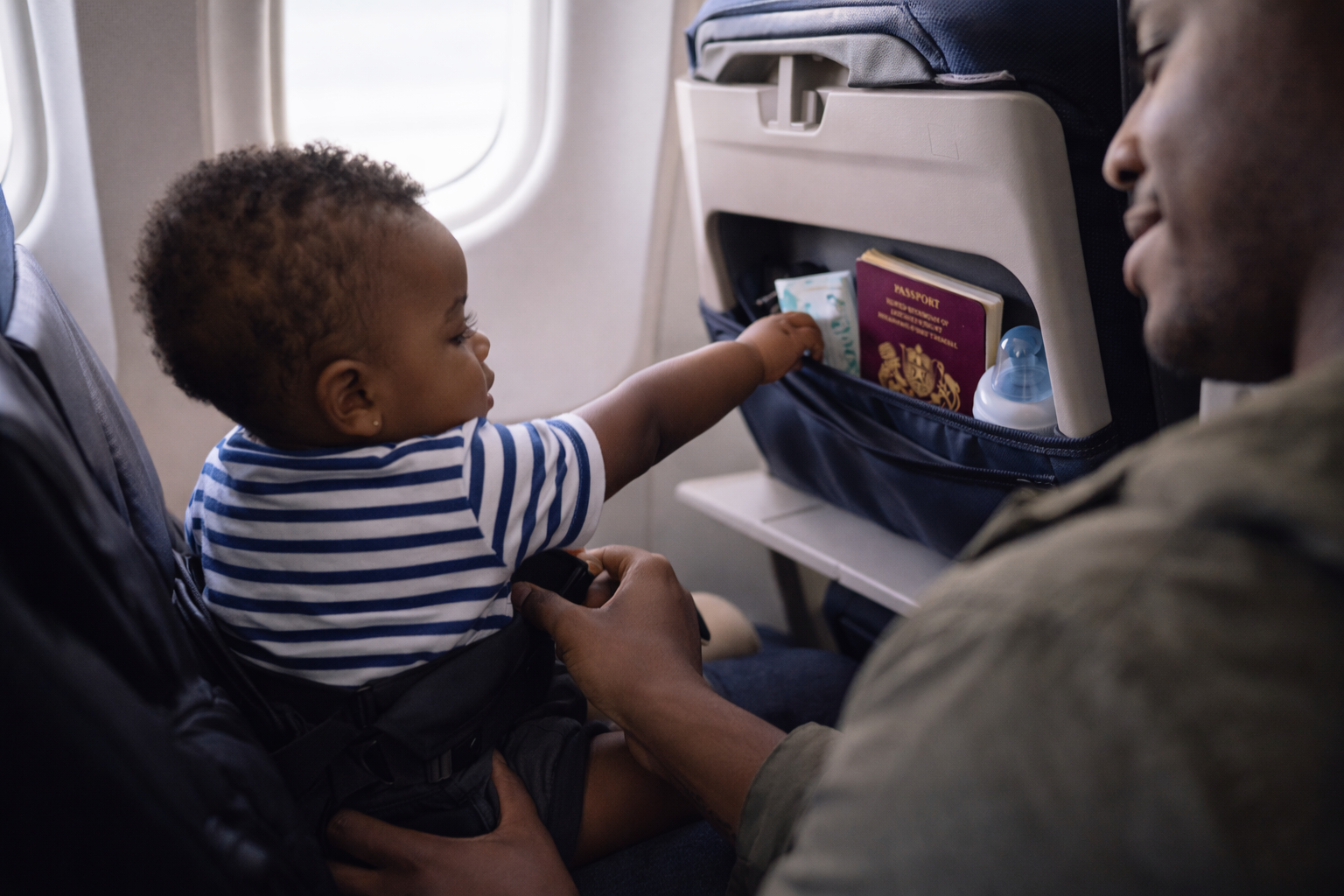
Use packing cubes or ziplock bags to separate categories. Nappies in one pouch, feeding kit in another, spare clothes in a third. You should be able to identify what you need by touch in a dark cabin without fully opening the bag.
Create an "emergency blowout kit" as a dedicated accessible pouch. It contains: one nappy, a small pack of wipes, one spare outfit, and a resealable bag for dirty clothes. This goes in the most accessible exterior pocket of your bag — not buried under everything else. When a blowout happens at 35,000 feet, you want this in your hand within ten seconds.
The dummy clip is not optional. A dummy rolling under the seat in front and disappearing during turbulence is one of aviation's most reliable stressors. Clip it to the baby's clothing or to you before boarding. Never leave it loose in the bag.
Seat-back pocket strategy: Before the aircraft doors close, move your most-used items into the seat-back pocket — muslin, dummy, one toy, one snack, your phone. These are the things you'll need in the first 30 minutes and reaching into the overhead bin with a baby in your arms is not something you want to be doing repeatedly. If you're travelling with a carrier for the airport, it can go in the overhead bin once you're seated. And if you've gate-checked a buggy, your cabin-friendly stroller should be waiting at the gate on arrival rather than baggage reclaim.
Count optional toddler gear before you pack
A CARES harness is about 500g, an inflatable toddler airplane bed is commonly around 1–1.3kg with its pump, and a ride-on suitcase can weigh 1.7–3.6kg before anything is packed. These items do not normally create another cabin allowance, so compare the packed size with the fare you bought.
4. Adjusting for Flight Length
The master checklist above is calibrated for medium-haul. Here's how to scale it:
| Flight Length | Nappies | Feeds | Outfit Changes | Entertainment |
|---|---|---|---|---|
| Under 3 hours | 3–4 | 1 + buffer | 1 | 2 toys, 1 book |
| 3–6 hours | 6–8 | 2 + buffer | 1 | 3 toys, book, snacks |
| 6+ hours | 10+ | 3–4 + buffer | 2 (+ pyjamas overnight) | Full kit + tablet + sleeping bag |
Short-haul (under 3 hours): Keep it minimal. The main risk is a delayed departure eating into your buffer, so pack slightly more than you think you'll need for the flight itself, but don't overload. You're on and off quickly.
Medium-haul (3–6 hours): The master checklist above is your guide. This is the range where everything on the list earns its place — you'll likely need most of it.
Long-haul (6+ hours): Add a baby sleeping bag (familiar sleep cue, useful if the cabin gets cold), pyjamas for overnight flights, and more entertainment variety. A white noise app on your phone or a compact white noise device can make a real difference once the lights go down — the Dreamegg D11 is a popular option with a clip that attaches to a cot or pram. On very long flights, the airline bassinet (request at booking, not at check-in) is the single biggest sleep aid available to you — your baby needs to be under a certain weight to use it, so check the airline's policy in advance.
✈️ Free Baby Hand Luggage Checklist
Never forget the essentials. Enter your email and we'll send the free checklist straight to your inbox — one page, every category, ready before every flight.
Frequently Asked Questions
How many nappies do I need in baby hand luggage?
The reliable rule is 3 nappies per 5 hours of total travel time — counting from the moment you leave the house to when you arrive at your accommodation, not just the flight. Add a few extra as a buffer for delays. For a 2-hour flight where you'll spend 3 hours in airports, that's around 6 nappies minimum. Running short on a delayed aircraft is genuinely unpleasant, so round up rather than down.
Can I take baby milk through UK airport security?
Yes. Breast milk, formula, cow's milk, and sterile water for formula preparation are all exempt from the 100ml liquid rule at UK airports. Pack them in a single clear bag at the top of your hand luggage and remove this bag at the security tray. The items may be tested electronically by security staff, but you should not be required to taste them. For full detail, see the UK government guidance on baby items in hand luggage.
What toys are best for a baby on a plane?
Small, soft, and quiet — the cardinal rules for plane toys. Crinkle books, soft stacking cups, taggie blankets, and simple board books all work well. Avoid anything that makes electronic noise without a volume control (your fellow passengers will thank you). The "secret weapon" principle works well: one completely new toy kept sealed until the difficult mid-flight patch, when novelty buys you 20–30 minutes of genuine calm.
Do I need a separate bag for baby's hand luggage?
It's personal preference, but many parents find it easier to have all baby items in one dedicated bag rather than mixed into their own hand luggage. A well-organised nappy bag or backpack works well — the key is that it's easy to open one-handed and that you can find things quickly in a dark cabin. Some parents use a large changing bag as their hand luggage; others use a compact backpack alongside a personal item. Either approach works if the contents are well organised.
What should I pack for a long-haul flight with a baby?
Scale up the master checklist: 10+ nappies, 3–4 feeds plus buffer, 2 changes of clothes and a set of pyjamas for overnight flights, a baby sleeping bag, and a tablet with pre-downloaded content for babies 12 months and over. Request an airline bassinet at booking (not at the airport) — it's free on most long-haul carriers and worth far more than any single item in your bag. Check the NHS guidance on preparing formula safely while travelling if you're flying with formula.
Can I take baby food pouches in hand luggage?
Yes. Baby food in jars, pouches, and tubs is exempt from the 100ml liquid rule at UK airports, in the same category as formula and breast milk. Pack them in your "baby security bag" alongside any milk and sterile water to keep the security process quick. Fresh fruit or vegetables are generally fine too, though rules vary for international arrivals — check the destination country's customs rules if you're flying internationally.
Pack Once, Pack Well
A well-packed hand luggage bag won't make your baby sleep through the entire flight, but it will make every difficult moment significantly easier to manage. Run through the master checklist the evening before departure rather than the morning of — you'll think more clearly, and you won't be searching for the nappy cream at 4 AM while the taxi waits outside.
Hand luggage allowances vary significantly by airline — Ryanair gives you an extra 5 kg infant bag, easyJet also allows a separate infant item, while on TUI the nappy bag must fit within your adult allowance. Check our airline-by-airline comparison before you pack.
For the full picture on flying with your baby — from booking to baggage reclaim — see our first flight with a baby guide. The air travel with baby hub covers every aspect of getting airborne with a little one. And if you haven't sorted your packing list for the holiday itself yet, the ultimate baby holiday packing list has you covered.