
Glamping With a Baby UK: Best Sites & What to Pack (2026)
By BabyTravel UK Editorial Team · Last updated August 2026
Glamping sits in the sweet spot between a tent and a cottage — you get the outdoor experience without sleeping on the ground. For parents with babies, that difference is enormous. Here's everything you need to know before you book.
Camping with a baby is doable, but it asks a lot of you. Pitching a tent in the rain, cooking on a camping stove, and trying to keep a baby warm overnight on a camp mat is an adventure some parents love — and one that exhausts others. Glamping removes the hardest parts of that equation. A real bed, often some form of heating, frequently a kitchen and a bathroom, and the outdoors right outside the door.
This guide covers what glamping actually looks like with a baby (versus what the Instagram pictures suggest), which accommodation types work best, real UK glamping sites worth booking, and the packing list that bridges the gap between a glamping site and a comfortable baby sleep setup. If you'd rather read about the full camping experience, our camping with a baby guide covers that in detail. For cottage holidays, see our baby-friendly UK cottages guide.
Quick Answer: Glamping With a Baby
- ✅ Glamping is significantly easier than camping with a baby — real bed, no ground mat, often heating.
- ✅ Best types for babies: safari/lodge tents and pods/cabins — most weatherproof and best facilities.
- ✅ Bring your own travel cot — most glamping won't provide one, or the one provided is unreliable.
- ⚠️ Canvas lets in a LOT of light — a portable blackout blind is non-negotiable.
- ⚠️ Bell tents can get cold overnight — especially from September. Check heating before booking.
- ✅ Best season: late May/June and September for warmth, availability, and value.
Glamping vs Camping vs Cottage: What's the Difference in Practice?
| Factor | Glamping | Camping | Cottage |
|---|---|---|---|
| Sleeping | Real bed (usually a double) | Mat/sleeping bag on the ground | Full bedroom setup |
| Heating | Often wood burner or electric heater | None — layers and sleeping bag only | Central heating throughout |
| Kitchen | Sometimes — varies by type | Camping stove only | Full kitchen always |
| Bathroom | Sometimes shared facilities | Campsite toilet block | Private bathroom always |
| Setup required | Minimal — accommodation is pre-pitched | Full tent pitch, everything from scratch | None |
| Outdoor feel | High — canvas walls, outdoor fire pit, nature | Very high | Low — depends on property |
| Baby difficulty | Moderate — manageable with right kit | High — cold, damp, no facilities | Low — easiest option |
| Price | £80–£200/night depending on type | £15–£40/night (pitch fee) | £100–£300+/night |
The honest conclusion: glamping with a baby is significantly more comfortable than camping, but still requires more active preparation than a cottage. The reward is the outdoor atmosphere — mornings with birdsong, evenings by a fire pit, countryside right outside the door — without the suffering of sleeping on the ground in a tent that smells of damp. For most parents with babies under 12 months, glamping is the sweet spot.
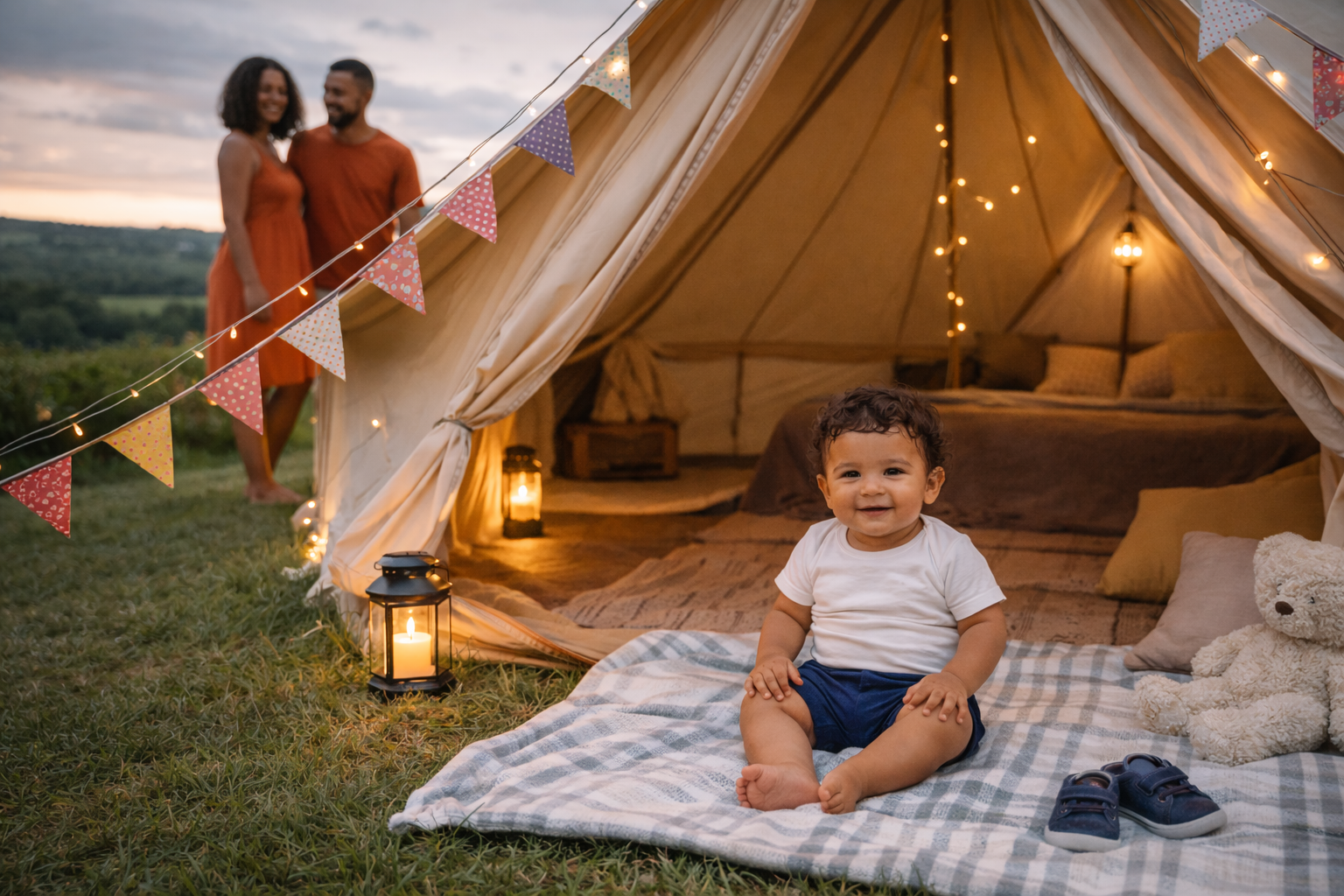
Types of Glamping Accommodation: Which Works Best With a Baby?
| Type | Space | Insulation | Own Bathroom? | Kitchen? | Heating | Baby Suitability |
|---|---|---|---|---|---|---|
| Bell Tent | Medium | Low — canvas only | Rarely | Sometimes a gas hob | Sometimes wood burner | ⭐⭐⭐ Summer only |
| Yurt | Large | Moderate | Sometimes | Often | Wood burner / electric | ⭐⭐⭐⭐ Good shoulder season |
| Shepherd's Hut | Small | Good | Often | Small kitchen | Wood burner / electric | ⭐⭐⭐ Check dimensions — tight with baby gear |
| Safari / Lodge Tent | Very large | Moderate–Good | Often | Full kitchen | Electric / wood burner | ⭐⭐⭐⭐⭐ Best option for babies |
| Pod / Cabin | Small–Medium | Very good | Often | Often | Electric heating | ⭐⭐⭐⭐⭐ Best year-round |
Bell Tents
Beautiful, atmospheric, and very popular on Instagram. Spacious canvas tents with a proper bed inside, sometimes a wood-burning stove, and a distinctly romantic feel. The limitations with a baby: canvas provides almost no insulation, so overnight temperatures track closely to outside air temperature. A September evening that feels pleasant outside can mean the inside of a bell tent dropping to 10°C by 3am. They're ideal for July and August; in shoulder season, check very carefully whether there's any form of heating and how effective it actually is. Also note: canvas lets light through from around 5am in summer. A blackout blind is not optional here — it's the difference between waking up at 5am and waking up at a more civilised hour.
Yurts
Circular, usually larger than bell tents, and better insulated thanks to the felted wool or foam construction of the walls. Many have wood burners and electricity, making them genuinely comfortable into October. The extra floor space is welcome with a travel cot to set up and baby gear spread around. A solid choice for families who want the canvas-and-nature atmosphere with slightly more thermal comfort.
Shepherd's Huts
Cosy, beautifully designed, and genuinely romantic — but measure the floor space before booking. Many shepherd's huts are designed as couples' retreats and the floorplan, once you've fitted a double bed and a wood burner, leaves very little room for a travel cot and the associated baby debris. The best ones have been extended or modified for families; check the listing dimensions carefully.
Safari Tents and Lodge Tents
The premium glamping option and the best one for families with babies. Multiple rooms, a full kitchen, often an en-suite bathroom — the closest experience to a cottage while still being technically glamping. Feather Down and similar operators do this well. You pay more, but you get facilities that genuinely make baby life manageable rather than aspirational.
Pods and Cabins
Wooden or composite structures with solid walls, proper insulation, and usually electric heating. The most weather-proof glamping option by some distance — comfortable year-round rather than just in peak summer. Less atmospheric than canvas but far more practical. Wigwam Holidays and many farm-based operators offer well-equipped pods that are underrated for family use.
Best UK Glamping Sites for Families With Babies
📋 Free Baby Holiday Packing Checklist
Enter your email and we'll send the free printable checklist straight to your inbox — every category, ready to tick off before every trip.
Feather Down (Multiple UK Locations)
Luxury canvas lodges on working farms across the UK and Europe. Each lodge is on a real farm — cows, chickens, pigs visible from the kitchen window. The lodges are spacious (multiple sleeping areas), well-equipped (wood-burning stove, proper kitchen with fridge), and genuinely family-focused. Baby farm animals are the most effective baby entertainment known to science. Prices are premium (typically £150–£250/night) but the experience justifies it. Book well ahead — they sell out months in advance for school holidays. featherdown.co.uk
Canopy & Stars (UK-Wide Booking Platform)
A curated platform of unusual and high-quality glamping accommodation across the UK — treehouses, shepherd's huts, yurts, safari tents, and more. The curation is genuinely good; properties are inspected and reviewed. Filter for "family friendly" and "cot available" to narrow down. Useful for finding hidden gems in specific regions rather than going with a large operator. canopyandstars.co.uk
Wigwam Holidays (Multiple UK Locations)
A network of wooden pod and cabin sites across the UK — over 80 locations. The pods are solid, weatherproof, and well-maintained. Not the most glamorous option, but consistently good value and genuinely reliable. Many sites have good family facilities (washing machines, communal kitchens, playgrounds). A good choice for a first glamping trip with a baby when you want to know what you're getting. wigwamholidays.com
Alde Garden, Suffolk
Yurts and bell tents set in a beautiful Suffolk garden, family-oriented, with a genuine sense of peace and quiet. Well regarded for baby and toddler families. Suffolk glamping means easy access to the coast, excellent food, and flat terrain for strollers and carriers alike. Smaller operation — personal service and well-maintained facilities.
Secret Meadows, Suffolk
Luxury safari-style lodges and glamping accommodation in Suffolk with optional hot tubs. The lodge tents are proper safari tents with full kitchens, proper beds, and enough space to manage a baby without everything feeling cramped. Suffolk has a reliable cluster of quality glamping options — it's one of the better regions in England for family glamping.
YHA Glamping Pods (Various Locations)
YHA operates camping pods at a number of its hostel sites across England and Wales — Lake District, Peak District, and South Downs among others. Budget-friendly, reliably clean, and with the full facilities of the hostel (café, showers, family rooms) available. Not luxurious, but a genuinely affordable entry point for families trying glamping for the first time.
Lake District and Welsh Options
Both regions have strong glamping provision for families wanting a wilder setting. In the Lake District, look for pod and cabin sites within reach of Windermere and the lower lake valleys — most provide excellent facilities and the scenery is unbeatable. In Wales, Snowdonia has several well-regarded sites and the drive from most of England is shorter than the Lake District. For destination inspiration, our Lake District guide covers what to do once you're there.
What's Usually Included — and What You Must Bring
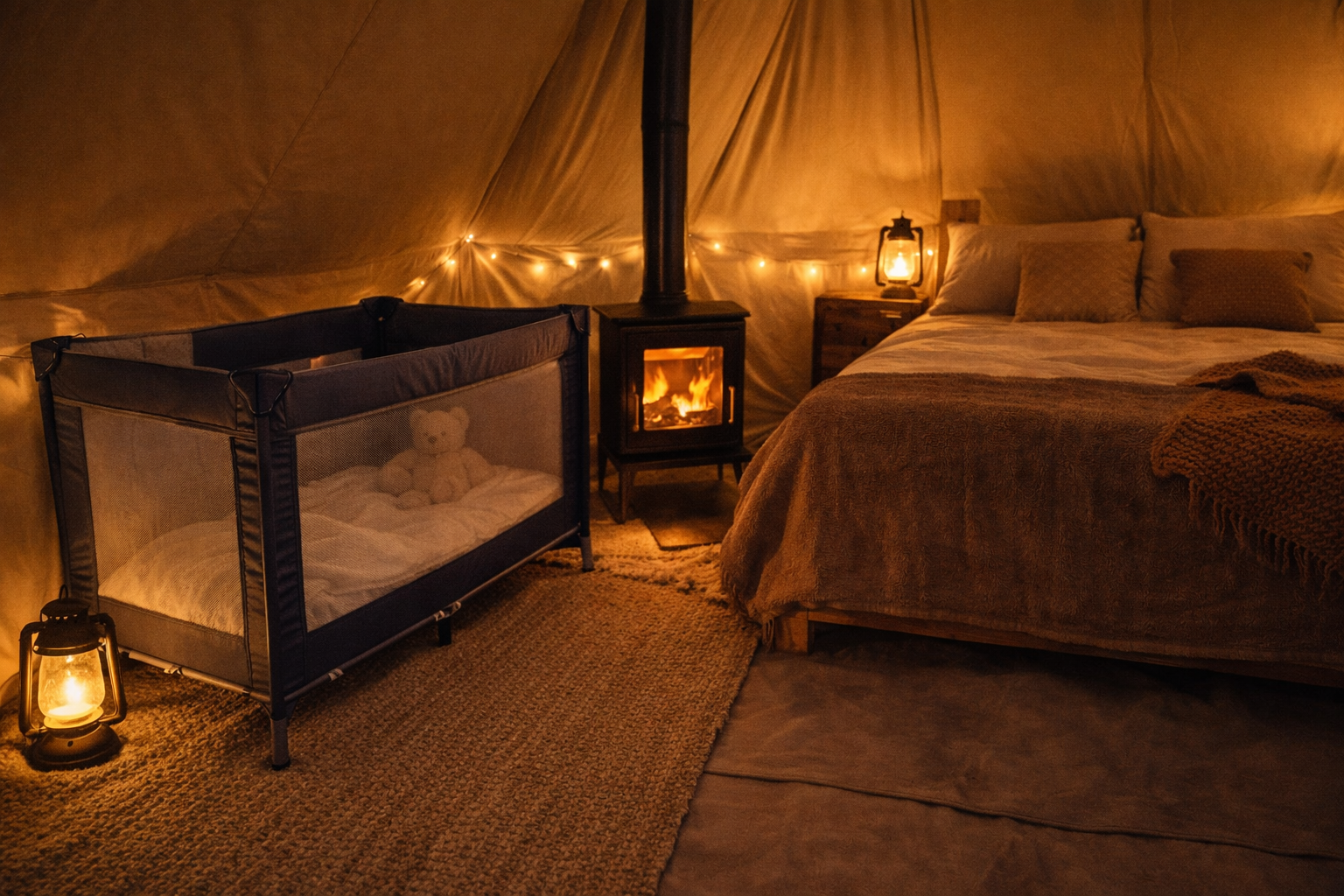
Most glamping accommodation provides: a proper bed with bedding, some basic cookware and crockery, an outdoor fire pit or barbecue, a welcome hamper of some kind, and (in better properties) heating. Most glamping does NOT reliably provide: a travel cot, a highchair, blackout curtains or blinds, baby bath, baby monitor, or any baby-specific equipment.
This matters because the gap between "cot available" in a listing and "a safe, clean, well-fitted travel cot that your baby will actually sleep in" is significant. Always ask specifically what type of cot is provided and how old it is before relying on it. Better still, bring your own.

BabyBjörn Travel Cot Light — Our Pick for Glamping
The BabyBjörn Travel Cot Light is the travel cot we'd reach for when glamping. It folds completely flat into a slim carry bag, sets up in seconds without tools or assembly, and — crucially — the mesh sides allow airflow in canvas accommodation that can get warm quickly. The firm, flat base meets safe sleep requirements without needing an additional mattress.
- ✅ Folds completely flat — fits easily alongside glamping luggage
- ✅ Sets up in seconds — no fiddly assembly after a long drive
- ✅ Mesh walls — good airflow in canvas tents and yurts
- ❌ Premium price — around £230, but genuinely worth it for regular users
Keeping Baby Warm at Night
This is the most common glamping mistake parents make — underestimating how cold canvas gets overnight. A bell tent that's a pleasant 20°C at 9pm can be 8°C by 3am in early September. Your baby's sleep setup needs to account for this, not assume the tent will stay warm.
The layering approach: start with a merino wool or cotton base layer (vest and sleepsuit), then a 2.5 tog sleeping bag as a minimum for summer glamping, moving to a 3.5 tog for anything into September or in bell tents without heating. The Tommee Tippee Grobag Dreamsack in 3.5 tog is a solid choice — it covers the coldest nights you're likely to encounter at a UK glamping site from May to October.
If your accommodation has a wood burner, position the travel cot well away from it — at least 2 metres — and never leave it burning unattended with a baby in the room. Electric fan heaters set on a thermostat are a safer option for overnight warmth in a baby's sleeping space. Follow Lullaby Trust safe sleep guidance for the cot setup — the same rules apply in canvas as at home.

Tommee Tippee Grobag Dreamsack (3.5 Tog) — For Cooler Glamping Nights
The 3.5 tog rating makes this the right sleeping bag for glamping from late spring through to autumn — covering the shoulder season nights when canvas accommodation gets genuinely cold. The two-way zip allows nappy changes without fully undressing baby, which matters a lot at 3am in a cold tent.
- ✅ 3.5 tog — suitable for cooler glamping nights (below 16°C room temp)
- ✅ Two-way zip — nappy changes without fully waking or undressing baby
- ✅ TOG rating clearly labelled — easy to layer correctly
- ❌ Too warm for midsummer in heated accommodation — use 1–2.5 tog then
Keeping Baby Safe at a Glamping Site
Open flames are the main safety consideration glamping adds compared to a cottage. Fire pits, wood burners, and barbecues are a feature of most glamping sites — and they're genuinely hazardous for curious babies and crawling toddlers. Keep the travel cot well clear of any heat source, supervise constantly near fire pits, and establish a clear "fire zone" that baby doesn't enter.
Campsite grounds also introduce hazards that don't exist indoors: uneven ground, tree roots, water features, neighbouring pitches with guy ropes at tripping height, and the general freedoms of outdoor space. None of this is a reason not to glamp — it's just a reason to do a quick sweep of the immediate outdoor space on arrival, the same way you would baby-proof a holiday cottage. For more on arrival safety sweeps, our Airbnb with a baby guide covers this process in detail.
For a systematic approach, our Arrival Sweep Baby-Proofing Navigator gives you a printable room-by-room checklist you can work through in the first 10 minutes after arriving — £4.99 as an instant download.
Follow the Lullaby Trust safer sleep guidelines for your baby's sleep setup in the cot. The guidance doesn't change because you're in a tent — firm, flat surface, correct sleeping bag tog, no loose bedding, no co-sleeping on a soft shared mattress.
Sorting the Blackout Problem
Canvas lets in light. A lot of light. At 5am in June, a bell tent glows like a lantern, and your baby — who has no concept of lie-ins — will treat this as a reasonable alarm clock. A portable blackout blind is one of the highest-impact items you can pack for any glamping trip. The Tommee Tippee Portable Blackout Blind uses static cling to attach to most surfaces including canvas and irregular window shapes — no suction cups, no tools, no fuss. It folds flat into its own pouch and weighs almost nothing.
The Best Time to Glamp With a Baby
Late May, June, and September are the sweet spots. Peak summer (July and August) is when glamping is warmest and the days are longest, but availability is tightest and prices are highest — book three to six months ahead if you want the best sites. Late May and June give you long evenings, genuinely warm weather, and more availability. September is often underestimated — the weather is frequently beautiful, sites are quieter, and prices drop noticeably. The main caveat for September is overnight temperatures in canvas accommodation: pack the 3.5 tog sleeping bag.
Pods and cabins are genuinely comfortable year-round if you want to glamp outside the main season — October and even early November can be wonderful in a well-heated wooden cabin with a fire pit and no other guests.
What to Pack for Glamping With a Baby
Lighter than camping, heavier than a hotel. The essentials that glamping won't reliably provide:
- Your own travel cot — don't rely on what the site provides
- Portable blackout blind — non-negotiable for canvas accommodation
- Appropriate-tog sleeping bag — 2.5 tog minimum; 3.5 tog for shoulder season
- White noise machine — campsite sounds (wind, wildlife, neighbours) disrupt sleep more than at home
- Extra warm layers for baby — merino base layer, fleece suit for very cold nights
- Baby monitor — canvas is not soundproof, but if you're sitting by the fire pit 20 metres away you still need one
- Changing mat — bring your own; assume none is provided
- Baby bath or wash bowl — if the accommodation doesn't have a proper bath, a small inflatable or foldable baby bath is useful
- Baby carrier — for exploring the site and surrounding countryside where a buggy won't manage
For a complete packing reference, our baby holiday packing list covers everything by category. For managing sleep in an unfamiliar environment, our holiday routine guide covers the strategies that help.
✈️ Free Baby Hand Luggage Checklist
Never forget the essentials. Enter your email and we'll send the free checklist straight to your inbox — one page, every category, ready before every flight.
FAQ: Glamping With a Baby
Is glamping suitable for newborns?
It depends heavily on the type of accommodation and the time of year. A heated pod or well-insulated safari tent in summer is manageable for a newborn. A bell tent with no heating in September is not. The key variables are temperature control overnight and proximity to bathroom facilities for frequent night feeds and changes. If you're glamping with a newborn, choose a pod or cabin with electric heating, verify the bathroom situation before booking, and avoid bell tents until baby is at least 3–4 months old.
Do glamping sites provide travel cots?
Some do, but quality and availability vary enormously. Always ask specifically what type of cot is provided, how old it is, and whether it meets current safe sleep standards before relying on it. We recommend bringing your own travel cot for glamping — the peace of mind is worth the extra luggage. The BabyBjörn Travel Cot Light folds flat and adds minimal bulk.
What's the best glamping type for a baby?
Safari lodge tents and wooden pods/cabins are the best options. Both offer more space, better insulation, and more reliable heating than bell tents or shepherd's huts. Safari lodges offer the most space for baby gear and often have full kitchens. Pods are more affordable and genuinely comfortable year-round.
How do I keep a baby warm in a glamping tent overnight?
Layer correctly: a merino base layer under a well-fitted sleeping bag of the appropriate tog for the expected overnight temperature. 2.5 tog is a minimum for summer glamping; 3.5 tog for anything into September or in canvas without reliable heating. Position the travel cot away from any draught (tent entrance, gap in canvas wall) and away from any open flame or wood burner. Check the overnight forecast before you go and pack one layer warmer than you think you need.
Can babies sleep in a bell tent?
Yes, but with the right setup. The main challenges are light (canvas glows at dawn — use a blackout blind) and temperature (canvas insulates poorly — use appropriate tog sleeping bag and check for heating). In July and August on a warm night, a bell tent sleep environment is entirely manageable. From mid-September, ensure there's a wood burner or electric heater available for the space before booking.
Which UK region is best for glamping with a baby?
The South West (Devon, Cornwall, Somerset, Dorset) has the highest concentration of quality glamping sites and the most reliable summer weather. Suffolk and Norfolk are excellent for flat, accessible sites with good countryside. The Lake District and Yorkshire Dales offer spectacular scenery but wetter weather — choose a pod or cabin rather than canvas if you're heading north. Wales has excellent glamping provision, particularly in Pembrokeshire and Snowdonia.
Do I need travel insurance for a glamping trip?
For UK glamping it's less critical than international travel, but a policy that covers cancellation and baby illness is still worthwhile — glamping deposits are often non-refundable, and a baby who spikes a temperature the night before you leave is not an uncommon scenario. Check your existing travel insurance terms before buying a new policy.
Is glamping or a holiday cottage better for babies?
A cottage is objectively easier — full kitchen, reliable heating, private bathroom, childproofable. Glamping offers something different: the outdoor atmosphere, the fire pit evenings, the farm animals at Feather Down, the sense of having a small adventure together. Whether that's worth the additional preparation is a personal call. For a first family holiday, a cottage is lower-risk. For families who've done a cottage holiday and want something a bit different, glamping is a genuinely brilliant step up.
Planning your glamping trip? For a full packing guide, visit our baby holiday packing list. For cottage alternatives, our baby-friendly UK cottages guide is worth a read. And if you're heading to a specific region, our Cornwall, Devon, and Lake District guides cover what to do once you're there.