
Holiday Park vs Cottage With a Baby: Which Is Better? (2026)
By BabyTravel UK Editorial Team · Last updated August 2026
Two excellent options. Very different holidays. Which one suits your family depends entirely on what kind of break you actually want — and what stage your baby is at.
It's one of the most common questions new parents face when planning their first proper family holiday: holiday park or cottage? Both are excellent choices with a baby. Both have real trade-offs. And the answer that's right for one family is completely wrong for another — because they represent fundamentally different kinds of holiday.
A holiday park says: we'll take care of everything, the facilities are here, there's a pool, there's food, you don't need to think too hard. A cottage says: it's all yours, do it your way, cook what you want, sleep when you want, sit in the garden at 6am in your pyjamas without judgement. Neither is objectively better. This guide will help you work out which one you are — and point you towards the specific options worth considering in 2026. For a broader look at UK family holiday options, see our best baby-friendly UK holidays hub. Still deciding where to go? Our free UK destination quiz matches you to one of 15 destinations — including Centre Parcs, Haven, and all the top cottage destinations.
Holiday Park vs Cottage: Quick Verdict
- Choose a holiday park if: It's your first holiday with a baby, you want a pool, you don't want to cook every meal, or bad weather is a real risk
- Choose a cottage if: Routine is your priority, you want privacy and space, you're a more confident parent, or you're staying longer than 4 nights
- Best holiday park for babies: Centre Parcs — pool quality and baby facilities are unmatched
- Best cottage search: Sykes or holidaycottages.co.uk — filter for enclosed garden and cot provided
- Cost: Broadly similar at peak season; cottages offer more flexibility and value outside school holidays
- The hybrid option: Hoseasons lodges or farm stays — park facilities with cottage-style privacy
The Core Trade-Off
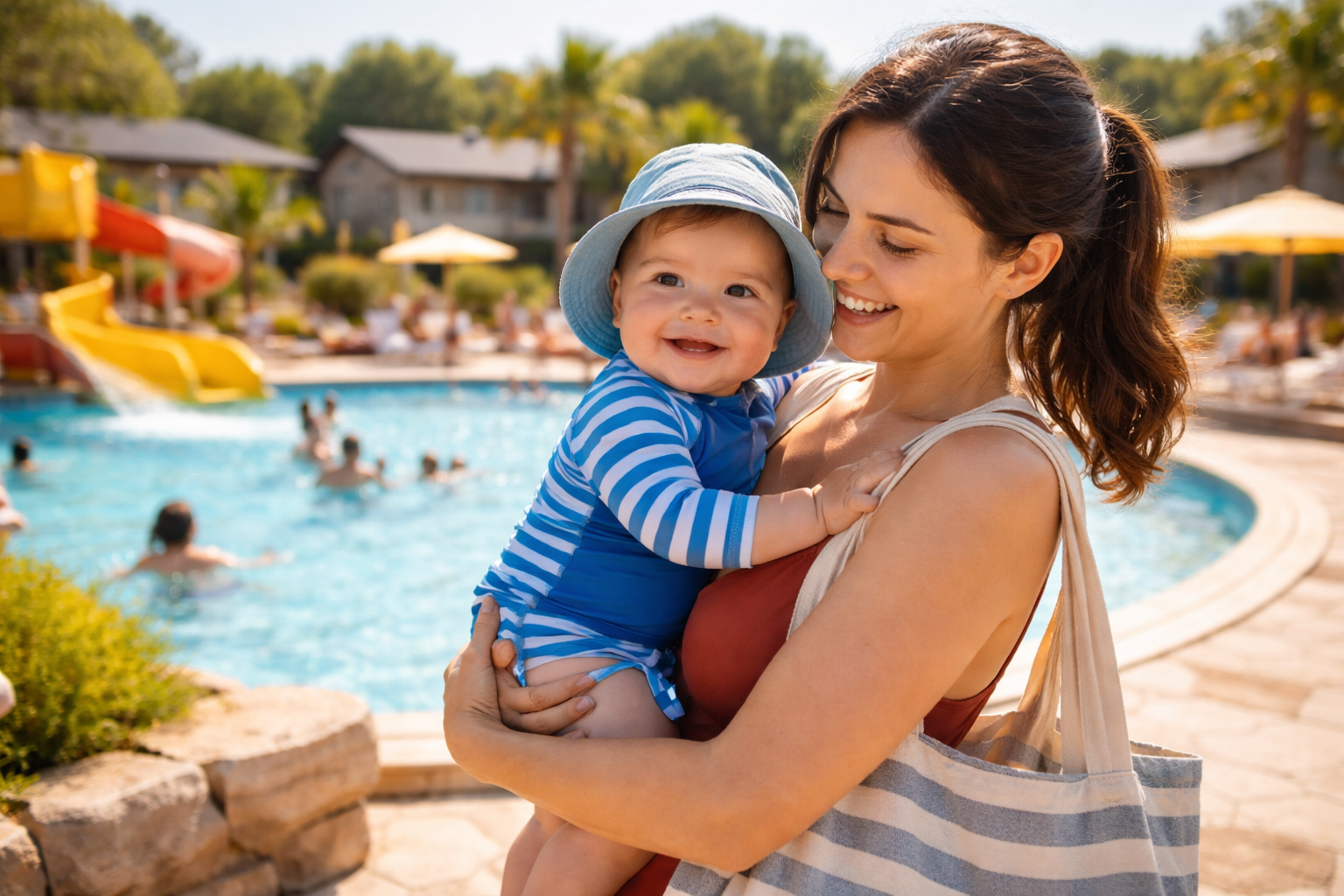
Holiday parks offer facilities, convenience, and structure. Swimming pools — usually the headline — restaurants when you can't face cooking, entertainment on tap, everything within a short walk of your accommodation. You arrive, you unpack once, and the infrastructure of the park does a significant amount of the work for you. For first-time parents in particular, this safety net is genuinely valuable: other families are around, the staff are used to babies, and a difficult evening doesn't require a 20-minute drive to find a restaurant.
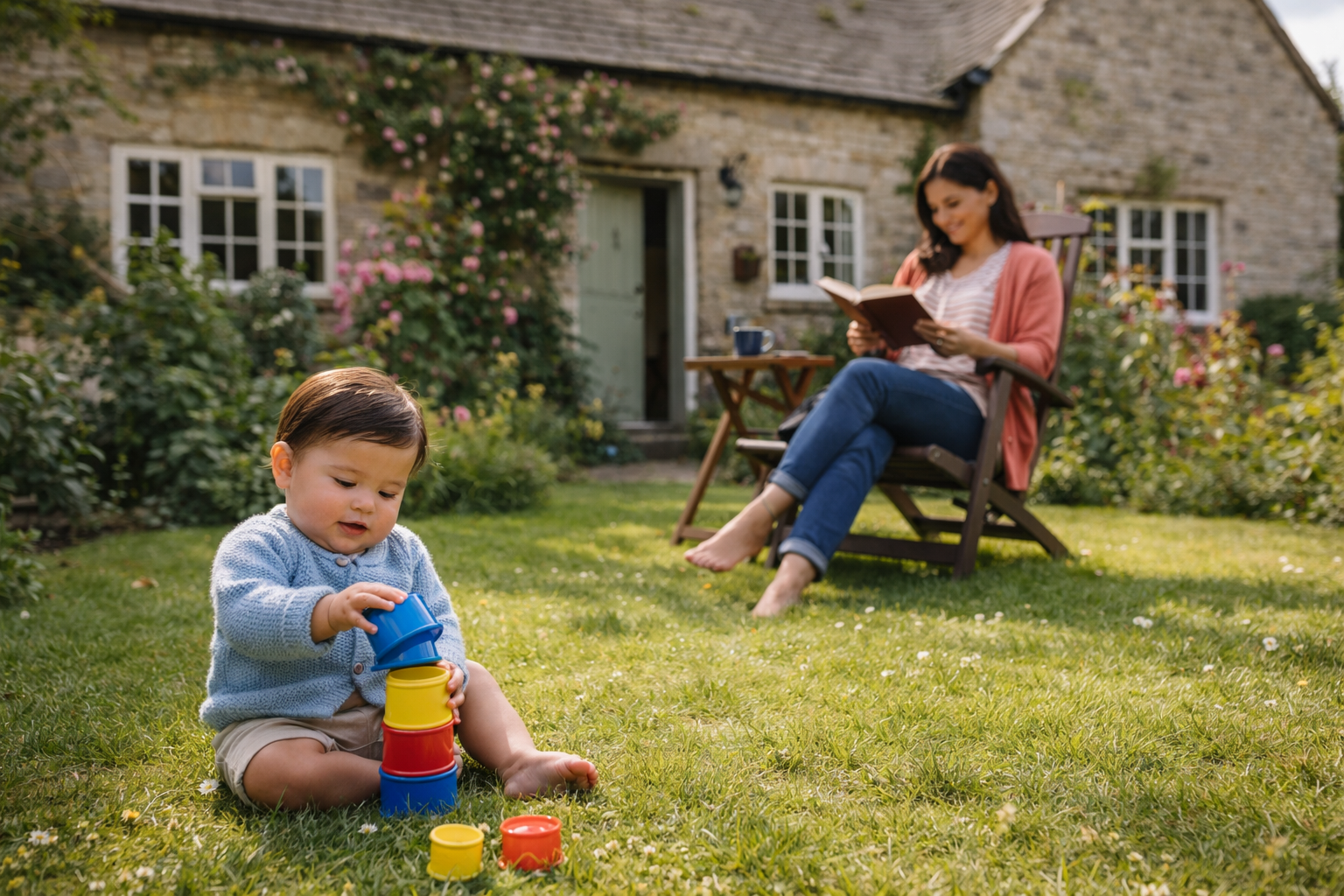
Cottages offer privacy, flexibility, and space. Your own kitchen means meals on your schedule with exactly what your baby will eat. Your own garden means a 6am wake-up doesn't have to involve getting dressed before you've had tea. Your own four walls mean that your baby's 7pm bedtime doesn't trap you in a tiny room listening to entertainment noise through thin walls. For families where routine is the priority and privacy matters, a cottage in the right location can be deeply restorative in a way that a holiday park simply can't match.
The right answer depends on what kind of holiday you want, what stage your baby is at, and which of these trade-offs you can live with most comfortably. Let's go through both in detail.
Holiday Parks With a Baby: The Full Picture
📋 Free Baby Holiday Packing Checklist
Enter your email and we'll send the free printable checklist straight to your inbox — every category, ready to tick off before every trip.
The Case For Holiday Parks
The single biggest draw for baby families is the swimming pool. A warm, supervised, indoor pool where your baby can splash in shallow water is genuinely hard to replicate in a cottage setting — and for many parents, it's the entire reason they choose a park. Centre Parcs' Subtropical Swimming Paradise, Haven's Splash Zones, and Butlins' Splash Waterworld are all genuinely good pool facilities that earn their reputation.
Beyond pools: restaurants and cafés on-site remove the pressure of cooking after a difficult day. If your baby has been unsettled all afternoon and you're running on four hours of sleep, being able to walk to a restaurant 200 metres away is a meaningful quality of life improvement. Baby equipment (cots, highchairs, sterilisers at some parks) is usually available to hire or is included, reducing what you need to bring. And the social element — being surrounded by other families in similar situations — can be enormously normalising for first-time parents who are still calibrating what "normal" looks like.
The Case Against Holiday Parks
The trade-offs are real. Noise is the most common complaint — other guests, entertainment programmes, and the general buzz of a busy park can make sleep management challenging, particularly at Centre Parcs where lodges are close together. Space constraints at budget tiers can be significant — a starter caravan or lodge is compact, and with a travel cot, changing mat, and baby kit deployed, it can feel crowded quickly.
Routine control is the other major limitation. Holiday park entertainment schedules don't align with 7pm bedtimes. If you're eating at the on-site restaurant, you're on their schedule rather than your baby's. The park environment can feel repetitive after a few days — there's only so much of the same facilities circuit before you start wondering what's beyond the park perimeter. And the on-site shops are almost universally expensive; stock up at a supermarket before you arrive.
Cottages With a Baby: The Full Picture
The Case For Cottages
Routine control is the headline advantage. You cook when you want, eat when you want, start bedtime when you want, and manage your baby's naps without negotiating around someone else's schedule. For families where routine is non-negotiable — and many are, especially in the 4–12 month window — a cottage is simply better. See our holiday routine guide for how to protect the routine in any accommodation type.
Space is another major advantage. A typical cottage offers separate bedrooms, a proper living room, a kitchen, and usually a garden — more space than any comparable holiday park accommodation. For a family spending a significant amount of time indoors (inevitable with a baby, even in summer), space genuinely matters. The ability to put the baby to bed and then sit in the living room rather than the bathroom is not a luxury — it's a reasonable quality of life expectation.
Privacy is the quiet benefit that many parents don't fully appreciate until they have it. No neighbours through thin walls. No other families watching your baby's meltdown in the shared outdoor area. No entertainment noise bleeding through from the next lodge. Just your family, your space, and your pace. For parents who found the social aspects of pregnancy and early parenthood exhausting rather than energising, cottage privacy is worth paying for.
The Case Against Cottages
You're responsible for everything. Shopping, cooking, cleaning, washing, entertaining — all of it falls to you, every day, in a setting where you also have a baby to manage. On good days, the self-sufficiency is satisfying. On bad days — when the baby hasn't slept, the weather is grim, and nobody can agree on what to have for dinner — it can feel like a slightly more expensive version of being at home.
Baby equipment provision varies enormously. Some cottages are brilliantly equipped with high-quality travel cots and highchairs; others offer a battered 20-year-old cot with a stained mattress. Always check specifically what's provided and its condition. If there's any doubt, bring your own travel cot — see our travel cots guide for the best portable options.
Cottages can also feel isolating for first-time parents who'd benefit from the normalising presence of other families. And if something goes wrong — you need milk at 10pm, the heating fails, you've forgotten something essential — you're further from a solution than you would be at a park with a 24-hour reception desk.
When to Choose a Holiday Park
- First holiday with a baby: The safety net of on-site facilities reduces anxiety for parents who aren't yet confident in managing everything independently away from home
- Babies aged 3–12 months: The pool is accessible, the entertainment provides some structure, and the on-site restaurants handle the difficult evenings
- Rainy weather destinations: Scotland, the Lake District, and winter breaks — indoor pool facilities matter more when outdoor options are limited
- Parents who want social interaction: Being around other families is normalising and social — the shared outdoor areas and restaurants provide natural connection
- Short breaks (2–3 nights): The park format rewards short intense visits; repetition is less of an issue over a weekend
- When you genuinely don't want to cook: The restaurant option isn't a cop-out — it's a legitimate quality of life consideration after a tiring day with a baby
When to Choose a Cottage
- Second or third family holiday: More confident parents who've done the first trip and know what they need — and don't need — from accommodation
- Longer stays (5–7 nights): A week at a park can feel repetitive; a week in a well-chosen cottage gives you a base to explore from rather than a contained environment
- Babies under 4 months: Very young babies need quiet and predictability more than facilities — a peaceful cottage is often the right call
- Routine-first families: If your baby's sleep schedule is non-negotiable, cottage control over mealtimes, bedtimes, and noise levels makes a significant difference
- Shoulder season travel: June, September, and half-terms outside August — cottage pricing drops significantly, and you get more space per pound than any park equivalent
- Families who want to explore: A cottage in a good location gives you a base from which to discover the surrounding area; a park can feel like it's the destination rather than the base
Essential Kit for Both Accommodation Types
Whether you choose a park or a cottage, two items make the difference between genuinely rested nights and the alternative:

BabyBjörn Travel Cot Light
From birth to 3 years | 11 kg | Sets up in 30 seconds | Includes carry bag
The reason we recommend this over the provided cots at both parks and cottages is simple: your baby knows it. Sleep is hard enough in a new environment without also introducing an unfamiliar cot — bringing the same travel cot every trip builds a sleep association that transfers across locations. The BabyBjörn sets up in 30 seconds, has a proper breathable mesh base (not the fabric sling some travel cots use), and packs into a carry bag that fits in most car boots alongside a full holiday load.
- ✅ Sets up in 30 seconds — no instructions needed
- ✅ Breathable mesh base — proper mattress support
- ✅ Baby learns to sleep in it consistently across trips
- ✅ Suitable from birth to around 3 years
- ❌ Heavier than some competitors at 11 kg
- ❌ Premium price — worth it if you'll use it regularly

Lindam Portable Pressure Fit Stair Gate
Pressure-fit | No tools or drilling | Fits openings 76–82 cm | From 6 months
Holiday cottages with stairs are the norm, and most don't have gates fitted. For babies who are mobile — crawling, pulling to stand, or beginning to walk — an unfamiliar staircase in a holiday property is a genuine hazard, particularly at night. This pressure-fit gate installs and removes without tools or damage to door frames, making it ideal for rental properties. It travels in a bag, takes 5 minutes to fit, and provides proper safety without the anxiety of managing stairs with a baby in an unfamiliar layout.
- ✅ No drilling — fits without damage to rental property
- ✅ Installs and removes in minutes
- ✅ Compact to pack in the car
- ✅ Covers the most common UK door/stair opening widths
- ❌ Pressure-fit only — not suitable for top of stairs as a permanent fitting
- ❌ Check your opening width before purchasing
Cost Comparison: What to Expect in 2026
Pricing is highly variable by location, season, and quality tier. The figures below represent realistic 2026 estimates across typical options — not absolute values.
| Option | Peak (Aug school hols) | Shoulder (June/Sep) | Notes |
|---|---|---|---|
| Centre Parcs (3-night woodland lodge) | £700–£1,200+ | £400–£700 | Pool included; activities extra. Books out early. |
| Haven (week, prestige caravan) | £500–£900 | £250–£450 | Beach access at most sites; activities extra. |
| Butlins (week, gold apartment) | £600–£1,000 | £300–£500 | Entertainment included; rides and some activities extra. |
| Sykes cottage (Cornwall, week) | £800–£1,800+ | £400–£800 | Wide range by size and location. No added activity costs. |
| holidaycottages.co.uk (Cotswolds, week) | £600–£1,200 | £350–£700 | Wider range of property sizes and price points than Cornwall. |
| Hoseasons lodge (mid-range, week) | £600–£900 | £300–£550 | Good middle ground — lodge privacy with shared site facilities. |
The headline conclusion on cost: broadly similar at peak season, with wide variation by location and quality. Outside peak season, cottages offer significantly better value — a June week in a Cotswolds cottage costs considerably less than the equivalent August week, and unlike holiday park pricing which stays elevated through school holidays, cottage pricing drops substantially in term time. See our baby-friendly cottages guide for more on what to look for and filter for. And if you're choosing between a specialist cottage site and Airbnb, our cottage vs Airbnb comparison covers which is more reliable for families with babies.
The Hybrid Option: Best of Both Worlds
If the holiday park vs cottage decision feels like a genuine dilemma, it's worth knowing that a middle ground exists. Several options give you cottage-style privacy with some degree of shared facilities:
Hoseasons lodges are standalone holiday lodges on small parks that often include a shared pool and some amenities, but without the scale and noise of a major park. You get your own front door and outdoor space, but a pool is accessible without a car journey. Hoseasons has a large UK inventory across most regions.
Farm stays offer the space and independence of a cottage with the bonus of outdoor activity built in — animals to look at (babies are reliably fascinated), open space, and often a family-owned feel that provides some social connection without the manufactured entertainment of a holiday park. Particularly good for babies from 6 months who are awake and engaged with their surroundings.
Glamping is another bridge option — self-contained accommodation (bell tent, shepherd's hut, yurt) in a shared site with sometimes excellent communal facilities, in beautiful rural locations that neither a park nor a conventional cottage would give you. See our glamping with a baby guide for a full breakdown. And for parents who want beachside facilities without the full holiday park commitment, our caravan holidays guide is worth reading alongside this one.
Holiday Park vs Cottage: Full Comparison
| Factor | 🏕️ Holiday Park | 🏡 Cottage |
|---|---|---|
| Swimming pool | ✅ Usually included — often excellent | ❌ Almost never included |
| Routine control | ⚠️ Limited — noise, restaurant hours, entertainment schedules | ✅ Total — your schedule, your pace |
| Cooking flexibility | ⚠️ Basic kitchen; on-site restaurants available | ✅ Full kitchen — cook exactly what your baby will eat |
| Space | ⚠️ Often compact, especially budget tiers | ✅ Typically more space, separate bedrooms, garden |
| Privacy | ❌ Neighbours audible; shared outdoor areas | ✅ Your own property — no shared walls or spaces |
| Rainy day options | ✅ Indoor pool, soft play, entertainment onsite | ⚠️ Dependent on local area — research before booking |
| Baby equipment | ✅ Cots and highchairs usually provided | ⚠️ Variable quality — always verify or bring your own |
| Social element | ✅ Other families around — normalising for new parents | ❌ Can feel isolating, especially for first-timers |
| Cost flexibility | ⚠️ Pricing peaks significantly at school holidays | ✅ Greater range; drops significantly in shoulder season |
| Best baby age | 3–18 months (pool, entertainment, on-site food) | 0–3 months and 12m+ (routine control, space to explore) |
| Ideal stay length | 2–4 nights | 4–7 nights |
| Our verdict for first holiday | ✅ Recommended — facilities reduce anxiety | ⚠️ Works well, but requires more confidence |
Which Should You Choose? A Quick Decision Guide
| If you want... | Choose... |
|---|---|
| A swimming pool | 🏕️ Holiday park |
| To control mealtimes and bedtime exactly | 🏡 Cottage |
| Someone else to cook dinner some evenings | 🏕️ Holiday park |
| An enclosed private garden for the baby | 🏡 Cottage |
| To be first-time parents on holiday | 🏕️ Holiday park |
| A longer stay (5+ nights) | 🏡 Cottage |
| To explore the surrounding area | 🏡 Cottage |
| Indoor options if the weather turns bad | 🏕️ Holiday park |
| To save money outside school holidays | 🏡 Cottage |
| A 2–3 night weekend break | 🏕️ Holiday park |
| Privacy and no neighbour noise | 🏡 Cottage |
| A baby under 3 months | 🏡 Cottage |
Our Tip: Try Both
Most families who take multiple holidays with a baby end up doing both — a holiday park for the first trip or a winter weekend, and a cottage for a longer summer stay. They're not competing options; they're different tools for different situations. Your preference will become clear once you've experienced both. The main thing is to go.
✈️ Free Baby Hand Luggage Checklist
Never forget the essentials. Enter your email and we'll send the free checklist straight to your inbox — one page, every category, ready before every flight.
Frequently Asked Questions
Is Centre Parcs worth it with a baby?
Yes, if the pool is important to you and you're prepared for the price. The Subtropical Swimming Paradise is genuinely excellent for babies from around 3 months — warm, supervised shallow areas, a relaxed atmosphere for families. The forest setting and short lodge-to-facilities distances also work well with a pushchair. The main caveats: August pricing is eye-watering, the lodges are closer together than you might expect (noise carries), and you need to book activities in advance or they'll be full. See our Centre Parcs with a baby guide for the full breakdown.
What should I check when booking a baby-friendly cottage?
The essentials: enclosed garden (essential for mobile babies — open gardens near roads or water are a stress), cot provided and confirmed as a proper travel cot rather than a blanket in a drawer, highchair included, ground floor bedroom option or easy stair configuration, and proximity to a supermarket for the inevitable forgotten essentials. Blackout curtains are a significant bonus — UK summer cottage windows are often thin on this front, hence the blackout blind in our kit list. Our baby-friendly cottages guide has a detailed checklist.
Do holiday parks provide everything you need for a baby?
Most major parks (Centre Parcs, Haven, Butlins) provide cots and highchairs either as standard or to hire, and have on-site shops for essentials. What they often don't provide: quality travel cots (bring your own if sleep is important to you), a blackout blind (pack one), or baby-specific food beyond the obvious. Check specifically what's included when you book — the standard of provided baby equipment varies considerably between parks and accommodation tiers.
Which is better for a very young baby — park or cottage?
A cottage, in most cases. Very young babies (under 3 months) need quiet, predictability, and a calm environment above all else — and the noise, entertainment, and social intensity of a holiday park environment can make managing a newborn's sleep harder rather than easier. A peaceful cottage within manageable distance of home, for a short stay of 3–4 nights, is the gentler introduction to holiday life for very young babies. See our first holiday with a baby guide for more on what works at different ages.
Can I take a travel cot to a holiday park if they provide one?
Yes, absolutely — and it's often worth doing. The cots provided by holiday parks are perfectly safe but your baby has never slept in them, which adds an extra variable to an already unfamiliar environment. Bringing your own travel cot removes that variable — your baby recognises the sleeping space and the scent even if everything else is new. If space in the car is tight, the BabyBjörn Travel Cot Light packs reasonably compactly and is worth prioritising.
Are there cottages with pools that give you the best of both options?
Yes — an increasing number of premium cottages and cottage complexes include a private or shared heated pool. Sykes and holidaycottages.co.uk both have pool filter options. A private pool cottage in a rural setting at peak season will cost significantly more than either a standard cottage or a holiday park, but for families where both privacy and water play are non-negotiable, they exist and they're worth knowing about.
What about Haven vs Butlins vs Centre Parcs for babies specifically?
Centre Parcs wins on pool quality and forest setting. Haven wins on beachside access and value, particularly at its coastal parks. Butlins wins on entertainment volume and all-inclusive options at budget-conscious price points. For a baby's first holiday, Centre Parcs is the most reliably excellent experience; for value and beach access, Haven is the stronger choice. See individual guides for each: Centre Parcs, Haven, and Butlins.
How do I baby-proof a holiday cottage?
The essentials on arrival: do a quick sweep for sharp corners, accessible plug sockets, and unsecured bookcases or heavy items. Fit a stair gate if there are stairs and your baby is mobile. Check the garden for gate security and any water features. Move cleaning products and medication to high shelves. Pack your own socket covers, corner protectors, and door stoppers — a small baby-proofing kit takes minimal space in the car and removes the anxiety of arriving at an unknown property with a mobile baby.
Our Verdict
If it's your first holiday with a baby and you're not sure what to expect, book a holiday park — the facilities reduce the anxiety of managing everything independently, and the pool will be the best decision you made. If you've done one trip and you know roughly how your baby travels, a cottage gives you the space, privacy, and routine control that makes a longer holiday genuinely restorative for the whole family. Either way, check our packing list before you go, and take a look at the baby-friendly UK holidays hub for destination ideas to pair with your chosen accommodation type.