
Travelling With a Newborn: A Survival Guide for the First 12 Weeks (2026)
By BabyTravel UK Editorial Team · Last updated March 2026
Newborns travel surprisingly well. The hard part is managing your own exhaustion and anxiety. Here's what's actually safe, what to bring, and what to skip.
The first weeks with a newborn are intense — sleep-deprived, emotionally raw, and full of anxious firsts. The idea of also going somewhere can feel either completely obvious (you need a change of scenery) or completely impossible (you can barely get out of the house). Both reactions are reasonable. This guide is for parents who feel ready — or nearly ready — to travel in the first three months, and want honest, practical information rather than either fearful caution or breezy encouragement.
The good news: newborns are, in many ways, the most portable version of your baby. They sleep constantly, feed in your arms, require no entertainment, and fit snugly in a carrier against your chest. The challenges are real — mainly the logistics of feeding and changing in unfamiliar places, the car seat time limits, and knowing when it's genuinely too soon. This guide covers all of it. For a broader overview of planning your first holiday with a baby, that guide picks up from here.
Travelling With a Newborn: Key Points
- Minimum age: Most GPs advise waiting 2 weeks for car travel; 6–8 weeks before flying is commonly recommended for healthy, full-term babies
- Best destination: A short UK trip — quiet cottage, family visit, or gentle holiday park within 1–2 hours of home
- Car seat rule: No more than 2 hours in a car seat without a break, regardless of age
- What to pack: Genuinely less than you think — nappies, feeding supplies, a safe sleep space, a couple of changes of clothes
- The hardest part: Your own recovery and the anxiety of doing something unfamiliar with a very new baby. Both are valid.
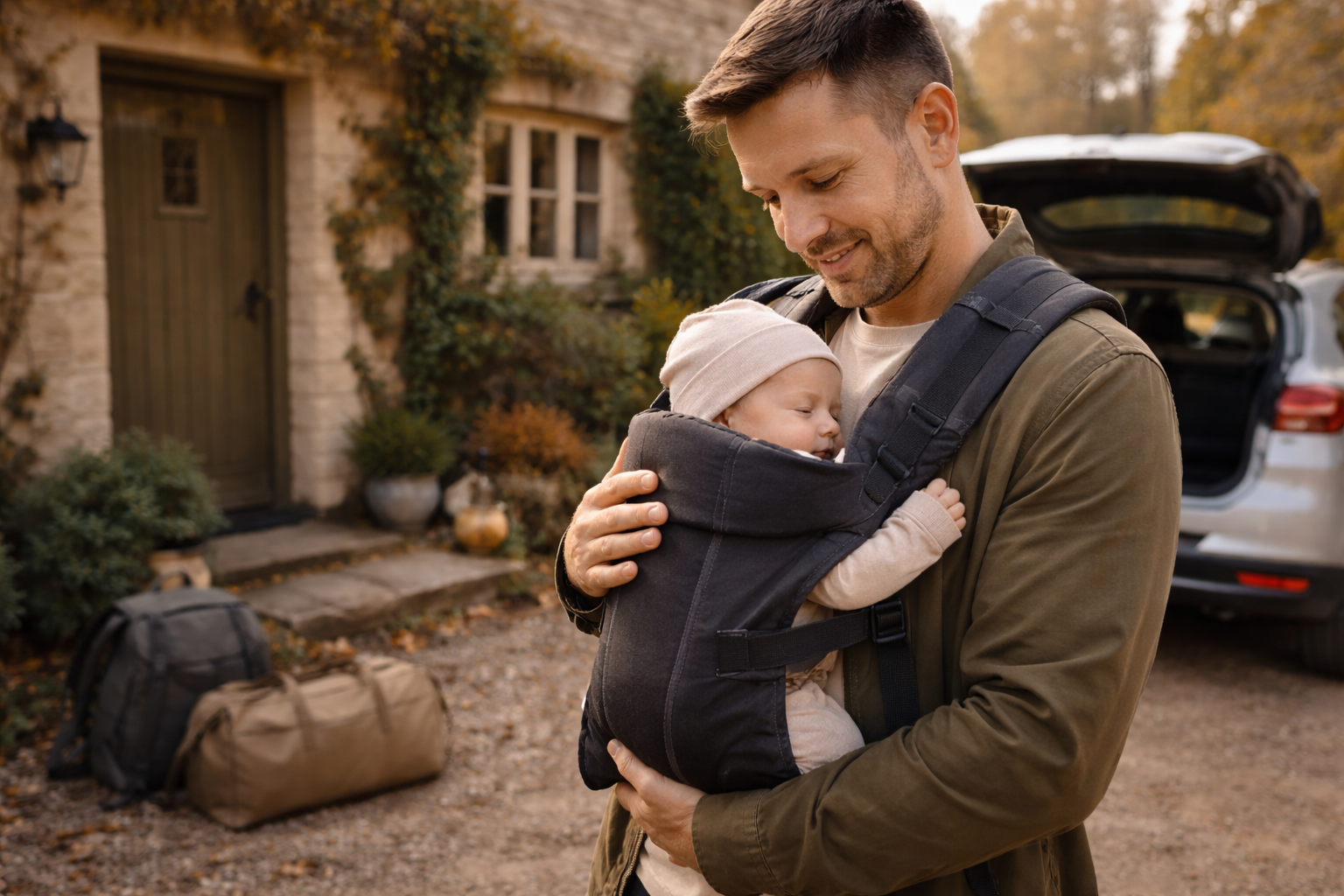
When Is It Safe to Travel With a Newborn?
There is no legal minimum age for travel in the UK — but there are medical considerations that matter. For a healthy, full-term baby born without complications, most GPs are comfortable with short car journeys from around two weeks of age, once the initial newborn checks are complete and feeding is established. Flying is a different matter: most airlines accept babies from two weeks (some from 48 hours), but the commonly cited guidance from health professionals is to wait until at least 6–8 weeks for a first flight. This isn't a rule — it's a recommendation based on your baby's immune system, the demands of air travel, and your own recovery.
Premature babies (born before 37 weeks) or those with any health complications — jaundice requiring ongoing treatment, feeding difficulties, low birth weight — should not travel without a GP sign-off. This isn't excessive caution: premature babies have different oxygen needs, immune profiles, and physiological baselines to a healthy full-term newborn. Check with your GP or health visitor before any travel if your baby was not born at full term.
The NHS newborn health checks — the heel prick test, hearing screening, and physical examination — are typically completed in the first few days to two weeks. These should be done before any travel. Similarly, the six-week check for the birthing parent is not a travel clearance, but it's a useful marker for your own physical recovery. If you're not there yet, the trip will wait.
What's Realistic at Each Stage: 0–12 Weeks
📋 Free Baby Holiday Packing Checklist
Enter your email and we'll send the free printable checklist straight to your inbox — every category, ready to tick off before every trip.
| Stage | What's realistic | Main considerations | Best destination type |
|---|---|---|---|
| 0–2 weeks | Short car journeys only. No overnight trips. No flying. | Newborn checks completing; feeding establishing; birthing parent recovering from birth | Family visits nearby, short drives only |
| 2–6 weeks | Short UK breaks by car (1–2 hours). Overnight trips possible if feeding is established. | 2-hour car seat rule applies; immune system still developing; stay near a GP surgery | Quiet UK cottage, family stay, baby-friendly holiday park |
| 6–12 weeks | Short-haul flying becomes reasonable for healthy, full-term babies. Longer UK trips manageable. | First vaccines at 8 weeks — consider timing. Birthing parent at or past six-week check. | Short UK flights, European short-haul, longer UK road trips |
A note on first vaccines
Babies in the UK receive their first vaccines at 8 weeks. These cover six serious diseases including whooping cough. Before this point, your baby has no vaccine protection at all. You don't need to stay at home — but it's worth knowing that crowded indoor spaces (airports, planes, busy public transport) carry more risk before 8 weeks than after. This is one of the reasons many health professionals suggest waiting until after the first vaccines before flying.
The Newborn Travel Advantage (Yes, Really)
Parents are often surprised to discover that 0–3 months is one of the easier windows to travel. A newborn sleeps roughly 16–18 hours a day. They don't require entertainment, activities, or a structured schedule in the same way a 12-month-old does. They feed, sleep, and are content in arms or in a carrier. If you're breastfeeding, your feeding equipment travels with you everywhere. If you're bottle-feeding, warm water and formula go in a cool bag.
A newborn in a carrier is a remarkably portable creature. You walk into a restaurant: baby comes with you in the carrier, hands-free, often asleep. You get on a bus: baby is on your chest, facing you, the pushchair is folded in the luggage area. You reach the cottage and it's smaller than the photos suggested: baby doesn't care, as long as their familiar scents (your clothes, their blanket) are there. The comparison to 18-month-old travel is stark — see our travelling with an 18-month-old guide to understand what comes later.
The actual challenges at this stage are your challenges — your sleep deprivation, your anxiety, the unpredictability of a very new baby's feeding or crying. The baby is not the difficult part.
Where to Go With a Newborn
The short answer: somewhere nearby, quiet, and within reach of normal services. A cottage within 1–2 hours of home, a visit to family with a spare room, or a calm holiday park with good facilities. Not a remote farmhouse three hours from the nearest town. Not a two-week package holiday abroad. Not anywhere that requires a long travel day at each end.
The reasons for staying close aren't about danger — they're about practicality. You want to be near a GP surgery and a supermarket. Unexpected things happen with newborns: feeding problems, minor illness, a jaundice recheck, mastitis. None of these are dramatic emergencies, but all are much easier to deal with when you're 20 minutes from help rather than five hours. Baby-friendly UK cottages that offer travel cots, blackout blinds, and enclosed gardens tend to work particularly well at this age — they give you a base without requiring much organisation beyond getting there.
European and long-haul travel is best left until after 8–12 weeks at the earliest. There's no prize for being the first in your NCT group to take a baby abroad — and the travel-day logistics are significantly harder before you've established a rhythm with feeding, sleep, and your own energy levels.
Driving With a Newborn
The two-hour car seat rule is not a guideline you can negotiate around: babies — particularly newborns — should not be in a semi-reclined car seat position for more than two hours at a stretch. Their airway is not fully developed, and sustained time in this position can compromise breathing. This is the same reason infant car seats are designed to be as flat as possible, and why road trips with babies require regular stops.
In practice, this means planning your route around natural stops. For a 2-hour trip, you can often drive straight through. For a 3-hour journey, build in a 20-minute stop in the middle — feed the baby, change them if needed, and put them back in. For anything longer than 4 hours, plan to break it across two days, or travel at night when you'd be stopping anyway.
A rear-facing mirror fitted to the headrest in front of the car seat lets you check on your baby without pulling over. It's a small, cheap addition that removes a lot of anxiety on longer drives. And always check that your car seat is correctly installed before you travel — the angle indicator on most infant seats is worth checking every trip.
Flying With a Newborn
Flying with a newborn is more manageable than most parents expect. The cabin pressure concern that worries parents most — ear pain from pressure changes — is actually less of a problem for newborns than for older babies. Newborns feed frequently and naturally, and the swallowing motion equalises pressure in the same way adults yawn. A feed or a dummy during ascent and descent is usually enough.
The real challenges are the logistics: getting to the airport early enough, navigating security (baby carriers make security easier; strollers go through the X-ray machine folded), finding space to change a newborn on a plane (the changing table in the toilet is small), and managing feeds in a confined seat. None of these are insurmountable, but they require planning. Our first flight with a baby guide walks through all of it, and the hand luggage checklist covers exactly what to pack for the cabin.
Most UK airlines accept babies from 2 weeks old. Some require a letter from a GP for very young babies. It's worth checking your airline's specific policy before booking, particularly for babies under 4 weeks.
If you're travelling solo with your baby or you and your child have different surnames, our Single Parent & Different Surname Travel Pack includes ready-to-use consent letter templates and a supporting documents checklist — £7.99 as an instant download.
Pro Tip
UK babies under 12 months need their own passport, even for EU travel. If you're planning to fly before 3 months, apply for the passport as soon as possible after birth — processing typically takes 3 weeks but can take longer at peak times. Application details are on Gov.uk.
What to Pack: The Stripped-Back Newborn List
For a personalised list built around your newborn's specific trip, try our free Baby Travel Packing Calculator — it calculates nappy quantities, accounts for your destination and travel method, and outputs a ticked-off list you can print or copy.
New parents tend to overpack for newborns. The reassuring reality is that babies this age need very little — and most of it is consumable (nappies, wipes, feeding supplies) rather than gear. For a 2–3 night UK trip, you can pack for a newborn in one large bag.
| Category | What you need | Notes |
|---|---|---|
| Nappies & changing | Nappies (more than you think), wipes, nappy bags, travel changing mat, barrier cream | Newborns go through 8–12 nappies a day. Pack generously. |
| Feeding | Breastfeeding: nursing bra, breast pads, nipple cream. Bottle-feeding: bottles, steriliser, formula, cool bag | Cold water steriliser tablets take up almost no space and remove the need for a microwave steriliser |
| Clothing | 3–4 sleepsuits, 2–3 bodysuits, 1 warm layer, hat, scratch mitts, an extra set for you | Newborns spit up constantly. Pack one more outfit than you think you'll need. |
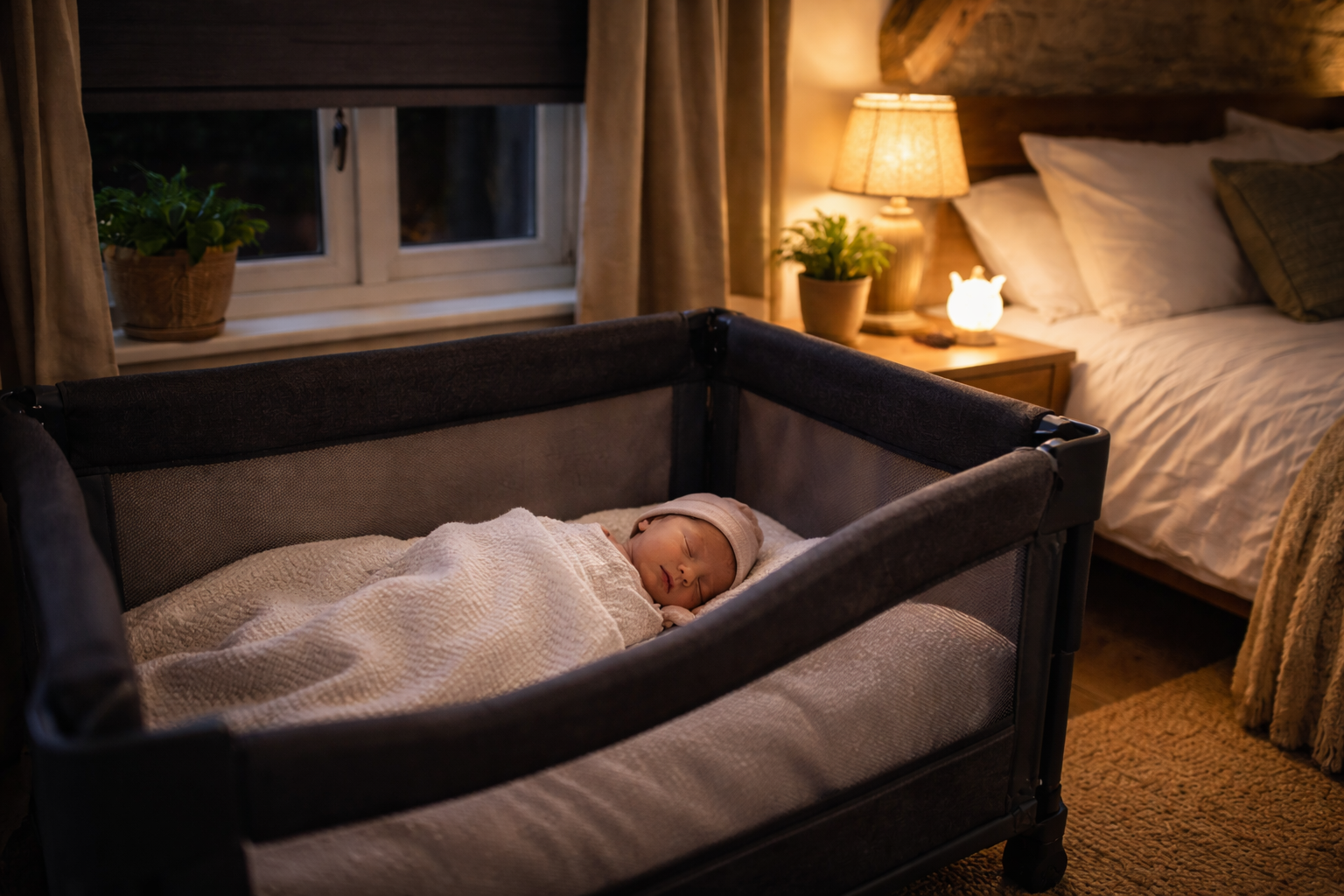
| Sleep | Travel cot (if not provided), firm-fitting sheet, sleeping bag in the right tog, blackout blind, white noise machine | Never bring a duvet or loose blanket for a travel cot. A tog-appropriate sleeping bag is the safe alternative. |
| Transport | Car seat, pushchair or carrier (or both) | At this age, a carrier is often more practical than a pushchair for navigating unfamiliar places |
| Health & comfort | Thermometer, infant paracetamol (from 2 months), any prescribed medications, muslin cloths (many) | Muslin cloths are multi-purpose: feeding cover, changing mat liner, sun shade, sick mopper. Pack six or more. |
Our complete baby holiday packing list goes into more detail for older babies, but at the newborn stage, the table above genuinely covers everything you need for a 2–3 night UK break.
The Case for a Baby Carrier at This Age
A soft structured carrier is arguably the most useful piece of kit for newborn travel. It keeps your baby close — which is calming for them and leaves your hands free — and removes the need to negotiate with a pushchair in unfamiliar spaces. Newborns are small, light, and most are happiest when held close anyway. A carrier lets you do both at once.
Look for a carrier with a newborn-appropriate insert or mode. Many full-featured carriers accommodate newborns from birth, but check the minimum weight — some require 3.5kg+, which most newborns reach quickly. The key things to check at this age are head and neck support, an ergonomic seated position (not dangling by the crotch), and that the baby's airway is clear. Our carrier and slings hub has full guidance on what to look for.

Ergobaby Omni Breeze (Versatile Newborn-to-Toddler Carrier)
One of the most popular soft structured carriers for travel — carries from newborn without a separate insert, includes lumbar support for the wearer, and folds to a compact bundle. Breathable mesh construction keeps both parent and baby cool. Around £150–£180.
Pros: Newborn-ready from birth, excellent lumbar support, breathable mesh, grows with baby to toddler stage.
Cons: Premium price; takes a few wears to dial in the fit.
Sleep and Feeding on the Go
Newborns sleep a lot — but not in predictable blocks. They may sleep for 3 hours, then wake every 45 minutes, then sleep again in the car. On holiday, this translates to: a lot of flexibility is required, and a rigid schedule is not something you need to try to maintain. The newborn stage is not the time to force a sleep routine. Your job is to respond to the baby and keep yourself sane.
That said, maintaining familiar sleep cues makes settling easier in a new place. This means the same sleeping bag they use at home, the same white noise if you use it, and a darkened room if possible — which is where a portable blackout blind earns its place. Many holiday cottages have thin curtains that do essentially nothing in summer. A clip-on or suction-cup blackout blind is small, lightweight, and transforms the sleep environment.

Dreamegg D11 Portable White Noise Machine
Compact, USB-rechargeable, and genuinely effective — the D11 plays 24 white and brown noise sounds, fits in a changing bag, and runs for hours on a charge. One of the most recommended travel sleep aids for babies. Around £25–£30.
Pros: Very compact, USB-rechargeable, long battery life, 24 sounds, reliable.
Cons: The touch controls can be fiddly in the dark until you learn them.
For feeding, the practical considerations depend on your method. If breastfeeding, all you need is somewhere comfortable to sit — a nursing top or cover if you want one, but not required. If bottle-feeding, keep a small flask of hot water for warming, pre-measured formula, and a couple of spare bottles. For more on setting up a good sleep environment on holiday, the travel cots and sleep solutions hub and keeping your baby's routine on holiday guide both have practical detail.
When Not to Travel
This is important enough to say plainly. Don't travel if:
- Your baby was premature and has not been cleared by a paediatrician or GP
- Your baby has ongoing jaundice requiring monitoring or treatment
- Your baby has a known health complication — cardiac, respiratory, or feeding-related
- Your baby is unwell with fever, respiratory symptoms, or any acute illness
- The birthing parent has not recovered physically from birth, or is experiencing any postnatal complications
- You don't want to. This last one matters. No one is required to travel with a newborn.
The NHS postnatal recovery guidance is clear that the six-week check is specifically to assess whether the birthing parent is physically recovering well. If you haven't reached that point, there is no urgency to travel. The cottage will still be there at 3 months, and 3 months is still an easy age to travel.
The Emotional Reality
Travelling with a newborn isn't just a logistics challenge — it's an emotional one. You're tired in a way that's hard to describe to someone who hasn't been through it. You're adjusting to parenthood. And now you're also in an unfamiliar place, without your usual support systems, managing a baby who can't tell you what's wrong.
Some parents find that a change of scene genuinely helps — it breaks the monotony of early weeks, gives you something to talk about other than feeds and nap times, and reminds you that the world still exists. Others find it adds stress rather than reducing it. Both are valid responses to the same situation.
If postnatal anxiety or low mood is part of your picture, travel during the newborn stage is worth approaching carefully. Being away from your familiar environment and support network can amplify difficult feelings. The NHS newborn health guidance includes signposting for postnatal mental health support if you need it — speaking to your health visitor or GP is always the right first step.
Safe Sleep in a Travel Cot
The same safe sleep guidance that applies at home applies in a travel cot. The Lullaby Trust is clear: firm flat mattress, baby on their back, feet to foot of the cot, no loose bedding, no pillows or duvets, no bed-sharing (unless you're practising safe co-sleeping and understand the guidelines). A well-fitted sleeping bag of the appropriate tog for the room temperature is the safe alternative to blankets.
If the cottage or accommodation provides a travel cot, check what mattress comes with it — some are thin, some have unknown histories. Bringing your own firm-fitting sheet, and your own sleeping bag, removes one variable. See our travel cots hub for guidance on the safest options.
✈️ Free Baby Hand Luggage Checklist
Never forget the essentials. Enter your email and we'll send the free checklist straight to your inbox — one page, every category, ready before every flight.
Frequently Asked Questions
Can you travel with a 2-week-old baby?
For short car journeys to nearby family or a quiet location, yes — provided your baby was born at full term, is healthy, and feeding is established. Overnight trips away from home at 2 weeks are riskier because newborn health can change quickly, and being far from your GP makes it harder to get reassurance or help. Flying at 2 weeks is technically allowed by most airlines but rarely advisable — wait until at least 6–8 weeks for a first flight.
Do newborns need a passport for European travel?
Yes. All UK children, including newborns, need their own passport to travel abroad. There is no minimum age for a child passport. Apply as early as possible after birth if you're planning to fly before 3 months — standard processing takes around 3 weeks but can take longer. Apply via Gov.uk.
Are planes safe for newborns?
For healthy full-term babies after 6–8 weeks, yes. The cabin pressure and ear pressure concerns that worry parents are genuinely less of an issue for newborns than older babies — frequent feeding and sucking helps naturally equalise pressure. The bigger considerations are the immune system maturity (pre-first vaccines, the baby has no vaccine protection), the logistics of managing a newborn through an airport, and the demand on an already tired parent.
Can a newborn sleep in a travel cot?
Yes, provided it has a firm, flat mattress and you follow safe sleep guidelines. The Lullaby Trust advises that travel cots used for sleep should have a firm mattress that fits the base without gaps, and you should never add a second mattress on top to make it softer. Baby should sleep on their back, feet to foot of the cot, with no loose bedding.
How do you keep a newborn warm on holiday?
A sleeping bag rated to the appropriate tog for the room temperature is the safe and effective solution for sleep. For daytime in cool weather, a base layer, babygrow, and a cardigan or light outer layer is usually enough. Avoid over-bundling — newborns can overheat easily. The Lullaby Trust has a room temperature and tog guide worth bookmarking.
What's the easiest type of trip with a newborn?
A short UK cottage break, 1–2 hours from home, where you have your own kitchen (helpful for bottle-sterilising and storing expressed milk), a quiet setting, and no demanding itinerary. The best newborn trip is the one where you go somewhere comfortable and do very little. Sightseeing and activities can wait until your baby is older and you're less tired.
Do you need a pushchair with a newborn?
Not necessarily. A carrier alone can get you through a short break with a newborn — it's lighter, more flexible, and often more practical in unfamiliar environments. If you do bring a pushchair, make sure it has a full flat recline or comes with a carrycot attachment: newborns should not be in a semi-upright pushchair seat for extended periods. See our carrier guide for the travel-specific options.
When does newborn travel get easier?
Most parents find the 3–6 month window genuinely easy for travel — the baby is awake and alert enough to be interested in their surroundings, feeds are more established, sleep is usually a little more predictable, and the anxiety of the very early weeks has settled. If the newborn stage feels too soon, waiting until 12–16 weeks is a completely reasonable decision.
When can a newborn go on holiday?
Most airlines accept babies from 2 weeks old, though some require 48 hours of age for flying. For road trips or UK staycations, there's no minimum — it's about whether you feel ready. Many parents find the newborn stage surprisingly manageable for short trips, since babies sleep most of the time and are content in a carrier or car seat between feeds. Minimum age policies differ by airline: KLM has no minimum age at all, British Airways accepts babies from 7 days, while easyJet and TUI require 14 days. Always check your specific airline's policy before booking.
Can you take a 4 week old baby on holiday?
Yes, many families do. By 4 weeks, most babies have established feeding and you'll have a better sense of their patterns. A self-catering cottage or somewhere with a kitchen is usually easier than a hotel at this age. Keep the trip short and low-key for that first time away — you can always be more ambitious next time.
The Bottom Line
Newborn travel is possible, manageable, and for many families genuinely enjoyable — as long as you pick the right kind of trip and give yourself permission to keep it simple. A quiet UK break within two hours of home, a carrier on your chest, the familiar sleeping bag in the cot, and no pressure to do anything impressive. That's the whole strategy.
When you're ready for the next stage of planning, our first holiday with a baby guide covers the full picture, and the complete baby holiday packing list will help you not forget anything important.