
Hotel vs Self-Catering With a Baby: Pros, Cons & How to Choose
By BabyTravel UK Editorial Team · Last updated August 2026
The honest comparison — because the right answer depends almost entirely on how long you're staying and what time your baby goes to bed.
The hotel vs self-catering debate comes up for almost every family planning a trip with a baby. Hotels promise convenience — no cooking, daily cleaning, a reception desk if you need anything. Self-catering promises control — your own kitchen, separate bedrooms, your own schedule. Neither is objectively better, but the right answer for your family depends on factors that most booking guides never address.
This guide cuts through the generalisation and gives you the specific situations where each option wins — including the one factor that, more than any other, determines which accommodation type will serve you better with a baby. Before deciding, it is also worth reading our first holiday with a baby guide for the broader planning picture. If you haven't chosen a destination yet, our free UK destination quiz covers 15 UK options and takes five questions to find your best match.
Quick Answer
- 🏨 Hotel wins for: city breaks of 1–2 nights, families who hate cooking, babies who tolerate restaurant meals, and parents who genuinely value not having to think about anything
- 🏡 Self-catering wins for: stays of 3+ nights, babies on strict routines, weaning-stage babies (food prep 3× daily), any family where 7pm bedtime is non-negotiable, and longer holidays where laundry becomes essential
- ⚖️ The deciding factor: What happens when your baby goes to bed at 7pm? In a hotel room, that is your bedtime too. In a self-catering cottage or apartment, you close the door and have the rest of the evening. For most parents, this single issue settles the question.
Hotels With a Baby: The Honest Case
The Case For
No cooking. If the thought of preparing three meals a day on holiday fills you with exhaustion, a hotel removes that entirely. Breakfast is made for you. Lunch can be a café. Dinner is the hotel restaurant or room service — imperfect, expensive, but there. For a 48-hour city break, this trade-off is entirely worth it.
Daily cleaning. Someone comes in each day and makes the room presentable again. With a baby who distributes debris at an impressive radius, this is not a trivial benefit. The constant low-level entropy of travelling with a baby is, temporarily, someone else's problem.
A reception desk. Need a cot moved? Extra towels for the four additional baths your baby required today? A recommendation for the nearest pharmacy? Hotels have people who can help. A rural cottage at 9pm on a Sunday does not.
Good for short stays. For one or two nights in a city — a weekend break, a family wedding trip, a night near an airport — a hotel is almost always the right call. The convenience advantage is concentrated; the disadvantages do not have time to accumulate.
Sometimes a pool. Hotel pools with warm water and good facilities are a genuine draw, especially for babies 6+ months. Baby-friendly hotels increasingly offer dedicated family pool sessions or shallow areas specifically for young children.
The Case Against
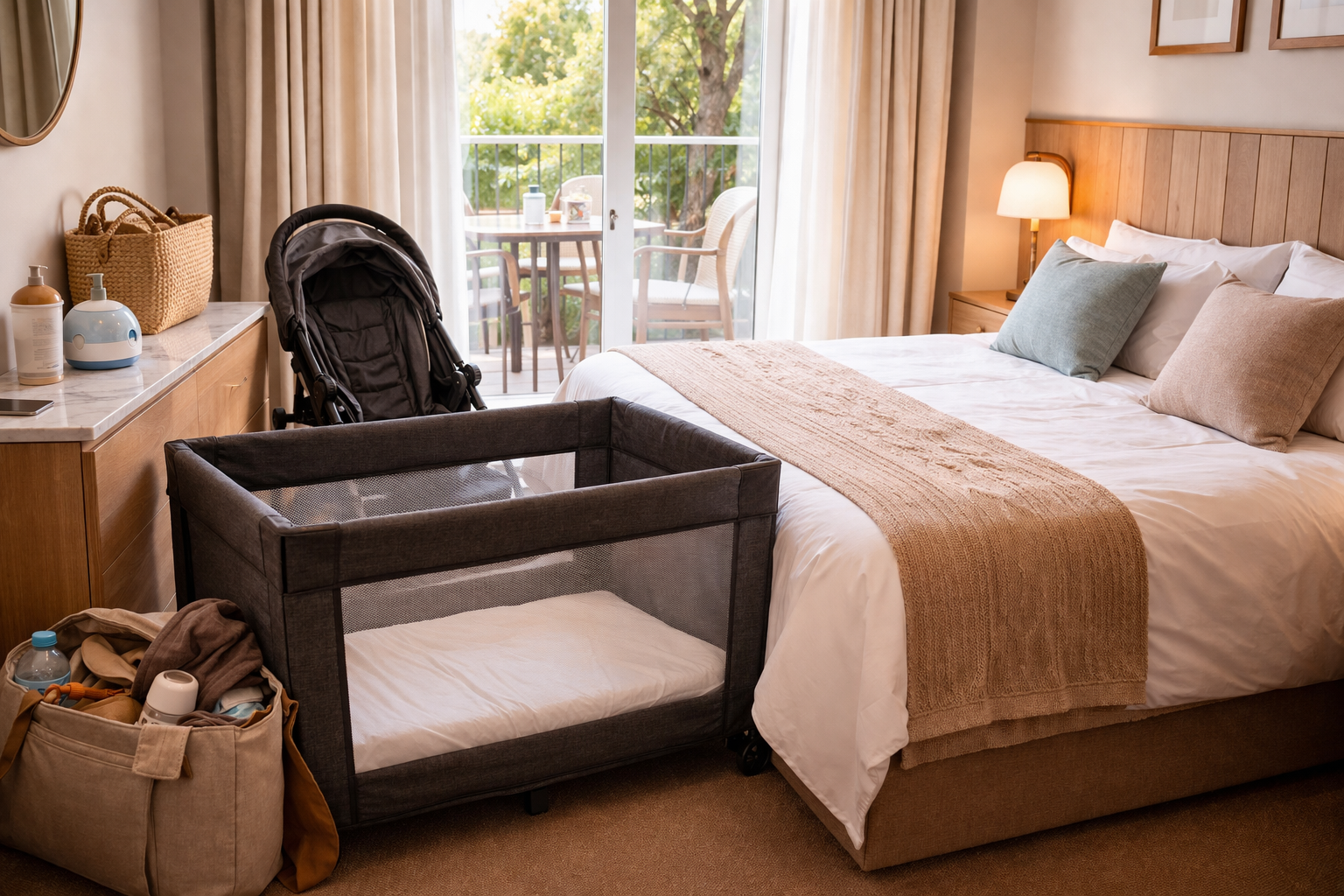
One room means one bedtime. This is the big one, and it gets its own dedicated section below. The fundamental geometry of a hotel room is that when your baby is asleep in it, you are also in it — with the lights off, whispering, or in the bathroom. For parents who have been looking forward to a quiet evening together, this is a significant compromise.
No kitchen means no control over food. At the weaning stage (roughly 5–12 months), you are preparing food three times a day to a baby's specific preferences. Doing this in a hotel room means requesting a microwave, fighting with the kettle, or relying entirely on pouches. It is doable, but it adds friction to every mealtime.
Restaurant meals with a baby are expensive and exhausting. Half the food ends up on the floor. The other half ends up on you. You have eaten standing up while simultaneously feeding, wiping, and apologising to the adjacent table. At £40–£60 for a family dinner, this experience rapidly loses its appeal over a full week.
Cots and blackout curtains are inconsistent. Hotel-provided travel cots range from adequate to ancient and slightly alarming. Blackout curtains in hotels are — like cottage "blackout" curtains — optimistically described. Always bring your own blackout solution regardless of what the listing says.
Corridor noise and thin walls. Other guests coming and going, lift noise, nearby rooms. Hotels are not built for babies' sleep, and a baby who would sleep soundly in a cottage bedroom may be disrupted by sounds that do not feature at home.
Self-Catering With a Baby: The Honest Case
The Case For
Separate bedrooms. Your baby goes to bed at 7pm in their room. You are in the living room with a glass of wine and an entire evening. This is the single most transformative feature of self-catering accommodation with a baby, and it is the reason that parents who try self-catering after hotels rarely go back. See our routine guide for how to use this advantage fully.
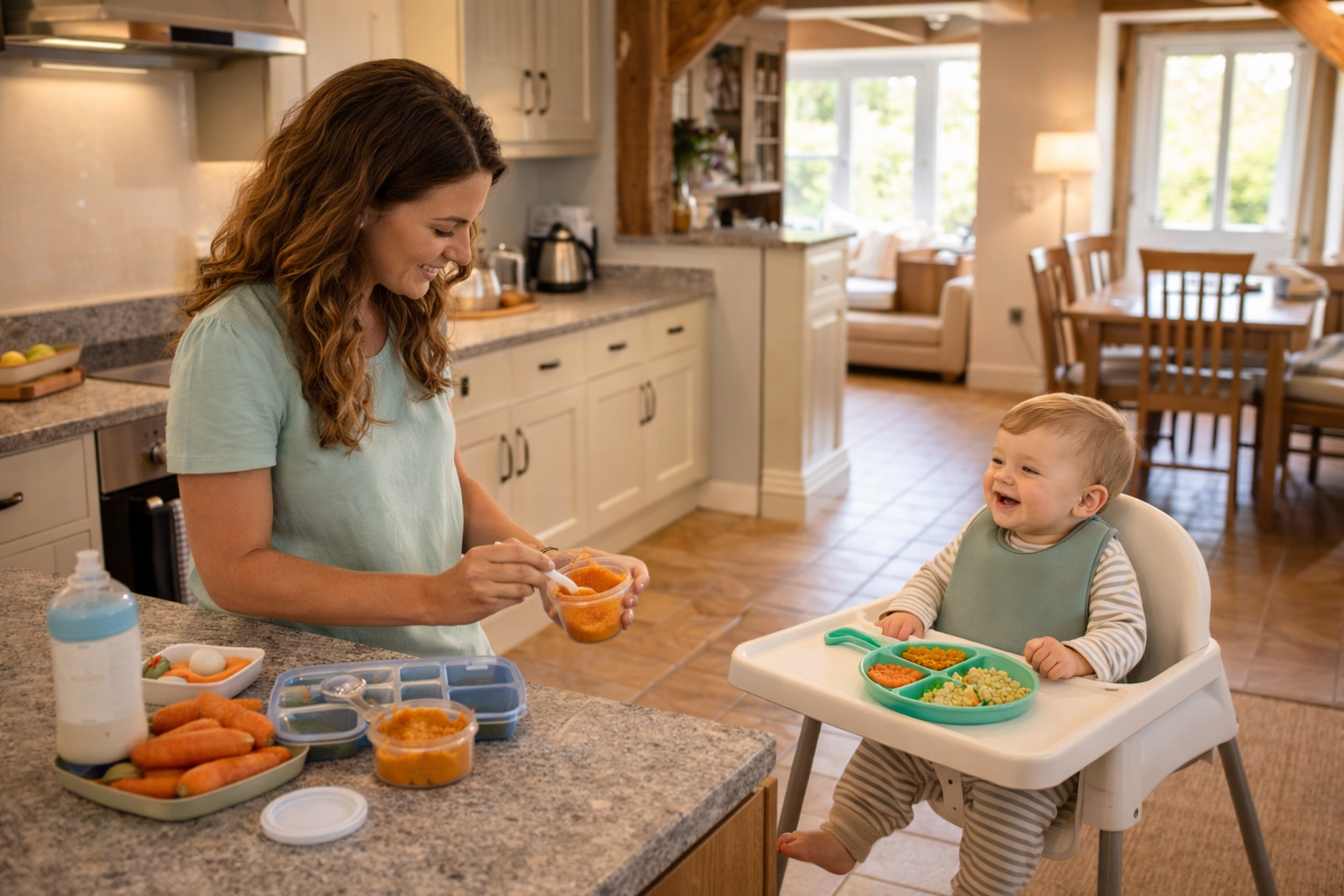
Full kitchen access. Cook what your baby will actually eat. Prepare food for the day's outings. Make a bottle at 3am without waking anyone or calling reception. Stock the fridge with familiar brands. For a weaning baby especially, a kitchen is not a luxury — it is an operational necessity.
A washing machine. This sounds mundane until you are on day four of a week's holiday with a baby who has had three blowouts and a vomiting episode. A washing machine transforms the laundry situation from a mounting crisis into a boring Tuesday evening task. It is genuinely one of the most underrated self-catering benefits.
More space. A living room, a kitchen, a garden or outdoor space at many properties. Babies who are in the pulling-up-to-stand or early-walking stage need floor space that a standard hotel room simply does not provide. The ability to put the baby down on a rug and let them explore freely is worth something real.
Often better value for longer stays. A self-catering property charged per week is frequently better value than a hotel for 5–7 nights, especially when you factor in the restaurant meals you are not buying. Our baby-friendly cottages guide covers what to look for in a booking to ensure the property actually delivers what it promises.
The Case Against
You are cooking and cleaning on holiday. For some parents, this is a dealbreaker. If the entire point of the holiday is to not be in charge of meals and tidying, self-catering recreates domestic life in a different postcode. This is a legitimate objection — be honest with yourself about whether you actually want to cook on holiday.
No help on-site. If the cot breaks, the boiler stops working, or you need something at 10pm, you are waiting for a property manager to respond rather than calling reception. Most self-catering issues get resolved, but the process is less immediate than a hotel.
You need to sort your own groceries. Arriving with a tired baby and having to find a supermarket before you can prepare anything is a recurring friction point on the first day of self-catering holidays. The fix — a pre-arrival grocery delivery, or bringing the first day's essentials — is simple, but it is a logistics step that hotels remove entirely.
Equipment quality varies. "Baby-friendly" in a cottage listing can mean a brand new BabyBjörn travel cot, or it can mean a 15-year-old playpen that has seen better decades. Always ask specifically about the cot model, the highchair, and the stair gates before booking. Our Airbnb with a baby guide covers this in the context of peer-to-peer accommodation specifically. If you've settled on self-catering and are choosing between a specialist cottage site and Airbnb, see our cottage vs Airbnb comparison for a detailed breakdown.
The Length-of-Stay Rule
📋 Free Baby Holiday Packing Checklist
Enter your email and we'll send the free printable checklist straight to your inbox — every category, ready to tick off before every trip.
The clearest framework for making this decision is the length of your stay.
1–2 nights (weekend city break): Hotel almost always wins. The convenience of not cooking or cleaning for such a short stay outweighs the space constraints. You will probably eat out for every meal anyway. The bedtime problem exists but is manageable for two nights. This is the format where hotels genuinely shine. See our city breaks guide for which cities work best with a baby.
3–4 nights (midweek break or long weekend): Either works, but self-catering begins to justify itself. By the third evening, you will want at least one meal that is not in a restaurant, and the laundry pile will have started forming its own ecosystem. If routine control matters to you, self-catering is the stronger choice from night three onwards.
5–7 nights (full week): Self-catering almost always wins. A week of restaurant meals with a weaning baby is logistically exhausting and expensive. Laundry is unavoidable. And by night five, the 7pm bedtime situation in a hotel room will have become genuinely wearing for both parents. The kitchen alone justifies the choice.
The Bedtime Problem
This deserves its own section because it is, in practice, the deciding factor for more families than any other consideration.
Most babies in the 4–18 month range go to bed somewhere between 6:30pm and 7:30pm. In a self-catering property, this means they go to bed, you close the bedroom door, and you have the rest of the evening in the living room — dinner, a film, a conversation, a glass of wine — like functioning adults.
In a hotel room, when your baby goes to bed at 7pm, your options are: sit silently in the dark in the same room, hide in the bathroom on your phone, go to sleep yourself, or take turns sitting in the corridor. None of these is the relaxing evening you had in mind when you booked the trip.
Some hotels address this with family suites that have a separate sleeping alcove or adjoining rooms. These exist, they are good, and they are worth the additional cost for stays of more than two nights. But standard hotel rooms — even large ones — share the fundamental problem of being a single undivided space. Honest question to ask yourself before booking: what are you going to do between 7pm and your own bedtime?

Tommee Tippee Gro Anywhere Blind
Essential for hotel stays | Fits most windows | Around £25–£30
Hotel blackout curtains are — politely — optimistic. The gap at the top, the gap at the sides, the sliver under the rail: all of these let in the dawn light that will wake your baby at 5:30am. The Gro Anywhere Blind uses adjustable ties rather than suction cups, making it particularly well-suited to hotel curtain rails and window frames where suction-cup solutions can struggle. It folds flat, weighs almost nothing, and is one of the genuine non-negotiables for any hotel stay with a baby.
- ✅ Adjustable ties work on most hotel curtain rails and rods
- ✅ Folds flat and extremely lightweight — no reason not to pack it
- ✅ Significantly reduces early morning waking caused by light gaps in hotel curtains
- ❌ Takes a few minutes to fit correctly on first use — read the instructions before arrival
- ❌ Less effective on very wide windows without a rail to tie onto
The Full Comparison
| Factor | Hotel | Self-Catering |
|---|---|---|
| Space | One room (unless suite). Baby gear everywhere. Limited floor space for play. | Separate bedrooms, living room, often a garden. Much more space per person. |
| Kitchen access | None in standard rooms. Kettle and minibar only. Microwave sometimes available on request. | Full kitchen. Cook exactly what your baby needs, whenever they need it. |
| Cost per night | Higher per night but includes meals (breakfast at least). No additional food prep costs. | Lower per night for equivalent space. Grocery costs added, but typically less than restaurant meals. |
| Cooking required | No — but restaurant meals with a baby are expensive and logistically demanding. | Yes — which some see as a burden and others see as normal life in a nicer location. |
| Routine flexibility | Limited — mealtimes and activities constrained by restaurant hours and shared facilities. | Complete — eat when you want, nap when you want, bedtime exactly when you want. |
| Laundry | Hotel laundry service exists but is expensive. Most hotels have no guest washing machines. | Washing machine usually included. Essential for a full week with a baby. |
| Evening freedom | 7pm bedtime = your bedtime in the same room. Significant impact on parent enjoyment. | Baby in their room, you in the living room. Real evenings exist. |
| On-site help | Reception desk available. Issues resolved quickly by staff. | Property manager contact. Usually responsive but not immediate. |
| Best length of stay | 1–2 nights — weekend city breaks, one-night stops. | 3+ nights — midweek breaks, full weeks, longer holidays. |
| Best baby age | Toddlers 12m+ who eat restaurant food more readily; very young babies who sleep most of the time. | Weaning babies (5–12m) who need regular home-cooked food; any age where routine control is critical. |
The Apart-Hotel Sweet Spot
If you want the convenience of a hotel with the space and kitchen of self-catering, apart-hotels and serviced apartments exist precisely for this combination. You get a kitchen and a separate sleeping area AND daily cleaning AND a reception desk. The trade-off is cost — apart-hotels typically charge more per night than a standard cottage — but for city breaks of 3–4 nights, the premium is frequently worth it.
Look for brands like Staybridge Suites, Residence Inn, SACO Apartments, Roomzzz, and Native Apartments, which operate in most major UK cities. Many short-let platforms including Airbnb now filter for "apartment with kitchen and hotel-style services" which surfaces similar options. Our Airbnb guide covers what to look for when booking through peer-to-peer platforms specifically.
Age Considerations
Newborns (0–4 months): Self-catering wins clearly. You need kitchen access for sterilising and warming around the clock, a washing machine for the volume of laundry a newborn generates, and separate room space so that one parent can sleep while the other is up. A hotel room at this stage is genuinely challenging.
Weaning stage (5–12 months): Self-catering wins strongly. You are preparing three meals a day to a specific and frequently changing set of preferences. A full kitchen is not optional at this stage — it is how you function.
Toddlers (12 months+): Hotels become more viable. Toddlers eat more of what restaurants serve, bedtime routines are more established (even in a hotel room), and the greater mobility of toddlers means they get more use from hotel facilities like pools and play areas. That said, self-catering still wins on space and evening freedom at any age.

Inglesina Fast Table Chair (Portable Highchair)
Best for: hotel restaurants and self-catering tables | Up to 15kg | Around £55–£70
Hotel-provided highchairs are inconsistent at best. Self-catering properties vary from "excellent sturdy highchair" to "a booster seat with a broken buckle." A portable clip-on chair removes both problems — it clips to virtually any table edge with no tools, weighs under 1kg, and folds flat into a bag that sits easily under the pram. Whether you are in a hotel restaurant, a cottage kitchen, or a local café, you have a reliable, familiar seat for your baby. One of the most useful travel accessories at the weaning stage and beyond.
- ✅ Clips to any table — hotel restaurants, cottage kitchens, cafés, grandparents' dining room
- ✅ Under 1kg — genuinely lightweight for what it does
- ✅ Folds flat — fits in a changing bag pocket or under the pram
- ❌ Not suitable for tables with certain edge profiles — check your specific table before relying on it
- ❌ No tray — baby reaches the main table, which works well but means messy food closer to the table surface
Quick-Pick: Which Should You Choose?
| If you want… | Choose… |
|---|---|
| A 1–2 night city break with minimal luggage | Hotel |
| A full week's holiday without cooking every day | Hotel only if all-inclusive abroad — otherwise self-catering |
| A real evening after 7pm bedtime, every night | Self-catering |
| Kitchen access for a weaning baby | Self-catering |
| A washing machine mid-week | Self-catering |
| A pool and restaurant on-site without driving anywhere | Hotel — or Centre Parcs/Haven for a UK option |
| Space for a baby to crawl and explore freely | Self-catering |
| Total routine control over mealtimes and sleep | Self-catering |
| The best of both (kitchen AND cleaning AND reception) | Apart-hotel or serviced apartment |
| Holiday park feel with cottage privacy | See our holiday park vs cottage guide |
✈️ Free Baby Hand Luggage Checklist
Never forget the essentials. Enter your email and we'll send the free checklist straight to your inbox — one page, every category, ready before every flight.
Frequently Asked Questions
Is a hotel or cottage better for a baby's first holiday?
For most families, a self-catering cottage or apartment is the stronger choice for a first holiday — separate bedrooms, a kitchen for baby food, and a washing machine make week-long stays significantly more manageable. The exception is a short 1–2 night city break, where the hotel's convenience advantage outweighs the space limitations. Our first holiday reflections guide covers why most parents end up preferring self-catering once they have tried both.
Do hotels provide cots and highchairs for babies?
Most hotels offer travel cots on request, but availability is not guaranteed and the quality varies significantly — some provide excellent modern cots, others have equipment that has seen better years. Always book a cot in advance and ask specifically what model they provide. Highchairs are usually available in hotel restaurants but may not be in your room. A portable clip-on highchair that travels with you removes the dependency on whatever the hotel happens to have.
What do I need to bring to a hotel with a baby?
The essentials: your own blackout blind (hotel curtains are almost never as dark as claimed), your baby's sleeping bag from home, a white noise machine, your own travel cot sheet, and a portable highchair. A small steriliser or Milton tablet sterilising solution handles bottle sterilisation without needing hotel cooperation. Our full baby holiday packing list covers everything by accommodation type.
Can you use a hotel room service to feed a baby?
To a limited extent. Most hotel room service menus do not include suitable baby food, but staff will usually warm a bottle or a food pouch without issue if asked. For a weaning baby eating three solid meals a day, room service is not a viable feeding solution for a full week — self-catering or a hotel restaurant with flexibility is necessary. Check before booking whether the hotel restaurant can accommodate early dinner times (6pm) and provide suitable food for a weaning baby.
Are apart-hotels worth the extra cost with a baby?
For city breaks of 3–4 nights, they often are. The combination of a kitchen, a separate sleeping area, and hotel-style daily cleaning removes almost all of the compromises of both standard hotel rooms and self-catering. The price premium — typically 20–40% over a standard hotel room — is offset by not eating every meal in a restaurant. For a full week in a rural location, a cottage is usually better value; for a city break of any length, an apart-hotel is worth a serious look.
What about holiday parks — where do they fit in?
Holiday parks like Centre Parcs and Haven sit in a distinct category — self-catering accommodation (you have a kitchen and separate bedrooms) combined with on-site facilities (pool, restaurants, entertainment). They offer the evening freedom of self-catering with more of the convenience of a hotel. Our dedicated holiday park vs cottage guide compares these two self-catering formats in detail.
How do I get a baby to sleep in a hotel room when I am still awake?
The honest answer is that you often cannot — this is the fundamental hotel bedtime problem. Strategies that help: a portable blackout blind and white noise machine to create a sleep environment regardless of ambient light and sound, a hotel room with a bathroom large enough to retreat to, or a hotel suite or interconnecting room with a separate space for the baby. Some parents simply accept that their evenings in a hotel are curtailed and plan accordingly — dining at 6pm, watching something quietly on a laptop after 7pm. For stays of more than two nights, self-catering is a more sustainable solution.
Is Airbnb better than a hotel for families with babies?
Airbnb can be excellent — it often delivers self-catering advantages (kitchen, separate rooms, space) at competitive prices. The risk is inconsistency: equipment quality, actual blackout provision, and cot availability vary between properties in a way that hotels do not. Read recent reviews from families with babies specifically, ask the host directly about cot age and condition, and check photos of the bedroom carefully. Our Airbnb with a baby guide covers what to look for and what questions to ask before booking.
The Bottom Line
The hotel vs self-catering decision comes down to two questions: how long are you staying, and what time does your baby go to bed? For short city breaks, hotels are convenient and perfectly manageable. For anything longer — and especially if a 7pm bedtime is a fixture rather than a flexible guideline — self-catering gives you your evenings back. That, more than any other factor, is what most parents with babies are actually paying for.