
First Flight With a Baby: What to Expect & Step-by-Step Guide
By BabyTravel UK Editorial Team · Last updated August 2026
The airport terminal doesn't have to be a battleground. Here is our 2026 guide to surviving—and even enjoying—your baby's first flight.
The thought of a first flight with a baby is enough to make even the most seasoned traveller break into a cold sweat. You worry about the luggage, the security queues, and—most of all—the possibility of your baby crying at 35,000 feet while 200 strangers look on. For a broader overview, see our flying with a baby hub.
In this guide, we break down the process from booking to landing. We cover the specific 2026 UK airline policies, how to navigate security with mountains of gear, and why your choice of travel stroller is the single most important decision you'll make before leaving for the airport. If this is part of your first holiday with a baby, we are here to help you get there in one piece.
Quick Answer: Flight Non-Negotiables
- 1. Booking: Add your infant to the booking early. Most airlines charge a small flat fee (around £20-£30) for a lap-sitting infant.
- 2. Gear: You can usually check in two items of baby equipment (e.g., a stroller and a car seat) for free.
- 3. Liquids: You are allowed to carry enough baby milk, sterilised water, and baby food for the journey, exceeding the 100ml limit.
- 4. Boarding: Families with young children usually get priority boarding—use it to get your overhead locker space sorted early.
- 5. Ear Pressure: Feed your baby during takeoff and landing to help their ears adjust to the change in cabin pressure.
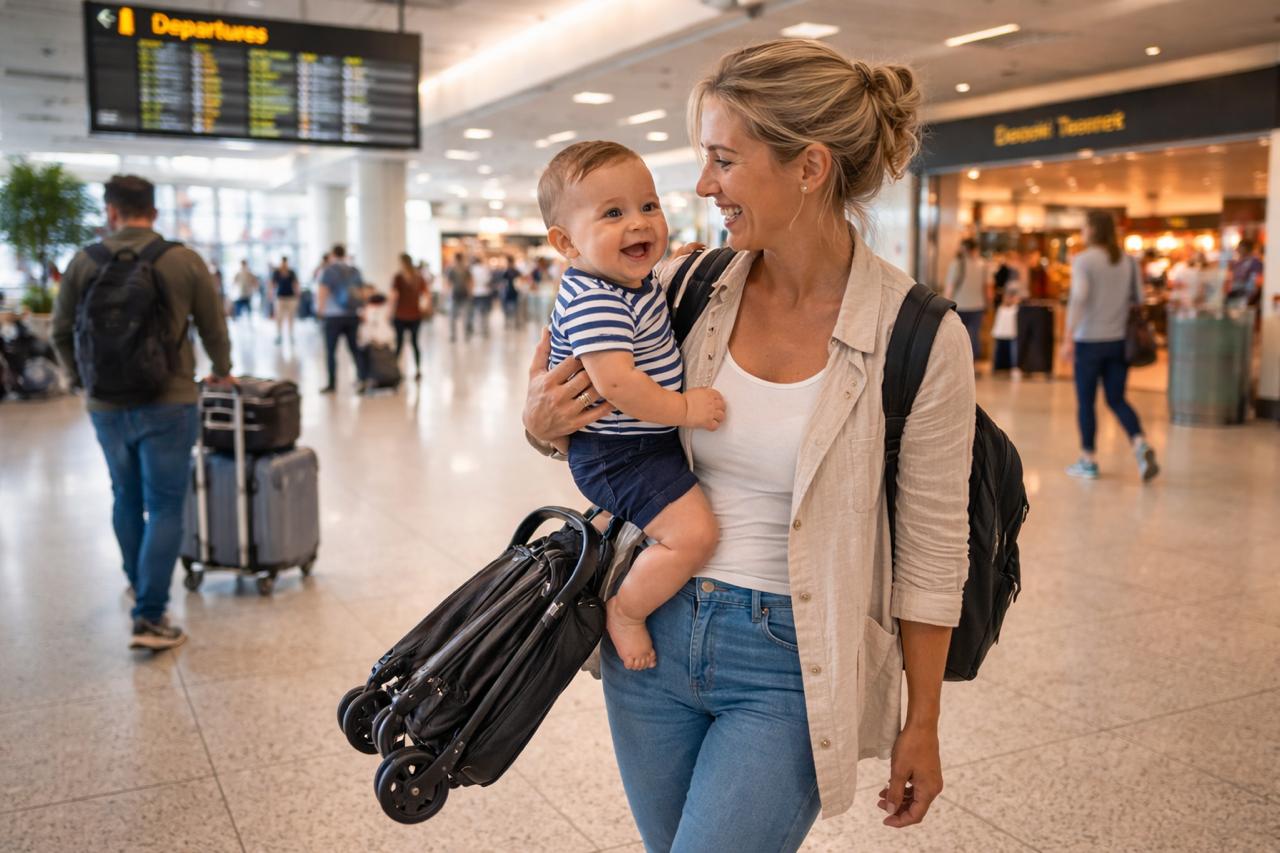
1. Booking & Airline Policies (2026 Update)
UK airlines have become increasingly family-friendly, but the fine print still matters. Whether you're driving to the airport or taking the train, ensure your booking is finalised weeks in advance.
British Airways
BA offers a generous infant policy. Infants under 2 can travel on your lap for 10% of the adult fare. They provide carrycots and infant seats on long-haul flights (request these at the time of booking). You also get an extra checked bag for the baby and can bring a collapsible stroller right to the aircraft door.
EasyJet & Ryanair
The "low-cost" giants charge a flat infant fee (usually £25 per flight). They both allow two items of baby equipment for free. Note that Ryanair requires you to check in your stroller at the gate, whereas EasyJet often allows small "cabin-approved" buggies to be stored in the overhead lockers.
Virgin Atlantic
Similar to BA, Virgin is excellent for long-haul. Their "Kids' Pack" often includes items for older toddlers, but for babies, their focus is on providing high-quality bassinets. Check the CAA guide to travelling with children for overarching UK safety rules.
We've written detailed guides for every major airline — covering exact infant fees, pushchair rules, nappy bag allowances, and booking tips. Check our guides for Ryanair, easyJet, British Airways, Jet2, TUI, and more airlines.
2. Navigating Airport Security
This is often the most stressful part of the journey. The key is to know your rights regarding liquids. In the UK, you can carry breast milk in containers up to 2 litres (it does not need to be in a transparent bag). Formula, cow's milk, and soya milk are also permitted in the quantities needed for the trip. Be prepared for staff to potentially test the liquids.
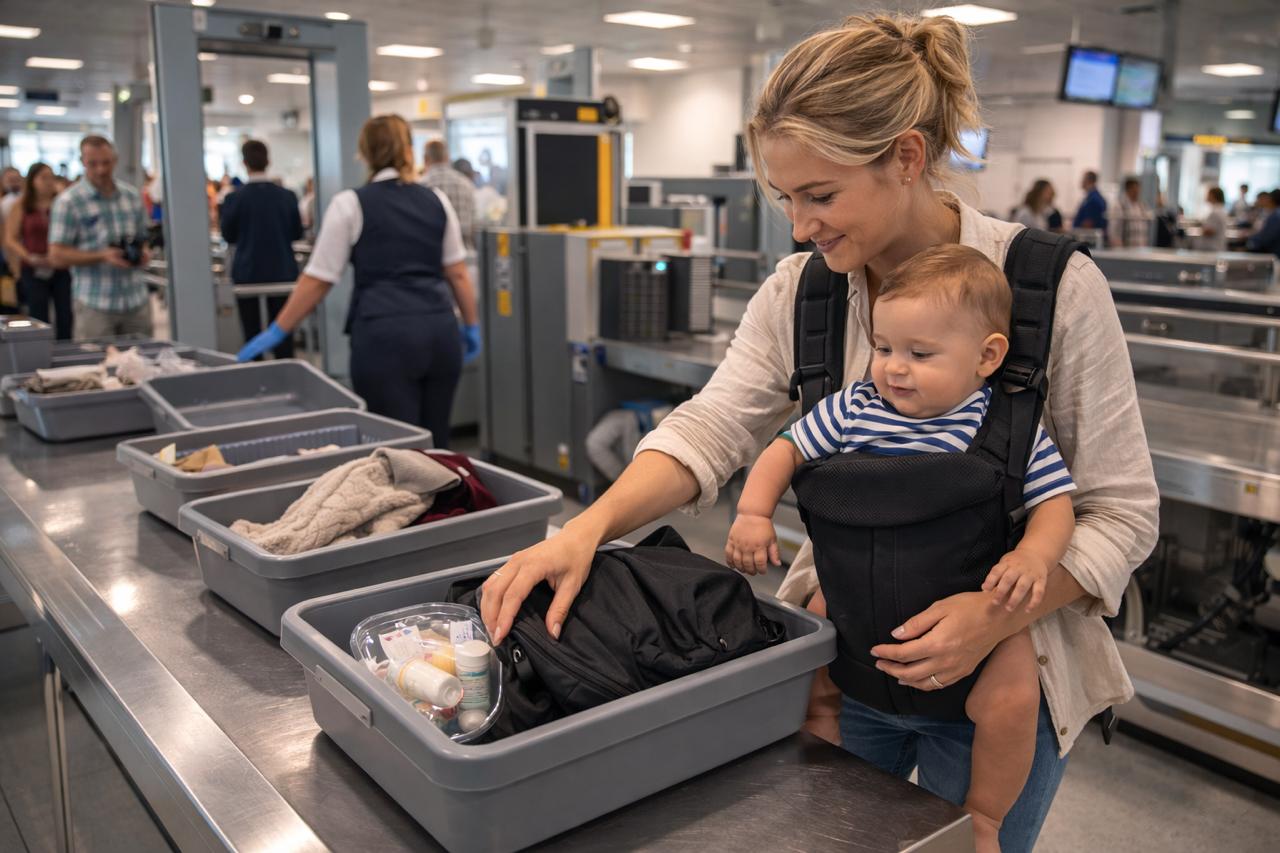
Pro Tip: Use a baby carrier for the security queue. You will have to take the baby out to go through the scanner, but having your hands free to deal with trays and strollers is invaluable. For more airport rules, see the Gov.uk hand luggage guide.
3. What to Pack in Your Carry-On
📋 Free Baby Holiday Packing Checklist
Enter your email and we'll send the free printable checklist straight to your inbox — every category, ready to tick off before every trip.
Haven't sorted the full holiday packing list yet? Our free Baby Travel Packing Calculator builds a personalised list for the whole trip — including what goes in the hold — based on your baby's age, destination, and trip length.
Your "survivability" on the plane depends on your nappy bag. Aside from the basics in our Ultimate Packing List, ensure you have:
- Spare Clothes: Two sets for the baby and one spare top for you (in case of "blowouts" or sick).
- Nappies & Wipes: Pack double what you think you'll need for the flight duration to account for delays. Included in our essential travel kit.
- Ziploc Bags: Essential for sealing away dirty clothes or nappies in a cramped plane toilet.
- New Toys: Small, quiet, and "new" items to keep the baby's attention during awake windows. Our pick of the best travel toys for babies and toddlers has options that pack flat and hold attention for longer.
- The Ear Trick: Sterile water or milk for takeoff and landing pressure changes.
If you're travelling solo with your baby or you and your child have different surnames, our Single Parent & Different Surname Travel Pack includes ready-to-use consent letter templates and a supporting documents checklist — £7.99 as an instant download.

J.L. Childress Deluxe Gate Check Bag
Price: Approx. £22 | Material: Heavy-duty 1680D Nylon
Protect your expensive stroller from grease, dirt, and baggage handling damage. This heavy-duty, water-resistant bag fits most single strollers and makes gate-checking a breeze.
Our Take: A small investment to protect a £800+ pushchair. We won't fly without a travel bag like this anymore after seeing how luggage is handled on a rainy Gatwick morning.
View on Amazon4. Survival Tips for the Flight
Once you are in your seat, the goal is to keep the baby calm and comfortable. If you are staying at baby-friendly hotels or Centre Parcs, consider the flight as the "final hurdle" before your holiday begins.
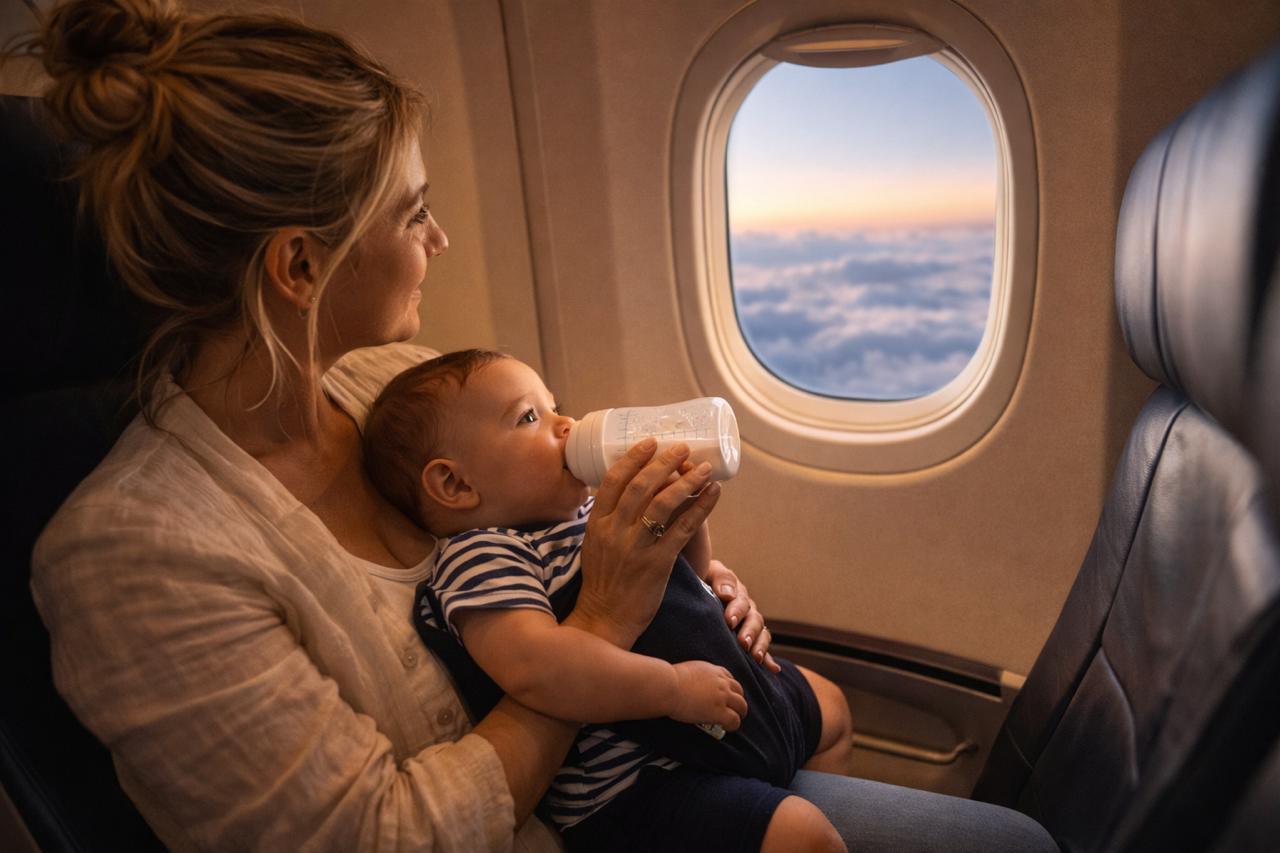
- The Feeding Window: Time your baby's feeds for takeoff and landing. The sucking motion helps equalise the pressure in their ears, preventing the pain that causes most mid-air crying.
- Walk the Ailse: If the "Fasten Seatbelt" sign is off and the baby is fussy, a slow walk up and down the aisle provides a necessary change of scenery.
- White Noise: Use a portable white noise machine like the Dreamegg D11 to mask the loud roar of the jet engines, which can be overstimulating for infants.
For quick, low-mess ideas you can pull out at a moment's notice, our Busy Bag 5-Minute Challenge Cards give you printable activity prompts designed for flights, queues, and restaurant waits — £4.99 as an instant download.
Nappy Changes at 35,000 Feet
Changing a nappy in an airplane lavatory is a feat of engineering. Most planes feature a fold-down changing table above the toilet—look for the baby icon on the door (usually at the back of the aircraft). These tables are hard plastic and often cramped, so always bring your own padded travel changing mat or a disposable liner.
Pro Tip: Space is so tight that it’s often easier to prep your "change kit" (one nappy, a few wipes, and a bag) before you leave your seat rather than bringing your whole nappy bag. If possible, always do a "fresh nappy" check 15 minutes before boarding to avoid having to use the onboard facilities during a short-haul flight.

Don't Forget Travel Insurance
Compare family travel insurance policies — covers medical emergencies, cancellations, and lost luggage.
Compare Travel Insurance5. Dealing with Jet Lag
If you are crossing time zones, jet lag is a reality, but it’s rarely as bad as parents fear. For short trips (under 3 hours time difference), our best advice is to stay on UK time. Don't shift your baby’s meals or naps; just keep the same rhythm to avoid two rounds of adjustment.
For longer-haul travel where staying on home time isn’t feasible, start a gradual shift 2–3 days before you fly, moving bedtime by 15–30 minutes each night. Once you land, maximise exposure to natural light during the morning to help reset their internal clock. Most babies are resilient and will fully adjust to a new time zone within 2–3 days. In the meantime, try to maintain familiar sleep cues—their usual white noise, sleep bag, and nighttime routine will help them feel secure in a new environment.
Flight Delayed or Cancelled? AirHelp helps you claim up to €600 in compensation — even for past flights.
Check If You Can Claim✈️ Free Baby Hand Luggage Checklist
Never forget the essentials. Enter your email and we'll send the free checklist straight to your inbox — one page, every category, ready before every flight.
Frequently Asked Questions
When can a baby fly for the first time?
Most airlines allow babies to fly from 2 weeks old, though many doctors recommend waiting until the first set of vaccinations (around 8 weeks) to ensure their immune system is stronger.
What if my baby cries for the whole flight?
This is the #1 fear for parents, but remember that airplanes are loud—the engine noise actually masks a lot of sound. If they cry, stay calm and walk the aisle or offer a feed. Most passengers are far more understanding than you'd expect; they’ve either been there before or are just glad it isn't their own baby!
What's the best seat on the plane with a baby?
For long-haul, always try to book the bulkhead seat so you can use a bassinet. For short-haul, an aisle seat is usually best as it gives you easy access to the toilet for changes and space to stand up if you need to soothe a fussy baby. Try to avoid the very back of the plane—it's loudest near the engines and toilets.
Do babies need a passport for UK domestic flights?
No, usually a birth certificate is sufficient for domestic UK travel, but check with your specific airline as requirements can vary. For international travel, an infant passport is mandatory.
Can I take baby milk through UK airport security?
Yes. You are allowed to carry enough baby milk (breast, formula, or cow's milk) and sterilised water for the journey. It is exempt from the standard 100ml liquid limit.
How do I stop my baby's ears from hurting on a plane?
Ensure they are sucking on a bottle, a breast, or a dummy during takeoff and landing. This action helps equalise the pressure in the middle ear.
Is it better to book a separate seat for a baby?
For short-haul flights (under 3 hours), a lap-seat is usually fine. For long-haul, booking a separate seat and using a car seat can be much more comfortable, but it obviously costs significantly more.
What happens to my stroller at the gate?
Most airlines allow you to push your stroller right to the aircraft door. The crew will then take it and store it in the hold. It will usually be returned to you at the aircraft door upon landing, or at the baggage carousel.
Conclusion
Your baby's first flight is a major milestone. While the logistics of airport security and cabin pressure are daunting, the reality is usually much smoother than the "worst-case scenario" in your head. By staying organised, timing those feeds, and protecting your gear with a gate check bag, you'll be touching down and starting your holiday before you know it. For more advice, check out our full air travel with baby hub.