
Isle of Wight With a Baby: Complete 2026 Family Guide
By BabyTravel UK Editorial Team · Last updated August 2026
Sandy beaches, a short ferry crossing, and an island pace that tired parents genuinely need.
The Isle of Wight with a baby is one of those holidays that exceeds expectations almost every time. You get the sandy beaches and shallow seas of Cornwall without the five-hour motorway crawl. You get a proper "going somewhere" feeling — complete with a ferry crossing — without the airport faff. And you get an island that moves at a pace that tired, overwhelmed parents will find unexpectedly restorative.
It is not the most obvious choice. Many parents default to Haven or Centre Parcs for a first UK break, and there is nothing wrong with that. But if you are open to something with a bit more character, the Isle of Wight deserves serious consideration. This guide covers everything you need to know — getting there, the best beaches, where to stay, what to do, and why the island's enforced slowness might be exactly what your family needs right now. Still comparing it against other UK destinations? Our free UK destination quiz helps you decide — 15 destinations, five questions, instant result.
Isle of Wight With a Baby: Key Takeaways
- ⛴️ Ferry crossing: Wightlink (Portsmouth–Fishbourne) is the most popular car ferry — book in advance for summer
- 🏖️ Best beaches: Sandown and Shanklin for facilities and shelter; Compton Bay for dramatic scenery
- 🦕 Unique draw: The island is known as "Dinosaur Island" — fossil-rich beaches that toddlers absolutely love
- 🚗 You need a car: The island is compact but bus links are limited — driving is essential for most families
- 🏡 Best areas to stay: Sandown/Shanklin for classic seaside; Ventnor for the warmest, sunniest microclimate
- 📅 Best timing: May half term, June, or September — cheaper, quieter, and surprisingly warm
If you are still deciding between coastal UK destinations, our best baby-friendly UK holidays guide has a full comparison. For first-time travellers, the first holiday with a baby guide covers the essential groundwork before any trip.
Why the Isle of Wight Works With a Baby
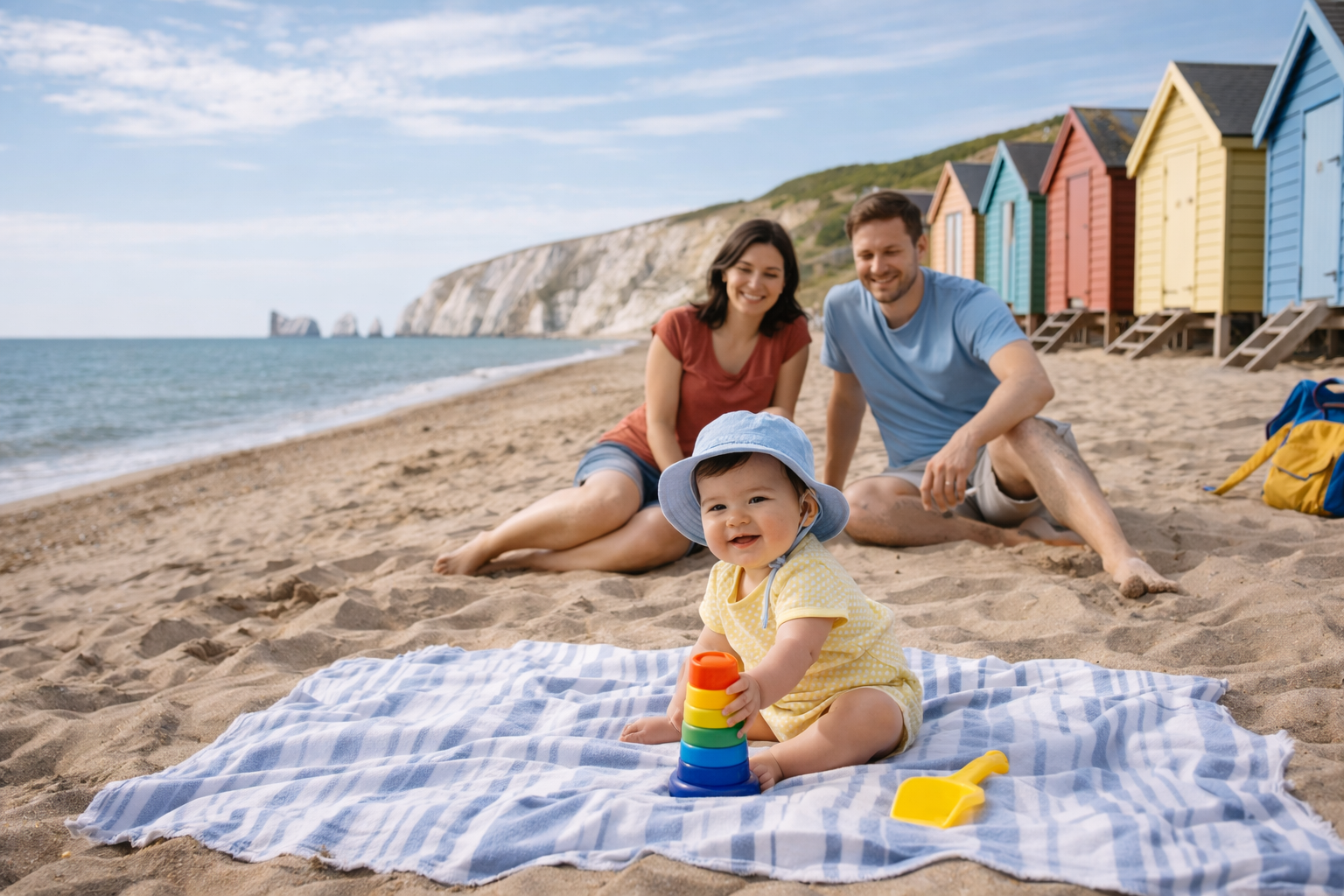
The Isle of Wight is not just a smaller version of the mainland coast — it has a distinctly different feel, and that difference tends to work in your favour when you have a baby. Here is what makes it genuinely family-friendly rather than just family-tolerant:
You can drive across it in 30 minutes. The island is roughly 23 miles across at its widest point. If you want a change of scenery — different beach, different town, different ice cream — you are never more than half an hour away. That matters enormously with a baby on a nap schedule.
The beaches have shallow, safe water. The south-coast beaches in particular have gentle, shelving sand rather than a steep drop-off. Sandown, Shanklin, and Ryde all have the kind of water where you can wade out 30 metres and still be knee-deep — exactly what you want when your baby is in a splash suit at the water's edge.
It is significantly quieter than Cornwall or Devon. Even at peak summer, the Isle of Wight feels noticeably less crowded than the big-name Westcountry destinations. Car parks have space. Beaches have room to breathe. Restaurants take walk-ins. That alone is worth something when you are managing a baby's unpredictable schedule.
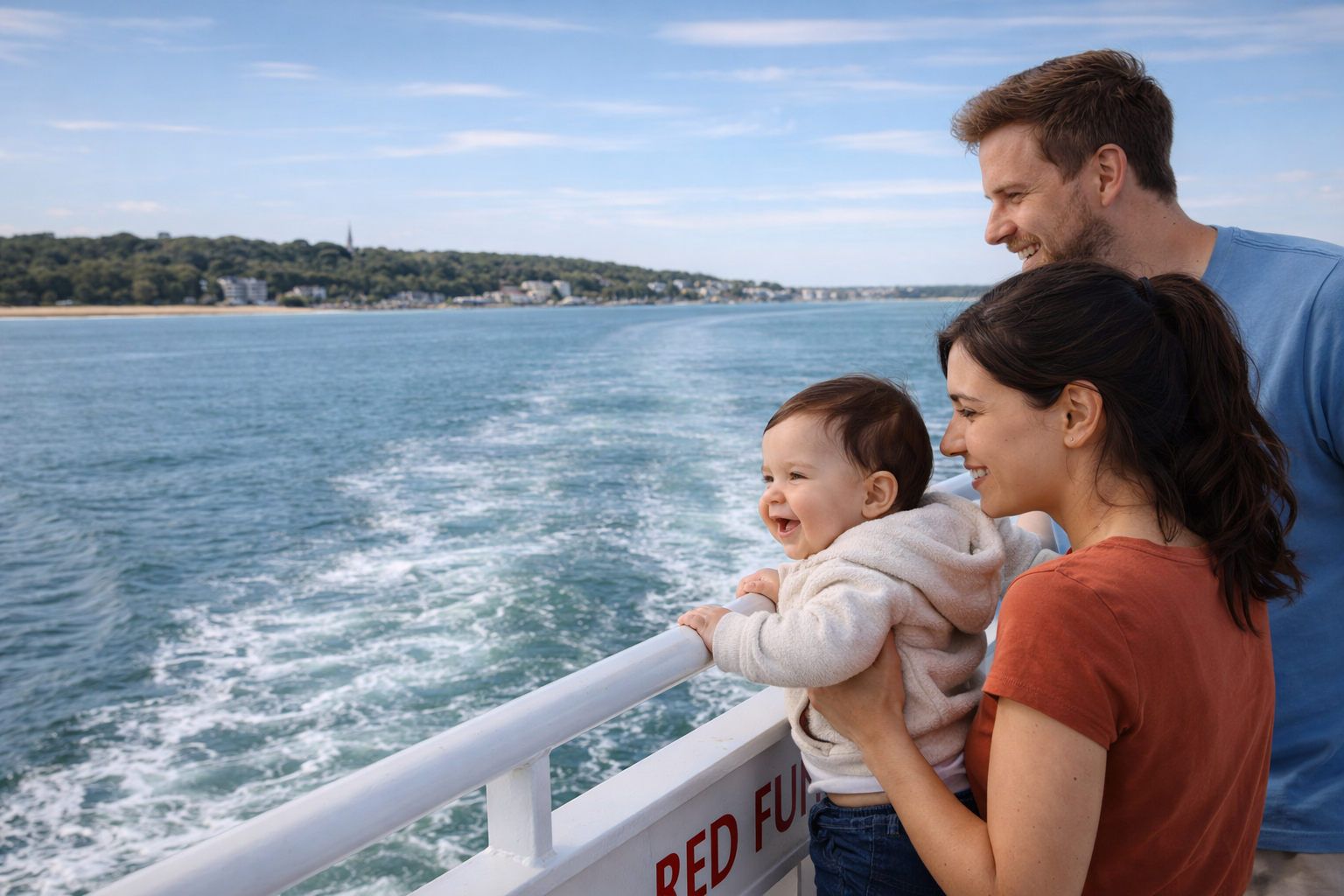
The ferry crossing is genuinely exciting. This sounds like a small thing, but it is not. Toddlers and older babies are fascinated by boats. The anticipation of the crossing, watching the island approach across the Solent, and the sense of arrival make this feel like a proper adventure — not just a car journey that happens to end at the coast.
Getting There: The Ferry Crossing
There are three main operators serving the Isle of Wight, and the right choice depends on where you are travelling from and whether you need to bring a car. For most families with a baby, a car is essential — the island's bus network is limited and you will want to be able to load and unload at will.
| Operator | Route | Crossing Time | Car / Foot | Price Guide | Our Tip |
|---|---|---|---|---|---|
| Wightlink | Portsmouth–Fishbourne | ~45 mins | Car ferry | From ~£80–£140 return (car + 2 adults) | Most popular; book early in summer — it sells out. Car deck is spacious and pushchair-friendly. |
| Red Funnel | Southampton–East Cowes | ~55 mins | Car ferry | From ~£80–£130 return (car + 2 adults) | Good option if travelling from west or via M27. Slightly longer crossing; comfortable for napping babies. |
| Hovertravel | Southsea–Ryde | ~10 mins | Foot passengers only | From ~£18–£25 return (adult) | The world's last commercial hovercraft — genuinely thrilling. Best for a day trip without a car; not practical for a full family stay. |
Practical ferry tips for families: Arrive at the terminal at least 30 minutes before your sailing — they start loading vehicles earlier than you expect. The crossing is short enough that you do not need to stress about feeding logistics on board, but the passenger deck has seating, a small café, and toilets if you need them. Children travel free on most operators up to age 3 or 4 — check the current policy when booking. In summer, book your outward and return crossings together; the most popular sailings on a Friday afternoon and Sunday evening fill up well in advance.
Pro Tip
If your baby has just fallen asleep in the car when you reach the terminal, you can usually stay in the vehicle on the car deck for the crossing. Check with the operator when you board — most allow it for very young babies, though crew may check on you periodically.
Isle of Wight With a Baby: Best Beaches
📋 Free Baby Holiday Packing Checklist
Enter your email and we'll send the free printable checklist straight to your inbox — every category, ready to tick off before every trip.
The island has more than 60 beaches, ranging from wide sandy bays to dramatic shingle coves. Not all of them are suitable for babies — some are shingle-only, some have steep access paths, and some are exposed to Atlantic swells. These are the ones that genuinely work.
| Beach | Area | Surface | Facilities | Buggy Access | Highlight |
|---|---|---|---|---|---|
| Sandown Beach | East coast | Sand | Excellent — cafés, toilets, beach huts, lifeguards in season | Good — flat promenade behind beach | Classic British seaside; wide, shallow water; easy parking nearby |
| Shanklin Beach | East coast | Sand | Good — cafés, toilets, beach huts | Good — flat access from town | Sheltered by cliffs; charming old town above; slightly less busy than Sandown |
| Ryde Beach | North coast | Sand | Good — town facilities nearby | Excellent — flat approach from ferry | Vast at low tide; great if arriving via ferry; very gentle gradient |
| Ventnor Beach | South coast | Sand and shingle | Good — cafés, independent shops | Moderate — steps down to beach from town | South-facing, warm microclimate; the sunniest spot on the island |
| Compton Bay | South-west coast | Sand | Minimal — National Trust car park, no café on-site | Moderate — path from car park | Dramatic scenery; fossil-rich cliffs; best for confident walkers with a carrier |
| Alum Bay | West tip | Sand and shingle | Good — café, chairlift, sweet factory | Limited — chairlift is a spectacle but not buggy-accessible | Coloured sand cliffs and Needles viewpoint; more of a viewpoint than a beach day |
For a full day at the beach with a baby, Sandown is the safest bet — it has everything you need within walking distance, the water is genuinely shallow, and the flat promenade means a pushchair can manage the whole day. Shanklin is almost as good and slightly more atmospheric. Compton Bay is spectacular but better suited to parents who are comfortable with a carrier on uneven ground, as the shingle approach makes pushchair use tricky. For guidance on which buggies handle sand, shingle, and seafront promenades best, our guide to the best buggies for seaside holidays covers exactly what to look for in a coastal pushchair.
Things to Do on the Isle of Wight With a Baby
Beyond the beaches, the island has a surprisingly varied activities offer for young families — including several things you simply cannot do anywhere else in the UK.
Amazon World Zoo Park
An indoor tropical house and walkthrough lemur enclosure in the centre of the island. Babies are captivated by the movement and colour, and because it is almost entirely undercover, it works on any weather day. The lemurs walk freely around you — which is either delightful or terrifying depending on your baby's temperament. Worth at least two hours.
The Needles and Alum Bay
The iconic chalk stacks at the island's western tip are genuinely spectacular, and the viewpoint at the top of the cliffs is pushchair-accessible — there is a good path from the car park. The chairlift down to Alum Bay beach is a thrill but is not suitable for babies in carriers or pushchairs (you transfer to the chair), so treat the clifftop viewpoint as the main event. The Needles Pleasure Park has a sweet factory and light fairground rides that older babies find fascinating.
Osborne House
Queen Victoria's seaside holiday home near East Cowes is managed by English Heritage and has beautiful, well-maintained grounds that are ideal for pushchair walks. The house itself involves some steps and narrow corridors but the gardens are accessible and the views over the Solent are lovely. A good half-day outing, especially combined with East Cowes town.
Isle of Wight Steam Railway
A short scenic steam train ride through the island's countryside between Smallbrook Junction and Wootton. Babies and young toddlers are almost universally entranced by trains, and this one is genuinely charming rather than a tourist gimmick. The journey takes about 20 minutes each way and there is a small museum at Havenstreet station.
Fossil Hunting on the South Coast Beaches
The Isle of Wight is known throughout the fossil-hunting world as "Dinosaur Island" — the Cretaceous-era cliffs along the south coast regularly shed shark teeth, belemnites, and occasionally dinosaur bones. Compton Bay is the most accessible fossil beach; even babies in arms can join in while a parent scans the shoreline. Toddlers who are old enough to hold and examine finds absolutely love it. No equipment needed — just walk the tideline after a high tide.
Blackgang Chine
Britain's oldest theme park (founded 1843) sits in dramatic clifftop grounds near Chale. The attractions skew towards toddlers and older children, but the grounds are pleasant for younger babies and the scenery is extraordinary — the clifftop setting above the English Channel is unlike anywhere else on the island. Be aware that parts of the park are increasingly affected by coastal erosion, so check their website before visiting.
Find Family Activities
Book skip-the-line tickets and family-friendly tours — free cancellation on most activities.
Browse Family ActivitiesRainy Day Options
The Isle of Wight catches its fair share of Atlantic weather, particularly on the western coast. These are the best options when the forecast turns:
- Amazon World Zoo Park — almost entirely indoor; the top rainy-day pick on the island
- Brading Roman Villa — a small, warm museum with genuine Roman mosaic floors near Sandown; good for an hour
- Robin Hill Country Park — has some covered areas and indoor soft play alongside outdoor attractions
- Isle of Wight Steam Railway Museum at Havenstreet — covered engine sheds and a café; compact but charming
- The café culture in Ventnor and Cowes — both towns have good independent coffee shops; Ventnor especially has a relaxed, unhurried atmosphere where lingering with a baby is perfectly acceptable
- Soft play — there are several soft play centres in Ryde, Newport, and Sandown; search locally for current options
Our Tip
Build in one genuine rainy-day option when planning your trip, even if the forecast looks good. UK coastal weather changes quickly, and knowing you have a backup plan reduces the anxiety of watching dark clouds roll in from the south-west.
Where to Stay on the Isle of Wight With a Baby
The island has a full range of accommodation — cottages, holiday parks, farm stays, hotels, B&Bs, and a small but growing glamping scene. For families with babies, self-catering (cottages and holiday lodges) tends to work best because you have control over mealtimes, bedtime routines, and kitchen access. Our baby-friendly cottages guide covers what to look for when booking, and both Sykes Cottages and holidaycottages.co.uk have good Isle of Wight selections. If the idea of a more adventurous stay appeals, our glamping with a baby guide covers what to look for in a site and which setups genuinely work with young children.
Best Areas to Base Yourself
Sandown and Shanklin are the best all-round choice for families with babies — you are on the beach, within walking distance of facilities, and well placed for day trips across the island. Most accommodation here is family-oriented and there is plenty of choice across all budgets.
Ventnor is the pick for parents who want something with a bit more character. The town sits in a sheltered south-facing bay with a notably warmer microclimate than the rest of the island — the palms and Mediterranean planting in the gardens are not a tourism gimmick, the climate genuinely supports them. Quieter and more boutique than the east coast resorts, with good restaurants.
Freshwater and Totland put you within easy reach of The Needles and the quieter, less commercialised west coast. Better for parents who want walks and scenery over bucket-and-spade beaches.
Cowes has a sailing culture, good restaurants, and a slightly more urban feel than the rest of the island — fine for a short break but less beach-focused than the east or south coast.
Whatever area you choose, if you are staying in a cottage, pack a routine toolkit and check that the cot and blackout situation is actually what it says in the listing. Cottage owners vary enormously in what "blackout curtains" means to them — which is why a portable blind is worth its weight.

Tommee Tippee Sleeptight Portable Blackout Blind
Best for: cottage and holiday let sleep setup | Fits most windows | From around £25
Cottage curtains and holiday let blinds are famously optimistic when it comes to actual blackout performance. The Sleeptight solves this — it uses a suction-cup system to create a proper blackout seal across most standard windows, and packs flat into a carry bag so it adds almost nothing to your luggage. Genuinely one of the most used baby travel products we rate.
- ✅ Creates a genuine blackout seal — not just "reduces light"
- ✅ Fits most standard UK windows; suction cups are strong and reliable
- ✅ Lightweight and folds flat — easy to pack for any trip
- ❌ Does not work on unusual window shapes or very large bay windows
- ❌ Suction cups can leave faint marks on some window surfaces
Browse Isle of Wight cottages
holidaycottages.co.uk lists hundreds of baby-friendly properties across the Isle of Wight, many with enclosed gardens, travel cots and highchairs available — filter for exactly what your little one needs before you book.
Browse Isle of Wight cottages →
Find Baby-Friendly Hotels
Search baby-friendly hotels with free cancellation, cot requests, and family room options.
Search Hotels on Booking.comThe Island Pace
This section might sound like filler but it is genuinely one of the island's most underrated selling points for baby families. There are no motorways on the Isle of Wight. The maximum speed limit on most roads is 40mph. The towns are compact. The general atmosphere is unhurried in a way that the mainland coast simply is not in August.
For parents who are used to the relentless scheduling and stimulation of parenting life at home, this enforced slowness is quietly therapeutic. You will probably get less done in a day than you planned. You will spend longer at the beach than expected. You will find yourself sitting in a café for an hour while your baby naps in the pram and nobody rushes you.
Lean into it. Plan fewer activities than you think you need. Build in afternoon nap time as a genuine fixture rather than something to squeeze around attractions. The island rewards the families who slow down — and the ones who try to pack in every attraction typically leave wishing they had spent more time on the beach.
What to Pack for the Isle of Wight
Beyond the standard baby holiday packing list, a few Isle of Wight-specifics are worth noting:
- A car is essential — unless you are staying in one resort for the whole trip, the island's bus network will frustrate you. Self-drive is the only sensible approach for most families.
- A carrier for coastal paths — some of the most beautiful scenery is accessible only on foot paths that a pushchair cannot manage. A good structured carrier opens up Compton Bay, the Tennyson Trail, and the clifftop walks that are the island's real highlight. See our carrier guide for recommendations.
- Layers — the island catches Atlantic weather and can be noticeably windier than the mainland, even in summer. A light waterproof layer is always worth having.
- Sun protection — factor 50+ for babies, UV suits for extended beach time. The south coast faces directly into summer sun and the reflection off the water intensifies it.
- First-day supplies — the island has supermarkets (Aldi, Tesco, Co-op in the main towns) but the selection is slightly narrower than mainland stores. Bring enough nappies, formula, and baby food to cover your first day while you find your feet.

Joie Pact Pro Compact Travel Stroller
Best for: island towns, promenades, and day-to-day use | From birth to 22kg | Around £179–£219
The Isle of Wight's towns are generally flat and pushchair-friendly along the seafronts, and the Joie Pact Pro handles them well at a price that does not require a second mortgage. What sets it apart at this price point is the rear spring suspension — unusual below £220 — which takes the edge off the occasional cobbled lane or uneven path. Compact fold, full recline for naps, and solid build quality for the price. A solid choice for island exploring.
- ✅ Rear spring suspension unusual at this price — noticeably better on uneven surfaces
- ✅ Full seat recline — baby can nap flat, not just semi-reclined
- ✅ Compact fold — fits easily in most car boots alongside holiday luggage
- ❌ Heavier than premium compact options at 7.4kg — noticeable on ferry stairs
- ❌ Build quality is functional rather than premium — feels the price
Planning when to visit the Isle of Wight? Our seasonal guides cover the key UK travel periods — May half term 2026 (26–30 May), UK summer holidays with a baby, and bank holiday breaks — with destination tips, booking advice, and what to pack.
Beach Essentials for the Isle of Wight
The Island's sandy bays and rock pools make for brilliant baby beach days — here's the kit that keeps little ones shaded, protected and happy in the sand.

Childs Farm SPF 50+ Sunscreen
Fragrance-free SPF50+ sunscreen made for babies' delicate skin (6 months+).
Check price on Amazon
Splash About UV All-in-One Swimsuit
A UPF50+ all-in-one covering shoulders to knees for pool and beach.
Check price on Amazon
Splash About Happy Nappy
Reusable swim nappy that meets most pools' double-nappy rule — no leaks, no waste.
Check price on Amazon
Babymoov Anti-UV Pop-Up Sun Tent
A pop-up UPF50+ tent giving your baby shade and a cool spot to nap on the sand.
Check price on Amazon
Green People Organic After-Sun
Gentle organic after-sun to soothe warm little skin at the end of a beach day.
Check price on Amazon✈️ Free Baby Hand Luggage Checklist
Never forget the essentials. Enter your email and we'll send the free checklist straight to your inbox — one page, every category, ready before every flight.
Isle of Wight With a Baby: FAQ
Is the Isle of Wight good for babies?
Yes — it is one of the best UK destinations for young families. Shallow, safe beaches, a compact island you can cross in 30 minutes, and a quiet pace that suits babies' routines make it genuinely family-friendly. The ferry crossing adds a sense of adventure without the stress of airport travel.
How do you get to the Isle of Wight with a baby and a car?
The main car ferry options are Wightlink (Portsmouth to Fishbourne, around 45 minutes) and Red Funnel (Southampton to East Cowes, around 55 minutes). Both are well set up for families — push the pram onto the car deck, take your changing bag up to the passenger lounge, and enjoy the crossing. Book in advance for summer sailings.
Do I need a car on the Isle of Wight with a baby?
For most families, yes. The island has a bus network but it is limited in frequency and coverage, and managing a pushchair, a changing bag, and a baby on rural buses is genuinely difficult. If you are staying in one resort for the whole trip (Sandown or Shanklin, for example), you could manage without a car — but for exploring the island you will want to drive.
What is the best beach on the Isle of Wight for babies?
Sandown Beach is the top pick — wide, sandy, shallow water with a very gentle gradient, good facilities including cafés and toilets, and a flat promenade for the pushchair. Shanklin Beach is a close second with a more sheltered feel. Both are on the east coast and easy to reach from the ferry terminal.
When is the best time to visit the Isle of Wight with a baby?
May half term, June, and September are the sweet spots — prices are significantly lower than peak school holidays, the beaches are quieter, and the weather is often better than you expect. July and August are peak season; prices jump and popular beaches get genuinely busy. If you can travel in term time, do.
What is there to do on the Isle of Wight with a baby on a rainy day?
Amazon World Zoo Park is the top rainy-day option — it is almost entirely indoors and babies love the tropical house and lemur enclosure. Brading Roman Villa is good for an hour in the warm and dry. The café culture in Ventnor and Cowes is excellent for a long, unhurried morning. Several soft play centres operate across the island — search locally for current options.
Are the Isle of Wight ferries easy to manage with a pushchair?
Yes — both the Wightlink and Red Funnel car ferries are straightforward with a pushchair. You can stay with the car on the deck for the crossing or take your changing bag and pushchair up to the passenger lounge. The Hovertravel service is foot passengers only and is not set up for pushchairs, so it is better for a quick solo crossing or a day trip without the buggy.
Is the Isle of Wight better than Devon or Dorset for a baby holiday?
It depends on what you prioritise. The Isle of Wight is significantly quieter than the popular Devon and Dorset resorts in peak summer, the ferry crossing adds a genuine sense of occasion, and the island's compact size means you are never far from what you need. Devon and Dorset offer more varied coastline and wider accommodation choices, but if crowd avoidance and ease are top priorities, the Isle of Wight often wins.
The Verdict
The Isle of Wight is the kind of UK holiday that parents book once as a "let's try something different" option and then go back to year after year. The combination of safe, shallow beaches, a ferry crossing that feels like a genuine adventure, and an island pace that no mainland destination can replicate makes it one of the most underrated family destinations in Britain. Start with Sandown, pack a good carrier for the coastal paths, book your ferry early, and let the island do the rest.
Also worth a read: our guides to rainy day activities with a baby and the best family-friendly restaurants in the UK pair well with any trip here.