
Cotswolds With a Baby: Prettiest Villages & Pushchair Walks (2026)
By BabyTravel UK Editorial Team · Last updated August 2026
Honey-stone villages, flat riverside paths, Sunday roasts in ancient pubs, and within two hours of London. The Cotswolds with a baby is easier than it looks.
The Cotswolds is probably the most photographed rural destination in England — and once you're there, you understand why. Honey-stone cottages draped in wisteria, shallow rivers running through village greens, rolling green hills without a sharp edge in sight. It looks almost impossibly picturesque. And the good news for families with babies: it's more accessible than it looks. The terrain is gently rolling rather than mountain steep, the villages are compact enough to explore before a nap window closes, and the pub and café culture is outstanding.
The Cotswolds sits within striking distance of London (1.5–2 hours on the M40), Bristol (1 hour), Oxford (45 minutes), and Birmingham (1.5 hours) — making it realistic for a long weekend rather than just a full week away. This guide covers the best villages for pushchair walking, where the paths actually work for buggies, what to do on a rainy day, and where to eat and stay. For more baby-friendly UK destinations, see our UK family holidays hub. If you're still comparing options, our free UK destination quiz matches your family to the right destination across 15 choices — takes about a minute.
Cotswolds With a Baby: Key Facts
- Drive from London: 1.5–2 hours (M40)
- Drive from Bristol: 1 hour; from Oxford: 45 minutes
- Best for: village walks, pub lunches, a gentle countryside weekend — one of the most pushchair-friendly rural destinations in England
- Best village for buggies: Bourton-on-the-Water — flat, paved riverside path right through the centre
- Best rainy day: Cotswold Wildlife Park (Burford) or Cotswold Farm Park (Guiting Power)
- Stay: self-catering cottage in or near a village — Sykes and holidaycottages.co.uk both have strong portfolios
Why the Cotswolds Works With a Baby
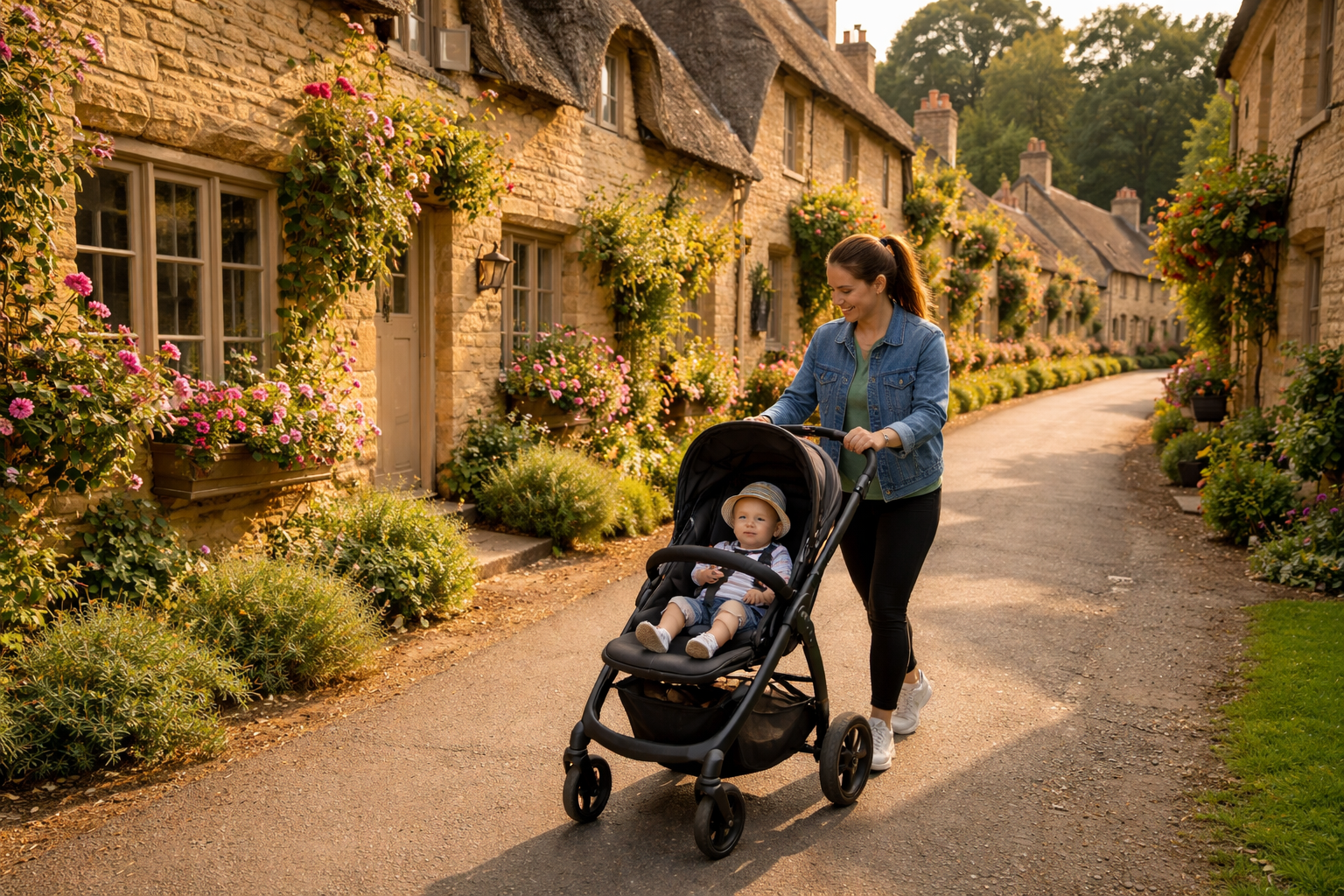
The terrain is the first thing to get right, because it matters enormously. The Cotswolds AONB is characterised by gently rolling hills that follow river valleys — not sharp peaks or mountain paths. The villages sit in the valleys or on gentle ridgelines, connected by lanes and footpaths that are generally manageable with a stroller. This is very different from, say, the Lake District or the Peak District, where terrain regularly makes buggy use impractical. In the Cotswolds, you can almost always find a route that works.
The compact village layout is another asset. Most Cotswolds villages are small enough to explore meaningfully in 45–90 minutes — which fits neatly around a nap window. You park, you wander, you have a coffee, you wander back. The combination of visual beauty and short distances means you get a lot of satisfaction from a small amount of walking, which matters on a day when the baby is in a mood.
The pub culture deserves particular mention. The Cotswolds has some of the finest village pubs in England — warm, ancient buildings with log fires, excellent food, and a generally relaxed attitude to families. A Sunday lunch in a Cotswolds pub with a baby in a highchair is one of those genuinely lovely holiday moments that requires minimal planning and delivers reliably. For city breaks nearby, Bath is 30–40 minutes from the southern Cotswolds and Oxford is 45 minutes from the eastern edge — easy day trips if you're based in the area.
The Best Cotswolds Villages to Visit With a Baby
📋 Free Baby Holiday Packing Checklist
Enter your email and we'll send the free printable checklist straight to your inbox — every category, ready to tick off before every trip.
Not all Cotswolds villages are equally accessible with a pushchair. Here are the ones that genuinely work — with honest notes on terrain, parking, and what to expect.
Bourton-on-the-Water
The most consistently accessible village in the Cotswolds for families with babies. A shallow river runs right through the village centre, crossed by a series of low stone bridges, with flat paved paths along both banks. Babies are mesmerised by the water, the ducks, and the general busyness of it all. Good cafés and facilities. Very popular in summer — arrive early or come on a weekday. The paddling is genuinely lovely in warm weather; the river is only inches deep and stays that way for a long stretch.
Bibury
Home to Arlington Row — the row of medieval weavers' cottages that may be the single most photographed street in England. The village is tiny, with limited facilities, but it's worth stopping for the scenery alone. The Swan Hotel does excellent lunches if you time it right. The village lane is mostly flat and pram-friendly for a short visit. Come mid-week if possible; summer weekends bring significant crowds to a very small space.
Stow-on-the-Wold
The most practical market town base in the Cotswolds. Good shops, multiple cafés and restaurants, a large market square, and proper facilities including public toilets. The high street is mostly flat. Stow makes a good operational base for a day of Cotswolds exploration — park here, provision up, and use it as your hub. The antique shops are a surprisingly good distraction for parents while the baby naps in the stroller.
Broadway
A wide, generous main street lined with honey-stone buildings, galleries, and cafés. One of the most genuinely attractive villages in the Cotswolds and very walkable with a buggy — the main street is flat and paved. Broadway Tower at the top of the escarpment is a popular walk, though the ascent is steep enough to require a carrier rather than a stroller. The village itself is entirely manageable. Good café options for lunch or a pit stop.
Chipping Campden
A quieter, less touristy alternative to Broadway with an equally beautiful high street. The Market Hall in the centre is one of the most striking buildings in the Cotswolds. Good independent cafés and a calm atmosphere that feels genuinely lived-in rather than purely tourist-facing. The high street has a slight gradient but is easily manageable with a buggy. A solid choice for a quieter visit.
Burford
The gateway to the Cotswolds from Oxford and London, with a distinctive steep high street dropping down to the River Windrush. The main street is steep enough that going down with a loaded buggy requires one hand on the brake — coming back up is a workout. That said, the river meadows at the bottom are flat and lovely for a walk, and the town has excellent facilities and good restaurants. Worth visiting but plan for the hill.
Lower and Upper Slaughter
Two small, almost impossibly picturesque villages connected by a short flat walk along the River Eye. Neither has shops or cafés — they're residential villages rather than tourist stops — but a walk between the two is genuinely one of the loveliest short strolls in the Cotswolds and entirely buggy-friendly. Combine with a lunch stop in nearby Bourton-on-the-Water (10 minutes' drive) for the complete morning out.
Castle Combe
Often cited as the prettiest village in England, and the claim is hard to argue with. The village is small, car-free within the centre, and extraordinarily beautiful. There are very limited facilities — one pub, the Manor House Hotel for a treat lunch — but the experience of walking through it with a baby in the stroller on a quiet morning is genuinely special. No need to stay long; an hour is about right.
| Village | Best For | Facilities | Parking | Pushchair? | Highlight |
|---|---|---|---|---|---|
| Bourton-on-the-Water | Families, paddling, riverside walks | Good — cafés, loos, shops | Paid car parks nearby | ⭐⭐⭐⭐⭐ | Shallow river running through the village |
| Bibury | Photos, short scenic stop | Limited — Swan Hotel for lunch | Small roadside car park | ⭐⭐⭐⭐ | Arlington Row — England's most photographed cottages |
| Stow-on-the-Wold | Base for a day out, facilities, lunch | Excellent — market town | Good town car parks | ⭐⭐⭐⭐ | Market square, antique shops |
| Broadway | Village walk, café stop | Good — cafés, galleries | Paid car park on High Street | ⭐⭐⭐⭐⭐ | Wide flat main street, beautiful buildings |
| Chipping Campden | Quiet, authentic village atmosphere | Good — independent cafés | Town car park | ⭐⭐⭐⭐ | Market Hall, beautiful high street |
| Burford | Facilities, river meadow walk | Excellent — good restaurants | Car park at bottom of hill | ⭐⭐⭐ (steep high street) | River meadows at the bottom are flat and lovely |
| Lower Slaughter | Quiet walk between two villages | None — residential | Limited roadside | ⭐⭐⭐⭐ | Mill, stream, fairy-tale setting |
| Castle Combe | Scenic visit, photography | Very limited — one pub | Car park outside village | ⭐⭐⭐ | Arguably the prettiest village in England |
Pushchair-Friendly Walks in the Cotswolds
The Cotswolds is crisscrossed with footpaths, but a significant number involve stiles, kissing gates, or muddy fields — none of which are friendly to a buggy. Here are the walks that genuinely work with a pushchair, either because they follow flat riverbanks, estate paths, or graded surfaces. A compact but well-built stroller is all you need for most of these — our travel stroller guide covers the options, and the Cotswolds is one of those destinations where a lightweight model genuinely performs as well as anything bigger.
Bourton-on-the-Water Riverside Walk
The flat paved path along the River Windrush through the village centre is one of the easiest and most pleasant buggy walks in the Cotswolds. Extend it by following the river footpath east toward the nearby villages — the path remains largely flat and grass-surfaced, manageable with a decent stroller. A 1–2 mile loop is easily achievable.
Blenheim Palace Grounds, Woodstock
Technically just east of the Cotswolds AONB boundary, but 30 minutes from most Cotswolds bases and worth every minute. The grounds of Blenheim Palace are enormous — over 2,000 acres — with gravel paths around the lake, formal gardens, a miniature railway, and a wonderful adventure playground. The paths are entirely pushchair-friendly. Budget a full morning or afternoon; the grounds are large enough that you won't cover everything in one visit. A day pass includes the palace interior, though that's less practical with a baby.
Westonbirt Arboretum, near Tetbury
One of the finest arboreta in the world, managed by Forestry England, with flat graded paths through extraordinary tree collections. Every season offers something different — spring blossom, summer shade, autumn colour (September–October is outstanding), and the winter light through bare branches is genuinely beautiful. Entirely pushchair-friendly throughout. Good café on site. A genuinely reliable half-day option at any time of year.
Sudeley Castle Gardens, Winchcombe
The gardens at Sudeley Castle are historic and beautifully maintained, with Queen Katherine Parr's tomb in the castle church and sweeping views toward the escarpment. Most of the garden areas are accessible with a pushchair, though some sections have steps or uneven surfaces — manageable but worth knowing. The village of Winchcombe itself is charming and worth a short walk after the castle.
Lower to Upper Slaughter Walk
The two-mile walk connecting the Slaughter villages along the River Eye is one of the most peaceful short walks in the Cotswolds. The path follows the riverbank on a flat, mostly firm surface and is manageable with a stroller in dry conditions (can get muddy in winter and after rain). No facilities at either end — combine with Bourton-on-the-Water for lunch, just a few minutes' drive away.
| Walk | Location | Buggy Suitable? | Distance | Highlight |
|---|---|---|---|---|
| Bourton-on-the-Water riverside | Bourton-on-the-Water | ⭐⭐⭐⭐⭐ Flat, paved | 1–2 miles | River, ducks, village atmosphere |
| Blenheim Palace grounds | Woodstock | ⭐⭐⭐⭐⭐ Gravel paths throughout | Flexible — up to 5 miles | Grand lake, formal gardens, playground |
| Westonbirt Arboretum | Near Tetbury | ⭐⭐⭐⭐⭐ Flat, graded paths | 1–4 miles | Extraordinary trees, all seasons |
| Sudeley Castle gardens | Winchcombe | ⭐⭐⭐⭐ Mostly accessible | Short — 1 mile | Historic gardens, castle views |
| Lower to Upper Slaughter | Near Bourton-on-the-Water | ⭐⭐⭐⭐ Flat riverside (can be muddy) | 2 miles return | Mill, stream, fairy-tale quiet villages |
Pro Tip
For field paths and anything off the main village lanes, a carrier gives you significantly more flexibility than a stroller. The Cotswolds footpath network includes many beautiful routes that simply aren't accessible with a buggy — having a carrier packed in the stroller basket means you can switch when the path dictates it, rather than turning back.
Things to Do in the Cotswolds With a Baby
Cotswold Farm Park, Guiting Power
Adam Henson's farm is one of the best family attractions in the Cotswolds — a working farm with rare breed animals, a tractor safari, and gentle outdoor activities. The paths are mostly flat and buggy-friendly. Babies are completely captivated by the animals at close range: sheep, pigs, cattle, and goats are all accessible from pram height. The on-site café is good. Allow 2–3 hours. See the Cotswold Farm Park website for seasonal events and opening times.
Birdland, Bourton-on-the-Water
A small but well-kept bird park in the centre of Bourton-on-the-Water, home to penguins, flamingos, parrots, and pelicans. The penguin feeding time is a highlight. The site is compact and pram-friendly. A good 90-minute option that combines naturally with a riverside walk and lunch in the village.
Cotswold Wildlife Park, Burford
Larger than Birdland and worth a full day if the weather is reasonable. White rhinos, giraffes, red pandas, and meerkats in spacious enclosures with well-maintained paths throughout. The adventure playground and narrow-gauge railway are more relevant for toddlers, but babies enjoy the animal-watching from the stroller. A genuinely good day out that keeps adults as entertained as children.
Cotswold Lavender, Snowshill (Seasonal)
Open late June to mid-August when the lavender is in bloom. Flat fields of purple lavender with views across the Worcestershire Vale — almost comically photogenic. Babies, predictably, are fascinated by the colour and scent. Paths between the rows are grass and manageable with a stroller. A two-hour visit maximum; go early in the season for the fullest colour.
Hidcote Manor Garden, near Chipping Campden
One of the most influential gardens in England, created by Lawrence Johnston in the early twentieth century and now managed by the National Trust. The garden is divided into a series of outdoor "rooms" separated by hedges and walls — beautiful and unusual. Most areas are accessible with a pushchair, though some sections have steps or narrow paths. The National Trust café is good. A half-day visit for garden-interested parents.
Book the attractions that need a date
Use the attractions' own booking pages for the two days out most likely to fill up. Both suit a pushchair-based visit and are easy to combine with nearby villages.
Where to Eat in the Cotswolds With a Baby
The Cotswolds pub scene is one of its defining features and one of its greatest assets for families. The classic format — a 17th-century stone building, a log fire, tables with space for a highchair, a garden for summer, and a menu that takes food seriously — is reliably present across the region. Sunday lunch in a Cotswolds pub is genuinely one of the best family meals you can have in England.
What to look for: pubs with gardens are the most practical in summer, as a mobile baby or toddler can be contained outdoors without worrying about other diners. Look for table-service rather than order-at-the-bar setups, which are easier to navigate with a baby in your arms. Most good Cotswolds pubs have highchairs — it's worth calling ahead to confirm, but it's rarely an issue.
For lunch specifically, village tea rooms and cafés are a reliable option and tend to have more relaxed attitudes to babies and buggies than formal restaurants. Bourton-on-the-Water has multiple good café options. Stow-on-the-Wold has a broader range for a full lunch or early dinner. If you're self-catering in a cottage, stocking up at the Stow or Burford farmers' market (both held monthly) is a genuinely pleasant morning activity.

Inglesina Fast Table Chair — For All Those Cotswolds Pub Lunches
A Cotswolds holiday involves a lot of pub and café meals — and while most Cotswolds pubs have highchairs, they vary significantly in quality, cleanliness, and stability. The Inglesina Fast Table Chair clips directly to any solid table edge, weighs under 1kg, and takes 30 seconds to put on and off. Having it in the changing bag means you're never dependent on whatever the pub provides. Suitable from 6 months to around 3 years (up to 15kg).
Pros: genuinely compact — disappears into a large changing bag; secure on virtually any solid-edged table; no floor contact so cleaner than freestanding highchairs; easy to wipe down after a typically messy pub lunch.
Cons: won't work on tables with a pedestal base or very thin edges — check the table before you commit. Typically around £60–£70.
View on Amazon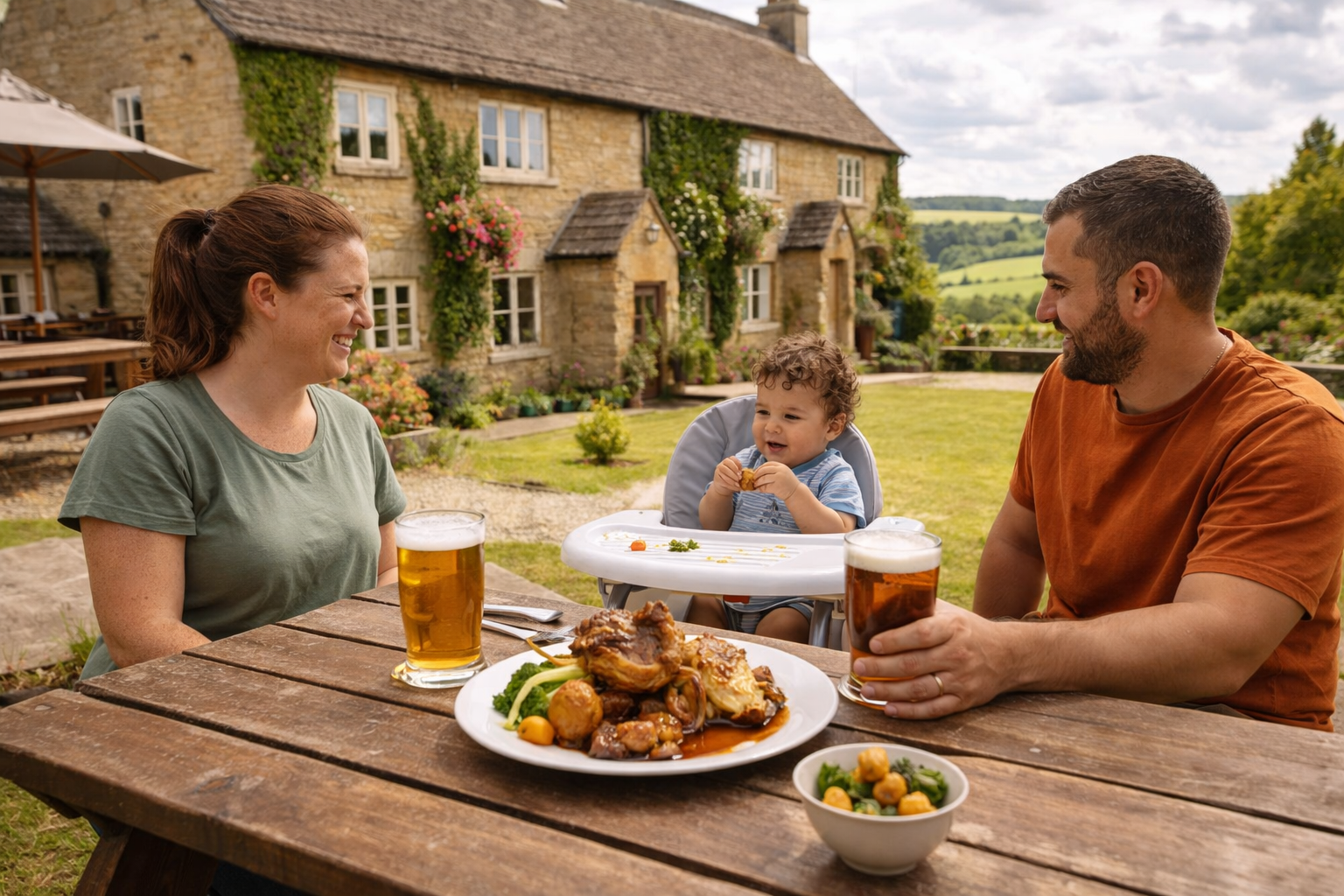
Where to Stay in the Cotswolds With a Baby
Self-catering cottages are the right call in the Cotswolds, and the county has some of the finest cottage stock in England. A stone cottage in or near a village — with a kitchen, a garden, and thick walls that keep the room quiet at bedtime — is the ideal base. Sykes Cottages and holidaycottages.co.uk both have excellent Cotswolds portfolios with baby-friendly filters. For the full picture on what to look for when booking, see our best cottages for babies guide.
The Cotswolds is premium-priced compared to other UK rural destinations — a decent cottage in a good village commands a significant premium, particularly in peak season. The budget-conscious option is to stay slightly outside the AONB boundary: Cheltenham (10–15 minutes from the northern Cotswolds), Cirencester (southern), or Witney (eastern) all offer more affordable bases with good road access into the villages. You sacrifice the romance of the stone cottage but save considerably on the accommodation cost.
Farm stays are an excellent Cotswolds option, combining the countryside setting with the authenticity of a working farm. Many Cotswolds farms have converted barns or holiday cottages on their grounds, with the bonus of animals on the doorstep — which entertains babies and toddlers without any effort from you. Search specifically for "farm stay Cotswolds" on the main booking platforms.
| Base | Best for | Most useful accommodation | Booking watch-out |
|---|---|---|---|
| Bourton or Stow | First visits and village days | Central cottage or aparthotel | Confirm parking before booking |
| Broadway or Chipping Campden | Northern villages and relaxed meals | Village cottage with enclosed garden | Older properties may have steep stairs |
| Burford or Cirencester | Southern attractions and useful shops | Cottage near town or family hotel | Check walking distance, not just mileage |
| Cheltenham | Lower prices and rail access | Hotel or serviced apartment | You will drive into the villages |
Our Tip
The Cotswolds is genuinely beautiful year-round, but May (bluebells, lambs, the countryside at its most lush) and September–October (golden autumn light, fewer crowds, cooler temperatures for walking) are arguably better than peak summer. August is busiest and most expensive. Christmas in the Cotswolds is magical — but wrap the baby up, because stone villages in December are seriously cold.
Browse Cotswolds cottages
holidaycottages.co.uk lists hundreds of baby-friendly properties across the Cotswolds, many with enclosed gardens, travel cots and highchairs available — filter for exactly what your little one needs before you book.
Search Cotswolds cottages
Compare Cotswolds Hotels
This link opens Booking.com's Cotswolds region results. Use the map to stay near your chosen villages, then request a cot from the property before arrival.
Search Cotswolds hotelsGetting to the Cotswolds With a Baby
A car is essentially required for the Cotswolds — there is no single gateway train station, the villages are spread across a large area, and the distances between places of interest make independent travel impractical without one. The M40 from London to junction 8 (Oxford) or junction 11 (Banbury) puts you at the eastern edge of the Cotswolds. The M5 from Bristol to junctions 11 or 12 accesses the western and southern areas. Journey times from London are typically 1.5–2 hours depending on your destination within the AONB.
If you're coming by rail, GWR serves Moreton-in-Marsh and Kingham from London Paddington — both are useful entry points into the northern Cotswolds. From there, local taxis or a hire car are needed to reach the villages. Cheltenham has good train connections and works as a rail-access base for the northern Cotswolds. For driving tips with a baby in the car, our car travel guide covers journey planning, break frequency, and keeping everyone comfortable on the road.
What to Pack for the Cotswolds
The Cotswolds is a four-season destination and the weather is genuinely variable — a warm October morning can turn into a sharp wind by lunchtime, and June can deliver rain without warning. Pack layers for both you and the baby, waterproofs for all, and walking boots for the parents (the paths can be muddy in anything other than dry summer conditions). A carrier for field and footpath walking, a compact stroller for the village lanes and cafés.
For the full kit list, our baby holiday packing list and holiday travel essentials guide cover the complete picture. Our routine on holiday guide is worth reading before you go — Cotswolds cottage stays tend to be quieter and more conducive to maintaining sleep schedules than hotel or holiday park trips, which works in your favour.

Ergobaby Omni Breeze — For When the Path Leaves the Village
The moment you step off the village lane and onto a Cotswolds footpath, a carrier becomes considerably more useful than a stroller. The Ergobaby Omni Breeze handles all carrying positions from newborn through to toddler, with a mesh construction that keeps both of you from overheating on warmer days. The hip carry and back carry positions work particularly well for longer Cotswolds footpath sections where you want your hands free and your back to stay intact.
Pros: newborn to toddler versatility; SoftFlex mesh is breathable and comfortable; excellent lumbar support for back carries; all positions covered including hip carry for curious older babies.
Cons: at around £175–£185, it's a premium investment. For shorter trips or lighter use, a structured buckle carrier at a lower price point may suffice — see our full carrier guide for alternatives.
View on AmazonPlanning when to visit the Cotswolds? Our seasonal guides cover the key UK travel periods — May half term 2026 (26–30 May), UK summer holidays with a baby, and bank holiday breaks — with destination tips, booking advice, and what to pack.
Cotswolds Essentials
The Cotswolds is gentle underfoot but the weather still turns without warning. This is the wet-weather and mixed-terrain kit that keeps village walks and field paths comfortable across the seasons.

Universal Stroller Rain Cover
A universal rain cover to keep your baby dry when the weather turns.
Check price on Amazon
Hippychick Waterproof All-in-One Suit
A waterproof pramsuit that keeps baby dry through drizzle and puddles.
Check price on Amazon
Universal Footmuff
A cosy universal footmuff for cold-weather walks and pram naps.
Check price on Amazon
Hauck Runner All-Terrain Buggy
Budget air-tyre all-terrain pushchair for gravel, grass and trails.
Check price on Amazon✈️ Free Baby Hand Luggage Checklist
Never forget the essentials. Enter your email and we'll send the free checklist straight to your inbox — one page, every category, ready before every flight.
Frequently Asked Questions
Is the Cotswolds good for a holiday with a baby?
Yes — it's one of the most pushchair-friendly rural destinations in England. The villages are compact and walkable, the terrain is gently rolling rather than steep, and the pub and café culture is excellent for families. It works particularly well for a long weekend, given its proximity to London, Bristol, Birmingham, and Oxford. The main consideration is that a car is essentially required to get between villages.
Which Cotswolds village is most pushchair-friendly?
Bourton-on-the-Water is the most consistently accessible — flat paved paths run along the shallow river right through the village centre, and babies love watching the ducks and the water. Broadway's wide flat main street is a close second. Burford has a steep high street but flat river meadows at the bottom. Castle Combe is beautiful but limited facilities and a car-free centre make it better for a short scenic stop than a full visit.
What are the best pushchair walks in the Cotswolds?
The Blenheim Palace grounds (Woodstock) and Westonbirt Arboretum are the most reliably flat and pram-friendly — both have excellent graded paths and work in all seasons. For village-based walks, the Bourton-on-the-Water riverside and the Lower-to-Upper Slaughter walk are the top picks. Most other Cotswolds footpaths involve stiles or muddy fields that work better with a carrier than a stroller.
What is the best time of year to visit the Cotswolds with a baby?
May and September–October are arguably the best months — beautiful weather, manageable crowds, and the countryside at its most photogenic. Summer (July–August) is busiest and most expensive but the villages are at their warmest and the outdoor dining and garden walks are at their best. Winter is quiet and atmospheric but cold; thick layers are essential and some attractions have reduced hours.
Do Cotswolds pubs allow babies?
The vast majority of Cotswolds pubs welcome families and have highchairs — it's one of the things the region does well. Pubs with gardens are particularly good in summer as babies and toddlers can move around more freely. It's worth calling ahead for a Sunday lunch reservation, both to confirm a highchair is available and to secure a garden table in peak season. Most village pubs are relaxed about buggies parked at the side of the dining room.
Where should I stay in the Cotswolds with a baby?
A self-catering stone cottage in or near a village is the ideal base — you need a kitchen for feeds and meals, and the thick walls of a Cotswolds cottage keep rooms genuinely quiet at night. Sykes Cottages and holidaycottages.co.uk both have strong portfolios. If budget is a consideration, staying in Cheltenham or Cirencester and driving into the villages works well. Farm stays are an excellent option if you want a more immersive rural experience.
Is a carrier or stroller better for the Cotswolds?
Both, ideally. The villages and arboreta walks are stroller-friendly; the Cotswolds footpath network beyond the villages works much better with a carrier. Pack both if you can — use the stroller for village walking and café stops, and switch to the carrier when the path demands it. If you can only bring one, a compact stroller covers most of the accessible highlights, with the carrier for the sections where the terrain changes.
Are there good rainy day options in the Cotswolds?
Yes — Cotswold Wildlife Park (Burford) is good in light rain as the enclosures are spacious and some areas are covered. Westonbirt Arboretum has canopy cover in much of the woodland, making it manageable in drizzle. Blenheim Palace has an extensive interior (less practical with a baby but fine for older toddlers). In heavy rain, the honest answer is that the Cotswolds works less well — a cosy pub lunch and an afternoon in the cottage with a good book is a legitimate rainy day plan.
The Verdict on the Cotswolds With a Baby
The Cotswolds is the easy win among UK rural destinations — beautiful, accessible, rich in good food and decent paths, and within two hours of most of England's major population centres. It rewards a relaxed pace: a village walk in the morning, a pub lunch, an afternoon at a farm park or arboretum, back to the cottage for bedtime. That rhythm suits babies beautifully. Take the carrier for the paths, the stroller for the villages, and book the Sunday roast in advance. If you're looking for more countryside options with a similar pace, our guides to the Yorkshire Dales and Peak District cover two excellent alternatives further north.
Also worth a read: our guides to rainy day activities with a baby and the best family-friendly restaurants in the UK pair well with any trip here.