
Scottish Highlands With a Baby: Essential Tips & Best Areas 2026
By BabyTravel UK Editorial Team · Last updated August 2026
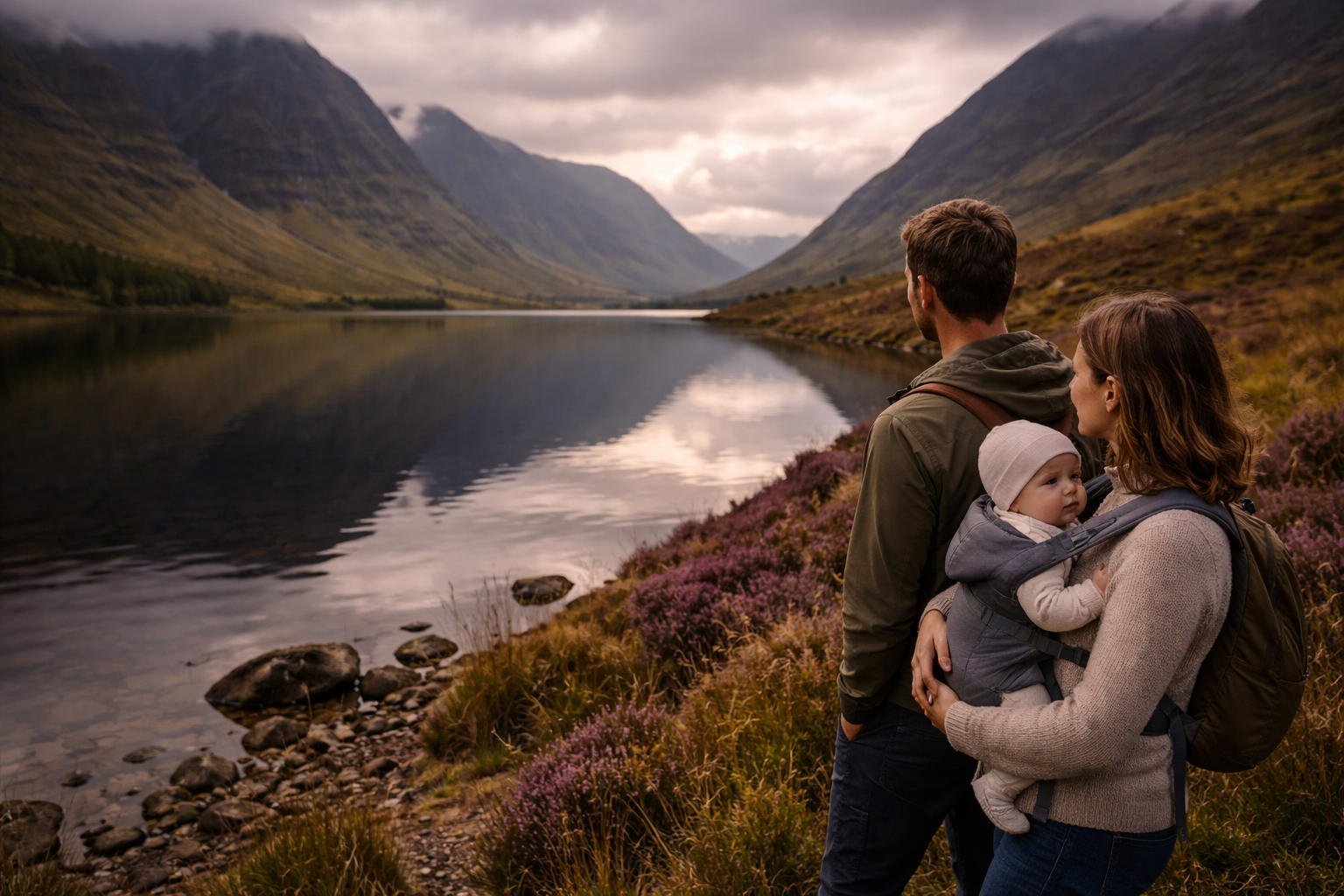
The Scottish Highlands offer something no other UK destination can match: a landscape so vast, dramatic, and wild that even a baby in a carrier at the edge of a Highland loch will make you stop and feel it. Glens that stretch for miles, mountains reflected in dark water, red deer on the hillside, Highland cows around every corner. There is nowhere quite like it in Britain.
It's also, let's be honest, one of the more challenging destinations with a very young child. The facilities are sparse, the distances are long, the weather is genuinely unpredictable, and in summer the midges can be fierce. This guide gives you both sides clearly — the aspiration and the practicalities — so you can make the right decision for your family and, if you go, have a brilliant time. If you're still choosing between the Highlands and other UK destinations, our free UK destination quiz covers 15 options and helps you find the right fit in five questions.
Quick Answer: Scottish Highlands With a Baby
- 🏔️ Best areas: Aviemore/Cairngorms (best infrastructure), Fort William (best access to scenery), Inverness (best facilities), Oban (best for coast and boat trips).
- 🦟 Midge reality: worst June–September near water. Avon Skin So Soft is baby-safe from 6 months. Time outdoor activities to avoid dawn and dusk.
- 🥾 Transport: mostly carrier territory — flat pushchair-friendly walks exist but are the exception. A structured carrier with waist support is essential.
- 🌧️ Weather: pack for all four seasons simultaneously, including in July. Proper waterproofs, warm layers, and sun cream. All at once.
- 🗓️ Best timing: May (pre-midge, long days) or late September (post-midge, autumn colour, lower prices).
The Honest Assessment
The Scottish Highlands are stunning. That part requires no nuance. But they are not the easiest destination with a baby, and being clear about that upfront is more useful than a breathless description of the scenery that leaves you unprepared at a petrol station 45 minutes from your cottage realising you forgot formula.
Facilities are sparse. In the most remote areas — Torridon, Ardnamurchan, Knoydart — the nearest supermarket can be an hour's drive. The nearest hospital further. This is not a problem if you're well-prepared and your baby is healthy; it becomes a problem if you're not.
Distances are long. The Highlands are enormous — roughly the size of Belgium. Driving from one area to another takes considerably longer than it looks on a map, because the roads are single-track in places, follow the contours of lochs and glens, and share space with sheep, tourists, and cyclists.
The weather is genuinely unpredictable. Four seasons in one day is not an exaggeration — it's an accurate weather forecast on many Highland days. Plan for all of them simultaneously.
All of that said: for families who love wild landscape, don't mind planning ahead, and are happy being slightly further from convenience than they're used to, the Highlands offer an experience that is completely unlike anywhere else in the UK. Many families who go once become devotees. Visit VisitScotland for the full picture before booking.
Best Areas for Families With Babies
The Highlands cover roughly 10,000 square miles. Treating them as a single destination is like treating "England" as a single destination. Here are the five areas that make most sense for families with babies, ordered by how family-friendly the infrastructure is.
| Area | Facilities | Remoteness | Best For | Midge Risk |
|---|---|---|---|---|
| Aviemore / Cairngorms | Good — town centre with supermarkets, cafés, hospital in Inverness 45 mins | Low | Flat lochside walks, funicular, wildlife, winter visits | Moderate — sheltered spots worse |
| Inverness | Best in the Highlands — full city amenities, Raigmore Hospital on-site | None | Day-trip hub, Loch Ness, Culloden, good base for first Highlands visit | Low in city, higher near Loch Ness shore |
| Fort William / Glen Nevis | Good — town with supermarkets, Belford Hospital, good café scene | Low–moderate | Ben Nevis backdrop, flat glen walks, Glencoe day trip, Jacobite steam train | Moderate — glens can be bad in summer |
| Oban / West Coast | Good in Oban town — more limited once you head north along the coast | Moderate | Seafood, boat trips to islands, CalMac ferry experience, coastal beaches | Moderate — coastal breeze helps |
| Torridon / Wester Ross | Sparse — nearest supermarket 45+ mins, limited medical facilities | High | The most dramatic scenery in Scotland — for well-prepared families only | High near water in summer |
Aviemore and the Cairngorms
The most family-friendly area in the Highlands by infrastructure. Aviemore is a proper town with supermarkets, a range of accommodation, good cafés, and Inverness Hospital 45 minutes away for anything serious. The Cairngorms National Park surrounds it — the UK's largest national park and home to some of its best flat, accessible walking. Loch an Eilein (a beautiful circular loch path on a compacted surface) is the standout pushchair-friendly walk. Loch Morlich has a sandy beach — yes, a genuine beach — that babies find deeply confusing and delightful. The Cairngorm funicular takes you to near-summit altitude without a single step of effort.
Inverness
The most practical base in the Highlands for families who want genuine urban comfort alongside access to Highland scenery. Inverness is a city — there's a hospital, multiple supermarkets, good restaurants, and all the infrastructure of normal life. Loch Ness boat trips depart from nearby Drumnadrochit (babies are transfixed by the idea of a monster, even if they don't know what a monster is). Culloden Battlefield has flat, largely accessible grounds and is historically significant without requiring the children to understand why. Good day-trip hub for most of the central Highlands.
Fort William and Glen Nevis
The "outdoor capital of Scotland" sits at the foot of Ben Nevis — the highest mountain in the UK — but you don't need to climb anything to enjoy the setting. The lower Glen Nevis walk (flat, spectacular, pushchair-possible on the lower section) follows the river through one of the most beautiful glens in Scotland. Glencoe is 30 minutes south and is visually extraordinary even from the car. The Jacobite steam train (the Harry Potter train) runs from Fort William to Mallaig over the Glenfinnan Viaduct — a brilliant day out even with a baby in your arms.
Oban and the West Coast
Oban is a proper seafood town with a working harbour, good facilities, and excellent access to the islands via CalMac ferries. A CalMac ferry crossing to Mull or Kerrera is an experience in itself — babies love the movement, the seabirds, and the scale of the water. The Oban seafront promenade is fully accessible and makes a pleasant easy walk. The West Highland coast has some spectacular beaches — Glenborrodale and Sanna Bay in Ardnamurchan are among the finest in the UK, though reaching them requires commitment.
Pushchair-Friendly Walks in the Highlands
📋 Free Baby Holiday Packing Checklist
Enter your email and we'll send the free printable checklist straight to your inbox — every category, ready to tick off before every trip.
The honest truth: most Highland scenery is carrier territory. The landscape that makes Scotland dramatic — the steep glens, the boggy moorland, the narrow lochside paths — is genuinely difficult or impossible with a pushchair. But flat, accessible walks do exist, and knowing where they are in advance makes the difference between a frustrating trip and a brilliant one.
| Walk | Area | Surface | Buggy Suitable? | Distance / Highlight |
|---|---|---|---|---|
| Loch an Eilein circular | Aviemore / Cairngorms | Compacted gravel path | ✅ Yes — most strollers | 5km loop / loch with island castle, ancient Caledonian pines |
| Loch Morlich beach walk | Aviemore / Cairngorms | Sandy beach and flat path | ✅ Yes | Flexible / freshwater beach, mountain backdrop |
| Great Glen Way (canal section) | Fort William | Flat tarmac towpath | ✅ Yes — fully flat | As far as you like / Caledonian Canal, Ben Nevis backdrop |
| Lower Glen Nevis walk | Fort William | Mixed — partly manageable | ⚠️ Partly — lower section only | 2km (lower) / river gorge, spectacular |
| Oban seafront promenade | Oban | Tarmac pavement | ✅ Yes — fully accessible | Flexible / harbour views, McCaig's Tower above |
| Culloden Battlefield paths | Inverness | Compacted gravel | ✅ Yes | 2–3km / atmospheric historic site, flat moorland |
For anything beyond these routes, swap the stroller for a carrier. Most Highland scenery rewards the effort of walking into it rather than past it from a car park, and a structured carrier with waist support makes even longer hikes comfortable once your baby is old enough to be carried facing outward. For the flat lochside paths, a stroller that handles mixed terrain is worth bringing — our guide to strollers for uneven terrain covers the models that cope best with gravel and compacted paths.

Ergobaby Omni Breeze — Best Carrier for Highland Walking
Best for: longer walks, all ages | Newborn to toddler (up to 20kg) | Around £180–£200
The Highlands are fundamentally a carrier destination, and the Ergobaby Omni Breeze is one of the best all-round structured carriers available in the UK. The waist belt takes the weight off your shoulders for longer walks — critical when you're carrying a 10kg toddler up a glen path. The breathable Air Mesh fabric is the standout feature for active use: it keeps both you and baby significantly cooler on the uphill sections. Four carry positions cover you from newborn (without an insert) right through to older toddler on your back. The front-facing carry position is particularly popular with babies who want to see the Highland cows coming.
- ✅ Waist belt transfers weight from shoulders — essential for longer Highland walks
- ✅ Air Mesh fabric — significantly more breathable than standard structured carriers
- ✅ Newborn to toddler (up to 20kg) — no separate insert needed from birth
- ✅ Four carry positions including front-facing outward
- ❌ Premium price — one of the more expensive structured carriers on the market
- ❌ Learning curve on the back carry position — worth practising before your trip
The Midge Question
Address this one early in your planning, because it genuinely affects when and where you go.
Midges (Culicoides impunctatus) are tiny biting insects found across the Scottish Highlands and Islands. At their worst — still, humid evenings in July near a sheltered loch — they can make outdoor life genuinely unpleasant. A baby who cannot use standard insect repellent and cannot scratch their own bites is particularly vulnerable.
When they're worst: June to September, in still conditions, near water (especially sheltered glens and lochsides), at dawn and dusk. A breeze of even 5mph disperses them entirely — elevated, open ground is typically midge-free.
Baby-safe repellent: options are limited for young babies. Avon Skin So Soft Original Dry Oil Spray is the cult Highland repellent — it's not marketed as a repellent and makes no official claims, but it is widely used by outdoor workers throughout Scotland and is considered safe from 6 months. Check the label and patch-test first. For babies under 6 months, physical barriers (long sleeves, a carrier cover, a pram net) are the safer option.
The honest advice for babies: if you're visiting with a baby under 6 months, consider timing your trip for May or late September, when midge numbers are significantly lower. July and August in a sheltered Highland glen with a baby who's being bitten and can't do anything about it is genuinely difficult. It's a solvable problem with the right timing — the NHS has useful guidance on insect bites and stings if you want to know what to watch for.
Weather and What to Pack
The Highlands are wetter, windier, and colder than the rest of the UK at any given time of year. Even in July, Highland evenings can drop to 8–10°C — cold enough to need a proper layer on a baby who's been out all day. Even in July, it can rain horizontally for six hours and then produce the most spectacular evening light you've ever seen.
Pack for all four seasons simultaneously. That's not an exaggeration — it's the only reliable Highland packing strategy. Specifically:
- Serious waterproofs for baby — not a light shower jacket. A proper all-in-one waterproof suit (or pramsuit with waterproof exterior) that covers arms, legs, and has a hood. Highland rain doesn't politely wait for you to find shelter.
- Warm layers — merino wool base layers are worth the investment for Scottish weather. Merino regulates temperature in both directions and stays comfortable when wet in a way synthetic base layers don't.
- Windproof hat — even in summer, Highland wind is cold on a baby's ears
- Waterproof stroller cover — if you're using a stroller at all
- Carrier rain cover — keeps your baby dry in a carrier without you needing to cut the walk short
- Sun cream — when the Highland sun comes out, it's genuinely strong at latitude 57°N. The UV index on a clear Highland day is higher than most parents expect.
Our Tip
Download the Midge Forecast app before you go — it's a free tool that gives daily midge risk ratings by location across Scotland. It won't make the midges go away, but knowing that tomorrow morning is a level 1 (low) and the afternoon is a level 5 (high) helps you plan your outdoor time intelligently.
Highlands Essentials
The Scottish Highlands ask you to pack for all four seasons at once. Here's the wet-weather and cold-weather kit that keeps your baby dry, warm, and sleeping well from Aviemore to Torridon.

Deuter Kid Comfort Pro Hiking Carrier
A framed hiking backpack carrier with proper back support for longer trails.
Check price on Amazon
Universal Stroller Rain Cover
A universal rain cover to keep your baby dry when the weather turns.
Check price on Amazon
Hippychick Waterproof All-in-One Suit
A waterproof pramsuit that keeps baby dry through drizzle and puddles.
Check price on Amazon
Universal Footmuff
A cosy universal footmuff for cold-weather walks and pram naps.
Check price on Amazon
Ergobaby Carrier Rain Cover
Keeps your baby dry and cosy in the carrier when the weather turns.
Check price on Amazon
Grobag Baby Sleeping Bag
A wearable sleeping bag for familiar, safe sleep conditions away from home.
Check price on AmazonWhere to Stay
Self-catering is the right choice for most families with babies in the Highlands — both because it gives you kitchen access for feeds and early dinners, and because in more remote areas it's often the only option. The nearest restaurant may be a 30-minute drive; the nearest takeaway, further still. Self-catering removes that dependency entirely.
Many Highland cottages are converted crofts with thick stone walls, good insulation, and a character that modern builds can't replicate. Look for properties that specify enclosed garden space, good heating (particularly in spring and autumn when Highland evenings are cold), and a washing machine (essential for wet outdoor kit). Sykes Holiday Cottages has a solid Highland portfolio and the baby-friendly filter makes it easier to find suitable properties. Our guide to the best cottages for babies covers what to look for in any self-catering booking.
For something more comfortable, a handful of Highland hotels are genuinely excellent — the Boat Hotel in Aviemore and the Glencoe House near Fort William are both worth considering if you want hotel facilities without sacrificing location. Always call ahead to confirm they can accommodate a travel cot and highchair.

Find Baby-Friendly Hotels
Search baby-friendly hotels with free cancellation, cot requests, and family room options.
Search Hotels on Booking.comGetting There
Flying to Inverness is often the smartest choice for families travelling from the south of England — easyJet and BA both fly direct from London in around 1.5 hours, then hire a car at the airport. The flying-then-driving approach avoids the long, tiring road journey and gives you a fresh start for the Highland driving on arrival.
Driving from Edinburgh to Inverness takes around 2.5–3 hours on the A9 — manageable with a baby if you build in stops. From Manchester to Fort William is around 5 hours in good conditions; from London, 8+ hours. That's too long in one stretch with a baby in a car seat — plan it as a two-day journey with an overnight stop, or take the train to Edinburgh and hire a car there. Our car travel guide covers long-drive logistics in full.
The Caledonian Sleeper from London to Fort William or Inverness is a genuinely special option if the overnight logistics work for your family. The train departs London Euston in the evening and arrives in the Highlands at dawn — some babies sleep brilliantly with the motion. Book a private cabin and manage expectations: it's cosy, characterful, and memorable rather than spacious and convenient. Our train travel guide covers the practicalities.
Wildlife to Look For
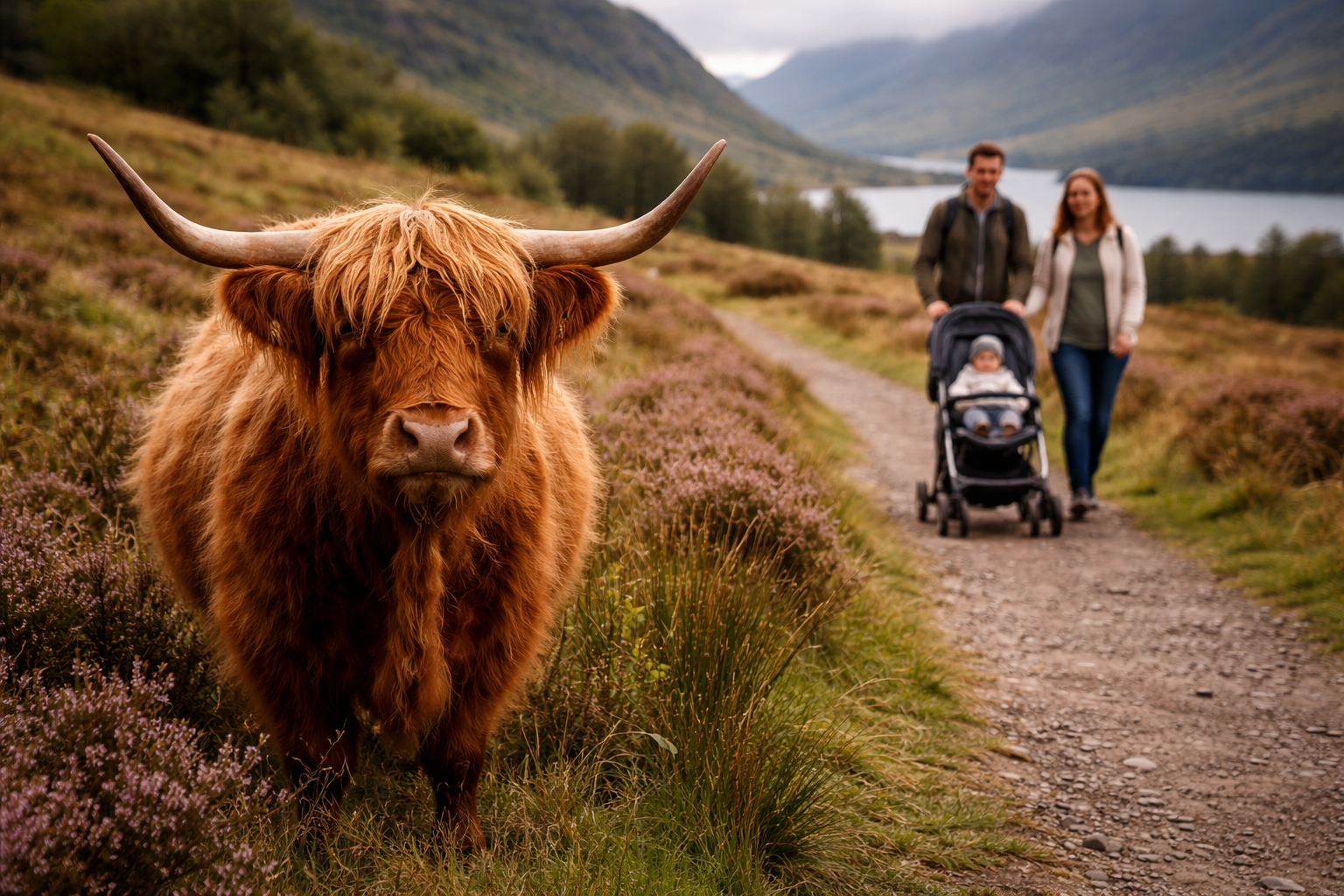
One of the Highlands' most accessible pleasures with a baby — wildlife requires no effort beyond being present and looking. Red deer are everywhere, particularly visible at dawn and dusk on hillsides. Highland cows (the defining Highland experience — they're large, shaggy, and have a manner that babies find immediately captivating) can be found along most Highland roads and in many fields. Red squirrels live in the pine forests around Aviemore; Loch Morlich and the Rothiemurchus estate are reliable spots. Dolphins in the Moray Firth (boat trips from Inverness) are a realistic sighting from April to September. And if you're very lucky — golden eagles, particularly above the larger glens of Wester Ross and the Cairngorms.

Joie Pact Pro — Best Stroller for Highland Gravel Paths
Best for: accessible Highland walks, gravel and compacted surfaces | Birth to 22kg | Around £179–£219
For the Highland walks where a stroller is viable — Loch an Eilein, the Great Glen Way canal path, the Culloden grounds — you want something with rear spring suspension to absorb the compacted gravel surfaces comfortably. The Joie Pact Pro is the best value option at this price for mixed-surface use: the suspension genuinely makes a difference on anything that isn't smooth tarmac, the full-flat recline handles mid-walk naps, and the compact fold fits in a Highland cottage boot without drama. It's not an all-terrain pushchair (nothing in this price range is), but for the accessible Highland walks listed above it performs well beyond its cost.
- ✅ Rear spring suspension — handles compacted gravel paths comfortably
- ✅ Full recline for walk naps — useful on longer accessible routes
- ✅ Compact fold — fits cottage car parks and Highland boot spaces
- ❌ Not an all-terrain stroller — not suitable for boggy moorland or steep, rough paths
- ❌ 7.4kg — heavier than ultra-compact alternatives if you need to carry it over stiles
Planning when to visit the Scottish Highlands? Our seasonal guides cover the key UK travel periods — May half term 2026 (26–30 May), UK summer holidays with a baby, and bank holiday breaks — with destination tips, booking advice, and what to pack.
Find Family Activities
Book skip-the-line tickets and family-friendly tours — free cancellation on most activities.
Browse Family Activities✈️ Free Baby Hand Luggage Checklist
Never forget the essentials. Enter your email and we'll send the free checklist straight to your inbox — one page, every category, ready before every flight.
Frequently Asked Questions
Are the Scottish Highlands suitable for babies?
Yes, with realistic expectations. The Highlands are stunning and genuinely wonderful for families — but they're remote, facilities are sparse in places, and the weather demands preparation. Choose the right area (Aviemore, Fort William, Inverness, or Oban for first-timers), book self-catering, and pack for all weathers. The experience is unlike anywhere else in Britain and worth the extra preparation.
What are midges and are they dangerous to babies?
Midges are tiny biting insects, worst June–September in still, humid conditions near water. They're not dangerous but their bites are itchy and distressing, particularly for babies who can't protect themselves. Baby-safe repellent options are limited — Avon Skin So Soft is the most widely recommended from 6 months. The best strategies are timing (avoid dawn and dusk) and location (breezy, elevated ground is midge-free). For babies under 6 months, consider visiting in May or late September instead.
Which part of the Scottish Highlands is best for families with babies?
Aviemore and the Cairngorms offer the best combination of infrastructure and scenery for families — good facilities, flat accessible walks, and the Cairngorm funicular for an effortless mountain experience. Inverness is the most urban and practical base. Fort William gives the best access to dramatic scenery. For a first Highland trip with a very young baby, Aviemore or Inverness are the lowest-risk choices.
Can you use a pushchair in the Scottish Highlands?
In specific areas, yes. Loch an Eilein near Aviemore (compacted path, beautiful circular route), the Great Glen Way canal towpath near Fort William, the Oban seafront promenade, and the Culloden Battlefield paths are all pushchair-friendly. Most Highland scenery, however, requires a carrier — steep, boggy, and uneven ground that no standard stroller handles well. See our carrier guide for structured options with good waist support for longer walks.
How do you get to the Scottish Highlands?
Flying to Inverness (around 1.5 hours from London direct) and hiring a car is often the smartest approach for southern families. Driving from Edinburgh to Inverness is a manageable 2.5–3 hours. From Manchester to Fort William is around 5 hours; from London, 8+ hours — too long in one stretch with a baby. The Caledonian Sleeper overnight train from London is a special option if the overnight logistics appeal. Full details in our car travel guide and train guide.
What should I pack for the Scottish Highlands with a baby?
Pack for all four seasons simultaneously, even in July. Serious waterproofs (proper all-in-one suit, not a light jacket), warm merino layers, a windproof hat, waterproof stroller cover, a carrier with rain cover, and sun cream. A midge repellent appropriate for your baby's age. And the usual sleep kit — blackout blind and white noise are more important than ever in Highland cottages with thin curtains and sheep outside the window at 5am.
When is the best time to visit the Scottish Highlands with a baby?
May and late September are the sweet spots — lower midge risk, long daylight hours in May, spectacular autumn colour in September, and lower prices than peak summer. July and August are warmest but most crowded and most midge-affected. Winter visits (November–March) offer dramatic landscapes in clear weather but require real preparation for cold, short days, and some facilities closing.
Is the Caledonian Sleeper suitable for babies?
It's possible and genuinely memorable, but requires planning. Book a private cabin. A travel cot won't fit in the cabin, but a small bassinet-style carrycot might work on the floor — check with Scotrail before booking. Many babies sleep brilliantly with the train's gentle motion. The journey through the Highlands arriving at dawn is unforgettable. Not for everyone, but if the logistics appeal it's a genuinely special experience. See our train travel guide.
The Scottish Highlands will ask more of you logistically than most UK destinations. They'll also give you more back. A baby held up to look at a red deer across a Highland glen, or watching the water from a CalMac ferry deck, or feeling the wind off a loch for the first time — these are moments that stay with parents long after the trip is over. Do the preparation, pick the right area, go in May if the midges worry you, and go. If you're flying into Edinburgh first, our Edinburgh with a baby guide covers how to make the most of a night or two in the city before heading north.
Also worth a read: our guides to rainy day activities with a baby and the best family-friendly restaurants in the UK pair well with any trip here.