
Cornwall With a Baby: Best Beaches, Cottages & Things to Do (2026)
By BabyTravel UK Editorial Team · Last updated August 2026
The definitive 2026 guide to navigating the rugged Cornish coast with your little one in tow.
Cornwall is the dream UK family holiday—stunning beaches, world-class cream teas, and scenery that makes the 5-hour drive (with multiple nappy stops) feel completely worth it. For many of us, it was the backdrop of our own childhood summers, and there is something special about introducing your own baby to the Cornish air for the first time.
But the reality of Cornwall with a baby is a little different from the footloose trips of your pre-parenting years. Narrow lanes, steep coastal paths, and remote coves require a new level of tactical planning. This guide covers exactly where to go, the best baby-friendly beaches, where to stay, and what you’ll need to bring to ensure your Cornish break is a success in 2026. For a broader overview of UK family travel, check our guide to the best baby-friendly holidays in the UK. Still weighing up whether Cornwall is the right fit for your family? Our free UK destination quiz covers 15 destinations and matches you to the right one in five questions.
Quick Answer: Cornwall Success Tips
- Best Area: The North Coast (Padstow, Newquay, Bude) for wider, more accessible beaches and facilities.
- Timing: Late May to mid-July or September—avoid the peak school holiday crush.
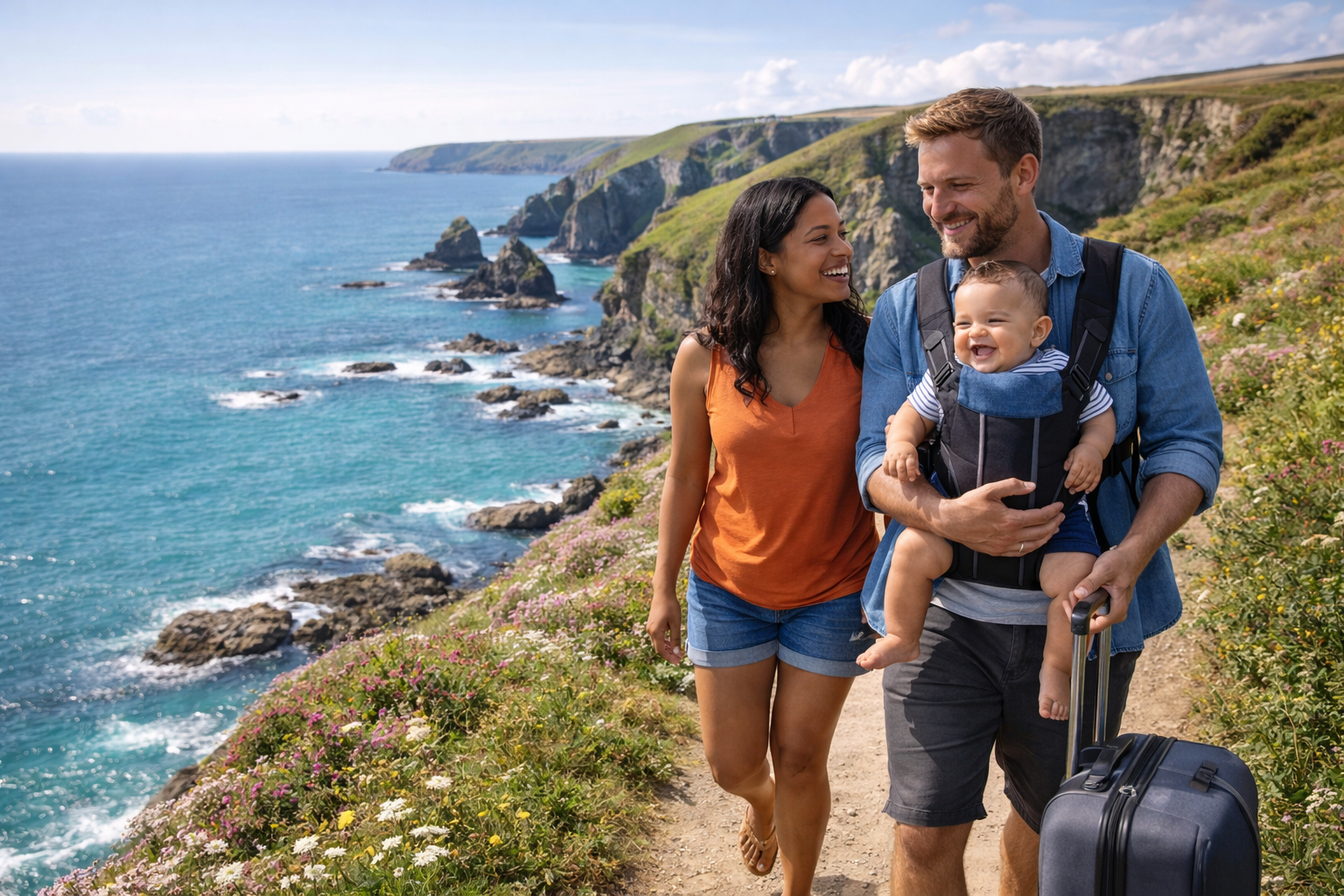
- The Carrier: A baby carrier is essential. Many Cornish villages and paths are genuinely not buggy-friendly.
- Budget: Expect to pay £800-£1,200 for a decent family cottage in peak months.
- Booking: Summer fills up fast. Aim to book your cottage 4-6 months in advance.
1. Best Baby-Friendly Beaches in Cornwall
Cornwall has hundreds of beaches, but for a baby, you need more than just a view. You need shallow water for paddling, soft sand for sitting, and—most importantly—easy access to toilets and a café for the inevitable blowout or mid-afternoon meltdown.
| Beach | Area | Baby-Friendly Features | Facilities |
|---|---|---|---|
| Porthminster | St Ives | Sheltered, very calm water | Toilets, café, changing |
| Polzeath | North Coast | Vast sand, easy parking on the beach | Toilets, shops, changing |
| Harlyn Bay | Padstow | Wide, flat sand, very sheltered | Toilets, seasonal café |
| Daymer Bay | Rock | Exceptionally shallow, like a lake | Toilets, café |
| Gyllyngvase | Falmouth | Paved access right to the sand | Excellent café & toilets |
| Sennen Cove | Land's End | Stunning views, lifeguarded | Toilets, café, parking |
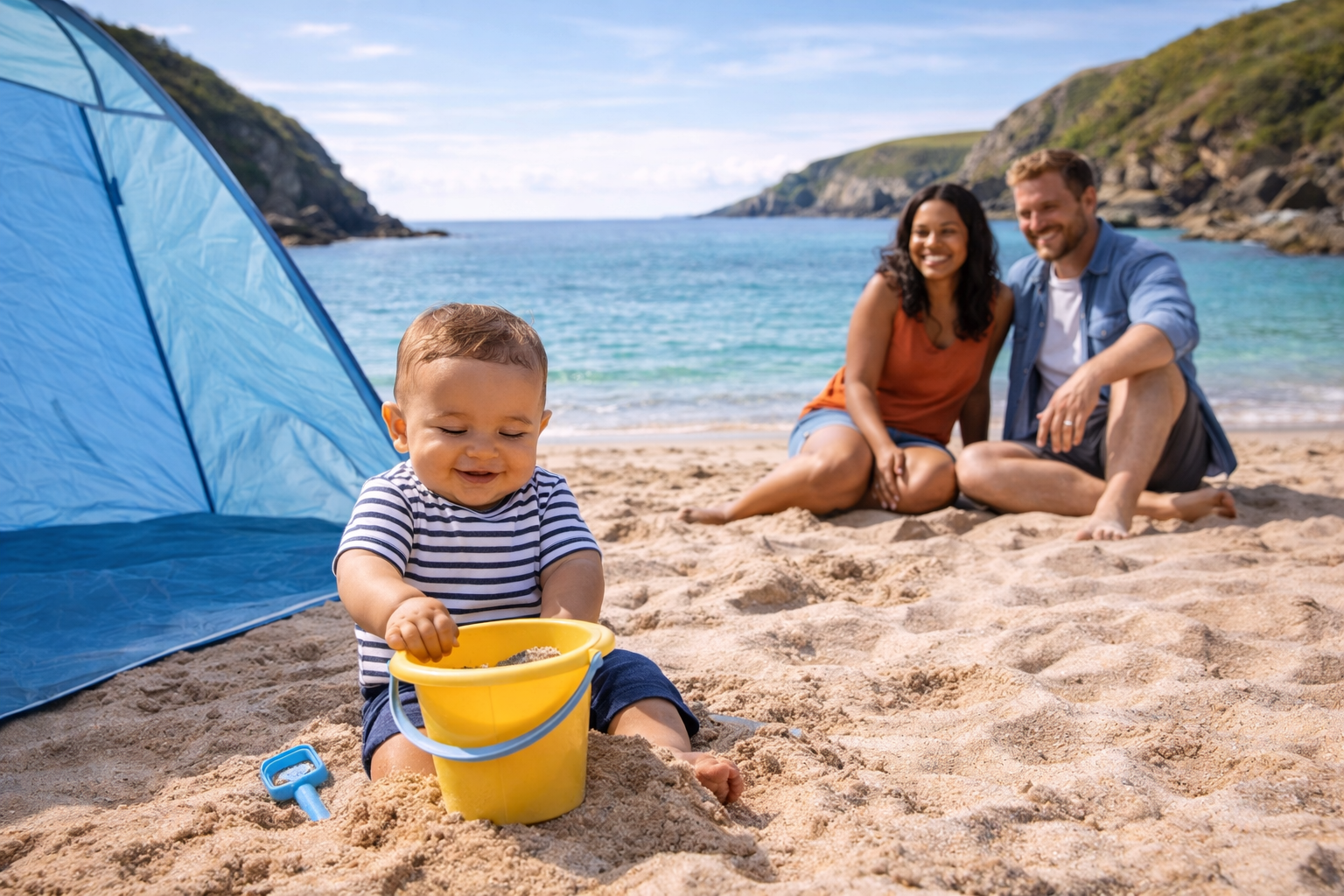
Beach Tips: The Cornish sun is deceptive—the Atlantic breeze keeps you cool, but the UV levels are high. Always bring a UV pop-up tent (see our recommendations below) and remember that many Cornish beaches "disappear" at high tide. Check the tide times before you pack the car!
2. Where to Stay: Accommodation Guide
Self-Catering Cottages (Top Pick)
A cottage is almost always the best option with a baby. You get a kitchen for 4:00 AM bottle prep, a washing machine for the inevitable sandy clothes, and separate bedrooms so you don't have to sit in the dark from 7:00 PM. Follow our holiday routine tips and remember to pack a portable blackout blind—many Cornish cottages have lovely, but very thin, curtains. For more on setting up a safe sleeping environment away from home, see our guide to travel cots and sleep solutions.
Our new baby-friendly Cornwall cottages comparison narrows this down to six named properties, with travel-cot details, enclosed-garden checks, beach access and direct availability links.
Where to Book: Platforms like Sykes Cottages, Classic Cottages, and the National Trust have excellent Cornish portfolios. Aim for the Padstow or Bude areas if you want flatter, more buggy-friendly terrain, or Falmouth if you prefer the sheltered south coast. Check the Visit Cornwall official site for local event listings during your stay.
Holiday Parks
If you're looking for a more affordable, social alternative, Cornwall has some excellent holiday parks, such as those run by Parkdean Resorts. These provide a similar level of infrastructure to Centre Parcs—with pools and cots provided—but usually at a lower price point and with quicker access to the actual beaches.
Browse Cornwall cottages
holidaycottages.co.uk lists hundreds of baby-friendly properties across Cornwall, many with enclosed gardens, travel cots and highchairs available — filter for exactly what your little one needs before you book.

Find Baby-Friendly Hotels
Search baby-friendly hotels with free cancellation, cot requests, and family room options.
Search Hotels on Booking.com3. Things to Do in Cornwall With a Baby
📋 Free Baby Holiday Packing Checklist
Enter your email and we'll send the free printable checklist straight to your inbox — every category, ready to tick off before every trip.
Outdoor Activities
The Eden Project near St Austell is an absolute must. It has some of the best baby-changing and breastfeeding facilities in the UK, and the biomes are almost entirely pushchair-friendly. For coastal walks, a baby carrier is better for the clifftops, but for a buggy-friendly route, the Camel Trail starting in Padstow is flat and perfectly paved.
Free Things to Do
You don't always need to pay high admission prices to enjoy Cornwall. Some of the best memories are made during simple, free activities:
- Rock Pooling: Head to beaches like Hannafore (Looe) or Castle Beach (Falmouth) at low tide. Little ones will be mesmerized by the tiny crabs and sea anemones.
- Harbour Watching: Simply sitting by the water at Padstow, St Ives, or Mevagissey and watching the colorful fishing boats come in is a great sensory experience for a baby.
- Coastal Walks: While some are steep, many sections of the South West Coast Path (like the stretch between Rock and Daymer Bay) are manageable with a carrier.
- Village Parks: Most Cornish villages have beautiful, well-maintained parks with play areas for older toddlers and plenty of grass for baby's tummy time.
Rainy Day Options
When the Cornish mizzle sets in, head to the National Maritime Museum in Falmouth—it has great indoor spaces and a dedicated play zone for little ones. Alternatively, a cream tea in a warm café (try the Peculiar Poultry in Newquay or the St Ives Bakery) is a legitimate holiday activity. Just remember: in Cornwall, it's jam first, then cream!

Find Family Activities
Book skip-the-line tickets and family-friendly tours — free cancellation on most activities.
Browse Family Activities4. Getting Around: Car vs Carrier
A car is almost essential for Cornwall with a baby. While public transport exists, getting a buggy onto a rural bus is no easy task. If you're driving from London or the North, plan for at least 4-5 hours and use our road trip survival guide to manage the stops. Most Cornwall routes like the A30 are well-serviced, but once you hit the minor roads, expecting "Cornish lanes"—narrow, high-hedged roads—to be a challenge is wise.
Arriving by Train: Great Western Railway (GWR) runs direct services from London Paddington to Penzance, stopping at Bodmin, Truro, and St Erth. It's a doable and quite scenic option with a baby, but you'll almost certainly need a hire car at the other end to reach the more remote cottages and beaches.
Once you're there, think carefully about your buggy. A compact travel stroller is great for the paved ports of Padstow, but for actual exploring, you'll want an all-terrain model or, ideally, a baby carrier. The cobbles of St Ives and the steps of Mevagissey will test the suspension of even the sturdiest pram.
5. What to Pack for Cornwall
On top of your Ultimate Packing List, you need these Cornish specific additions. Be sure to check our holiday travel essentials and travel accessories guides for more equipment depth.

Babymoov Anti-UV Pop-Up Sun Tent
Our Take: Essential for Cornish beaches where the wind can be strong and shade is scarce. It pops up in seconds and provides UPF 50+ protection for naps on the sand.
Key Feature: Large enough for baby and gear, folds into a small travel bag. | Price: Around £35-£40.

Hippychick Shell Suit Waterproof Overalls
Our Take: Cornish weather can change in five minutes. These waterproof overalls are better than a separate jacket because they keep the wind and spray out during coastal walks.
Key Feature: Breathable, lightweight, and fully waterproof with adjustable stirrups. | Price: Around £25.
Beach Essentials for Cornwall
The little extras that make a Cornish beach day with your baby run that bit smoother.

Childs Farm SPF 50+ Sunscreen
Fragrance-free SPF50+ sunscreen made for babies' delicate skin (6 months+).
Check price on Amazon
Splash About UV All-in-One Swimsuit
A UPF50+ all-in-one covering shoulders to knees for pool and beach.
Check price on Amazon
Splash About Happy Nappy (Reusable Swim Nappy)
Reusable swim nappy that meets most pools' double-nappy rule — no leaks, no waste.
Check price on Amazon
Green People Organic After-Sun
Gentle organic after-sun to soothe warm little skin at the end of a beach day.
Check price on Amazon
Baby Bucket & Spade Set
A bucket-and-spade set to keep little hands happily busy in the sand.
Check price on AmazonDriving to Cornwall?
A few in-car extras to make the long haul down to Cornwall calmer for your little one.

Car Window Sun Shade
Cuts glare and heat off the back window so your baby isn't squinting on a long drive.
Check price on Amazon
Baby Car Mirror (rear-facing)
A back-seat mirror so you can check on a rear-facing baby without turning round.
Check price on Amazon
Car Seat Protector
Protects your upholstery from scuffs and crumbs under the child seat.
Check price on Amazon6. Practical Tips for Cornwall 2026
- Mobile Signal: Signal is famously patchy in rural Cornwall. Download offline Google Maps before you leave the cottage.
- Consumables: Local Co-ops and SPARs are well-stocked—you don't need to pack 50 nappies from home.
- Sun Safety: Follow NHS sun safety advice. Even on cloudy days, the Atlantic reflection is strong. If your baby does catch the sun, our guide to the best baby after-sun covers soothing options worth packing.
Planning when to visit Cornwall? Our seasonal guides cover the key UK travel periods — May half term 2026 (26–30 May), UK summer holidays with a baby, and bank holiday breaks — with destination tips, booking advice, and what to pack.
✈️ Free Baby Hand Luggage Checklist
Never forget the essentials. Enter your email and we'll send the free checklist straight to your inbox — one page, every category, ready before every flight.
Frequently Asked Questions
Is Cornwall a good holiday destination with a baby?
Absolutely. It is one of the safest and most infrastructure-rich family destinations in the UK. Provided you plan for the terrain and pick the right base, it's a 10/10 choice.
What are the best baby-friendly beaches in Cornwall?
Porthminster (St Ives), Polzeath, and Daymer Bay are our top picks. They each offer sheltered water, soft sand, and accessible toilets and cafés within a very short walk.
When is the best time to visit Cornwall with a baby?
Late May, June, or September are ideal. You get the warmth of the coastal sun without the overwhelming crowds or premium pricing of the August school holidays.
What should I pack for a Cornwall holiday with a baby?
Prioritise a baby carrier for coastal paths, a UV sun tent for the beach, and plenty of layers. Cornwall's "mizzle" can arrive fast, so a full waterproof puddle suit is also essential.
Are there things to do in Cornwall when it rains with a baby?
Yes. The Eden Project is the best rainy-day option due to its covered biomes. The National Maritime Museum in Falmouth also offers excellent indoor learning and play spaces.
Do I need a car in Cornwall?
Yes, we strongly recommend it. While the trains reach major towns, many of the best baby-friendly cottages and beaches are only accessible via narrow rural lanes.
How far is Cornwall from London?
Usually 4.5 to 5 hours. With a baby, we recommend allowing 6.5 hours to account for feeding and nappy changes along the main A30 or M5/A303 routes.
Is the Eden Project baby-friendly?
Yes, arguably the most baby-friendly major attraction in Cornwall. They have microwave stations for bottles, large changing areas, and flat, buggy-friendly paths throughout.
Is Cornwall good for babies?
Yes — Cornwall is one of the UK's most baby-friendly destinations. Self-catering cottages are plentiful, beaches are wide and sandy, and the pace of life is relaxed. The main challenges are the long drive from most of the UK and narrow country lanes — worth planning around but not a reason to avoid it.
What is the best part of Cornwall for families with babies?
The north coast around Polzeath and Rock offers wide, flat beaches that handle a buggy well. South Cornwall near Falmouth is gentler and more sheltered. For first-timers, basing yourself around Padstow or St Ives gives a good mix of beaches, food, and easy walking without the narrowest lanes.
Are Cornwall beaches pushchair accessible?
Many are, though it depends on the beach and the tide. Fistral, Perranporth, and Carbis Bay have firm sand at low tide that handles a pushchair well. Steep cliff path access can be tricky — all-terrain tyres help considerably. Check the individual beach before you go so you know what to expect on arrival.
Conclusion
Cornwall is a rite of passage for British families, and while it requires a bit more logistics than it used to, the reward is worth it. Start by picking your base—North Cornwall for ease, South for scenery—and pack that carrier. You're about to make memories that will last a lifetime.
Ready to go? Revisit our first holiday pillar guide or see the ultimate packing list to make sure you haven't missed a thing.
Also worth a read: our guides to rainy day activities with a baby and the best family-friendly restaurants in the UK pair well with any trip here.