
Camping With a Baby for the First Time: Complete Beginner's Guide (2026)
By BabyTravel UK Editorial Team · Last updated March 2026
Glamping to full under-canvas — everything first-time camping parents need to know, including how to keep baby warm, what to pack, and the best UK family campsites.
Camping with a baby sounds either brilliant or completely mad, depending on who you ask. The honest answer is it's both. It is more logistically demanding than a cottage or holiday park — there's no washing machine, no proper kitchen, no warm bathroom at 3am. But the rewards are real: fresh air, nature, undivided family time, and the deeply satisfying feeling of having actually done it.
The key is going in prepared. Parents who hate their first camping trip with a baby usually have one thing in common: they underestimated the cold. Parents who love it usually have one thing in common: they started with glamping. This guide covers the full spectrum — from bell tent glamping to traditional under-canvas camping — so you can pick the right level for where you are. See our UK baby-friendly holidays guide for a broader comparison with other holiday types, or our first holiday with a baby guide if you're starting completely from scratch.
Camping With a Baby: Key Facts
- When to start: most families wait until 3–4 months minimum. Glamping is fine from earlier.
- #1 challenge: keeping baby warm at night — UK summer nights can drop below 10°C in rural areas
- Glamping vs camping: glamping (bell tents, pods, yurts) removes 80% of the difficulty — start here if you're nervous
- Best campsites: choose family-focused sites with good facilities — working toilets, showers, and a nearby shop
- Essential gear: travel cot, 2.5+ tog sleeping bag, carrier, portable highchair, and a reliable nightlight
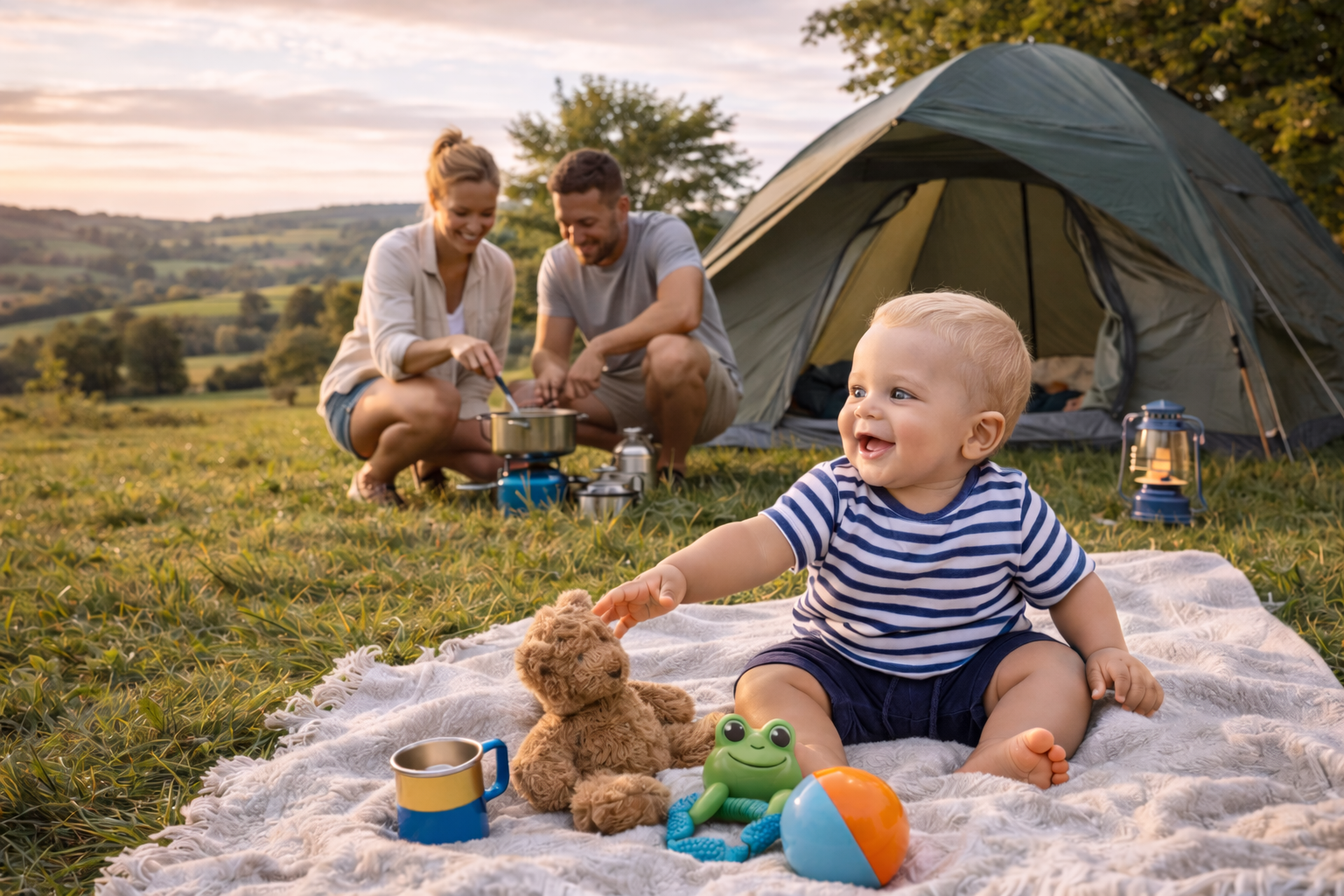
Camping vs Glamping: Where Should You Start?
The decision between traditional camping and glamping isn't just about preference — it can make the difference between a trip you love and one you spend swearing you'll never do again. Here's an honest breakdown of both.
Glamping: The Easier Option
Bell tents, shepherd's huts, yurts, and camping pods give you the outdoor experience without most of the outdoor hardship. The best glamping setups include a real bed (so you're not sleeping on a camping mat), heating or a wood burner for cold nights, and sometimes a private kitchen or bathroom. For a baby, this is significant.
Glamping works at almost any age from a few weeks old, because you're essentially staying in a quirky rural cottage that happens to be made of canvas. The main providers worth knowing in the UK are Feather Down Farms (luxury canvas lodges on working farms, multiple UK locations) and Canopy & Stars (a curated collection of unusual glamping stays around the country). Both are well suited to families with young babies.
Traditional Camping
Tent, sleeping bag, camp stove — the full experience. Completely doable with a baby, but it requires significantly more gear, more planning, and an acceptance that you'll spend more time on logistics than relaxing. You will be cold at least once. The camp stove will be slower than expected. Your baby will wake at 5am when the birds start.
And then your baby will watch the morning mist over a field while you make the first cup of tea of the day, and it will feel like one of the best moments of your parenting life. It's worth it — just go in with realistic expectations. Traditional camping is best suited to outdoor-experienced parents with babies of at least 4 months who are in a predictable enough routine to manage sleep in a new environment.
Keeping Baby Warm and Safe at Night
📋 Free Baby Holiday Packing Checklist
Enter your email and we'll send the free printable checklist straight to your inbox — every category, ready to tick off before every trip.
This is the most searched topic within camping with a baby, and rightly so. The cold is the biggest practical risk — not the tent itself, not the outdoors, but the temperature drop after dark that catches first-time camping parents off guard.
The Sleep Setup
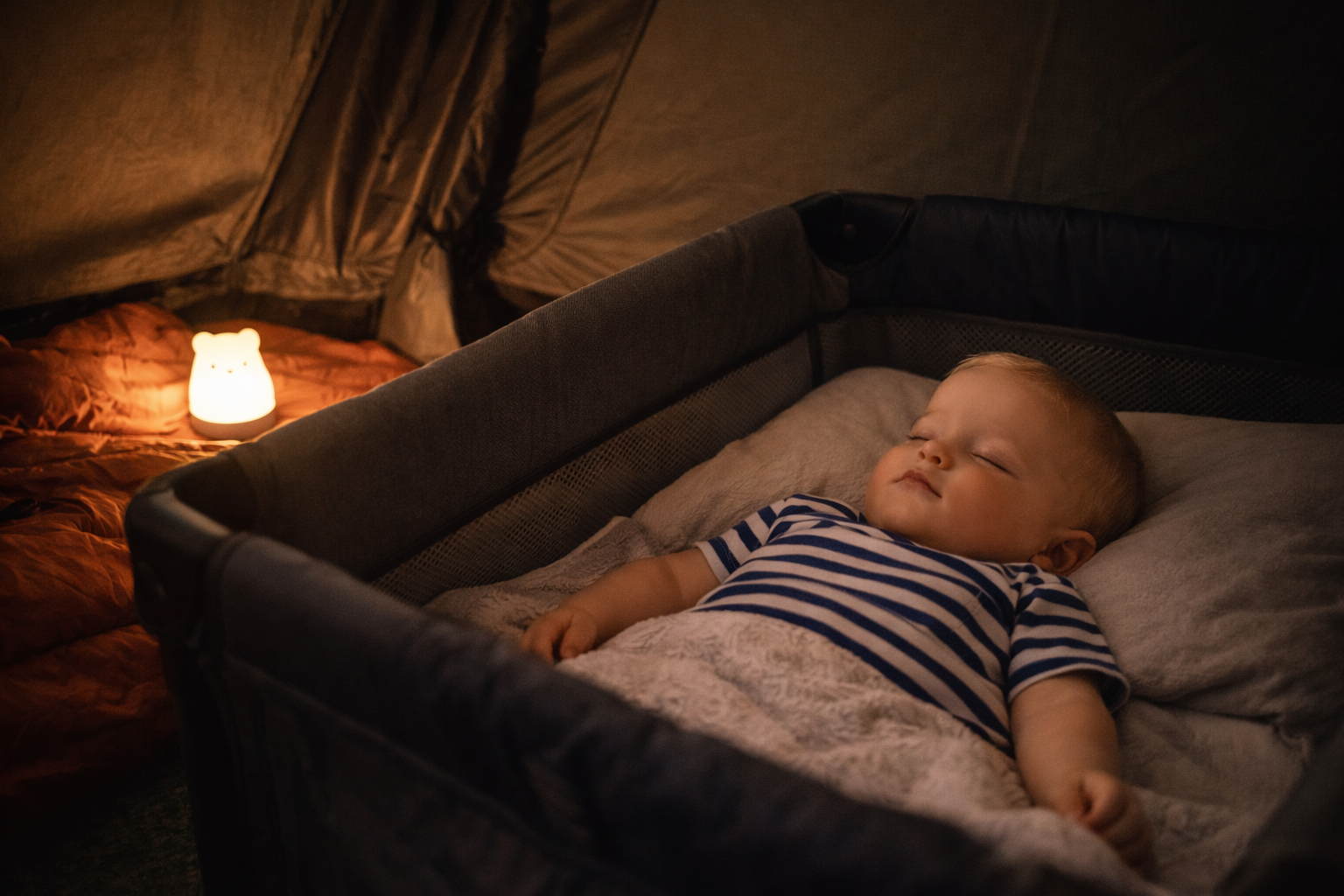
Always use a travel cot inside the tent — never put baby directly on the tent floor, which conducts cold from the ground. Place the cot on an insulation mat or folded blanket. If your baby is under 4–5 months and still in a carrycot, that works too. Use a fitted sheet and your baby's familiar sleeping bag — the smell of home in an unfamiliar environment is a genuine sleep aid.
Lullaby Trust safe sleep guidelines apply in tents exactly as they do at home: firm, flat surface, no loose bedding, feet to the bottom of the sleep space, no overheating. See our travel cot guide for specific recommendations on which cots pack small enough for camping.
Temperature Management
UK summer nights can drop to 5–10°C in rural areas — even in July and August. Use the tog guide below to select the right sleeping bag, and add merino wool base layers for extra warmth that won't overheat. Merino is the best fabric for this use case: it regulates temperature, wicks moisture, and doesn't irritate sensitive skin.
| Tog Rating | Temperature Range | When to Use |
|---|---|---|
| 1.0 tog | 18°C and above | Warm summer nights only |
| 2.5 tog | 12–18°C | Standard — covers most UK camping |
| 3.5 tog | Below 12°C | Cold nights, spring and autumn camping |
To check your baby's temperature at night, place your hand on their chest or back (not their hands or feet, which can feel cold even when they're warm enough). If their chest feels warm to the touch and they're settled, they're fine.
Important Safety Note
Never use hot water bottles, electric blankets, or loose blankets in a sleeping space with a baby. A correctly rated sleeping bag and appropriate base layers are the only safe way to manage temperature in a tent.

Tommee Tippee Grobag Dreamsack (3.5 Tog)
The go-to high-tog option for cold-night camping. The 3.5 tog rating handles UK spring and autumn camping temperatures with ease. Secure zip, generous sizing, and available from birth to 18–36 months. Around £25–£35.
Pros: Well-established brand, widely available, sized well for wriggling babies.
Cons: May be too warm for July heatwaves — check the forecast and pair with lighter base layers on warmer nights.
The Tent Setup
Position the travel cot away from the tent walls, where condensation collects overnight. Use a groundsheet and an insulation mat underneath the cot to prevent cold from travelling up from the ground. A portable nightlight is non-negotiable for night feeds in the dark — and a white noise machine helps mask the sounds of the campsite (other campers, wind, wildlife) that might otherwise disrupt sleep. The Dreamegg D11 is compact, USB rechargeable, and good enough to travel with year-round.
Essential Baby Camping Gear
Below is a comprehensive checklist of everything you'll realistically need. Cross-reference with our complete holiday packing list and our travel accessories guide for product links.
| Category | Item | Notes |
|---|---|---|
| Sleep | Travel cot | Raised off ground. See our travel cot guide |
| Sleep | High-tog sleeping bag (2.5–3.5 tog) | Match to expected overnight temperature |
| Sleep | Merino base layers (x2) | Regulates temperature, wicks moisture overnight |
| Sleep | Insulation mat | Goes under the travel cot — essential for cold ground |
| Sleep | Portable blackout blind | Dawn is early in summer — baby will wake with the light without one |
| Sleep | Portable nightlight | For midnight feeds in the dark |
| Sleep | White noise machine | Dreamegg D11 or similar — masks campsite sounds |
| Feeding | Portable highchair | Inglesina Fast Table Chair clips to picnic tables |
| Feeding | Insulated cool box | Keeps milk and weaning food cold |
| Feeding | Cold-water steriliser bags (Milton) | No microwave on site — cold water sterilisation only |
| Changing | Portable changing mat, nappies, wipes | Standard kit plus extra nappy bags |
| Getting around | Baby carrier | Better than a buggy on grass and uneven paths. See our carrier guide |
| Getting around | All-terrain buggy (optional) | Needs large wheels for camping terrain. See sturdy stroller guide |
| Clothing | Waterproof all-in-one | UK weather is unpredictable — wet grass is guaranteed |
| Clothing | Sun hat and warm hat | Be prepared for both in the same day |
| Safety | First aid kit | Include infant Calpol, thermometer, antiseptic, plasters |

Hippychick Waterproof All-in-One
Camping is wet — wet grass, muddy paths, unexpected drizzle. This all-in-one goes over normal clothes and is fully waterproof. Fits over a carrier harness, which is a bonus. Sizes from 6 months. Around £25–£35.
Pros: Fits over bulky clothing and carrier straps, durable waterproofing, easy to wipe clean.
Cons: Can feel restrictive in very warm weather — remove in sunshine.
Best UK Campsites for Families With Babies
Not all campsites are created equal when you have a baby in tow. These are some of the most well-regarded family options in the UK — each with specific reasons they work well at this stage.
Feather Down Farms (Multiple UK Locations)
The gold standard for family glamping. Feather Down's canvas lodges sit on working farms, sleep up to six, and come with a real bed, wood-burning stove, and basic kitchen. Baby-friendly by design — enclosed space, campfire for evening warmth, farm animals for entertainment. Typically around £700–£1,200 per week depending on location and season. Book via featherdown.co.uk.
Trevornick, Holywell Bay, Cornwall
One of Cornwall's most popular family campsites, with direct access to a quiet beach, a heated indoor swimming pool, and genuinely good facilities including clean shower blocks and a well-stocked shop. Pitches are well maintained and the staff are used to families. A solid choice for a first traditional camping experience.
Cotswold Farm Park Camping
Attached to Adam Henson's Cotswold Farm Park, this site combines camping with farm animals, flat terrain (useful with a buggy), and good on-site facilities. The baby-toddler crossover audience is well catered for. Ideal for families who want a gentle introduction to camping without remote isolation.
Kelling Heath, Norfolk
Set in heathland near the Norfolk coast, Kelling Heath offers camping, glamping pods, and holiday lodges all in one park. It's well suited to families who want flexibility — you can try a pod first time and graduate to pitching a tent on a return visit. Close to North Norfolk's excellent beaches and nature reserves.
Canopy & Stars Collection (Nationwide)
Rather than a single site, Canopy & Stars curates unusual glamping stays across the UK — from shepherd's huts in the Brecon Beacons to treehouses in Devon. Many properties specifically list family suitability. Prices vary widely; filter by 'cot available' when booking with a young baby.
Eweleaze Farm, Dorset
A seasonal cliff-top campsite with direct beach access, open only during August. Eweleaze is famously popular and books up within hours of opening — but if you can get a pitch, it's one of the most beautiful camping settings in England. The sea view from your tent is genuinely special. Facilities are simple but functional.
Practical Tips for First-Time Camping Parents
Do a Trial Run at Home
Set up your tent in the garden and have baby sleep in the travel cot inside it for one night. This achieves two things: you discover any gear issues before you're on-site, and your baby gets a first exposure to the canvas-muffled sounds of the outside world. It's much easier to troubleshoot in your own back garden than at a campsite three hours from home.
Arrive in Daylight
Pitching a tent with a baby in the dark is an exercise in low-level chaos. Aim to arrive at least three hours before sunset. This gives you time to set up properly, get the travel cot positioned, and locate the facilities before you need them at 2am.
Choose a Pitch Near the Facilities
Being 30 seconds from the shower block matters much more with a baby than it did before. A close pitch also means the walk back with a wriggling wet baby is short. It's worth asking the campsite when you book if they can accommodate this — most family sites will try.
Prepare a Night Box
A small crate or bag by the cot, containing everything you might need in the dark: 2 nappies, wipes, a spare onesie, a bottle or pre-measured formula, your nightlight, and nappy bags. When you're half asleep at 3am in a dark tent, you want everything in one place you can find by feel.
Food Prep Before You Leave
If your baby is weaning, batch cook and freeze meals at home. Transfer to the cool box on travel day; they'll defrost safely during the drive and can be warmed on the camp stove. Food pouches are a reliable backup for any meal. For managing feeds and routines away from home, our keeping the routine on holiday guide covers the full approach.
Our Tip
Lower your expectations for the first trip. Your first camping trip with a baby won't feel relaxing in the traditional sense — you'll be managing a lot. But it will be an adventure. Most parents who do it once go back the following year. Accept the chaos on trip one; enjoy the competence on trip two.
Camping vs Other UK Holiday Types
Not sure if camping is the right call for your family right now? This comparison covers how it stacks up against other popular UK options. See our detailed guides to baby-friendly cottages, Centre Parcs, Haven, and our full UK holiday guide for more.
| Feature | Camping | Glamping | Cottage | Holiday Park |
|---|---|---|---|---|
| Price | £ | ££ | ££–£££ | ££–£££ |
| Effort level | High | Medium | Low | Low |
| Nature immersion | Maximum | High | Medium | Low |
| Facilities | Basic | Moderate | Full | Full |
| Best baby age | 4+ months | Any age | Any age | Any age |
| Our verdict | For outdoor lovers | Best compromise | Easiest option | Most facilities |
✈️ Free Baby Hand Luggage Checklist
Never forget the essentials. Enter your email and we'll send the free checklist straight to your inbox — one page, every category, ready before every flight.
Frequently Asked Questions
What age can you take a baby camping?
For glamping, any age — the setup is more like a quirky cottage than outdoor sleeping. For traditional camping, most families wait until at least 3–4 months, when baby is in a more predictable routine and temperature management is slightly more straightforward. Premature babies or babies with health conditions should be cleared with a GP before any outdoor sleeping.
How do I keep my baby warm camping?
Use a high-tog sleeping bag rated for the expected overnight temperature (2.5 tog for most UK summer camping, 3.5 tog for spring, autumn, or cold nights). Layer merino base layers underneath. Place the travel cot on an insulation mat, away from tent walls. Check temperature at the chest, not the hands or feet.
Is glamping easier than camping with a baby?
Significantly. Glamping accommodation typically includes a real bed, heating, and a basic kitchen — which removes the three hardest parts of camping with a baby. If you're new to camping or have a young baby, glamping is the right starting point. You can always graduate to traditional camping later.
What do I need for camping with a baby?
The non-negotiables: travel cot, high-tog sleeping bag, insulation mat, portable nightlight, nappies and wipes, feeding equipment, baby carrier, and a first aid kit. The full camping gear checklist above covers everything else. A good cool box is also essential once weaning begins.
Can a baby sleep in a tent safely?
Yes, provided you follow safe sleep guidelines. Use a travel cot raised from the ground, with a fitted sheet and correctly rated sleeping bag. No loose blankets, no overheating, firm flat surface, feet at the bottom. The Lullaby Trust safe sleep guidance applies in tents exactly as it does at home.
What are the best UK campsites for babies?
For glamping: Feather Down Farms and Canopy & Stars are the best-known options. For traditional camping: Trevornick in Cornwall, Kelling Heath in Norfolk, and Cotswold Farm Park are popular with young families. The key is choosing a site with good facilities — clean shower blocks and a shop matter far more with a baby than scenic location alone.
Should I do a practice night before camping with a baby?
Yes, absolutely. A garden trial run — tent up, travel cot inside, baby sleeping in it — will surface any gear problems and get your baby familiar with the feel and sound of a tent. It's much easier to fix issues at home than three hours into a campsite drive.
Is camping with a baby worth the effort?
If you love the outdoors, yes. It's an adventure rather than a relaxation exercise — especially the first time. But there's something genuinely special about being outdoors as a family, and most parents who try it come back for more. Start with glamping or a well-facilitated family campsite rather than remote wild camping, and go in prepared for a few logistics challenges.
Ready to Go?
Camping with a baby takes more kit and more patience than most other holidays — but it also delivers experiences that a hotel room or a holiday lodge simply can't. Fresh air, open skies, and watching your baby discover the world from a blanket on the grass is worth the effort of the packing list. If you're not sure where to start, glamping is always the right first step.
For a broader look at UK family holiday options, see our UK baby-friendly holidays guide. For the complete first-trip planning checklist, see our first holiday with a baby guide.