
How to Baby-Proof a Holiday Cottage: The 10-Minute Checklist
By BabyTravel UK Editorial Team · Last updated August 2026
You've arrived. The baby is in the carrier or on the back seat. The boot is loaded with more kit than you've ever taken anywhere in your life. You open the cottage door, and within about 90 seconds your crawling baby has identified the fireplace, the staircase, and the decorative bowl of river stones on the coffee table. Welcome to holiday baby-proofing.
You can't transform a rental into a home. That's not the goal here. The goal is to do a fast, effective sweep in the first 10 minutes — before anyone unpacks, before the kettle goes on — and neutralise the main hazards. Everything else is supervision.
The 10-Minute Baby-Proofing Sweep: Key Points
- 🏠 Do it first: Before unpacking, before the kettle — sweep the whole property on arrival
- ⚠️ Biggest hazards: Open water in garden, unguarded stairs, low cleaning products, open fireplaces
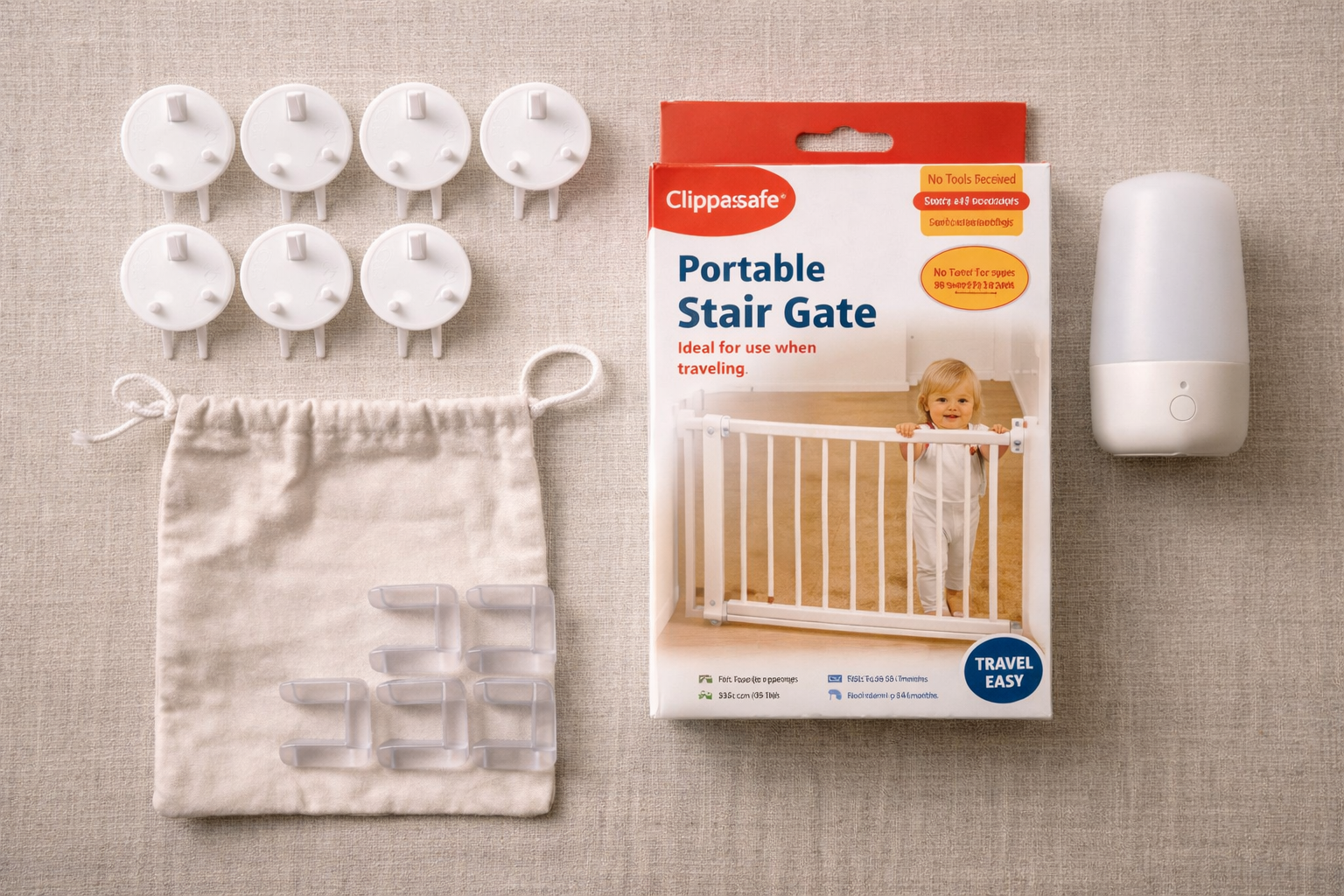
- 🧰 Pack a small kit: Socket covers, portable stair gate, nightlight, door wedge
- 📋 Note down: The cottage address/postcode, nearest A&E, and where the fuse box is
- 👁️ Remember: Baby-proofing buys you reaction time — supervision is the real safety tool
The 10-Minute Arrival Sweep
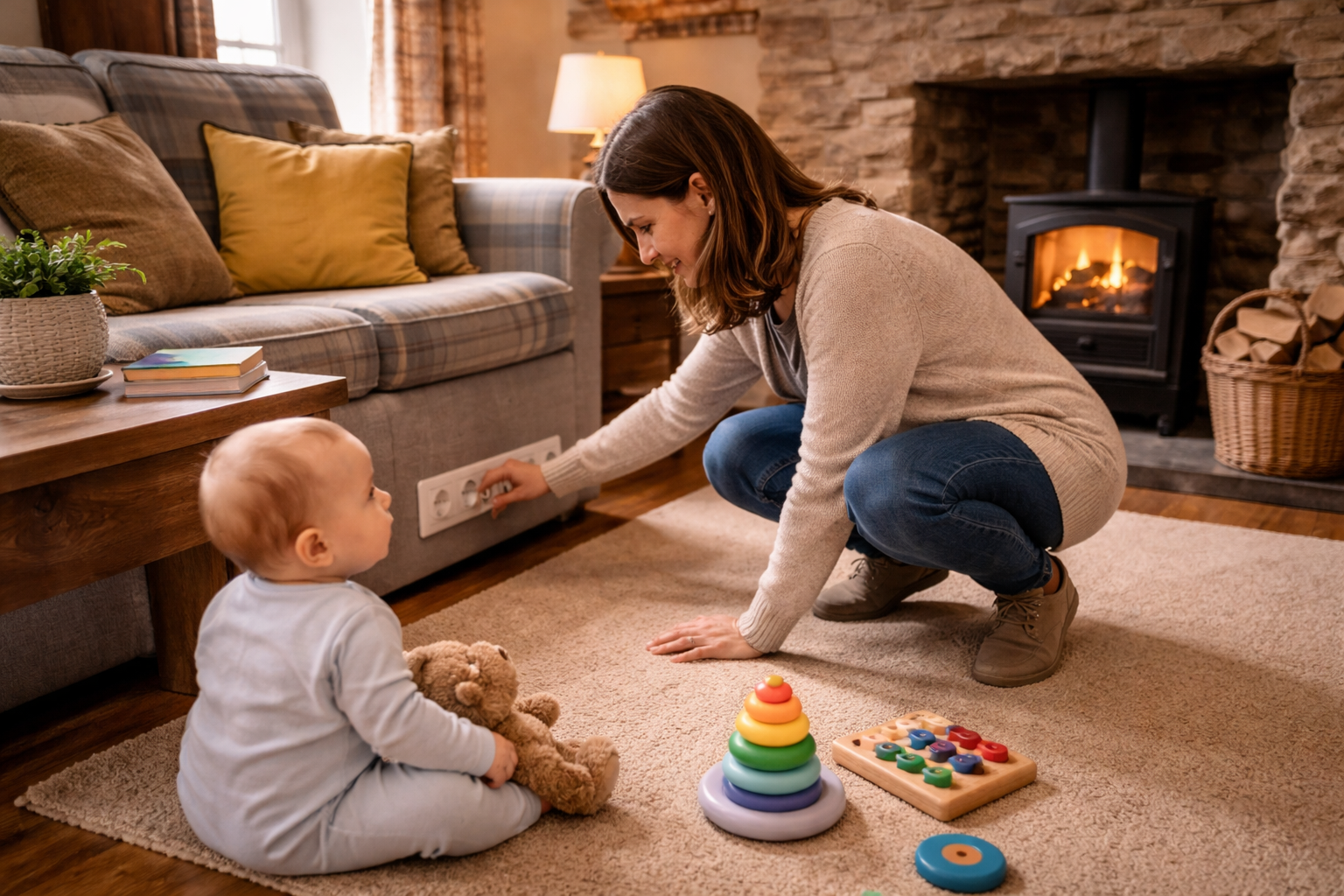
The moment you walk through the door, before the luggage comes in, one parent does the sweep while the other manages the baby. It takes about ten minutes if you're systematic. The brief below tells you exactly what to look for in each room.
You're not baby-proofing like you would at home. You're doing a risk triage — identifying the things that could seriously hurt your baby quickly, and dealing with those first. Everything else can wait or be managed through supervision.
For a systematic approach, our Arrival Sweep Baby-Proofing Navigator gives you a printable room-by-room checklist you can work through in the first 10 minutes after arriving — £4.99 as an instant download.
Room-by-Room Checklist
📋 Free Baby Holiday Packing Checklist
Enter your email and we'll send the free printable checklist straight to your inbox — every category, ready to tick off before every trip.
| Room | Hazard | Action | Time to Fix |
|---|---|---|---|
| Living room | Plug sockets at crawling height | Insert portable socket covers (pack of 12 in your kit bag) | 2 min |
| Living room | Open or unguarded fireplace | Block access with furniture pushed across the front; keep it blocked whenever baby is in the room | 1 min |
| Living room | Loose rugs on hard floors | Roll up and move to another room; a loose rug is a guaranteed trip hazard once baby is pulling up | 1 min |
| Living room | Decorative ornaments and fragile items at low level | Move to high shelves or another room — no need to ask permission, just replace them on departure | 2 min |
| Living room | Sharp-cornered glass coffee table | Drape a folded towel over sharp corners, or move the table to the side of the room | 1 min |
| Kitchen | Cleaning products in low cupboards | Move everything — bleach, dishwasher tablets, washing liquid — to the highest shelf or on top of a unit | 2 min |
| Kitchen | Low bin access | Move bin inside a high cupboard or on the worktop; babies find bins irresistible | 30 sec |
| Kitchen | Fridge magnets at baby height | Remove and store — small magnets are a choking hazard | 30 sec |
| Bedrooms | Windows that open wide (upstairs) | Check that window restrictors are fitted or that windows don't open wide enough for a baby to fall through; if not, keep windows closed | 2 min |
| Bedrooms | Curtain and blind cords | Tie up out of reach or wind around the bracket — cord strangulation is a real and documented risk | 1 min |
| Bedrooms | Small objects on bedside tables | Coins, glasses cases, medication — move to the top of a wardrobe | 1 min |
| Bathroom | Toiletries and medicines | Clear everything from low shelves into a bag and store on the highest shelf or in a locked cabinet if available | 2 min |
| Bathroom | Hot bath taps | Test bath tap temperature before bathing baby — some cottage boilers run very hot; always run cold first and mix carefully | 30 sec |
| Stairs | Unguarded staircase | Fit your portable pressure-fit gate at the bottom; use furniture to block the top if needed until the gate is positioned | 5 min |
| Garden | Open water — pond, stream, water feature | This is your most serious outdoor hazard. Block garden door access entirely, or ensure constant supervision whenever baby is outside | 1 min to block |
| Garden | Gaps in fence or garden boundary | Walk the perimeter. If gaps exist and you can't block them, supervise all outdoor time — don't assume the garden is enclosed | 3 min check |
| Everywhere | Fuse box location unknown | Find it and note the location. Also note the first aid kit if the cottage has one. | 1 min |
The Two Products Worth Packing Every Trip
Most packing lists focus on what the baby needs day-to-day. These two items are specifically for making an unfamiliar property safe — and both are small enough that there's no reason not to bring them every time.

Lindam Portable Pressure Fit Gate — For Cottages With Stairs
No drilling required | Fits most doorways | Around £25–£35
Most holiday cottages have stairs. Many have no gate at the bottom. This is the gap this gate fills — it installs with pressure fit in under five minutes, requires no tools, and doesn't leave any marks on the doorframe. Compact enough to stand upright in the boot alongside your travel cot. Worth bringing on every cottage trip from the moment your baby starts crawling.
- ✅ Pressure fit — no drilling, no wall damage, no tools needed
- ✅ Adjustable width to fit most standard doorways
- ✅ One-hand operation once installed
- ❌ Not suitable for the top of stairs — pressure fit gates are bottom-of-stairs only
- ❌ Won't fit unusually narrow or wide door frames without additional adaptor

VTech DM1211 Audio Baby Monitor — For Thick Cottage Walls
DECT digital | 300m range | No Wi-Fi needed | Around £30–£40
Old stone cottage walls play havoc with Wi-Fi, which means smart monitor apps frequently drop signal — exactly when you need them most. The DM1211 uses DECT digital radio rather than Wi-Fi, giving a reliable 300m range that cuts straight through thick walls. A dedicated parent unit means no phone dependency and no Wi-Fi required. The temperature display on the parent unit is genuinely useful overnight.
- ✅ DECT signal — works through thick stone walls where Wi-Fi fails
- ✅ Up to 300m range — reliable in large cottage layouts
- ✅ Temperature display on parent unit
- ✅ Two-way talk — settle baby without going upstairs
- ❌ Audio only — no video feed
- ❌ Parent unit needs charging separately
What to Bring: Your Baby-Proofing Travel Kit
This kit lives in a small zip bag in the boot and comes on every trip. Total weight: under 500g. Total cost to assemble: around £35–£50 depending on whether you already have a gate.
| Item | Why You Need It | Approx. Cost |
|---|---|---|
| Portable socket covers (pack of 12) | Covers all accessible sockets on arrival; standard UK plugs fit standard covers | £3–£5 |
| Portable pressure-fit stair gate | Blocks stair access without drilling; essential from crawling onwards | £25–£35 |
| Plug-in nightlight | For navigating an unfamiliar cottage layout at 3am without waking anyone up | £5–£10 |
| Door wedge | Props doors open (so baby can't get fingers trapped) or holds them shut (to block room access) | £2–£3 |
| Baby monitor (DECT) | Reliable signal in stone-walled cottages where Wi-Fi monitors fail | £30–£40 |
What About Corner Protectors and Cabinet Locks?
You'll see baby-proofing kits that include corner protectors for furniture, cabinet locks, and door slam stoppers. For a short holiday stay, most parents find these unnecessary and fiddly. The goal is removing the biggest risks, not replicating every safeguard from home.
The exception is if your baby is particularly persistent around a specific hazard — a sharp-cornered stone hearth, say, or a kitchen unit with a gas cleaning product. In that case, a temporary fix (a rolled towel wedged against the hearth, a chair pushed in front of the unit) is quicker and more effective than trying to install a proper lock on a rental cabinet.
For more on keeping sleep safe in an unfamiliar environment, see our travel cots and sleep solutions hub and the routine guide for keeping bedtime consistent away from home.
Talking to the Cottage Owner
Many family-friendly cottage owners will add a stair gate, remove hazardous ornaments, or check plug sockets if you ask ahead of arrival. It's always worth emailing or messaging a few days before. But don't depend on it being done, and don't skip your own sweep if it is. Your standard for "safe enough" may differ from theirs, and that's fine — you know your baby, they don't.
The same principle applies to Airbnb and self-catering rentals more generally: guest descriptions like "family friendly" often mean "we have a highchair," not "we have addressed every crawling-baby hazard." Be pleasantly surprised if the place is well done; never assume it is.
The Perspective Check
You can't make a holiday cottage as safe as your home. After three years of living there, you know every hazard in your own house and have addressed them one by one. You've been in this cottage for ten minutes.
The point of this sweep is to get the serious risks — open water, unguarded stairs, accessible poisons — under control quickly. After that, active supervision is your main safeguard. A toddler who moves constantly can find hazards faster than any parent can pre-empt them. The baby-proofing just gives you a few extra seconds of reaction time. That's all it is, and it's enough.
For further guidance on keeping children safe in holiday environments, RoSPA's home safety guidance and the Child Accident Prevention Trust are both excellent resources. The NHS baby safety guide covers the principles that apply anywhere your baby sleeps or plays.
✈️ Free Baby Hand Luggage Checklist
Never forget the essentials. Enter your email and we'll send the free checklist straight to your inbox — one page, every category, ready before every flight.
Frequently Asked Questions
How do you baby-proof a holiday cottage?
Do a quick room-by-room sweep within the first 10 minutes of arriving. Move cleaning products and medicines to high shelves, cover accessible plug sockets, check for open fireplaces, test window locks, and block or gate any stairs. The goal isn't to replicate your home — it's to remove the most serious hazards quickly so you can relax.
What should I pack for baby-proofing a holiday cottage?
A small kit covers most situations: a pack of portable socket covers, a portable pressure-fit stair gate if your baby is crawling or walking, a nightlight for navigating at night, and a door wedge. The whole kit weighs almost nothing and fits in a small bag — see the table above for the full list.
What are the biggest hazards in a holiday cottage for babies?
The most serious are: open water in the garden (ponds, streams), open or unguarded fireplaces, staircases without gates, and cleaning products in low cupboards. After those, loose rugs on hard floors, accessible plug sockets, and upper-floor windows that open wide are the most common risks to address.
Should I ask the cottage owner to baby-proof before I arrive?
It's worth asking — many owners will accommodate reasonable requests. But always do your own sweep on arrival regardless of what was promised. Their definition of baby-safe and yours may not match. Bring your own kit so you're never dependent on what's provided.
Is a holiday cottage or a hotel safer for a crawling baby?
Hotels tend to have simpler layouts with fewer hazards — no garden, no stairs in the room, minimal ornaments. Cottages give you more space but require more active baby-proofing. Neither is inherently safer — it depends on the specific property and how thoroughly you assess it on arrival.
Do I need to bring a stair gate for a holiday cottage?
If your baby is crawling or walking and stairs are at all possible, yes. Many cottages have stairs and no gate at the bottom. A portable pressure-fit gate takes five minutes to install without any tools, takes up minimal space in the boot, and is worth bringing as standard from around eight months onwards.
What should I check about the garden of a holiday cottage?
Four things: is it enclosed, is there open water, are there poisonous plants, and is there animal mess nearby? Open water — ponds and streams — is the single most serious outdoor hazard for young children. If the garden isn't securely enclosed, supervise every outdoor moment rather than assuming containment.
How do I manage a baby monitor in a holiday cottage?
Old stone cottage walls can block Wi-Fi signals that smart monitors rely on. A DECT audio monitor with a dedicated parent unit — like the VTech DM1211 above — is more reliable in rural and older properties. Check the signal before you need it rather than discovering it doesn't reach on the first night.
The Bottom Line
Ten minutes on arrival, a small kit in the boot, and the understanding that supervision beats perfection. That's holiday baby-proofing. The first holiday is always the most daunting — by the third cottage stay you'll do the sweep on autopilot, and the kit will be the thing you're most glad you packed.