
How to Entertain a Baby on a Long Car Journey (What Actually Works)
By BabyTravel UK Editorial Team · Last updated August 2026
A 4-hour drive with a baby doesn't have to be the ordeal it sounds. The right timing, the right toys, and knowing what not to do makes an enormous difference — here's what actually works.
Long car journeys with a baby sit somewhere between "absolutely fine" and "genuinely difficult" depending on a handful of factors — most of which you can control. The age of your baby matters. The time of day you leave matters a lot. Whether you have a second adult in the back matters enormously. And the difference between a bag of well-chosen toys and a bag of the wrong toys is about 90 minutes of relative peace versus a screaming back seat.
This guide is specifically about entertainment and distraction strategies — what to bring, when to leave, and what to do when nothing is working. For the broader picture of driving on holiday with a baby, our car travel and road trips guide covers logistics, car seat rules, and route planning. For packing everything else, the baby holiday packing list has you covered.
Quick Answer: Keeping Baby Happy in the Car
- ⏰ Timing is everything — driving during a nap window is worth more than any toy.
- 🧑 Rear-seat adult — if there are two of you, one sits in the back. Game-changer.
- 🛑 Break every 90 minutes to 2 hours — not optional for safety or sanity.
- 🪀 Novel toys work — save specific toys only for car journeys so they feel new.
- 🍌 Snacks (6m+) for the last third — deploy when patience is running thin.
- 🎵 White noise or nursery rhymes through the car speakers work surprisingly well.
The 2-Hour Car Seat Rule
Before we get into entertainment strategies, this matters: babies should not spend more than 2 hours continuously in a car seat. This is a safety guideline, not a suggestion. Infant car seats (particularly those in the lying-flat or semi-reclined position) can restrict a young baby's airway if they slump forward while asleep, and prolonged time in a seat puts pressure on a developing spine. NHS guidance recommends breaks every 30 minutes for very young babies (under 4 weeks); for older babies, aim to stop every 90 minutes to 2 hours.
Build this into your journey plan — not as an inconvenience, but as a fixed part of the route. A 4-hour drive becomes two 2-hour legs with a proper break in the middle. That structure makes the whole thing more manageable for everyone.
Timing Your Journey: The Single Biggest Strategy
No toy on the market is as effective as a sleeping baby. Timing your departure around your baby's sleep schedule is the highest-leverage thing you can do for a long car journey — by a significant margin.
| Departure Time | Baby State | Journey Experience | Best For |
|---|---|---|---|
| 5–6am | Drowsy / just woken, happy to go back to sleep | Often very smooth — baby sleeps for first leg | Long journeys (4h+), early risers |
| After morning nap | Alert, fed, rested — good mood window | Solid 60–90 mins of engagement before lunch nap | Shorter journeys (2–3h) |
| After lunch (12–1pm) | Fed, heading toward afternoon nap | ⭐ Often the golden window — long nap in the car | Medium journeys (3–4h), all ages |
| Evening (after bedtime) | Sleepy or already asleep when placed in seat | Adults arrive tired but baby arrives calm | Long journeys with two adults; older babies |
| Mid-morning (9–11am) | Alert, nap has happened or is overdue | Variable — works well or badly depending on timing | Avoid on the M25 on a Friday |
| Late afternoon | Tired, overtired, approaching witching hour | Often the most difficult window | Avoid where possible |
The post-lunch departure is consistently the most reliable for parents with babies on two naps. Feed them, let them have 15 minutes of floor time, strap them in, and go. Many babies will be asleep within 20 minutes of leaving and stay that way for 90 minutes to 2 hours — which covers the hardest part of most journeys.
The Rear-Seat Adult
📋 Free Baby Holiday Packing Checklist
Enter your email and we'll send the free printable checklist straight to your inbox — every category, ready to tick off before every trip.
If there are two adults on the journey, one sits in the back. This is the single most effective entertainment strategy available, and no product can replicate it. A parent next to the car seat can offer toys the moment they lose interest in the previous one, catch dropped items before they disappear into the footwell, spot grumbling before it becomes screaming, and provide the kind of face-to-face interaction that babies fundamentally need. The driver can focus on driving. Everyone is calmer.
If you're a solo parent driving, the approach shifts: everything needs to be set up before you leave, accessible without you turning around, and self-sufficient. The toy clips, the mirror, the pre-loaded snack cup — these are what the solo parent relies on. A hands-free playlist through the car speakers is also more important when you're the only adult.
Best Toys for the Car Seat: What Actually Works
The key principle: novelty. A toy your baby has seen every day for two months will buy you about 90 seconds. A toy they've never seen — or one you save specifically for the car — will buy you significantly more. Rotate your car toys. Keep a small dedicated bag that only comes out on journeys.
For quick, low-mess ideas you can pull out at a moment's notice, our Busy Bag 5-Minute Challenge Cards give you printable activity prompts designed for flights, queues, and restaurant waits — £4.99 as an instant download.
Car Seat Activity Arch / Toy Bar
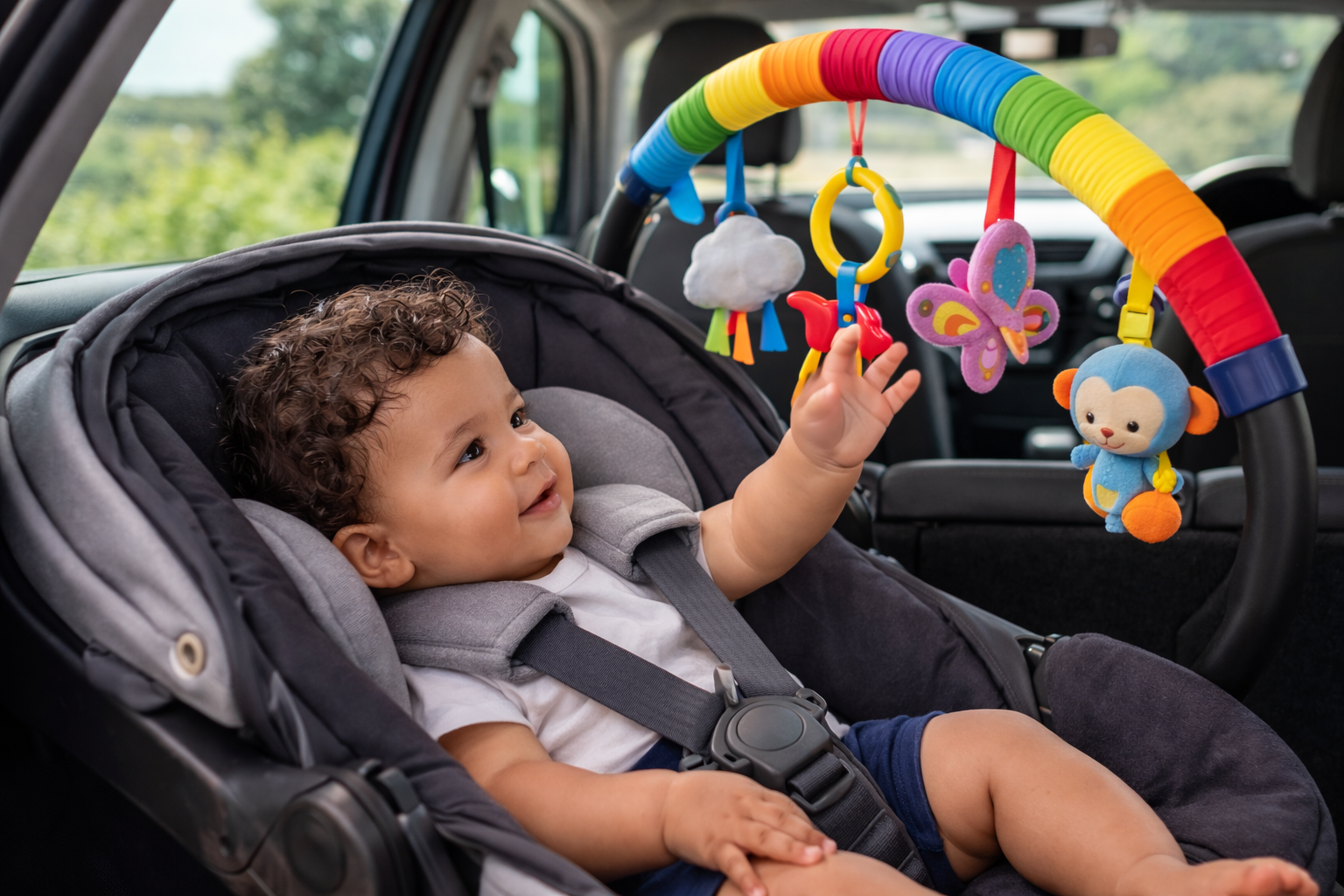
For babies under 6 months who are still in a rear-facing infant carrier, a toy arch that clips onto the handle is one of the most useful car accessories you can buy. It puts hanging toys within reach of small hands and feet without requiring any adult intervention — which matters enormously when you're driving alone. Look for one with a mix of textures, a crinkle element, and a mirror. The best ones detach easily so the toys can be used elsewhere too.

Car Seat Activity Arch / Toy Bar
Clips onto the handle of a rear-facing infant carrier and puts hanging toys within reach of small hands and feet — no adult input required, which matters enormously when you're the one driving. Look for a mix of textures, a crinkle element, and a small mirror on the toys. The best ones detach easily for use at home too.
- ✅ Keeps little hands occupied without needing a rear-seat adult
- ✅ Attaches to most infant carrier handles — no tools required
- ✅ Multiple textures and sounds for sensory engagement
- ❌ Best for 0–6 months — older babies lose interest as mobility increases
Suction Cup Window Toys
These attach to the car window beside your baby's seat and provide visual stimulation for the journey. At around 4–5 months, when babies are tracking movement and colour with increasing interest, a high-contrast spinning toy stuck to the window at the right height can hold attention for a surprisingly long time. They're lightweight, cheap, and transferable between cars. Worth having two or three different ones to rotate.
Crinkle Books and Soft Texture Books
Fabric books with different textures, crinkle panels, and squeakers are ideal car toys from around 3 months. They're safe if dropped on a baby's face (unlike board books), they make satisfying sounds when grabbed and scrunched, and they don't roll under the seat. They're the kind of thing that occupies little hands for 10–15 minutes — which on a long journey is precious. Clip a carabiner through the cover ring so it stays within reach rather than getting lost in the seat gap.
Teething Toys on Clip Straps
From around 4 months, teething toys go everywhere a baby goes — including the car. The problem in a car seat is that dropped toys disappear into the footwell black hole and cannot be retrieved while the car is moving. Solve this with a toy clip strap: a short elasticated or fabric strap with clips at each end that attaches the toy to the car seat harness or your baby's clothing. They're inexpensive, essential, and save enormous frustration. Buy three.
The Rear-Facing Baby Mirror
For rear-facing babies, a mirror that clips to the rear headrest and faces your baby is one of the most underrated car accessories available. Babies are endlessly fascinated by their own reflection — it provides stimulation that requires no input from an adult, and it lets the driver see their baby in the rear-view mirror without turning around. That second benefit reduces parental anxiety on long journeys significantly.

Baby Rear View Car Mirror
Clips to the rear headrest and angles toward your rear-facing baby so they can see themselves (babies find their own reflection endlessly interesting) and, crucially, so you can see them in your rear-view mirror without turning around. Reduces driver anxiety, provides passive stimulation, and takes about 30 seconds to install. One of the most underrated car accessories for new parents.
- ✅ Wide-angle mirror — clear view from the driver's seat
- ✅ Clips securely to most headrests — no tools or fittings
- ✅ Provides passive stimulation without any adult input
- ❌ Only useful while baby is rear-facing — typically birth to 12–15 months
Music and White Noise Through the Car Speakers
Don't underestimate this one. A playlist of familiar nursery rhymes — the ones your baby hears at home — provides consistent audio comfort throughout the journey. White noise works particularly well for younger babies and can help settle a drowsy baby into a nap. The Dreamegg D11 white noise machine is portable and can be mounted or placed near the car seat if you prefer a dedicated device to the car speakers. Spotify has good pre-made nursery rhyme and baby sleep playlists that cost nothing extra.
Entertainment by Age: What Works at Each Stage
| Age | What Works | What Doesn't | Biggest Challenge |
|---|---|---|---|
| 0–3 months | White noise, nursery rhymes, movement of the car, rear-facing mirror, timing = sleeping | Complex toys — vision isn't developed enough | Hunger — can't delay feeds; feeds stop the journey |
| 3–6 months | Toy arch, crinkle books, high-contrast window toys, music, mirror | Anything that requires independent sitting or two hands | Short attention span — novelty wears off fast |
| 6–12 months | Snacks (game-changer), soft stacking cups, teethers, songs, rear-seat adult, finger foods | Restraint — they want to move and the car seat prevents it | Wanting to crawl, lunge, and grab; can't be still |
| 12–18 months | Window watching (movement and vehicles), familiar songs sung by adults, snacks, rear-seat adult, short audiobook/song CDs | Screens before 18 months — limited value and not recommended | Wanting to walk; understanding they're trapped; genuine frustration |
The Snack Strategy (6 Months+)
Once your baby is on solids, snacks become your most powerful tool in the car — but deploy them strategically, not immediately. If you give snacks at the start of the journey, you've used your best resource too early. Save them for the last third when patience is wearing thin and the novelty of every toy has been exhausted.
The best car snacks are things that take time to eat, don't crumble catastrophically, and can be handed back from the front seat without looking. Rice cakes, breadsticks, soft fruit in a mesh feeder, banana (peeled and handed directly), and fruit pouches with spout tops all work well. Pre-load a snack cup before you leave and wedge it somewhere accessible from the front seat. When the back seat starts getting restless, deploy it — and buy yourself another 20 minutes of peace.
Don't give snacks that are choking hazards in a moving car. Grapes, whole nuts, chunks of hard vegetable — anything that might dislodge and require immediate adult intervention while you're doing 70mph on a motorway. Stick to things that dissolve or compress easily.
Motorway Service Station Survival
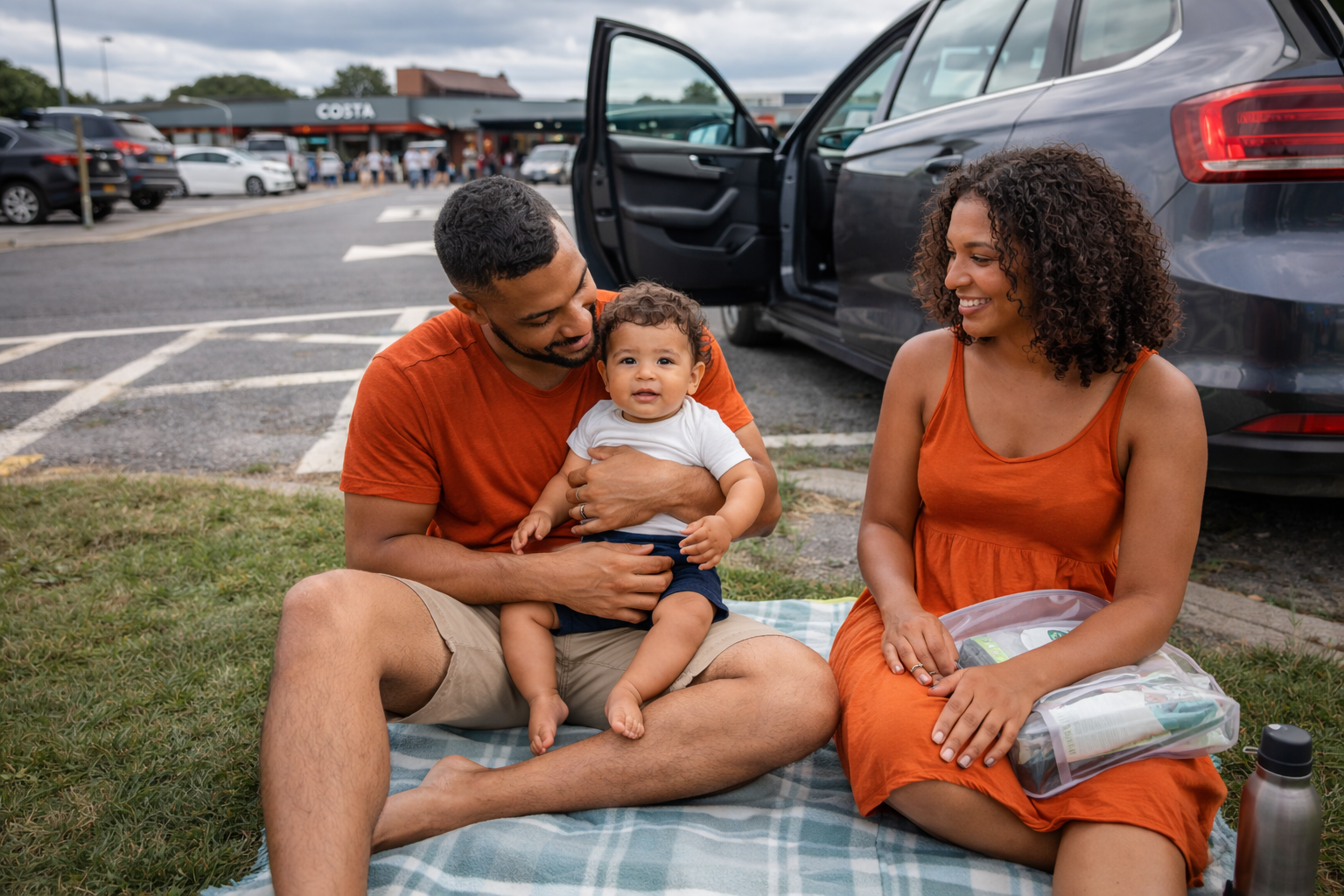
A good stop is worth 15 minutes of your journey time and buys far more than 15 minutes of calm on the next leg. The formula: feed if due, change if needed, and then give baby 5–10 minutes out of the car seat on a blanket on the grass (most services have a small grassy area — find it). Kicking their legs freely and having the physical sensation of not being strapped in resets them more effectively than any toy.
On cleanliness: Waitrose-branded motorway services (generally on the M40 and M1) consistently have the best baby-changing facilities — clean, well-stocked, and with adequate changing space. Moto services are variable but generally acceptable. Extra MSA services tend to be reliably clean. If you're planning a specific route, it's worth checking reviews of the services on your road beforehand.
Keep your stop bag accessible from the driver's seat — change bag, blanket, snacks, a fresh top for baby (and one for you, because it will be needed eventually). Don't put it in the boot where you'll have to get out and rummage while holding a baby in a car park.
What NOT to Do
- Don't hand back hard toys — anything rigid (board books, hard plastic toys) becomes a projectile in a sudden stop. Stick to soft toys, fabric books, and silicone teethers in the car.
- Don't try screens before 12–18 months — babies under 12 months can't focus effectively at screen distance in a moving vehicle. A tablet propped in front of a 5-month-old in a car seat is not doing what you think it's doing. Save that for later.
- Don't ignore escalating crying — it rarely gets better on its own. Early whimpering addressed quickly (a toy, a song, a snack) stays manageable. Ignored, it becomes a full meltdown that's impossible to reverse while driving.
- Don't keep driving through a full meltdown — see below.
The Emergency Meltdown Protocol
Sometimes, everything fails. The timing was wrong, the toys are all exhausted, the snacks are gone, and your baby is screaming with the full force of their tiny lungs. This is not a parenting failure. It is a baby in distress who needs to be out of the car seat.
The protocol: signal, pull over at the next safe point — a layby, a service station, a petrol station. Get out. Take baby out of the car seat. Hold them. Let them calm down. This takes about 10–15 minutes. Then, when they're settled, feed if due, change if needed, return to the seat, and continue.
Trying to drive through a full baby meltdown is genuinely dangerous. It is distracting in the way that handling a phone is distracting. The 15 minutes you spend pulling over and resetting is far less risky — and far less stressful — than pushing on and hoping it stops. It rarely stops.
⚠️ One More Thing
Check baby's harness every time you put them back in after a stop — it's easy to clip it looser than intended when you're rushing in a car park. The harness should be snug enough that you can't pinch any slack at the shoulder. A quick check takes five seconds and matters more than leaving two minutes earlier.
✈️ Free Baby Hand Luggage Checklist
Never forget the essentials. Enter your email and we'll send the free checklist straight to your inbox — one page, every category, ready before every flight.
FAQ: Entertaining a Baby in the Car
How long can a baby be in a car seat on a long journey?
No more than 2 hours continuously — this is NHS and RoSPA guidance for most babies, and even shorter (30-minute breaks) for newborns under 4 weeks. Plan your route with scheduled stops every 90 minutes to 2 hours. This isn't just about entertainment — it's a safety guideline related to infant airway positioning in a semi-reclined seat.
What's the best time to leave for a long car journey with a baby?
After lunch (around 12–1pm) is consistently the most reliable departure window. Most babies are heading into their afternoon nap, which means you cover the first 1.5–2 hours of the journey while they sleep. Early morning departures (5–6am) also work well. Avoid late afternoons, which tend to coincide with the witching hour and tired, overstimulated babies.
What toys are safe for babies in car seats?
Soft toys, fabric books, silicone teethers on clip straps, and toy arches that attach to the car seat handle are all safe. Avoid hard plastic or board items that become projectiles in a sudden stop. Clip or strap toys to the harness so they don't fall out of reach. For young babies, a rear-facing mirror provides stimulation without any toy at all.
Can I give my baby a screen in the car?
Most guidelines recommend no screens before 18 months, and for babies under 12 months they're largely ineffective in the car anyway — the focal distance, the movement, and the developmental stage all combine to mean a baby isn't really engaging with a tablet the way an older toddler would. White noise and nursery rhymes through the car speakers are more effective for young babies.
My baby hates the car seat — what can I do?
Some babies genuinely dislike car seats regardless of what you do, usually because they want to move freely and the harness prevents it. Short of time and practice building familiarity, the most reliable strategies are: timing the journey around a nap, having an adult in the back seat, and keeping journeys short until around 4–5 months when attention span and tolerance improve. Check that the harness isn't too tight and that the recline angle is correct for the baby's age and weight.
What are the best service stations for baby changing on UK motorways?
Waitrose-branded services (on the M40 and M1 among others) are consistently rated highest for cleanliness and facilities. Moto and Extra MSA services are generally adequate. The RNID and Which? consumer reviews of motorway services are worth checking for your specific route before you travel.
Is white noise safe in the car for a baby?
Yes, at a sensible volume — around 50–60 decibels, which is roughly the level of a calm conversation. The engine noise of a moving car is already around 65–70 decibels, so white noise played through the car speakers at a moderate volume is not adding significantly to what the baby already hears. Many parents find a dedicated portable white noise machine near the car seat works better than the car speakers for direction and consistency.
Does my baby need to come out of the car seat at a motorway stop?
Yes — if the stop is more than a very brief fuel stop, take baby out of the seat. Even 5–10 minutes on a blanket on the grass, kicking their legs and being held upright, gives their spine and airways a break from the semi-reclined position and resets their tolerance for the next leg. It's the most effective use of a 15-minute stop.
Planning a long drive to your holiday destination? Our car travel and road trips guide covers route planning, rest stops, and what to do if things go wrong. Our Devon guide, Cornwall guide, Lake District guide, and Snowdonia guide all involve a decent drive from most of England — the entertainment strategies in this guide will serve you well for any of them.