
Best Pushchair and Stroller Travel Bags for Flights (UK 2026)
By BabyTravel UK Editorial Team · Last updated November 2026
For a double pushchair, start with the Bramble XL. For a slim umbrella-fold buggy, look at Huckaboo. If you only fly occasionally and want a cover to keep the buggy clean in the hold, the bright red J.L. Childress is a simpler buy. Measure the pushchair folded, including wheels and handles, before ordering any of them.
A gate-check bag protects the pushchair from grime and scuffs. It doesn't make a pushchair cabin-approved. If you want to take it on board, check the outside measurements of the packed bag against your airline's cabin stroller limits as well as any allowance that applies to your booking.
Compare pushchair travel bags for flying
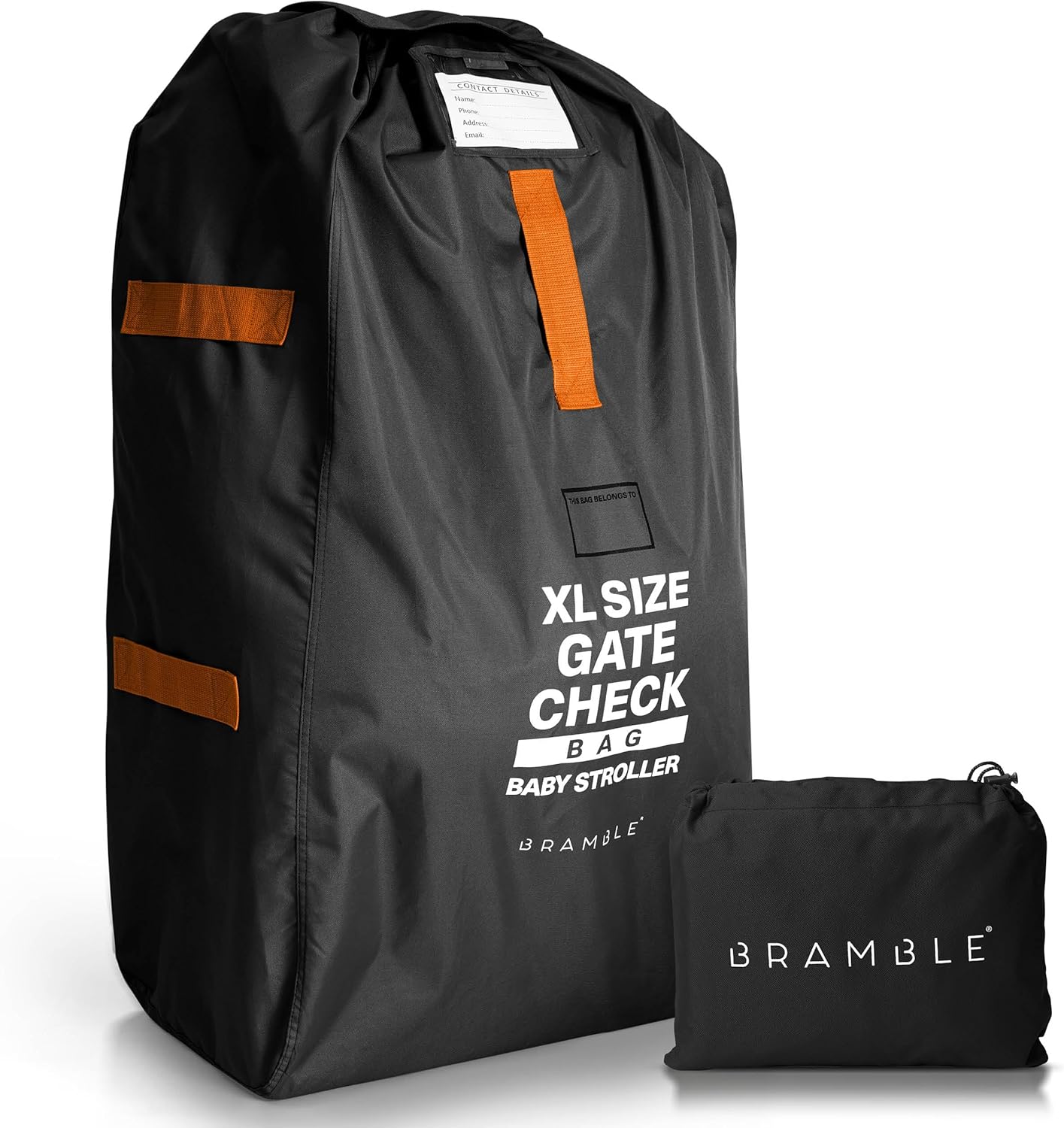
Double or wide fold
100 × 65 × 40 cm; padded shoulder straps, not a padded shell
Check price on Amazon: Bramble XL
Longer, narrower fold
114 × 52 × 33 cm; check the wheels fit through the opening
Check price on Amazon: Orzbow Pram Travel Bag
Longer, deeper fold
Approx. 119 × 61 × 46 cm; basic nylon cover
Check price on Amazon: V VOLKGO Large Gate Check Bag
Occasional gate check
Bright red cover; little protection against knocks
Check price on Amazon: J.L. Childress Gate Check Bag
Umbrella-fold buggy
Huckaboo Umbrella Stroller Bag
Long, narrow shape; padded base only
Check price on Amazon: Huckaboo Umbrella Stroller Bag
Bugaboo Butterfly
Bugaboo Butterfly Transport Bag
Model-specific; check the packed size with your airline
Check price on Amazon: Bugaboo Butterfly Transport Bag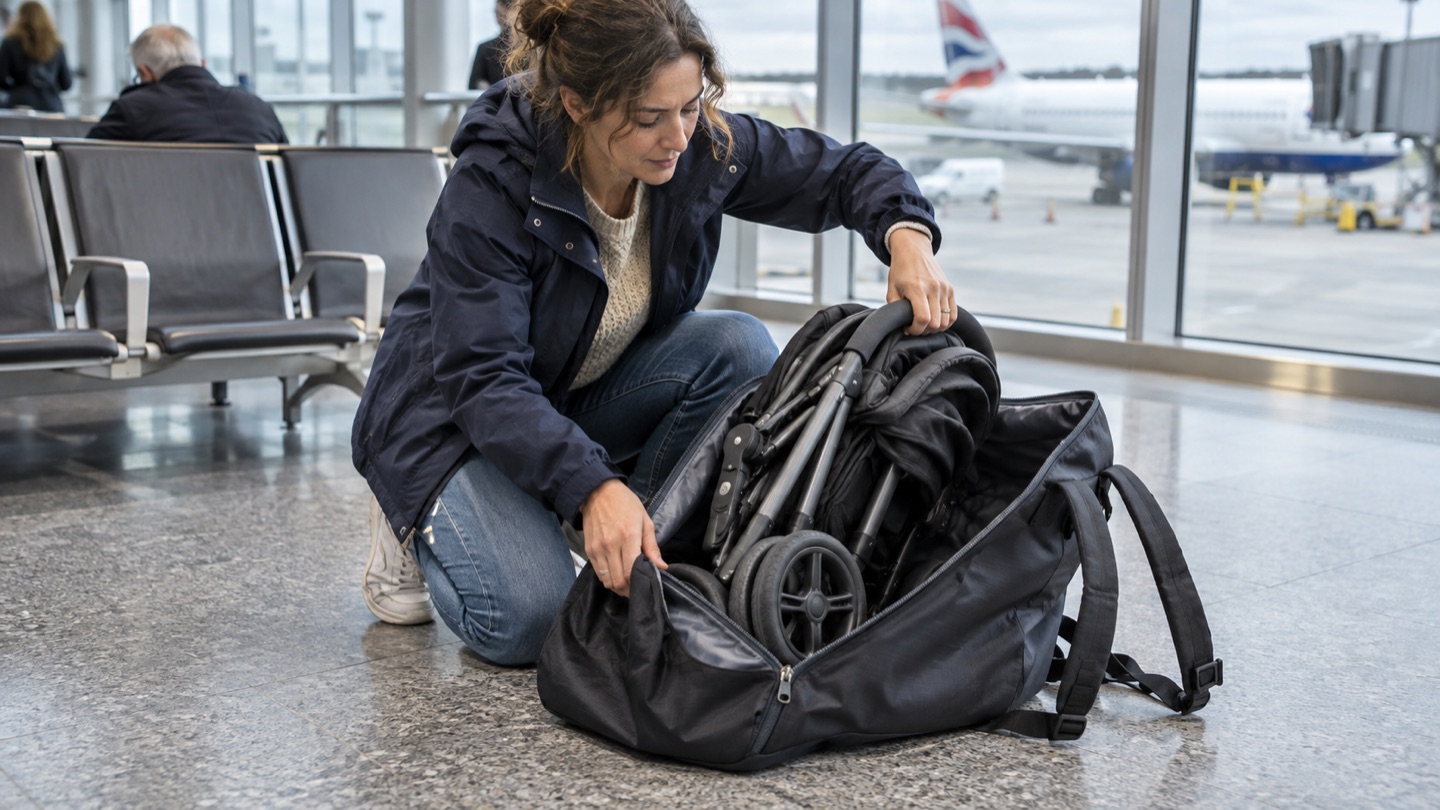
Still deciding where to hand it over? See our UK gate-check guide or follow our step-by-step pushchair packing guide.
What a gate-check bag protects
Most damage does not happen during your careful packing at home. It happens during transfers between gate, hold, trolley, and reclaim. Even when staff are careful, your stroller gets moved quickly around heavy luggage and narrow spaces.
A travel bag does four useful jobs:
- Protects from scuffs, grime, and weather exposure on the tarmac
- Keeps removable accessories together (rain cover, cup holder, clips)
- Makes carrying easier through terminals and transport links
- Helps identify your gear faster at reclaim points
Check where the airline takes your pushchair
📋 Free Baby Holiday Packing Checklist
Enter your email and we'll send the free printable checklist straight to your inbox — every category, ready to tick off before every trip.
Always check your airline’s child baggage page before flying. Rules differ by cabin class, destination, and stroller size. Start with official guidance from the UK Civil Aviation Authority, then confirm carrier-specific rules (for example the British Airways family travel page).
For security and prohibited item checks, use the latest GOV.UK hand luggage restrictions. If your trip is international, review destination advisories on GOV.UK Foreign Travel Advice.
The six stroller-bag features worth comparing
A bag that looks sturdy can still be frustrating if it is the wrong size or awkward to carry. Compare these features before choosing:
- Protection level: material thickness, seams, closure security
- Carry comfort: shoulder/backpack straps and balance when loaded
- Fit range: compact strollers vs larger travel systems
- Ease at airport: quick bagging, ID visibility, handling simplicity
- Storage profile: how small it folds when not in use
- Value: cost relative to stroller value and travel frequency
How to choose a pushchair bag
1) Measure folded stroller dimensions
Most return headaches come from size mismatch. Measure folded length/width/depth and compare with bag dimensions, leaving breathing room for wheels/handles.
Add at least a few centimetres around the widest wheel or handle point and check the size of the bag’s opening, not only its stated internal capacity. An XL bag is useful for a full-size pushchair but can be unnecessarily loose around a YOYO³, Libelle or other ultra-compact stroller. A closely fitted brand bag is easier to carry; a universal bag is more flexible if you expect to change pushchairs.
2) Decide your protection level
Occasional short-haul trips: durable nylon may be enough. Frequent travel or premium stroller: choose reinforced and padded options.
3) Pick carry style
Backpack straps are often easiest when managing baby + bags + passport flow. For short transfers, shoulder carry can still be fine.
4) Check closure and seams
Zips and stitching fail before fabric in many cheap bags. Prioritise reinforced seams and straightforward closures that are easy under pressure.
5) Match to trip type
City breaks with trains/taxis reward compact carry. Family holidays with transfers and rough handling reward sturdier construction.
Which bag fits your pushchair?
Bramble XL: for wider folds and double buggies
The Bramble measures 100 × 65 × 40 cm. Its width is the reason to choose it over the Orzbow if you have a side-by-side buggy. The bag has a drawstring with a clip-down flap, an ID window and padded shoulder straps. It packs into its own pouch after you unpack the buggy.
Check the length as well as the width. A narrow umbrella stroller may fold longer than 100 cm and fit better in a different bag. The shoulder padding is for carrying; the nylon shell isn't an impact case.
Orzbow: for a long, narrower pushchair
At 114 × 52 × 33 cm, this bag gives a long fold more room than the Bramble, but takes less width and depth. The 900D nylon and adjustable side straps are useful when you want to pull excess fabric in around a single buggy before you hand it over.
Check the widest point across the back wheels. If you have to take a wheel off, do a practice pack at home. The drawstring is easy to close but isn't a sealed zip; put loose accessories in your main luggage.
V VOLKGO: for a long, deep fold
The listed dimensions are 47 × 24 × 18 inches (about 119 × 61 × 46 cm). That gives you more depth for wheels than the Orzbow. Compare all three sides: it is deeper than the Bramble, but a little narrower.
The bag is a water-resistant nylon cover, useful for dirt and scratches rather than cushioning a blow. If your folded pushchair is much smaller than the bag, try carrying it at home before the trip. The extra fabric and a moving load can be awkward.

Best Lightweight: ONGUARD Double Stroller Bag for Airplane
At a glance: A lower-bulk choice that is easier to carry through airports when mobility matters most.
Why we like it: Useful when you care about carry burden and easier movement through busy terminals.
- Pros: easier handling, travel friendly
- Cons: less protective than heavy-duty padded alternatives
J.L. Childress: a simple red gate-check cover
This is a simple cover to pull over the pushchair at the gate. The red fabric is easy to spot among dark suitcases and it packs away between flights. The linked size is listed for standard and double buggies; measure yours rather than relying on that label.
There is little protection against knocks. If you're sending an expensive frame through multiple airports, compare its own transport bag and check which parts the manufacturer asks you to remove first.
Brand-specific bags worth a look
If you'd rather buy from a name you already recognise, these two brand options cover different ends of the market. We've also included one useful companion item that isn't a stroller bag at all — flagged clearly so you know what it does.
Bugaboo Butterfly Transport Bag: for the matching pushchair
This is the Butterfly transport bag, not the larger Bugaboo travel bag. Its backpack straps are useful when you need both hands between the train and the terminal. Check Bugaboo's compatibility notes for your exact Butterfly version before ordering.
Even with a model-specific bag, measure the outside once packed. A retailer's hand-luggage description doesn't override your airline's rules or guarantee space on board.
Huckaboo: for slim umbrella-fold buggies
This is the long, narrow navy bag for umbrella-fold pushchairs. The hood and drawstring cover the opening and the base has neoprene padding. That is useful around the lower end of the buggy, but it isn't padding all the way round.
Don't buy this variant for a double buggy or a square-fold cabin stroller. Fold your buggy with the wheels in their travel position and measure around the handles, which may stick out farther than the frame.
Pack the nappies, snacks and spare clothes separately from the pushchair. A hands-free changing backpack makes it easier to fold the buggy at the gate and leaves you with everything you need after handover. See our baby hand luggage checklist for what to keep with you on the plane.
What to do at bag drop and at the gate
- Remove loose accessories before security or boarding.
- Wipe wheels quickly to reduce dirt transfer in the bag.
- Fold and lock stroller fully before bagging.
- Put wheels down first where possible for easier closure.
- Add contact details and visible ID tag.
- Confirm with gate staff where pickup happens at arrival.
If you want the full operational version, see our detailed gate-check guide.
Mistakes that cost parents money
- Choosing by price alone: cheap bag + damaged stroller can be false economy.
- No fit check: oversized wheels and handles can stress seams and zips.
- Leaving accessories attached: loose cup holders and clips often get lost.
- Ignoring carrier policy: each airline can differ on where and how strollers are accepted.
Pack the pushchair at home once
Do a trial run with everything you would normally leave on the pushchair. You'll find out whether the bumper bar needs to come off and where to put it before you get to the gate.
- Pre-pack at home once: run a dry test so you know the fastest fold and insertion direction.
- Remove vulnerable add-ons: put cup holders, hooks and clips in a pouch in your own luggage.
- Use soft protection points: check whether the pushchair maker recommends a way to protect protruding parts before packing.
- Label everything: add internal and external contact tags.
- Photograph setup: one quick photo before handover helps if you need to report damage.
Bag fabric, seams and zips
Not all “water-resistant” claims are equal. In practice, these details matter:
- Fabric density: tighter weave usually resists abrasion better
- Coating quality: improves short rain exposure performance
- Seam reinforcement: critical where handles and straps take load
- Zip quality: weak zips are a common failure point during airport rushes
If you’re carrying an expensive stroller, paying a bit more for seam and zip reliability often saves money over time.
When to pack the pushchair at the airport
Parents often ask whether bagging at check-in or gate is better. The answer depends on airline flow and how much walking you need to do with the stroller. Gate bagging usually keeps mobility longer and can be simpler with babies and hand luggage.
Best practice:
- ask staff at check-in and again at the gate (rules can differ by route)
- keep your bag accessible, not buried in another suitcase
- arrive a little earlier so packing isn’t rushed
- use bright tags or ribbons to improve reclaim visibility
When to choose padded vs non-padded
Choose padded if:
- you fly multiple times per year
- your stroller is high-value or has delicate frame parts
- your itinerary includes multiple transfers and handling stages
Choose non-padded if:
- you fly rarely and mainly need dirt/scratch protection
- you prioritise compact storage and lower carry weight
- your stroller is durable and cheaper to replace
How much protection is worth paying for?
For one direct flight with a basic buggy, a lightweight cover often does the job. For an expensive pushchair on a connecting flight, look first for a fitted transport bag with padding around the frame. A loose bag can still leave wheels and hinges exposed to knocks inside it. Check if your pushchair has a travel lock, and test whether it still holds after you've removed the accessories.
Pushchair bag checklist before you fly
- Airline stroller policy checked within 48 hours of departure
- Stroller dimensions verified against bag dimensions
- Loose accessories removed and put in your own luggage
- Contact tag attached to the bag and an identification label on the pushchair
- Quick photo taken before handover at check-in or gate
Photograph the folded pushchair as well as the packed bag. If it comes back damaged, these photos help show its condition before you handed it over. Keep the baggage receipt until you have collected and checked the buggy.
External resources worth bookmarking
For policy updates, keep these official references handy: CAA passenger guidance, GOV.UK hand luggage rules, and your specific airline family travel page. These are the links we recommend checking before each trip because policies change faster than blog posts.
Which bag suits your trip?
Example 1: London city-break family, 2 flights/year, compact stroller. You likely don’t need premium padding. A well-priced bag with decent seams and easy carry will do the job and keep costs sensible.
Example 2: Family visiting relatives abroad 5+ times/year with premium stroller. Go padded. The repeated handling cycles justify better protection and reinforced seams.
Example 3: Parents with double stroller and multi-leg route. Prioritise size compatibility first, then carrying ergonomics. A bag that barely closes will fail at the worst moment.
If you're between two sizes, try the fold with the wheels and bumper bar in the positions you'll actually use on the day. It's much easier to change the bag at home than to take the pushchair apart in the boarding queue.
Before handing over your pushchair
Even the best stroller bag can’t fix rushed handling. These habits consistently reduce incidents: avoid overstuffing the bag with unrelated items, close every zip/strap completely before handoff, and keep a simple packing order every trip so nothing gets forgotten. If your stroller has removable wheels or delicate parts, protect those areas first with soft wraps.
At arrival, inspect quickly before leaving the reclaim area. If something is wrong, report it immediately and keep your photos, boarding pass, and bag tag together. Ask for a written report or reference number before leaving the airport.
✈️ Free Baby Hand Luggage Checklist
Never forget the essentials. Enter your email and we'll send the free checklist straight to your inbox — one page, every category, ready before every flight.
Frequently Asked Questions
Is a stroller bag mandatory for flying from the UK?
Usually no, but strongly recommended. It materially reduces dirt/scuff risk and makes handling easier.
Can I gate-check and still use a bag?
Yes. Many parents bag at the gate just before handoff. It’s one of the best protection habits.
Do I need a padded bag for every stroller?
Not always. Match bag protection to stroller value and travel frequency. More trips and higher stroller value justify stronger protection.
What links should I check before each flight?
Check your airline child baggage page, CAA baggage guidance, and GOV.UK hand luggage restrictions.
Does a pushchair bag count as cabin luggage?
That depends on your airline and fare. If you intend to take it into the cabin, measure the bag with the buggy inside, including anything that sticks out. Be prepared to hand it over for the hold if the airline cannot take it on board.
Can I put nappies or a rain cover in a gate-check bag?
Ask the airline before using the bag for anything other than the pushchair. Put loose parts in your own luggage if the bag closes with a drawstring, and keep anything you need during the flight in your cabin bag.
Can stroller damage be claimed?
Policies vary. Report issues immediately at airport services desks and keep photos/receipts.