
Taking a Stroller on a Plane: UK Airline Policies Explained (2026)
By BabyTravel UK Editorial Team · Last updated March 2026
Every major UK airline handles pushchairs differently. Here is exactly what each one allows — and how to make it work smoothly.
Yes, you can take a stroller on a plane. Every major airline operating out of the UK allows pushchairs, though the rules about how, where, and at what cost vary more than you'd expect. Get it wrong and you're facing an unexpected charge at the gate, or arriving at your destination to find your stroller has been checked into the hold when you needed it at the aircraft door.
This guide covers the three ways to fly with a stroller, the specific policies of every major UK airline, and how to gate-check without damaging your pushchair. For everything else about the airport experience with a baby, see our first flight with a baby guide and our air travel hub.
Important Note on Airline Policies
Airline policies change frequently and without notice. The information below was verified in March 2026 — always check your specific airline's website before travel, and confirm at check-in that your pushchair is tagged correctly.
Taking a Stroller on a Plane: Key Facts
- The 3 options: gate-check (most common), hold luggage, or cabin carry-on (very limited strollers qualify)
- Most family-friendly: British Airways and Jet2 — clear policies, no charges, consistent handling
- Budget airline tip: On Ryanair and easyJet, book your pushchair in advance online — don't assume it's automatically included
- Cabin strollers: Very few strollers are approved for the cabin; the Babyzen YOYO² is the most widely accepted
- Always protect it: A gate check bag prevents damage during handling — the J.L. Childress is the most popular budget option
The 3 Ways to Fly With a Stroller
1. Gate-Check (Most Common)
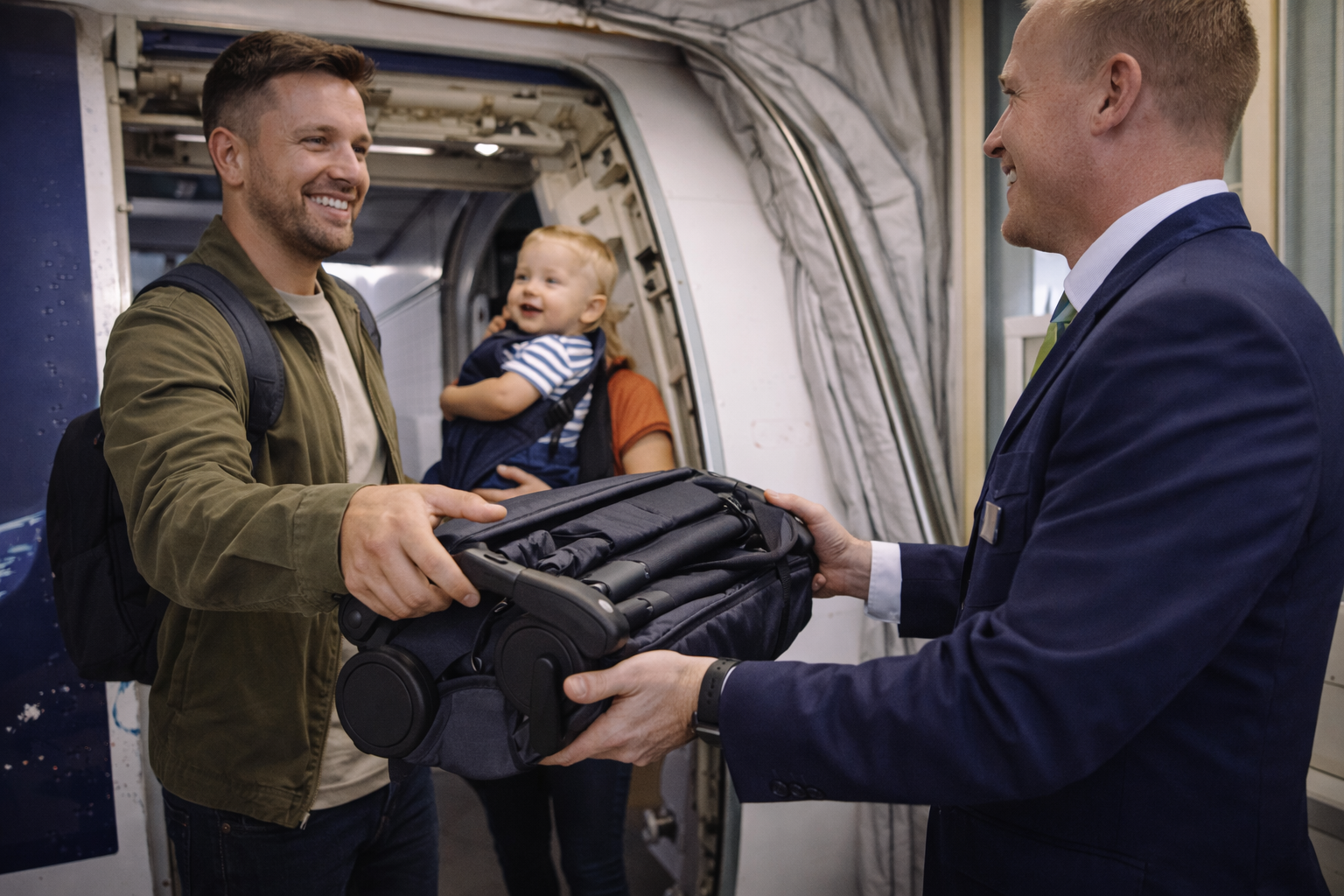
Gate-checking is the standard approach for most families. You use the stroller all the way through the terminal — check-in, security, departure lounge — then hand it to ground staff at the aircraft door immediately before boarding. You collect it either at the aircraft door on arrival (on many short-haul flights) or at the oversized baggage belt, depending on the airline and destination.
The advantages: you have the stroller with you during the long airport wait, which matters enormously with a young baby or toddler. The disadvantage: the stroller goes into the hold unprotected unless you've brought a gate check bag, and it can be handled roughly. For how to gate-check properly, see the step-by-step section below.
2. Checked Hold Luggage
Most airlines allow you to check a pushchair as hold luggage at the bag drop desk, either as part of your standard luggage allowance or for a separate charge. The stroller goes in the hold for the entire journey; you collect it at the baggage reclaim on arrival, sometimes at the oversized items belt. This is the right choice if you're travelling to a destination with good equipment hire or won't need the stroller immediately on arrival — but it means walking through two airports without it, which with a baby can be challenging. A rigid travel bag or good gate check bag is important for hold travel to prevent damage.
3. Cabin Carry-On (Limited Options Only)
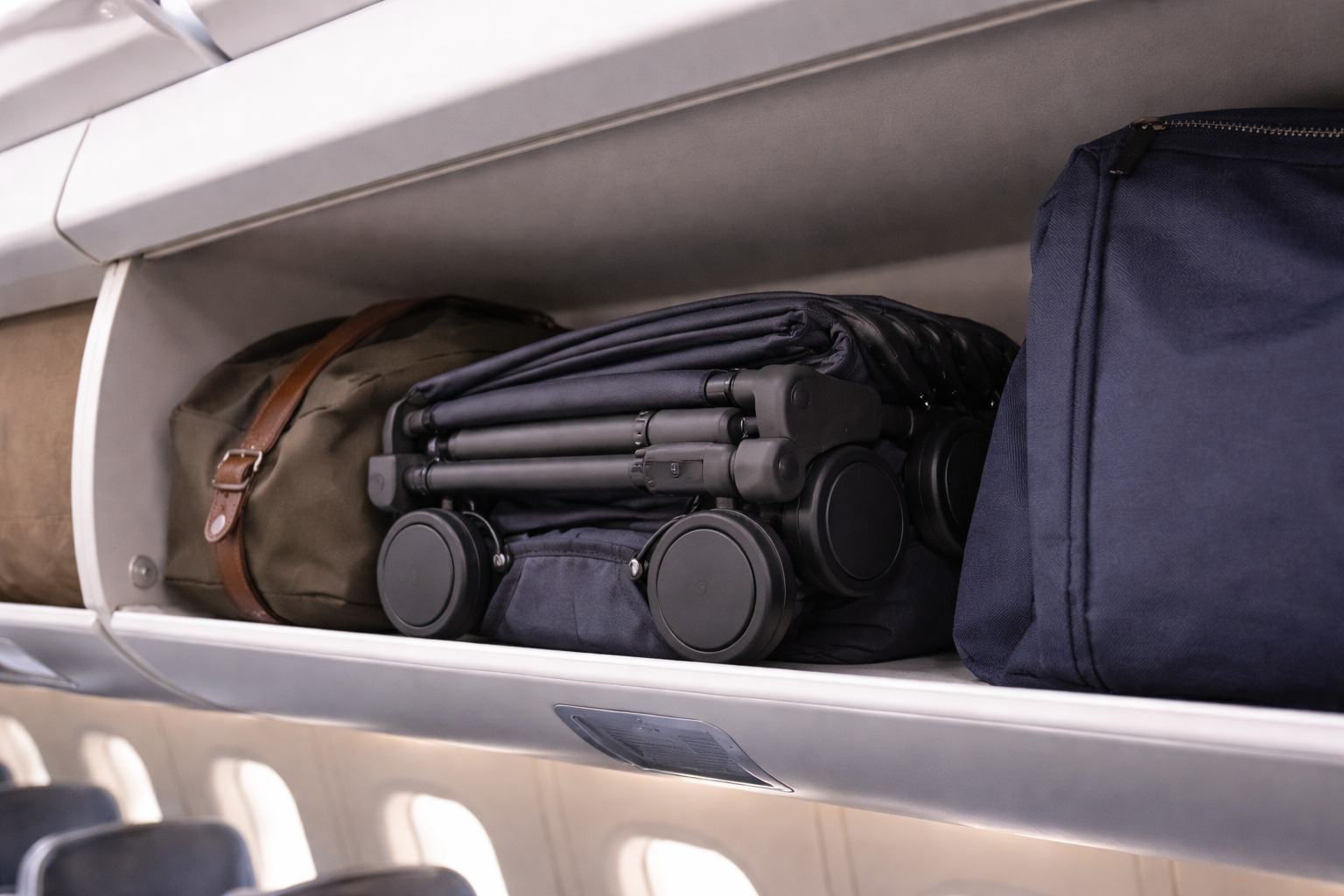
A small number of ultra-compact strollers — most notably the Babyzen YOYO² — are specifically approved for cabin travel by certain airlines, fitting within the overhead locker. This is genuinely convenient: the stroller never leaves your sight, there's no waiting at baggage reclaim, and there's no risk of gate-check damage. The catch is that very few strollers actually qualify, airline approval varies even for the YOYO², and staff discretion at the gate can override official policy. If you're planning to use a stroller as cabin baggage, verify with your specific airline before travel. For cabin-friendly stroller recommendations, see our cabin strollers guide.
UK Airline Stroller Policies Compared (2026)
📋 Free Baby Holiday Packing Checklist
Enter your email and we'll send the free printable checklist straight to your inbox — every category, ready to tick off before every trip.
| Airline | Gate-Check | Cabin Allowed? | Cost | Bag Required? | Notes |
|---|---|---|---|---|---|
| British Airways | Yes | If within carry-on limits | Free (1 per infant) | Recommended | Tag at check-in. Returned at aircraft door on most short-haul routes. |
| easyJet | Yes | No (unless meets carry-on size) | Free (1 per infant) | Recommended | Must be booked online or at check-in. Tag given at bag drop. Collected at aircraft door or belt. |
| Ryanair | Yes | No | Free (book in advance online) | Recommended | Add as "infant" equipment when booking. Not automatic — must be added to booking. Collected at aircraft door on most routes. |
| Jet2 | Yes | If within carry-on limits | Free (1 per infant) | Recommended | One of the most family-friendly airlines for pram handling. Tag at check-in, returned at aircraft door. |
| TUI | Yes | No | Free (1 per infant) | Recommended | Pushchair goes in the hold. Returned at aircraft door on most routes but confirm when booking. |
| Wizz Air | Yes | No | Free (1 per infant) | Recommended | Add infant equipment to booking. Wizz Air's handling of delicate items has received mixed reviews — a padded bag is advisable. |
| Virgin Atlantic | Yes | If within carry-on limits | Free (1 per infant) | Recommended | Generally very family-friendly. Tag at check-in, confirm return point (door or belt) at the gate. Travel bag strongly recommended for long-haul hold travel. |
Airline-by-Airline Guide
easyJet
easyJet allows one pushchair free per infant, but you must tell them about it — either when booking online or at check-in. You'll receive a tag at the bag drop desk which identifies the pushchair as a "special item" and determines where it's returned. On most routes it comes back at the aircraft door; on some (particularly when using a remote stand rather than a jet bridge) it goes to the oversized baggage belt at arrivals. Confirm at the gate which applies to your specific flight. See easyJet's infant baggage page for current specifics.
Ryanair
Ryanair's pushchair policy is free but it requires active effort on your part to set it up. You need to add a pushchair to your booking as an "infant item" — if you don't, you may be charged at the airport. Log into your booking, go to "Add bags," and add the infant pushchair option. You won't pay for this, but you have to do the step. At the airport, you'll be tagged at check-in and the stroller gate-checked at the aircraft door. On most Ryanair routes the stroller is returned at the aircraft door on arrival. Check Ryanair's baby equipment FAQ for the latest.
British Airways
British Airways is among the most straightforward airlines for families. One pushchair per infant is checked free of charge, tagged at check-in, and gate-checked at the aircraft door. On most short-haul BA routes, the pushchair is returned at the aircraft door on arrival. For long-haul flights it often goes to the oversized baggage belt — confirm at the gate. BA's handling reputation is generally good. See BA's baggage policy for full details.
Jet2
Jet2 has a strong reputation for family travel, and their pushchair handling reflects that. One free per infant, tagged at check-in, returned at the aircraft door on most routes. Staff at Jet2 gates are generally experienced with families and tend to be helpful with the handover process. Check Jet2's pushchair guidance before travel.
TUI
TUI allows one pushchair free for infants and the overall process is similar to other charter-style airlines — tag at check-in, gate-check at the door, returned at the door on most routes. TUI routes are predominantly to holiday destinations (Canary Islands, Turkey, Greece) where they operate jet bridges at the destination, making door return more common. See TUI's pram guidance for current policy.
Wizz Air
Wizz Air permits one pushchair free per infant. As with Ryanair, ensure it's correctly added to your booking in advance. Wizz Air's handling has received more mixed feedback from parents than some other carriers — a padded gate check bag is particularly advisable if you're flying with them. Confirm the return point at check-in. See Wizz Air's infant travel page for the latest policy.
Virgin Atlantic
Virgin Atlantic is very family-friendly and their pushchair policy reflects this. One pushchair free per infant, gate-checked at the aircraft door. For long-haul flights on Virgin, a travel bag is strongly recommended — the pushchair may travel significant distances in the hold and handling on wide-body aircraft can be rougher than on short-haul. See Virgin Atlantic's baby equipment page for specifics.
Which Strollers Can Go in the Cabin?
Most strollers — even very compact ones — are technically too large for airline cabin carry-on dimensions. The standard carry-on limit across most UK airlines is around 55 × 40 × 20cm, and almost all strollers exceed this in at least one dimension when folded.
The exception that most parents know about is the Babyzen YOYO². When folded with the frame and seat attached (not separated), it measures approximately 52 × 44 × 18cm and weighs around 6.4kg — within the carry-on limits for some airlines, and specifically approved as cabin baggage by Air France and a number of other carriers. However, UK airlines including easyJet and Ryanair do not formally list it as cabin-approved, and whether you're permitted to bring it onboard can depend on individual staff at the gate. Some parents report no issues; others are asked to gate-check it.
The only reliable approach if you want to fly cabin with a stroller: contact your specific airline before travel and get written confirmation that your exact stroller model is permitted in the cabin on your route. Don't rely on general policy descriptions or forum reports from other parents on different airlines or routes.
For a full roundup of the most compact travel strollers — including which ones are most likely to be accepted cabin-side — see our cabin-friendly strollers guide and our travel stroller review.
Pro Tip
If you're planning to gate-check rather than take cabin, the stroller brand matters less than the fold speed. Practise folding one-handed before the trip — at the aircraft door you'll typically have 30 seconds while the crew is waiting, sometimes with a baby in your other arm.
How Gate-Checking Works: Step by Step
The process is straightforward once you've done it once, but it helps to know exactly what to expect before your first flight.
Step 1: Check-in. Mention the pushchair at bag drop. You'll be given a bright sticker tag (often orange or yellow) to attach to the stroller. This tag identifies it as a "gate check" item and tells ground staff where to take it. Don't leave this step out — an untagged pushchair at the gate can cause delays and confusion.
Step 2: Through security. Fold the stroller and put it through the X-ray belt, just like a bag. Most airports have a dedicated lane or a wider belt for larger items. Unfold it on the other side if you need it for the departure lounge.
Step 3: At the boarding gate. When boarding is called, fold the stroller and join the queue. Most airlines board families first — use that boarding priority to get to the aircraft door before the rush.
Step 4: Aircraft door. Hand the folded stroller to ground staff at the bottom of the jet bridge or at the aircraft door. They'll take it and load it into the hold. If you have a gate check bag, the stroller goes in folded; if not, staff will handle it as-is.
Step 5: On arrival. For most short-haul routes, the stroller is returned at the aircraft door — you'll see it waiting in the jet bridge as you disembark. On some routes (particularly remote stands, or when the airline's policy puts it in the hold) it comes to the oversized baggage belt at arrivals. Always confirm which applies at the gate before boarding.
Protecting Your Stroller: Gate Check Bags
A gate check bag is not mandatory, but it makes a meaningful difference to how your stroller arrives. Without one, the stroller is handled directly by ground staff and goes into the hold exposed — which means scuffs, scratches, and occasionally broken parts. With a bag, you have a layer of protection and the stroller is easily identified on the belt.
Two options dominate the market. The J.L. Childress Gate Check Bag is the most popular budget-friendly option — a straightforward drawstring bag that covers most compact strollers and fits in a pocket when not in use. The Bramble XL Stroller Bag (amzn.to/4bhbcSB) is the better option for larger or umbrella-fold strollers, with more durable waterproof fabric and a wider opening. For a full comparison of stroller bags, see our travel accessories guide.

J.L. Childress Gate Check Bag for Strollers
The most popular gate check bag among UK travelling parents — a drawstring design that fits most compact and umbrella-fold strollers, folds to almost nothing when empty, and adds a clear layer of protection in the hold. Around £15–£20.
Pros: Very compact when not in use, fits most single strollers, easy to pull on at the aircraft door, good value.
Cons: Thinner material than padded alternatives — more scratch protection than impact protection; not suitable for large travel systems.
What Damage to Watch For
The most common stroller damage from air travel: scratched frames, buckled handlebar grips, bent wheels (especially smaller front swivel wheels), and broken sun canopy arms. Check the stroller thoroughly on arrival at the baggage belt before leaving the airport. If there is visible damage, report it to the airline's baggage desk before leaving the arrivals hall — this is the only point at which you can make a damage claim. Airlines typically have a 7-day window for baggage damage claims, but the evidence requirement is much easier to satisfy if you flag it immediately.
What to Use in the Terminal Once You've Gate-Checked
If you gate-check at the aircraft door you'll have the stroller through the terminal — which covers check-in, security, the departure lounge, and the walk to the gate. That's the most comfortable approach for young babies.
Once you hand it over at the gate, you have two options for the boarding process and the aircraft itself: hold your baby, or use a carrier. A carrier is significantly more practical — both hands free for boarding passes and luggage, easier to navigate the aisle, and many babies will sleep in a carrier in a way they won't in an aircraft seat. See our best carrier for airport travel guide and carrier hub for options that fold small enough to pack away once you're seated.
✈️ Free Baby Hand Luggage Checklist
Never forget the essentials. Enter your email and we'll send the free checklist straight to your inbox — one page, every category, ready before every flight.
Frequently Asked Questions
Can I take a pushchair on a plane for free?
On most UK airlines, yes — one pushchair per infant is included free of charge. The key exceptions: on Ryanair, you must add it to your booking online in advance or you may be charged at the airport. Always verify with your specific airline before travel. The table above covers current policies for all major UK carriers.
Do I need to check in my pram separately?
Yes — mention it at the bag drop desk when you check in, even if it's going to be gate-checked. You'll receive a tag that identifies it as a pushchair and authorises it as a gate check item. An untagged pushchair at the gate can cause problems and delays.
Where do I get my pram back after the flight?
This depends on the airline and route. On most short-haul flights using a jet bridge, the stroller is returned at the aircraft door as you disembark — you'll see it waiting in the jet bridge. On flights that use remote stands (where you board by stairs to a bus), or on some long-haul routes, it goes to the oversized baggage belt at arrivals. Always confirm which applies at the gate before you board.
Can I bring a double stroller on a plane?
Yes, though double strollers are subject to the same free-per-infant allowance as singles — you'd typically need two infants flying to qualify for two pushchairs free. Doubles are also harder to gate-check due to size and weight. A padded travel bag is particularly important for doubles. See our guide on travel strollers for compact double options.
Do I need a gate check bag?
Not required, but strongly recommended — especially for premium pushchairs. A gate check bag protects against scratches and scuffs and makes your stroller easy to identify. The J.L. Childress bag (above) covers most compact strollers and folds to almost nothing when empty. If you have a larger travel system, consider the Bramble XL for better coverage.
Can I use my stroller as a car seat on the plane?
Only if it's been specifically approved as an aircraft restraint. The Babyzen YOYO² and a small number of other approved strollers can be used as a seat on the plane with an aircraft-approved harness. Standard strollers and travel systems are not approved for use as aircraft seating regardless of whether they have five-point harnesses. Your baby must either be held as a lap infant or seated in an approved child restraint for the duration of the flight.
What is the best stroller to take on a plane?
For gate-checking, the most important features are a fast one-hand fold and a compact folded size. For potential cabin use, the Babyzen YOYO² is the benchmark — though always confirm with your specific airline before assuming it'll be accepted onboard. See our full travel stroller guide and cabin stroller roundup for current recommendations.
Can I take a stroller through airport security?
Yes — fold it and send it through the X-ray belt, just like a bag. Most UK airport security lanes have a wider belt or a dedicated lane for buggies and car seats. Unfold it once through. If your stroller has a removable seat unit, you don't need to take it apart — fold the whole stroller and send it through as a unit.
The Short Version
Every major UK airline allows one free pushchair per infant. Gate-checking at the aircraft door is the standard approach and works well — bring a gate check bag, tag it at check-in, and confirm the return point before boarding. If you want to fly cabin with a stroller, the YOYO² is your best bet, but always verify with the airline first.
For more on the airport experience with a baby — from security to the flight itself — see our first flight with a baby guide. For pushchair recommendations at different price points, our travel stroller reviews cover all the bases.