
Travelling on UK Trains With a Baby: A Practical Guide (2026)
By BabyTravel UK Editorial Team · Last updated July 2026
No airport security, no car seat time limits, and a rhythm that sends most babies straight to sleep. Train travel with a baby is more manageable than you might think — once you know the practical realities.
There's a lot of content out there about flying with a baby, but almost nothing practical about travelling on UK trains with a baby. That's a gap worth filling, because for many UK family journeys, the train is genuinely the better option. No car seat time limits, no airport security queues, space to walk up and down the carriage, and — for longer journeys — modern intercity trains with proper facilities.
The practicalities are also less documented: which operators actually have accessible pushchair spaces? Which trains have a changing table? When should you fold the buggy and when can you leave it up? This guide covers all of it, from booking through to arrival, so you can travel with confidence rather than hoping for the best.
Key Takeaways: UK Train Travel With a Baby
- 1. Book a seat near the pushchair space — most operators have dedicated buggy areas, but they're first-come-first-served unless you book specifically.
- 2. Avoid peak hours — a 9am train is a different experience from an 11am train. Off-peak is vastly more relaxed with a baby.
- 3. Always carry your own changing mat — train changing tables are hit or miss. Some are excellent; some are genuinely grim.
- 4. LNER and GWR main lines are the most family-friendly operators — modern rolling stock, good facilities, reliable buggy spaces.
- 5. A compact-fold stroller is much easier on a busy train — leave a large travel system at home for this kind of trip.
Compare Train Tickets
Compare train fares and book the cheapest tickets — children under 5 travel free.
Compare Train TicketsWhy Trains Can Be Better Than Driving or Flying for UK Trips
The honest answer is: it depends on your destination and your baby's temperament. But trains have some genuine advantages that parents often underestimate.
| Mode | Typical Cost | Convenience With Baby | Stress Level | Best For |
|---|---|---|---|---|
| Train | £30–£120 return (advance) | High — room to move, no car seat | Low–Medium | City-to-city trips; scenic routes |
| Car | Variable (fuel + parking) | Medium — car seat limits; traffic stops | High (motorway with a screaming baby) | Rural destinations; heavy luggage |
| Plane | £80–£200+ (incl. bags, parking) | Low — airport security, weight limits | Very high | Far north Scotland; time-critical trips |
For city-to-city journeys — London to Edinburgh, London to Bath, Manchester to Liverpool — the train wins on almost every metric. No car seat time limits, so your baby can feed, move, and sleep freely. No airport security queues with a changing bag and a stroller. The rhythmic motion and background noise of a moving train is actively calming for most babies. And on modern intercity services, you can walk up and down the carriage when things get restless.
Where the car wins is for rural destinations — cottages in remote areas of Scotland, Snowdonia, or the Lake District — where you'll need the car on arrival anyway. And for very young babies who sleep through everything, the car is sometimes simpler. But as a default assumption, trains are underused by UK parents with babies.
Booking: Pushchair Spaces, Quiet Coaches, and First Class
Do You Need to Book a Pushchair Space?
It depends on the operator. On most major routes, dedicated pushchair areas exist near the doors — typically a fold-down seat or wide vestibule area — but policies on reserving them vary. LNER and GWR allow you to note a pushchair when booking, and it's worth doing. CrossCountry and Avanti West Coast are first-come-first-served, which means on a busy service you may find the space already occupied by bicycles or luggage.
The practical advice: book an adjacent seat reservation if you can (seat near the buggy area), travel off-peak, and arrive at the platform early enough to board before the carriage fills up. On busy Friday afternoon services, the pushchair space situation can be genuinely chaotic.
Quiet Coaches: Worth It With a Baby?
Technically, there's no rule against travelling with a baby in a quiet coach. Practically, it's a source of tension. Quiet coaches are designated for silent travel — no phone calls, limited noise — and while a sleeping baby is perfectly appropriate, a crying one will generate passive-aggressive looks from other passengers. Our honest take: if your baby is in a settled phase, quiet coaches are lovely (more space, calmer atmosphere). If you're in a unsettled phase, standard coaches are less fraught for your mental health. You're not obligated to sit anywhere specific.
First Class: Sometimes Worth It
Advance first class tickets on LNER and GWR are often only £10–£20 more than standard, and the benefits for families are real: significantly more seat space, wider aisles, quieter carriages, and on LNER, complimentary food and drink at seat. If you're travelling London to Edinburgh and your baby needs room, upgrading to first class on a quiet day can transform the journey. Check Trainline prices both in standard and first class before assuming first is out of reach.
Getting On and Off: The Platform Gap Reality
📋 Free Baby Holiday Packing Checklist
Enter your email and we'll send the free printable checklist straight to your inbox — every category, ready to tick off before every trip.
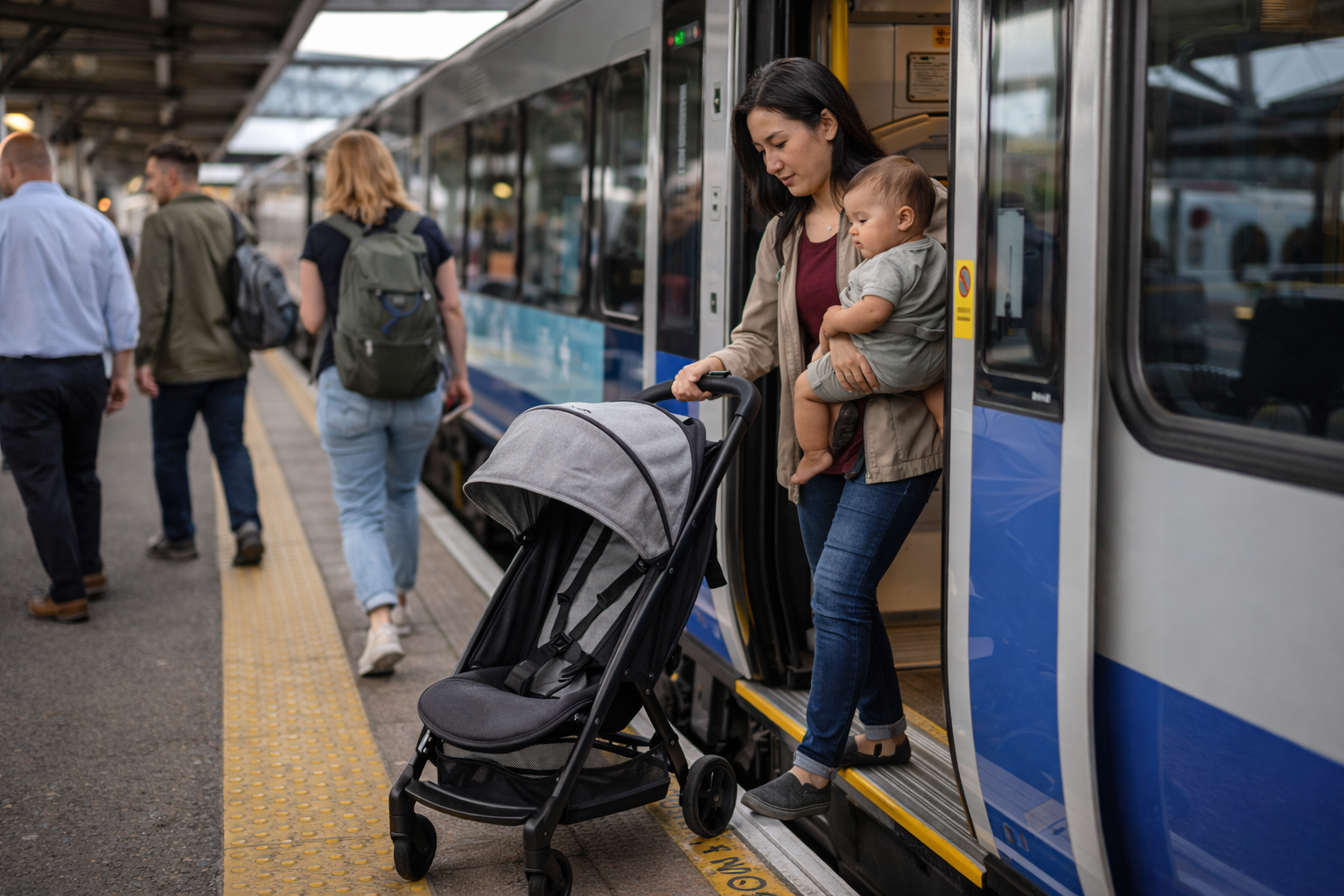
This is where UK train travel can be genuinely frustrating for parents with pushchairs. Most UK stations are not fully step-free, and even at those that are, platform gaps and step heights vary between different trains and platforms.
The National Rail accessibility pages show step-free access routes for individual stations — always check your departure and arrival stations before travelling, not just your main terminus. Many smaller stations on branch lines have no step-free access to some platforms at all.
At staffed stations, ask a member of staff for a boarding ramp if there's a significant step. Most operators carry portable ramps, and staff are generally willing to help — but you may need to ask. On unmanned stations (common on rural branch lines), there's no one to help and you may simply have to lift the pushchair. Factor this in when choosing your route, especially if you're travelling solo.
Worth Knowing
If you're travelling with a pushchair and a baby and nobody else to help, boarding and alighting can feel like a logistics puzzle. The most useful approach: fold the stroller before boarding if there's a significant step (sling the baby in a carrier or use a baby seat in the overhead luggage if offered), load the stroller first, then collect it at the other end. Practise the fold before you travel.
Pushchair Logistics on the Train
Whether to fold the stroller or leave it up depends on how busy the train is and whether the dedicated space is free.
If the pushchair space is free: leave it up. Modern intercity trains have proper vestibule areas or fold-down priority spaces that comfortably fit a standard travel stroller. Your baby stays in it (it's their de facto seat), you park it in the space, and everyone is comfortable.
If the train is busy or the space is taken: fold and store. A compact-fold stroller stands up against the wall or in the overhead luggage shelf. Baby goes on your lap or in a carrier. This is where choosing the right stroller for train travel really matters — a bulky travel system becomes a major inconvenience in a crowded vestibule.
Avoid peak-hour commuter trains with a pushchair if you can help it. A 7:45am service from London Victoria is a genuinely hostile environment for a parent with a stroller. The 10am or 11am train is a completely different experience — the same route, but with space to breathe.

Silver Cross Clic (Our Pick for Train Travel)
Our take: For UK train journeys, you want the most compact fold possible. The Silver Cross Clic is one of the lightest strollers available in the UK at around 5.9kg, with a one-second fold to a genuinely tiny package. On a busy train, it stands upright unaided against the wall, fits easily in overhead luggage, and draws no complaints from other passengers. The trade-off is a limited recline and a smaller basket — fair for a stroller you're specifically choosing for transport convenience.
Key specs: 5.9kg; 6 months to 25kg; one-second self-standing fold; rain cover included. | Price: around £280–£320.
If you want slightly more stroller capability — a deeper recline, better suspension — the Bugaboo Butterfly (7.3kg, one-second auto-fold) and the Joolz Aer+ (6.2kg, compact fold) are both manageable on trains without the micro-fold of the Clic. A full-size travel system is really best left at home for city train trips.
Feeding on a Train
Breastfeeding: completely fine, no legal restriction, and modern intercity trains have no dedicated feeding rooms (the toilet is not an appropriate place — ignore anyone who suggests otherwise). Table seats are the easiest for feeding: rest the baby on the table surface supported with your arm, or use a nursing pillow tucked into your bag. Most passengers are entirely unbothered. If you'd rather a bit more privacy, request a window seat facing away from the aisle.
Bottle feeding: no facilities to heat bottles on UK trains, so bring a wide-mouth Thermos flask filled with freshly boiled water from home. Mix formula when needed — the water stays hot for several hours and is ideal for making up feeds at the right temperature. Pre-measured formula pots make this simple. Never use the hot drinks service water from the buffet car for formula — it's not consistently safe for infant use.
Solids: entirely manageable with a table seat, a few muslins, and realistic expectations about mess. Baby food pouches, soft finger foods, and rice cakes travel well. Bring more than you think you'll need — journey times extend when trains are delayed, and a hungry baby on a delayed service is not a situation you want to be underprepared for.
Nappy Changing on a Train
Many UK trains have an accessible toilet with a fold-down changing table. Quality varies dramatically. The good news: LNER Azuma trains and GWR IET trains have decent, reasonably spacious accessible toilets with changing facilities. The bad news: older rolling stock (CrossCountry Voyagers, some regional services) has cramped facilities that are barely usable with a wriggling baby.
A few specifics:
- LNER (Azuma): Accessible toilets are among the best on the network — large, clean, dedicated changing shelf.
- GWR (IET on main lines): Good facilities; older High Speed Trains on some routes are more limited.
- CrossCountry (Voyager): Tight. Manageable but not comfortable. Some services have accessible toilets; check before boarding.
- Short commuter services (Southern, Southeastern, TfL Rail): Some have no accessible toilet at all. Check before you travel if this is a concern.
Always carry your own waterproof changing mat regardless of what the train provides. A fold-flat mat that fits in your changing bag is genuinely essential for train travel — the train surface alone is not something you want near your baby. Our baby travel packing list has all the essentials worth carrying in your changing bag.
Best UK Train Operators for Families
| Operator | Rolling Stock (2026) | Changing Facilities | Buggy Space | Family Rating |
|---|---|---|---|---|
| LNER | Azuma (Class 800/801) — modern | ✅ Excellent | ✅ Dedicated spaces | ★★★★★ |
| GWR | IET main lines; older stock on branches | ✅ Good (main lines) | ✅ Good on IETs | ★★★★☆ |
| Chiltern | Class 168 — modern and comfortable | ✅ Decent | ✅ Good | ★★★★☆ |
| ScotRail | Mixed; newer CAF units on some routes | ⚠️ Variable | ⚠️ Variable | ★★★☆☆ |
| Avanti West Coast | Pendolino + newer Hitachi | ⚠️ Variable | ⚠️ Tight on Pendolino | ★★★☆☆ |
| CrossCountry | Voyager (Class 220/221) — ageing | ⚠️ Limited | ❌ Often occupied/tight | ★★☆☆☆ |
CrossCountry deserves a special mention as a caution. It's the operator that connects many major UK cities without going through London — Birmingham to Bristol, Edinburgh to Plymouth — but the Voyager trains are ageing, frequently overcrowded, and the pushchair experience can be genuinely stressful. If your route can be done on LNER or GWR instead (sometimes with a connection), it's usually worth it. If CrossCountry is your only option, book early, travel off-peak, and lower expectations accordingly.
Best UK Train Routes for Families With a Baby
London to Cornwall (GWR)
Paddington to Penzance is around 5 hours on an express service — long, but one of the most scenic rail journeys in England. The stretch from Exeter onwards, hugging the Devon and Cornwall coastlines, gives you sea views that genuinely make babies look up and pay attention. Modern IET trains have good facilities. Book a table seat if you can, ideally with sea views. Allow extra time at Paddington for boarding.
London to Edinburgh (LNER)
King's Cross to Edinburgh in around 4.5 hours on the Azuma — this is the benchmark UK train experience for families. Modern, spacious, with at-seat catering in first class and genuinely good accessible facilities. The journey through Northumberland and the Borders is stunning. This route is the one that most converts parents to train travel. If you're planning an Edinburgh family break, the LNER from King's Cross is our recommended route.
Manchester to the Lake District (Northern/Avanti)
Trains from Manchester Piccadilly to Windermere (via Oxenholme) take just over 1.5 hours. The final section through the Lune Gorge and into the Lakes is genuinely beautiful. This is a solid option for families who want a car-free day trip from Manchester, though you'll need to hire a car or use local buses on arrival if you want to explore widely.
London to Bath (GWR)
Just under 90 minutes on the fast service from Paddington. Bath is one of the most pushchair-friendly city destinations in England — flat enough in the centre, Georgian architecture, excellent cafés, and a very relaxed pace. The short journey makes this entirely manageable even on a bad day with a baby. See our baby-friendly city breaks guide for what to do once you arrive.
Tips for Keeping Your Baby Happy on a Train
Trains suit babies surprisingly well, but a few things help:
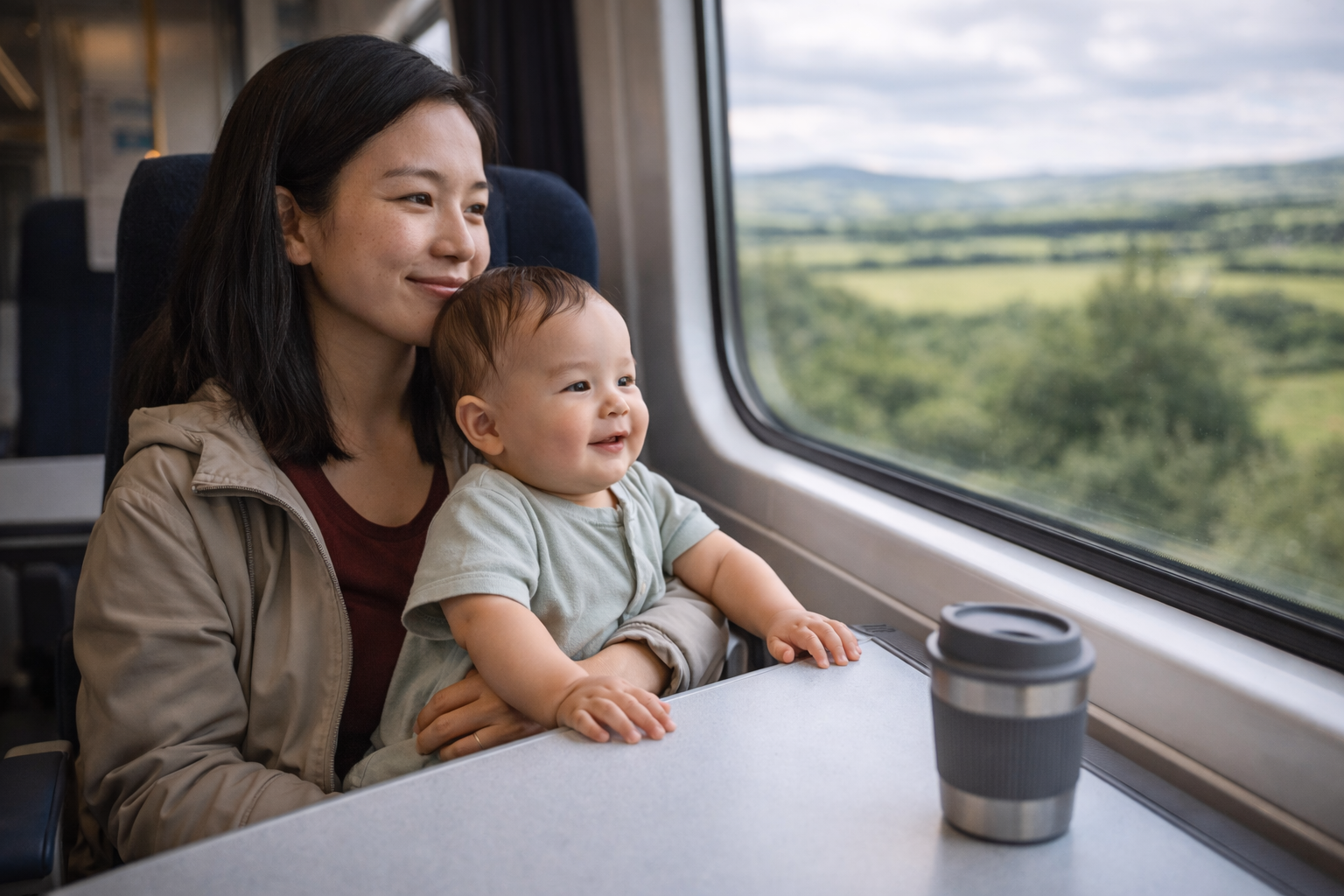
- Window seat, forward-facing — the moving landscape is genuinely stimulating for babies from around 3 months. A window seat with good countryside views can entertain a baby for a surprisingly long stretch.
- Use the carriage to your advantage — when things get restless, a slow walk up and down the aisle settles most babies. The movement, noise, and new faces are distracting in the best way.
- The train rhythm — the clickety-clack of older rolling stock and the low hum of modern trains both tend to send babies to sleep. Many parents find trains more effective than car journeys for this.
- Bring more snacks and toys than you think you need — delayed trains happen. A 30-minute delay with a hungry, bored baby is manageable if you're prepared; chaotic if you're not. Our pick of the best travel toys for babies and toddlers has options that pack small and keep a toddler entertained well past the first stop.
- Avoid rush hour as a non-negotiable — this cannot be overstated. The difference between a 9am and an 11am departure is enormous. Off-peak travel with a baby on a UK train is genuinely pleasant; peak commuter travel is not.
For quick, low-mess ideas you can pull out at a moment's notice, our Busy Bag 5-Minute Challenge Cards give you printable activity prompts designed for flights, queues, and restaurant waits — £4.99 as an instant download.
Pro Tip
Download the train operator's app before you travel. LNER's and GWR's apps both show live train capacity by carriage — useful for finding the quietest coach before you board. On a quiet carriage, you can often have a whole section to yourself, which transforms the experience.
A baby carrier is worth packing even if you're bringing a stroller. When you board a busy train and need both hands — one to manage the stroller in the vestibule, one for the changing bag and boarding passes — having the option to pop baby into a carrier for the boarding and alighting phase makes a meaningful difference. It's also useful if you're doing a mixed public transport day at the destination, combining the train with buses or the Underground.
✈️ Free Baby Hand Luggage Checklist
Never forget the essentials. Enter your email and we'll send the free checklist straight to your inbox — one page, every category, ready before every flight.
Frequently Asked Questions
Do I need to book a pushchair space on a UK train?
It depends on the operator. LNER and GWR both allow you to note a pushchair during booking, which is worth doing. On other operators, pushchair spaces are first-come-first-served. Even where booking is available, it's not guaranteed — arrive early and speak to staff if the space is occupied by other luggage.
Can I take a pushchair on UK trains for free?
Yes. Pushchairs travel free on all UK rail services. You do not need to buy a separate ticket or reservation for your stroller. This applies to unfolded and folded pushchairs. Baby under 5 also travels free.
Should I fold my pushchair on a train?
Only if necessary. If the dedicated pushchair space is free, leave it up — your baby stays comfortable and you keep everything accessible. Fold only if the train is busy, the space is taken, or you need to move through the carriage. For this reason, a stroller with a quick, one-handed fold is strongly worth prioritising for train travel.
Are there baby changing facilities on UK trains?
On most intercity services, yes — in the accessible toilet. Quality varies significantly: LNER Azuma trains have excellent facilities; older CrossCountry Voyager stock is much more limited. Always carry your own waterproof changing mat. Some short commuter services have no accessible toilet at all — check before travelling if nappy changes are a concern.
Is breastfeeding allowed on UK trains?
Yes, it is legal and completely acceptable to breastfeed anywhere on a UK train. You are not required to use the toilet or any specific area. A table seat makes feeding more practical. Most passengers are entirely unbothered. If you're concerned about comfort, a standard carriage (rather than quiet coach) tends to have a more relaxed atmosphere.
Which UK train operator is best for families with a baby?
LNER is consistently the best, with modern Azuma trains, good facilities, and well-managed accessible spaces. GWR on its main InterCity Express routes is a close second. Avoid CrossCountry if you have the option — the Voyager trains are cramped, often overcrowded, and facilities are limited. Chiltern is a pleasant surprise for the London–Birmingham corridor.
Is a train better than driving with a baby?
For city-to-city journeys, usually yes. No car seat time limit, space to move around, and the train rhythm often sends babies to sleep. The car wins when your destination is rural, when you need a car on arrival anyway, or when you have a lot of bulky gear. For a weekend city break, the train is almost always the lower-stress option.
What's the best stroller for UK train travel?
The most compact fold you can manage while still meeting your baby's needs. The Silver Cross Clic, Bugaboo Butterfly, and Joolz Aer+ are all solid choices — all under 7kg, with fast one-handed folds. Avoid large travel systems and three-wheeled all-terrain strollers for train journeys; they create genuine problems in busy vestibules.
Train Travel With a Baby: The Bottom Line
UK train travel with a baby is genuinely underrated. Book off-peak, choose a table seat, travel with a compact stroller, and carry your own changing mat — and what might feel daunting becomes one of the more relaxed ways to move around the country with a young child. The London to Edinburgh journey on LNER, in particular, is the kind of trip that makes you wish you'd discovered it sooner.