
Travelling With a Baby Who Won't Sleep: Tips for Exhausted Parents
By BabyTravel UK Editorial Team · Last updated March 2026
You are not failing. Sleep falls apart on holiday for almost every baby. Here is what actually helps.
If you are reading this at 2am in a holiday cottage, hotel room, or holiday park lodge with a baby who has been awake for three hours — firstly, you are not alone, and secondly, this page is for you specifically. Travelling with a baby who won't sleep is one of the most common holiday crises parents face, and it is almost never as catastrophic as it feels at 3am.
This is not a general sleep guide. Your routine maintenance guide covers preventing sleep disruption in the first place. This is the companion piece for when prevention has failed — when the routine is already in pieces and you need to know what to do right now. It is written for exhausted parents, by people who understand exactly what exhausted parents are going through.
Quick Answer: What Actually Helps
- 🌙 Recreate the home sleep environment — same sleeping bag, white noise, blackout blind. Familiar sensory cues are your most powerful tool.
- 🔁 Keep the bedtime sequence identical to home — bath, pyjamas, milk, book, bag, darkness. The sequence IS the sleep trigger.
- 😴 Expect night 1 to be rough — it almost always is. Night 2 is nearly always better. Night 3 is usually settled.
- 🤲 Offer more reassurance — sitting by the cot until they sleep is appropriate in a new environment. It is not a regression.
- 🌡️ Check the temperature — holiday accommodation is often warmer or colder than home. Check chest and back, not hands.
- 🏥 Know when it's not just sleep — fever over 38°C, ear pulling, rash, refusing fluids: see a doctor.
First: You Are Not Failing
Before anything practical — a genuine reassurance. If your baby is not sleeping on holiday, you have not ruined them. You have not undone months of sleep training. You are not a bad parent, and you have not made a mistake by going on holiday.
Unfamiliar environments disrupt sleep for virtually all babies, and for many adults too. Your baby's brain is doing exactly what it is supposed to do: staying partially alert in an unfamiliar setting because the familiar safety cues of home are not present. This is a survival mechanism, not a malfunction. It is temporary. Most babies return to their home sleep pattern within 2–3 nights of getting back, often without any intervention at all.
The worst thing you can do right now is catastrophise. Hold on to this: night 2 is almost always better than night 1. Night 3 is almost always better than night 2. You are in the hardest part, and it has a natural end point.
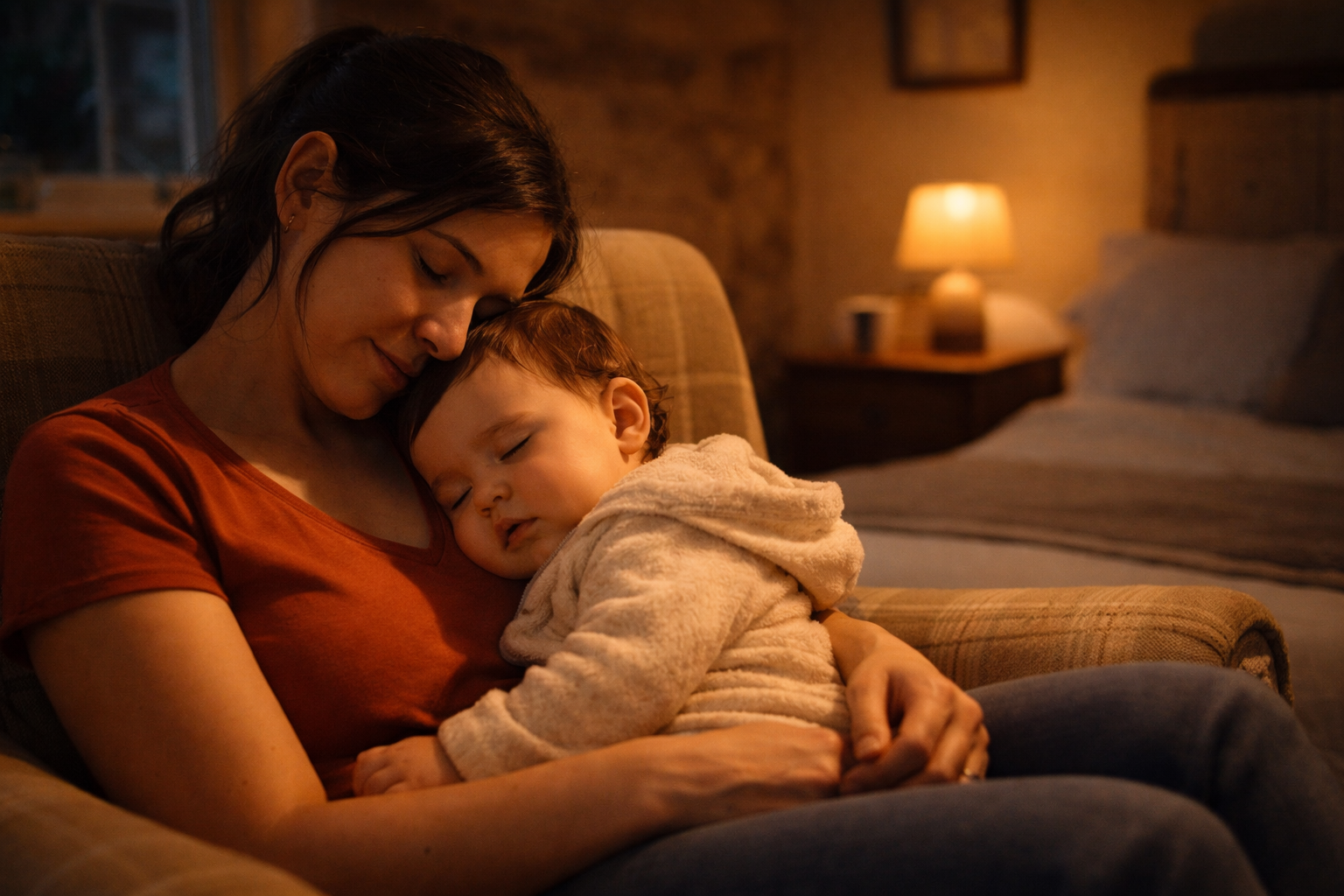
Why Babies Stop Sleeping on Holiday
Understanding why it happens does not immediately fix it, but it does make the 3am anxiety significantly more manageable. There are four main drivers.
The New Environment
New smells, new sounds, new light levels, different temperature, unfamiliar ceiling above the cot. Babies are acutely sensitive to environmental change — far more so than older children or adults. The sleep environment at home has been carefully associated with sleep over weeks or months. The holiday environment has not. That association has to be rebuilt, and the rebuilding takes 1–3 nights.
Routine Disruption
Even careful parents find that holiday schedules drift — later bedtimes, skipped naps, more stimulation than usual, later meals. Overstimulation is particularly relevant: a busy day at the beach, a long car journey, lots of new faces and experiences will wind a baby up rather than wind them down. An overtired baby does not sleep better — they sleep worse, because the cortisol response to tiredness actually interferes with settling.
Sleep Regression Timing
Sleep regressions typically occur at around 4, 8, 12, and 18 months, but they do not pause for holidays. If your baby was already showing signs of a developmental leap before you left, the combination of regression and new environment can be particularly rough. There is nothing to do about this except wait it out — regressions are temporary regardless of location.
The Parent Anxiety Feedback Loop
This is the one that nobody talks about but is genuinely significant. When you are anxious about whether your baby will sleep, your body language and tension communicate to them. Babies are extraordinarily sensitive to parental stress. A parent who tiptoes to the cot in a state of high anxiety is, however unintentionally, cueing the baby that there is something to be vigilant about. The calmer you can be — even if you have to fake it — the better. Easier said than done at 11pm, but worth knowing.
The First Night Reality
📋 Free Baby Holiday Packing Checklist
Enter your email and we'll send the free printable checklist straight to your inbox — every category, ready to tick off before every trip.
Almost every parent who has travelled with a baby reports the same thing: the first night is the worst. This is so consistent that sleep researchers have a name for it — the "first night effect." Even adults sleep less well in a new environment on the first night; our brains maintain a degree of vigilance in unfamiliar settings that is simply part of how we function.
For babies who cannot rationalise the new environment the way adults eventually can, the first night effect is amplified. The good news is that it is genuinely self-limiting. By the second night, the environment has moved from "unknown" to "known but unfamiliar." By the third night, it is usually close to normal.
The practical implication: plan nothing demanding for the morning after the first night. Give yourself the buffer to be functional humans who have not slept well. It is not wasted time — it is essential recovery.
What Actually Helps: Strategies Ranked by Impact
1. Recreate the Home Sleep Environment
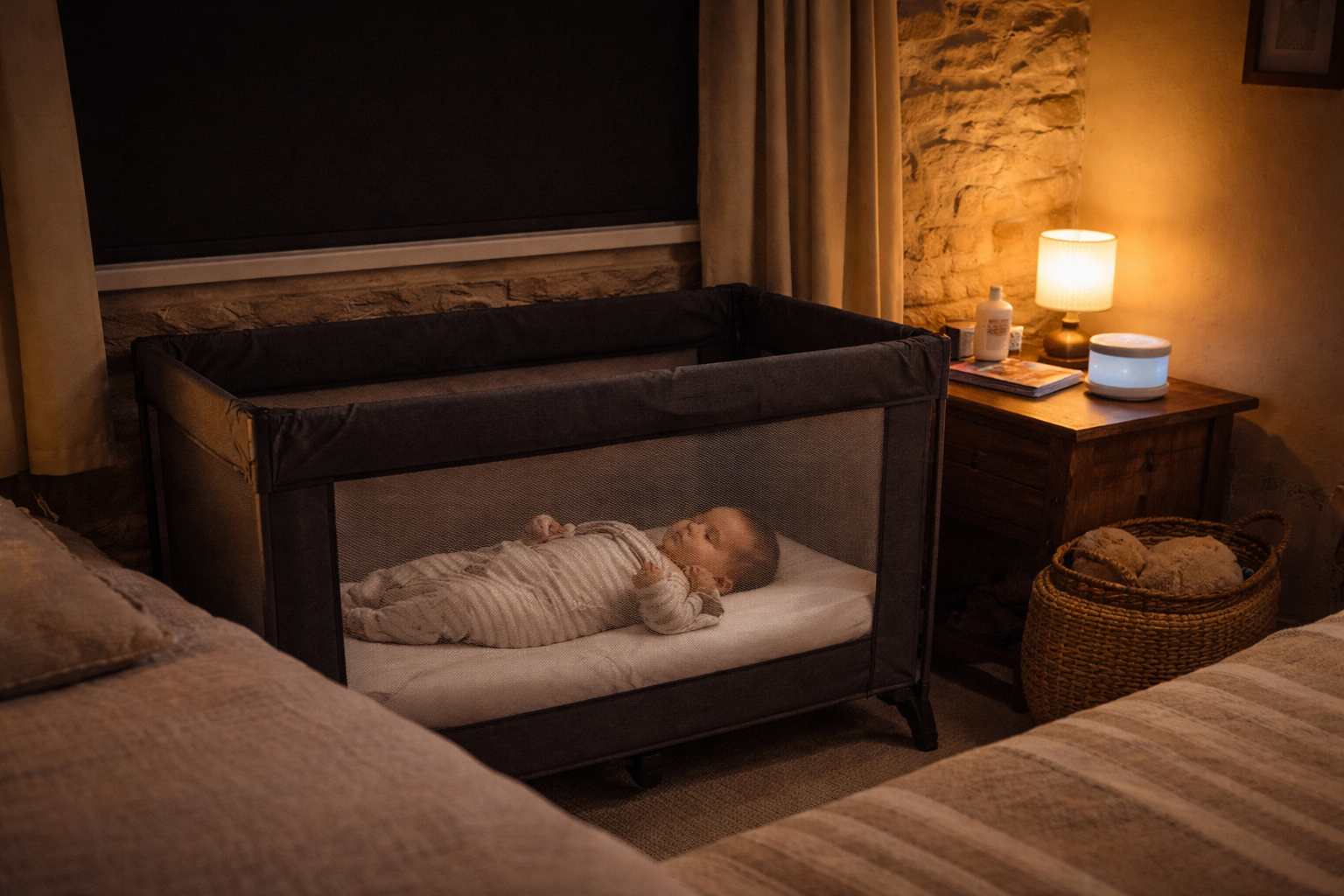
This is the single highest-impact strategy and it should be your first action, ideally before the first night rather than after. The goal is to make the sleep environment smell, sound, and feel as close to home as possible. The three essentials: a portable blackout blind (light is a primary sleep disruptor for babies), a white noise machine (masks unfamiliar sounds and provides a familiar auditory cue), and the baby's own sleeping bag from home. These three items can transform a strange room into something the baby's brain recognises as a sleep space.
2. Keep the Bedtime Sequence Identical
The sequence — not the clock time — is your most powerful tool. Bath, pyjamas, milk, book, sleeping bag, white noise, darkness. Whatever your sequence is at home, run it identically. The sequence is the conditioned sleep cue; the location becomes almost irrelevant once it is strongly established. A baby who recognises "this is what happens before sleep" will begin to settle even in an unfamiliar room because the sequence itself tells them what comes next.
3. Offer More Reassurance Than Usual
If your baby normally settles independently at home but is not doing so on holiday, sitting by the cot and offering a hand or a calm voice until they fall asleep is not a regression. It is a sensible, appropriate response to a genuinely unsettling situation. You can gradually move further from the cot over subsequent nights as the environment becomes familiar. Do not let anxiety about "undoing sleep training" stop you from responding — one week of extra reassurance will not undo months of work.
4. Protect Daytime Naps
The temptation on holiday is to push through tiredness to do more activities. Resist it. An overtired baby sleeps worse at night, not better. Protect at least one proper nap in a darkened room each day — not a buggy nap if you can avoid it, but a genuine lying-down nap in the travel cot. It feels like you are losing time, but the night that follows a protected nap day will be noticeably better than one where naps were rushed or skipped.
5. Check the Temperature
Holiday accommodation is notoriously variable in temperature — cottages with thick stone walls stay cold even in summer; holiday park lodges can be warm and stuffy at night; hotel rooms with floor-to-ceiling windows get very warm. An uncomfortable baby will not settle regardless of how good your routine is. Check your baby's chest and back — not their hands, which are an unreliable temperature indicator. Adjust their sleeping bag tog or add/remove a layer as needed.
6. Accept and Adapt — Including Co-Sleeping If Necessary
Sometimes, despite everything, the travel cot is not going to work on night one. Some parents make the pragmatic decision to co-sleep on holiday. If you do, follow safer co-sleeping guidance carefully. The Lullaby Trust guidance on safer co-sleeping covers the specific conditions that reduce risk — a firm flat surface, no alcohol or sedating medication, no soft bedding near the baby's face. It is a survival strategy for a difficult night, not a long-term plan.

BabyBjörn Travel Cot Light
Best for: consistent sleep setup away from home | Birth to approx. 3 years | Around £250–£280
One of the reasons babies struggle to sleep in unfamiliar travel cots is that the cot itself is unfamiliar — a different smell, a different firmness, a different height from the mattress. Using the same travel cot every trip builds an association between that specific cot and sleep. The BabyBjörn Light is worth the investment precisely because it is good enough to use consistently trip after trip — the mesh sides allow full airflow and visibility, and the single-piece fold means setup takes under a minute.
- ✅ Folds in one piece — no assembly, just unfold and it's ready
- ✅ Breathable mesh sides for airflow and easy visibility
- ✅ Firm, flat mattress — meets safe sleep guidelines without padding
- ❌ Premium price — significantly more expensive than budget travel cots
- ❌ Heavier than the lightest alternatives at around 5.5kg
What Doesn't Help
These are the things exhausted parents try that either make no difference or actively make things worse:
- Rigid insistence on "the plan." If the plan was the baby sleeping independently in the travel cot and it is clearly not working tonight, abandoning the plan and offering reassurance is not failure — it is appropriate flexibility. Stubbornly repeating the same approach at 1am, 2am, and 3am and expecting different results is not good for anyone.
- Screen time before bed. The blue light stimulates brain activity; the content is engaging rather than calming. If you are tempted to use the tablet to "tire them out," it will almost certainly have the opposite effect.
- Driving around at midnight. Sometimes this works for a specific nap, but as a repeated strategy it creates a car-sleep association that will complicate things further. Use it as a last resort for one specific night, not as a pattern.
- Comparing your baby to other people's babies. If someone tells you their baby "slept perfectly on holiday," they have either an unusually adaptable baby, a selective memory, or they are lying. Most babies find the first holiday night difficult. The ones that don't are the exception, not the standard.
The Night-by-Night Reality
| Night | What to Expect | What to Do |
|---|---|---|
| Night 1 | Likely rough — longer to settle, more night wakings, earlier morning waking. The "first night effect" is real and almost universal. | Offer extra reassurance. Run the sequence. Have a blackout blind and white noise in place. Plan nothing for the following morning. |
| Night 2 | Nearly always better than night 1. The environment is no longer completely unknown. Settling usually happens faster; fewer night wakings. | Same sequence. Offer reassurance but begin very gradually withdrawing — sit slightly further from the cot. Protect the daytime nap. |
| Night 3 | Usually close to normal. Most babies are settled into the new environment by now. Some early morning waking may persist. | Back towards your normal approach. Blackout blind still essential for early mornings. Start to relax — the hard part is usually over. |
| Night 4+ | Should be close to or at home normal. If significant disruption persists, check for illness, teething, or environmental factors (temperature, noise, light). | Normal routine. If still disrupted, work through the diagnostic checklist below. |
Why Baby Won't Sleep on Holiday: A Diagnostic Guide
| Symptom | Likely Cause | What to Try |
|---|---|---|
| Won't settle at bedtime, fine once asleep | New environment anxiety — brain staying alert | Extra reassurance at settling; sit by cot; white noise on |
| Wakes multiple times but settles with comfort | Light sleep cycles disrupted by unfamiliar sounds or light | Blackout blind, white noise, check room temperature |
| Wakes very early (before 6am) | Room too light at dawn; sleep pressure exhausted | Portable blackout blind essential; protect afternoon nap day before |
| Screaming rather than just unsettled | Overtiredness, or possible illness/teething | Check for fever, ear touching, rash; offer infant paracetamol if teething suspected |
| Fine at night but won't nap in travel cot | Nap association different to night sleep association | Buggy nap as alternative; or darken room more fully for nap attempt |
| Sleep suddenly worse after 3+ settled nights | Possible illness, teething, developmental leap, or overtiredness from a busy day | Check temperature, ear pulling; reduce stimulation next day; protect nap |
| Perfectly fine on some nights, terrible on others | Day-to-day overstimulation variation; developmental factors | Track what the previous day looked like — busier days often produce worse nights |
When to Abandon the Plan Entirely
Sometimes — despite the routine, the blackout blind, the white noise, and the reassurance — the baby is not going to sleep in the travel cot tonight. Accepting this before midnight rather than after is genuinely better for everyone. Here are the contingency options, ranked from most to least disruptive:
The buggy walk in the dark. Genuinely effective for some babies — the motion and the night air can settle a baby who is simply too wound up to sleep in a cot. Not a long-term strategy, but for one difficult night it can get everyone through to morning. The baby gets some sleep; you get a quiet walk; by the time you return they may be ready to transfer.
The late-night car drive. A last resort. Works for specific babies at specific ages. Creates car-sleep associations. Use sparingly and only when everything else has failed. If you do it once, do not plan on doing it every night.
Bringing them into your bed. If you do this, do it safely — firm flat mattress, no duvet near the baby's face, no pillows around them, no one in the bed who has had alcohol or taken sedating medication. The Lullaby Trust's safer co-sleeping guidance covers this in full. It is a legitimate choice for one or two difficult nights on holiday.
Taking shifts. If you are travelling as a couple, one parent takes the baby while the other gets 3–4 hours of unbroken sleep, then you swap. Neither of you gets a full night, but both of you get enough to function. It is unglamorous and it is not the holiday you planned. It is also how most parents survive the difficult nights.

Tommee Tippee Grobag Dreamsack 3.5 Tog
Best for: recreating the home sleep environment | Available in multiple sizes | Around £25–£35
The baby's own sleeping bag from home is one of the highest-value sleep tools you can take on holiday. It smells familiar, it provides familiar temperature regulation, and — crucially — it is strongly associated with sleep from months of consistent use at home. The Grobag 3.5 tog is particularly useful for UK and European holidays where cottage and holiday park accommodation temperatures vary widely; the warmth means your baby stays comfortable even if the room turns cold overnight.
- ✅ The familiar bag from home is a powerful conditioned sleep cue
- ✅ 3.5 tog handles variable UK and European accommodation temperatures
- ✅ Well-made, durable, and washes well after holiday use
- ❌ 3.5 tog is too warm for hot weather — a 1.0 tog alternative needed for summer abroad trips
- ❌ Sizing runs small; check the weight range carefully before buying
The Recovery: When You Get Home
Most babies snap back to their home sleep routine within 2–3 nights of returning. The familiar environment, familiar smells, familiar sounds — everything clicks back into place faster than you expect. Do not panic about long-term damage from a week of disrupted sleep. It does not exist.
Go straight back to your full home routine from the first night. Do not introduce new comfort measures at home that you only started on holiday (side-lying until asleep, for example) — if you want to withdraw those, start doing so immediately rather than letting them become the new normal. Be consistent, be calm, and expect 2–3 nights of readjustment. By night 3 at home, almost all babies are back to where they were before the trip.
When Sleep Problems Suggest Something Else
Most holiday sleep disruption is environmental. But some wakefulness is a signal that something else is wrong. Know the difference:
- Ear pulling or tugging — ear infections are more common after flying and swimming. A baby with an ear infection may settle in the daytime but wake screaming in the night when the lying-down position changes the pressure in the ear canal.
- Temperature over 38°C — this is a fever, not just teething. See a doctor or pharmacist.
- Refusing all fluids for more than 8 hours — needs medical attention.
- Unusual rash — especially any rash that does not fade under a glass tumbler pressed against it. Seek medical help immediately.
- Unusual lethargy or unresponsiveness — a baby who is genuinely inconsolable and cannot be comforted at all (rather than just unsettled) may be unwell rather than environmentally disturbed.
The NHS guidance on when to call a doctor for a baby is the clearest reference. If you are in any doubt, contacting a pharmacist or seeking medical advice is always the right call. A false alarm is infinitely preferable to waiting and worrying.
✈️ Free Baby Hand Luggage Checklist
Never forget the essentials. Enter your email and we'll send the free checklist straight to your inbox — one page, every category, ready before every flight.
Frequently Asked Questions
How long does it take for a baby to sleep normally on holiday?
Most babies settle into a near-normal pattern by night 3 in a new environment. Night 1 is almost universally the worst, night 2 is nearly always better, and by night 3 most babies are close to their home pattern. If significant disruption continues beyond night 4, it is worth checking for environmental factors (temperature, light, noise) or possible illness.
Should I bring a travel cot from home or use the one at the accommodation?
Bring your own where possible, or at least use the same travel cot on every trip. A familiar cot that smells and feels like previous holidays becomes a sleep-associated object in its own right. Accommodation-provided cots are often older, less comfortable, and unfamiliar in smell and texture — all of which work against settling. Our travel cots guide covers the best options for consistent travel use.
My baby sleeps perfectly at home but won't settle in the travel cot. What's different?
The cot itself is only part of it. The whole sensory environment is different — different smells, sounds, light levels, temperature. The travel cot may also have a different mattress firmness that feels wrong to a baby accustomed to their home mattress. Recreating the sensory environment (blackout blind, white noise, familiar sleeping bag) addresses most of this. Some babies also respond to a worn piece of parent clothing left near the cot — the familiar smell can be reassuring.
Is it safe to co-sleep in a hotel or cottage if the baby won't sleep in the cot?
It can be, if you follow safer co-sleeping guidelines carefully. The Lullaby Trust covers the specific conditions that make co-sleeping safer — a firm flat surface, no alcohol or sedating medication for either adult, no soft pillows or duvets near the baby's face, and no bed-sharing if the baby is premature or low birth weight. Hotel beds are generally firmer than home beds, which is safer. Avoid very soft mattresses or plush toppers.
Will a week of bad sleep on holiday ruin my baby's routine?
Almost certainly not. A week of disrupted sleep does not undo months of sleep training. When you return home and re-establish the full home routine immediately, most babies readjust within 2–3 nights. The key is not to bring holiday adaptations (new comfort measures, later bedtimes) back into the home routine — reset fully from night one at home and be consistent.
My baby slept fine for the first few nights but is now suddenly not sleeping again. Why?
A few possibilities: a busy activity day the day before (overstimulation catches up with a 24-hour delay), teething (can intensify unpredictably), a minor illness starting, or simply the normal variation that babies display even at home. Check for fever, ear pulling, or other signs of illness. If none of those apply, look at how stimulating the previous day was — a quieter, lower-key day usually produces a better night.
Can I use infant paracetamol to help my baby sleep on holiday?
Infant paracetamol is appropriate for pain relief — if your baby is teething or showing signs of ear discomfort, giving it 20–30 minutes before bedtime is a legitimate approach. It is not a sleep aid and should not be used simply because the baby is unsettled with no other symptoms. Always use the correct dose for your baby's age and weight, and never exceed the recommended frequency on the packaging.
What sleep kit should I always pack for any trip with a baby?
The non-negotiable sleep kit: a portable blackout blind (accommodation curtains are rarely as dark as claimed), a white noise machine (masks unfamiliar sounds), the baby's own sleeping bag from home (familiar smell and temperature regulation), and — if your baby uses one — their comforter or comfort toy. Everything else is optional. Our full packing list covers these in the sleep section.
A Final Word
A baby who won't sleep on holiday is not a reason not to take holidays. It is a stage, it is temporary, and it gets progressively easier with each trip as your baby builds familiarity with the concept of sleeping somewhere new. Most parents who have been through a rough first-holiday night report that by their third or fourth trip, sleep away from home was almost as reliable as sleep at home. You are laying that groundwork now, one difficult night at a time.