
Top 5 Baby-Friendly European Destinations for Summer 2026
By BabyTravel UK Editorial Team · Last updated July 2026
Short flights, warm weather, and beaches that actually work with a baby. Here's where to go — and what to know before you book.
Taking a baby to Europe feels like a big step. But for most families, a short-haul flight to a warm, well-equipped destination is genuinely manageable — and often far more relaxing than a soggy UK summer spent hoping for two consecutive dry days. The key is knowing which destinations actually work with a young baby: calm, shallow beaches, short transfer times, reliable medical facilities, and accommodation set up for families rather than adapted around them.
This guide covers the five European destinations that consistently deliver for UK families with babies under 2. All are within four hours' flying time from UK airports. All have healthcare systems covered by the free GHIC card. And all are accessible in shoulder season without the dangerous peak-summer heat that makes July and August genuinely unsuitable for the youngest babies. If you're in the thick of planning your first holiday with a baby, this is where to begin.
Baby-Friendly European Holidays: Key Points
- Best age to start: 6 months+ for peak-heat destinations; 3 months+ for shoulder season or the French Riviera
- Shoulder season wins: May/June or September — 4–8°C cooler, cheaper, quieter, and much safer for young babies
- GHIC card: Apply free before you travel — every family member, including your baby, needs their own
- Travel insurance: Essential — the GHIC covers treatment, not repatriation or delays
- All five destinations are under 4 hours from UK airports; shorter is better when managing a baby on a plane
At a Glance: Comparing the Top 5
Before we go into detail, here's how the five destinations compare on the factors that matter most when travelling with a baby.
| Destination | Flight Time (London) | Best For Age | Avg Temp (July) | Accommodation Style | Rating |
|---|---|---|---|---|---|
| Majorca, Spain | ~2h20 | 6 months+ | 30°C | All-inclusive resorts, family apartments | ★★★★★ |
| Algarve, Portugal | ~2h40 | 6 months+ | 28°C | Self-catering villas, family hotels | ★★★★★ |
| Sardinia, Italy | ~2h35 | 6 months+ | 29°C | Family villas, smaller hotels | ★★★★☆ |
| Crete, Greece | ~3h40 | 9 months+ | 32°C | Large family resorts, apartments | ★★★★☆ |
| French Riviera, France | ~1h50 | 3 months+ | 27°C | Gîtes, city apartments, boutique hotels | ★★★★☆ |
Temperatures shown are July averages. Shoulder season (May/June or September) is 4–8°C cooler and strongly recommended for babies under 9 months.
1. Majorca, Spain — Our Top Pick for Baby-Friendly European Holidays
📋 Free Baby Holiday Packing Checklist
Enter your email and we'll send the free printable checklist straight to your inbox — every category, ready to tick off before every trip.
Majorca has been the go-to family holiday destination for UK parents for decades, and for good reason: the infrastructure for families with young children is genuinely excellent. This isn't luck — it's a deliberate part of the island's tourism economy. Family resorts in the north, around Alcúdia Bay, offer on-site baby equipment hire (cots, highchairs, sterilisers and bottle warmers at many hotels), pools a few inches deep designed specifically for toddlers, and beaches that are about as safe for young children as any stretch of sand in Europe.
The best area for babies is Alcúdia Bay on the north coast. Playa de Muro — a 6km arc of fine white sand — is one of the most consistently recommended beaches in the Mediterranean for families with young children: the water is flat, crystalline, and so shallow it barely reaches waist height 20 metres from the shore. Puerto Alcúdia at the southern end of the bay has excellent supermarkets stocked with European baby brands, pharmacies, and all the practical facilities you'd want close by. The resort strip itself is well-maintained and walkable without being overwhelming.
From London, Majorca (Palma airport) is roughly 2h15–2h30 by air. From Manchester or Edinburgh, budget around 2h45–3hrs. Multiple carriers fly direct year-round, which keeps prices competitive. The island is well connected from most major UK departure airports.
The one firm caveat: July and August temperatures regularly reach 33–36°C, which is dangerous for babies under 6 months and uncomfortable for those under 12 months. The NHS advises keeping babies under 6 months out of direct sunlight entirely — in peak Majorcan summer, that means essentially staying indoors between 10am and 5pm. Travel in May, June, or September instead: temperatures sit at a comfortable 22–26°C, prices are meaningfully lower, and the beaches are quieter.
Spain has a good public healthcare system, and the GHIC card is accepted at public facilities across the island. Majorca's main hospital is in Palma; most resort areas have a local health centre within a short drive.
Our Tip
If you're travelling with a baby who's not yet eating solids, Majorca's large all-inclusive resorts often have dedicated family concierge teams who can arrange steriliser facilities, warm water for bottles, and specific baby meals. It's worth calling ahead before booking to confirm what's available — the best resorts genuinely go out of their way.
Best for: Families who want maximum facilities and ease, especially on their first trip abroad with a baby. Also a strong choice if you want a large resort with an all-inclusive option so you're not worrying about meal logistics.
2. Algarve, Portugal — Best for Value and a Welcoming Culture
Portugal has a well-earned reputation as a family destination, and the Algarve is the standard-bearer. What sets it apart isn't just the beaches — it's the culture. The Portuguese genuinely welcome children in restaurants, cafés, and public spaces. Where some Mediterranean destinations can feel as though families with babies are merely tolerated, in Portugal they're actively included. Restaurant staff will fetch highchairs without being asked, plates come in portions suited to small appetites, and the pace of life is relaxed enough to accommodate babies who don't operate on a schedule.
For families with babies, the central and eastern Algarve offers the most practical options. Meia Praia near Lagos is a long, calm, sandy beach with gentle conditions well-suited to young children. Armação de Pêra is a working fishing town with a wide beach, excellent facilities, and a local feel that keeps it from feeling entirely touristic. Vilamoura, the marina resort in the central Algarve, is polished and convenient — good supermarkets, reliable restaurants, a clean beach within easy reach. For villa holidays, the upmarket Quinta do Lago and Vale do Lobo area in the eastern Algarve is quieter, with private pool access making hot afternoons much easier to manage.
A note on the sea: the Algarve faces the Atlantic, not the Mediterranean. The water is generally cleaner and slightly cooler than Spanish island beaches, which many parents prefer for babies. However, some western Algarve beaches — particularly near Sagres and the dramatic clifftop coastline — have Atlantic swells and undertow that are not suitable for babies or toddlers. Always check conditions at the specific beach, and stick to the eastern and central sections for families.
Flight time to Faro from London is around 2h30–2h45. Direct flights are available from most UK regional airports. In terms of cost, the Algarve is consistently better value than Majorca — self-catering villas with private pools are significantly more affordable, and food and drink across the board is cheaper. For a family on a budget, the value case is hard to argue with.
Best for: Families who want value, quality villa rental, a welcoming local culture, and a beautiful setting. Particularly good in June and September, when the Atlantic air keeps temperatures below 26°C.
3. Sardinia, Italy — Best for Natural Beauty and Quiet Beaches
Sardinia is the destination on this list that most rewards families willing to do a little more research. The package-holiday infrastructure isn't as developed as Majorca or the Algarve, but what Sardinia offers instead is extraordinary: some of the clearest, most beautiful water in the Mediterranean, beaches that are genuinely uncrowded outside peak August, and an Italian food culture that welcomes children so naturally it barely feels worth mentioning.
For babies specifically, the north-west of the island is the most celebrated. La Pelosa near Stintino is the Sardinia beach that appears on every list for good reason: water so shallow and so clear that you can see the sandy bottom for 40 metres from shore, with no waves, no undertow, and the island of Asinara visible on the horizon. For a baby who wants to splash and be held in the water, it's as close to ideal as a natural beach gets. Further south, Villasimius on the eastern cape and Cala Brandinchi near San Teodoro offer similarly exceptional conditions with more local facilities nearby.
Italian dining culture is part of the experience. Restaurants don't serve children in a corner with a paper placemat and a kids' menu — they simply include them, as they do everyone. Plain pasta, grilled fish, bread, and soup are available everywhere. You will not struggle to feed a baby or toddler well.
The practical considerations: direct flights to Sardinia (Cagliari in the south, Olbia in the north) operate from London Gatwick and a handful of other UK airports, but coverage is patchier than for Majorca or Faro. Check availability from your departure airport carefully, as routes fill up quickly. Budget around 2h30–2h45 from London. Sardinia is also not cheap — villa rental is comparable to the upmarket Algarve, and eating out in tourist areas is priced accordingly.
Best for: Families prioritising natural beauty and quieter beaches over resort infrastructure. Particularly well-suited to families hiring a villa and self-catering, who are comfortable navigating a destination that rewards exploration.
4. Crete, Greece — Best for Large Resorts and a Long Season
Crete is the largest Greek island and has a well-developed north coast resort infrastructure that makes it one of the more accessible Greek destinations for families. The island's size works in its favour: there's enough variety between the different resort areas to suit different kinds of family holiday, and the north coast towns — Heraklion, Rethymnon, Hersonissos — have all the practical amenities a family needs close by.
The standout beach for families with young babies is Georgioupolis, a short drive west of Rethymnon. This is where a river meets the sea, creating a broad, sandy beach with water that is astonishingly shallow for a long stretch from the shore — ankle-depth for 10 metres or more, with almost no wave action. It's the kind of beach where a baby can sit in the shallows and splash without any risk, while you sit a metre away on the sand. The town behind it is pleasant without being a purpose-built resort, with a good range of tavernas and a relaxed atmosphere. Further east, Elounda offers a calm, sheltered bay with upmarket accommodation and beautiful scenery.
There are two practical considerations to weigh carefully before choosing Crete. First, the flight time is longer than the other destinations on this list — typically 3h30–3h45 from London, closer to 4hrs from northern UK airports. A 4-hour flight with a baby is a meaningfully different experience to a 2.5-hour one: it's a longer time to manage feeding, settling, and entertainment in a confined space. Our guide to your baby's first flight has practical strategies for managing longer journeys. Second, Crete in July and August regularly hits 33–35°C. The shoulder season recommendation applies even more strongly here than in Portugal or France — September in Crete, with sea temperatures still around 24°C and air temperatures in the mid-20s, is genuinely excellent.
Best for: Families with babies 9 months+ who want a large resort holiday with good facilities. Particularly good for September travel, when the sea is warm, prices drop, and the heat becomes very manageable.
5. French Riviera and Provence, France — Best for Younger Babies and Short Flights
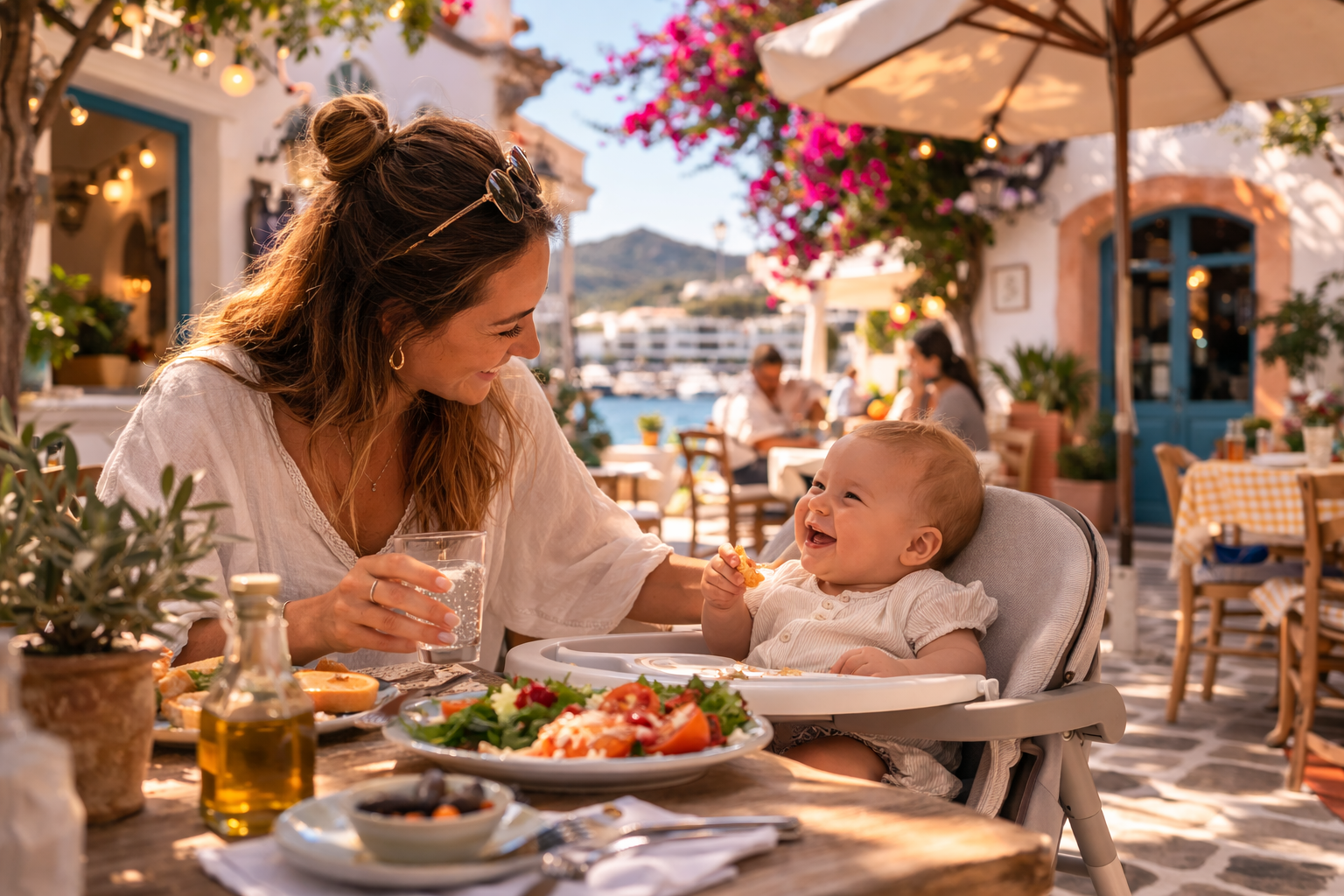
The French Riviera earns its place on this list partly because of the flight time. Nice is just 1h45–2hrs from London — making it the shortest journey on the list, and genuinely significant when you're managing a baby on a plane. From London, there's also the Eurostar option: Paris in 2h15, then a TGV to Nice in around 3h15. It's not always the most practical route with a baby and luggage, but it removes airport security altogether, gives you much more physical space, and is worth knowing about — particularly if you're travelling with a large amount of kit or have an older baby who needs to move around.
Nice itself is a proper city with outstanding healthcare (the Côte d'Azur has some of the best private and public hospitals in France), every practical amenity imaginable, and a promenade along the seafront that's ideal for walking and fresh air. The city beach is pebbly rather than sandy — honest note — but the old town, the covered markets, and the café culture make it a pleasure to base yourself in regardless of the beach situation. For sandy beaches, Antibes and Cannes (30 minutes by train from Nice) have better options, alongside a more relaxed resort atmosphere. Further west, Bandol and Cassis are smaller, more characterful, and have calmer, more family-friendly beaches.
The Riviera's temperatures are warm but more moderate than Spain or Greece: Nice averages around 27–29°C in July, which is hot but manageable with shade and sensible timing. May, June, and September are genuinely lovely — 21–24°C, mostly sunny, significantly quieter and cheaper than the peak-season crowds. For babies under 6 months, the French Riviera in shoulder season is the most accessible European option on this list: the short flight, the world-class healthcare nearby, and the cooler temperatures make it a reasonable first international trip even for quite young babies.
French food culture handles children well at most levels of dining. Self-catering in a gîte with access to local markets, bakeries, and cheese shops is a particularly popular option for UK families — and significantly more affordable than the hotel-heavy alternatives on the Riviera proper.
Best for: Younger babies in shoulder season, cultural travellers, families who want a combination of city and beach, and anyone who values a short flight time or the option to travel by train rather than plane. Also the best option if you want to combine a beach holiday with genuine local culture rather than a resort environment.
What Every Family Needs to Know Before Going
Heat and Sun Safety: The Most Important Factor
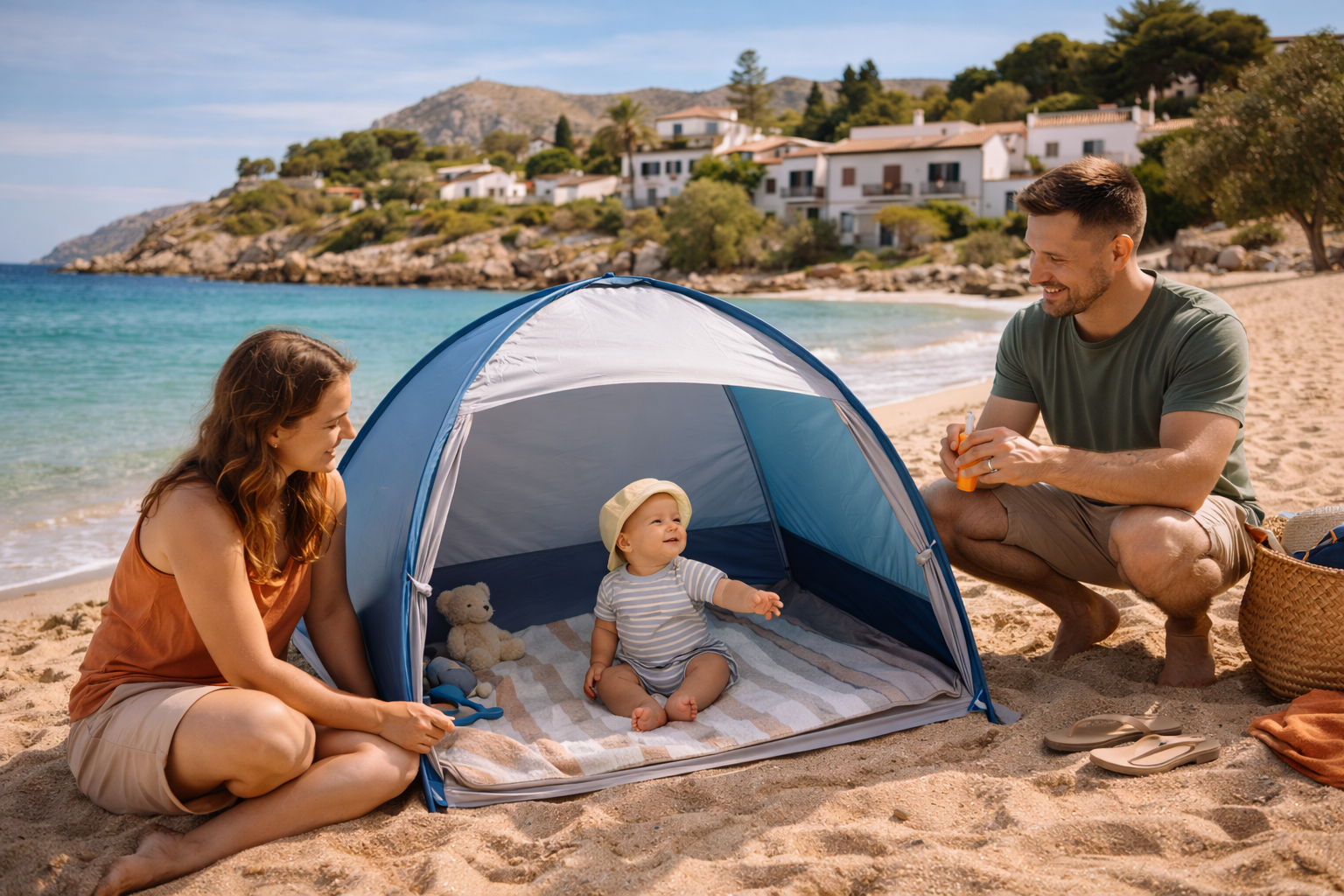
Heat management is the single biggest consideration for European travel with a baby. The NHS sun safety guidance is clear: babies under 6 months should be kept out of direct sunlight entirely, as their skin has almost no protective melanin and sunscreen is not recommended for this age group. For babies 6 months and over, factor 50 sunscreen on all exposed skin, a sun hat with neck coverage, UV-protective clothing, and shade between 11am–3pm are all essential in the Mediterranean sun.
At all ages, the practical beach strategy for Mediterranean destinations is: morning sessions (before 11am) and late afternoon (after 3.30pm), with the middle of the day spent in shade, at a restaurant, or in air-conditioned accommodation. This applies at all five destinations — it's not a peak-season-only concern. Even in June, Mediterranean midday sun is intense enough to cause sunburn and overheat a young baby rapidly.
Your GHIC Card — Apply Before You Go
The Global Health Insurance Card (GHIC) replaced the EHIC for UK travellers after Brexit. It's free to apply for and entitles you to emergency and necessary healthcare in EU countries at the same cost as local residents. Every member of your family — including your baby — needs their own card. Apply via the NHS website — you'll need your baby's name, date of birth, and NHS number (found in their red book). Cards typically arrive within 7–10 days.
One important note: the GHIC covers treatment but not repatriation, not lost or emergency medication, and not trip cancellation due to illness. You still need travel insurance — and this matters considerably with a baby, where unexpected GP visits, short hospital stays, and changes to travel plans are all genuinely possible.
Travel Insurance — Essential, Not Optional
Most family travel insurance policies include children automatically, but check the policy carefully before buying. Key things to confirm: that the baby is covered from birth (some policies have a lower age limit of 3 months), that the medical coverage limit is substantial (look for at least £2 million for medical expenses), and that the policy covers cancellation if your baby is unwell before travel. Always declare any known health conditions — including any that arose at birth or during early weeks — as failing to declare can invalidate a claim.

Don't Forget Travel Insurance
Compare family travel insurance policies — covers medical emergencies, cancellations, and lost luggage.
Compare Travel InsuranceFormula and Nappies Abroad
Formula and nappies are available in supermarkets and pharmacies across all five destinations, but the specific brands differ from UK products, and formula formulations — even from the same manufacturer — can vary between countries. If your baby is settled on a particular UK formula, switching mid-holiday can cause digestive upset. The practical approach: bring enough formula for the first 2–3 days of your trip, then locate a local supermarket or pharmacy and assess what's available. If your baby is very formula-specific, bringing enough for the full trip is a reasonable precaution. Nappies are universally available and size systems are consistent.
Check FCO Travel Advice
It takes 30 seconds and is worth doing before any international trip. The UK government's Foreign Travel Advice pages cover entry requirements, local laws, health risks, and safety information for every destination. For Western European resort destinations this is largely routine, but it's the right habit to have — and entry requirements can change, particularly for documentation (including children's passports).
What to Check Before You Book
| Check | Why it matters |
|---|---|
| GHIC card for all travellers (including baby) | Covers EU emergency healthcare — free to apply, issued per person. Apply at least 2 weeks before departure. |
| Travel insurance that covers your baby | Confirm age coverage, medical limits, and cancellation terms. The GHIC does not replace this. |
| Baby's passport is valid | UK babies need their own passport for all international travel. Apply early — processing typically takes 3 weeks. |
| Flight time from your actual departure airport | Majorca is 2.5hrs from London but 3hrs from Leeds. Crete is 4hrs+ from some northern UK airports. Shorter matters with a baby. |
| Travel dates vs average temperature | July/August peaks at 30–35°C across most of these destinations. Shoulder season is safer and more practical for young babies. |
| Cot policy at your accommodation | Does your hotel or villa include a travel cot? Is there a charge? What mattress is provided? Confirm before arrival. |
| Transfer time from the airport | A 2-hour airport transfer at each end of a 2.5-hour flight adds significantly to the journey. Check before booking — it's not always obvious. |
| Nearest medical facility to accommodation | Worth knowing in advance, especially for babies under 6 months. Look up the nearest health centre (centro de salud / centro de saúde / cabinet médical). |
| Sun and shade plan for the beach | A UV pop-up tent or large parasol is essential. Many beaches charge for umbrellas — bringing your own gives you flexibility and saves money. |
| Formula/nappy supply for first days | Bring enough for 2–3 days until you've located local supplies. Formula brands differ across Europe. |
Getting There: The Flight Itself
All five destinations are within 4 hours — but a 4-hour flight and a 2-hour flight are very different with a baby, particularly once you add airport time, security, boarding, and the transfer at the other end. Our guide to flying with a baby for the first time covers the full airport experience, and the baby hand luggage checklist covers exactly what to pack in the cabin bag. A few destination-specific notes:
For Majorca, the Algarve, and Sardinia, the total door-to-door time from most UK cities is comfortably under 6 hours — manageable even for younger babies. Crete adds around 90 minutes to the flying time, which tips the balance toward being a better fit for older, more settled babies. The French Riviera, with its short flight time, is the gentlest introduction to air travel with a young baby.
For the flight itself, a compact cabin-friendly stroller and a baby carrier are genuinely useful: the stroller goes in the hold or at the gate, and the carrier keeps your hands free through security, boarding, and the airport itself. Understanding everything about flying with a baby before you go removes most of the anxiety. Having a solid plan for keeping your baby's routine on holiday helps once you arrive.
Finally, don't forget your full packing list — going abroad adds a few additional items (passport, GHIC card, travel insurance documents, formula in hand luggage) that are easy to overlook in the main rush of packing.
Need a Hire Car?
Compare car hire from all major providers — most include free cancellation and baby seat options.
Sun & Beach Essentials
The kit that makes Mediterranean beach days genuinely relaxed, whether you're in Majorca, the Algarve or on the French Riviera — sun-safe cover, shade, and a way to keep your baby cool.
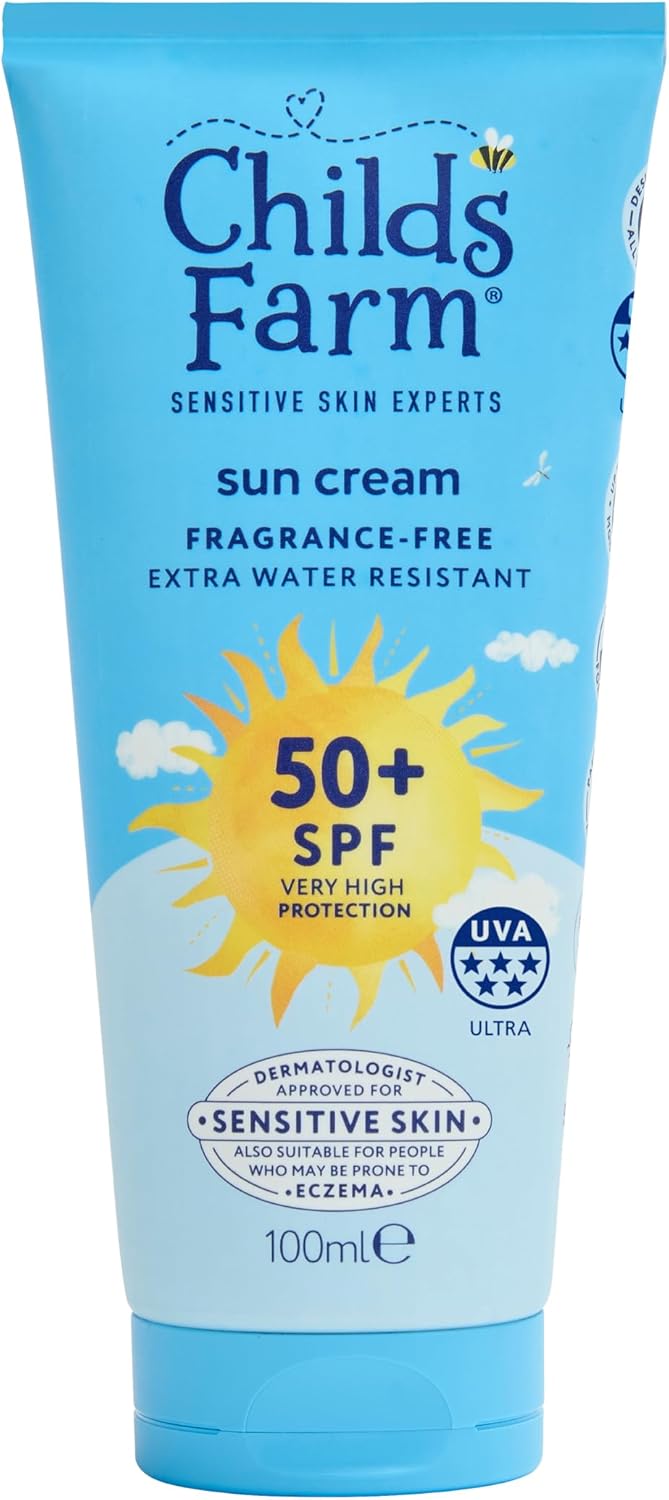
Childs Farm SPF 50+ Sunscreen
Fragrance-free SPF50+ made for babies' delicate skin (6 months+).
Check price on Amazon
Splash About UV All-in-One Swimsuit
UPF50+ all-in-one covering shoulders to knees for pool and beach.
Check price on Amazon
Splash About Happy Nappy (Reusable Swim Nappy)
Reusable swim nappy that meets most pools' double-nappy rule.
Check price on Amazon
Babymoov Anti-UV Pop-Up Sun Tent
Pop-up UPF50+ tent for shade and a cool nap spot.
Check price on Amazon

SkyGenius Clip-On Fan
Rechargeable clip-on fan to keep the pram cool in the heat.
Check price on AmazonSleep-Abroad Essentials
Unfamiliar, bright hotel rooms are the usual reason babies won't settle in a new time zone. These three recreate the dark, quiet, familiar feel of home.

Tommee Tippee Sleeptight Blackout Blind
Suction-fit blackout blind for dark naps in bright hotel rooms.
Check price on Amazon
SlumberPod
A dark, private sleep canopy over the travel cot — great for jet lag.
Check price on Amazon
Yogasleep Hushh White Noise
Rechargeable pocket white noise to mask unfamiliar hotel noise.
Check price on Amazon
Find Baby-Friendly Hotels
Search baby-friendly hotels with free cancellation, cot requests, and family room options.
Search Hotels on Booking.com✈️ Free Baby Hand Luggage Checklist
Never forget the essentials. Enter your email and we'll send the free checklist straight to your inbox — one page, every category, ready before every flight.
Frequently Asked Questions
What age can you take a baby on a European holiday?
There is no legal minimum age, but most health professionals advise waiting until at least 6–8 weeks before flying with a healthy, full-term baby. For Mediterranean destinations where heat is a significant factor, 6 months is a more practical starting point for most families — it's when sunscreen becomes usable, when the baby is more robust, and when you as parents are likely to be less exhausted. The French Riviera in shoulder season (May/June or September, temperatures around 22–24°C) is accessible from around 3 months for those ready to travel earlier.
Do babies need their own GHIC card for Europe?
Yes. The GHIC is issued per person, not per household. Your baby needs their own card, applied for separately. You'll need their NHS number (found in the red book), name, and date of birth. Apply free of charge via the NHS website at least two weeks before travel — cards typically arrive within 7–10 days but can take longer in busy periods.
Is Majorca or the Algarve better for a baby?
Both are excellent, and the honest answer is that it depends on your priorities. Majorca edges ahead on resort infrastructure — the large family resorts around Alcúdia Bay are specifically set up for babies and toddlers, with equipment hire, baby pools, and family-focused facilities. The Algarve wins on value, villa quality, and a slightly cooler Atlantic climate that can be better for younger babies in shoulder season. Neither is a wrong choice.
What travel insurance do I need for a baby in Europe?
Most family travel insurance policies include dependent children automatically, but check the policy wording. Confirm: that infants are covered (some policies have a lower age limit), that the medical coverage limit is at least £2 million, and that the policy covers cancellation if your baby is unwell before travel. Always declare any known health conditions — even those that have resolved, or that arose at or around birth.
When is the best time to take a baby to the Mediterranean?
May, June, or September. Peak-season temperatures across all five destinations regularly hit 30–35°C in July and August — which is unsafe for babies under 6 months and genuinely uncomfortable for those under 12 months. Shoulder season brings 22–27°C temperatures that are warm but manageable, lower prices, quieter beaches, and a much more relaxed holiday overall. It's not a compromise: shoulder season is simply a better time to go with a young baby.
Can I take a pushchair to Europe?
Yes — and it's usually worth it. The practical advice is to travel with a compact travel stroller rather than a full-size pushchair: lighter to carry, easier to gate-check, and much more manageable on cobbled European streets and café terraces. Some lightweight strollers can be carried as cabin baggage depending on the aircraft type. Our cabin-friendly stroller guide covers the models that genuinely work for short-haul trips. A carrier as a complement to the stroller — particularly useful through airports and security — is worth packing regardless.
Do you need to bring baby formula to Europe?
Bring enough for the first 2–3 days of your trip, then buy locally once you've located a supermarket or pharmacy. Formula is available across Western Europe, but the brands differ from UK products and formulations can vary even when the brand name appears similar. If your baby is settled on a specific UK formula and you're concerned about digestive upset from switching, bringing enough for the full trip is a sensible precaution. For most short holidays of 7–10 days, this is a manageable amount to pack.
Is Crete safe for babies?
Yes, with appropriate heat management and timing. Crete has good medical facilities on the north coast, calm family beaches at places like Georgioupolis, and a warm and welcoming local culture. The main considerations are the longer flight time (3.5–4hrs, which is more demanding with a baby) and the peak summer heat (regularly 33–35°C in July and August). For babies under 9 months, September travel to Crete is significantly more comfortable — sea temperatures are still warm at 24°C, the air temperature drops to the mid-20s, and the island is pleasantly quiet.
Choosing Your First European Baby Holiday
All five destinations on this list are genuinely good choices for families with babies — the difference comes down to your priorities, your baby's age, and when you're travelling. For ease and infrastructure, Majorca is hard to beat. For value and culture, the Algarve. For natural beauty, Sardinia. For longer stays with older babies, Crete. For younger babies or those who want a shorter flight, the French Riviera.
Whatever you choose, the same principles apply: travel in shoulder season where possible, sort your GHIC card before you go, plan your hand luggage carefully, and don't underestimate the value of good accommodation with the basics sorted — a cot, a kitchen, and somewhere to put the changing bag. The rest will follow.