
Best Stroller for Holidays Abroad (UK Family Guide)
By BabyTravel UK Editorial Team · Last updated July 2026
Holiday stroller decisions should be based on destination and routine, not generic rankings. A model that works for a city break can feel frustrating at a beach resort. A model built for comfort can feel too bulky for frequent transfers.
This guide helps UK families choose by travel scenario so your stroller supports the trip instead of slowing it down.
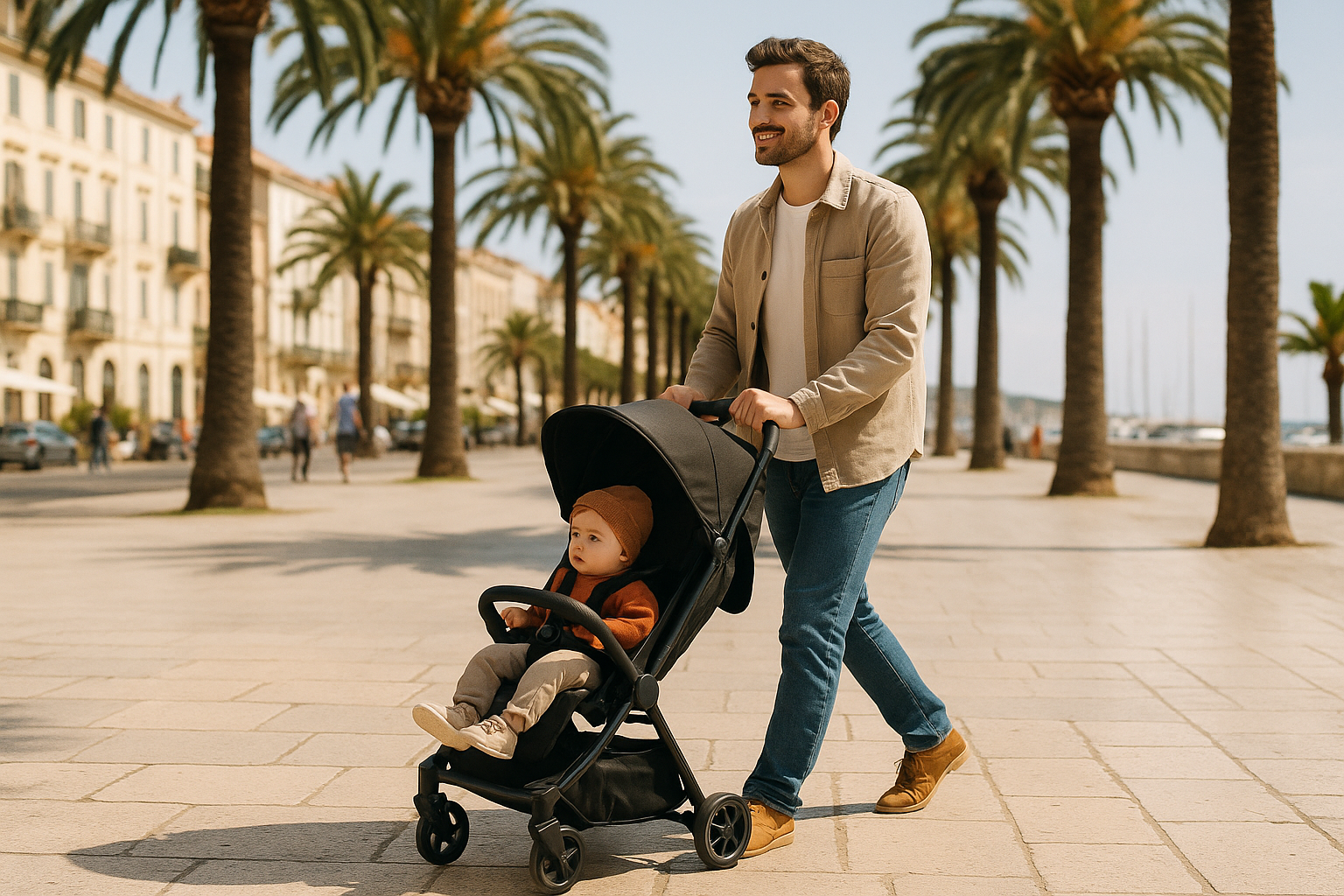
Quick destination-based picks
| Trip type | Recommended stroller type | Priority |
|---|---|---|
| City break | Compact lightweight | Fold speed + mobility |
| Resort holiday | Comfort-focused compact | Seat comfort + canopy |
| Multi-stop itinerary | Travel-ready all-rounder | Carry + reliability |
Top stroller picks for holidays abroad
| Category | Product | Why | Link |
|---|---|---|---|
| Best all-round holiday pick | Babyzen YOYO² | Strong portability and trip flexibility | Check price |
| Best comfort + premium handling | Bugaboo Butterfly | Smooth ride and refined fold behaviour | Check price |
| Best carry-ease travel option | Joolz Aer+ | Light carry and easy movement on transfers | Check price |
| Best value holiday option | Baby Jogger City Tour 2 | Balanced travel function without premium cost | Check price |
What changes by destination
📋 Free Baby Holiday Packing Checklist
Enter your email and we'll send the free printable checklist straight to your inbox — every category, ready to tick off before every trip.
City breaks
Need: quick fold, tight turning, easy carrying. You will likely face stations, stairs, and crowded walkways. Our London stroller guide covers what this looks like in practice on the Tube and buses.
Beach/resort
Need: better canopy, comfort support, and practical storage. Transfer speed still matters, but comfort gets bigger weight. For sun and heat specifically, our guide to strollers for hot weather covers canopy quality and airflow across popular holiday models.
Road trip holidays
Need: reliable loading and stability over repeated daily use.
Holiday prep checklist
- policy check for airline handling
- fold rehearsal before departure
- essentials pouch fixed and reachable
- accessories minimised for transfer phases
- backup carry option considered
How to avoid holiday stroller regret
Use this rule: choose for your most frequent holiday movement phase, not your nicest holiday moment. If your trip has many transfers, mobility wins. If your trip is mostly long promenade use, comfort wins.
Travel safety and policy references
For up-to-date handling guidance, check CAA passenger pages, GOV.UK rules, and your airline family page.
How to choose by holiday type instead of generic rankings
Most families search for one “best stroller for holidays abroad,” but the truth is more specific. The right stroller for your trip depends on transport type, destination layout, and daily rhythm. A great city-break stroller can be the wrong tool for resort-heavy travel. A comfort-first model can be awkward on transfer-heavy routes.
This section helps you map your trip to the right stroller profile so your decision reflects real conditions, not abstract scores.
Holiday type breakdown
City break holidays
Need quick fold, easy carry, and strong steering in tighter spaces. You will likely face transport transitions, narrow pavements, and frequent stop-start movement.
Resort holidays
Need comfort and weather protection. Long promenade use and daily outing blocks make seat quality, recline practicality, and canopy performance more important.
Road-trip or multi-stop holidays
Need loading reliability and repeatable setup. You will fold/unfold often and need a model that stays consistent under repeated use.
How climate changes stroller priorities
Hotter destinations increase the importance of airflow, shade, and hydration access. Cooler destinations make wind and rain protection more relevant. Choose based on expected weather, not ideal-weather assumptions.
The transfer-effort rule
If your itinerary has multiple transfers per day, prioritise fold speed and carry behaviour over premium extras. If your itinerary has fewer transfers and longer seated use, comfort moves up the priority list.
This rule alone improves most holiday stroller decisions.
Airport-to-hotel workflow plan
- Confirm stroller handling before boarding.
- Keep one essentials pouch outside stroller storage.
- Minimise accessories before gate handover.
- Switch to backup carry method if return is delayed.
- Reset setup at destination before first outing.
Consistency here makes arrival days far easier.
What experienced travelling parents do differently
- they test fold/carry at home before departure
- they pack by access frequency, not by item category
- they ask direct handling questions early
- they avoid over-accessorised travel-day setups
These habits are simple and repeatable, which is why they work.
Cost planning for holiday strollers
Do not spend for features you will not use. Spend where friction is frequent. If you do several trips per year, better fold reliability and carry comfort can be worth the extra cost. If trips are occasional, strong value models can be the smarter purchase.
Common holiday buying mistakes
Mistake 1: choosing by looks first. Fix: choose by route and transfer pattern.
Mistake 2: ignoring destination weather. Fix: prioritise canopy/coverage as needed.
Mistake 3: overloading accessories. Fix: carry only proven essentials.
How to run a realistic pre-trip test
- simulate a short transfer with luggage
- fold/unfold three times under mild time pressure
- push on mixed pavement and curb transitions
- test comfort after 20–30 minutes of continuous use
If this test feels smooth, your holiday setup is likely strong.
Official policy links to check each trip
Always verify current policy details via CAA passenger guidance, GOV.UK rules, and your airline family pages.
30-day post-trip review method
After holiday return, write down three friction points and one fix per point. Apply fixes before next trip. This approach gives better long-term outcomes than replacing gear too quickly.
Final practical takeaway
There is no single best stroller for all holidays abroad. There is only the best fit for your destination pattern and movement reality. Choose for repeatable ease, and your trips will feel much smoother. If you're heading to a European beach, our European beach holidays with a baby guide covers specific destinations worth considering — and what stroller terrain you'll actually face.
Detailed practical framework for better decisions
When content around strollers feels vague, parents end up making expensive trial-and-error choices. A stronger approach is to use a repeatable framework with clear decision points. This section gives that framework in practical language so you can apply it immediately.
Start by identifying your highest-frequency movement pattern, not your occasional edge case. Most families do better when their setup is optimised for daily or weekly reality. Occasional edge cases can be managed with small process adaptations.
Step 1: Define your top friction points
Write three moments where your current setup feels hardest. Examples include loading into a small boot, folding at a station, navigating crowded areas, or sustaining child comfort on longer outings. This list should be specific and honest.
Step 2: Weight by frequency
Give each friction point a frequency score: high, medium, or low. High-frequency friction should dominate buying decisions. This keeps you from overpaying to solve low-frequency issues.
Step 3: Test under realistic conditions
Run quick practical tests with realistic load and mild time pressure. If a setup works only in ideal conditions, it will likely fail in real conditions.
Decision matrix parents can use immediately
| Question | If yes | If no |
|---|---|---|
| Do you carry frequently? | Prioritise lighter, balanced carry design | Prioritise comfort and stability |
| Do you transfer often? | Prioritise fast, repeatable fold | Prioritise ride quality |
| Do you use tight spaces often? | Prioritise compact width and turning | Prioritise seat/storage comfort |
| Is budget tight? | Prioritise fundamentals over extras | Consider premium only if friction is high |
This matrix keeps decisions clear and avoids overcomplication.
How to compare two shortlisted models properly
- Run the same test route for both models.
- Use the same bag load and accessories.
- Time fold/unfold and loading transitions.
- Record effort level after each run.
- Pick the model that feels more consistent, not just better once.
Consistency predicts long-term satisfaction better than one strong first impression.
Parent energy and decision quality
Fatigue affects equipment choices more than people expect. If a setup feels complicated when you are fresh, it will feel worse when tired. Choose systems that reduce mental load through predictable sequencing and minimal unnecessary steps.
Accessory control strategy
Accessories should earn their place. If an add-on does not save time or increase comfort consistently, remove it. Lean setups usually handle better and create fewer transition problems.
Monthly optimisation routine
- review one recurring friction point
- apply one targeted change
- test change over two outings
- keep or remove based on outcome
This process drives steady improvement without unnecessary spending.
Risk management and policy checks
For travel scenarios, verify official policy details before major trips. Keep screenshots and route notes easy to access. This avoids delays and helps when staff guidance differs between locations.
Final decision rule
The best stroller choice is the one that reduces repeated friction in your highest-frequency routine while keeping comfort and safety standards intact. If that condition is met, your decision is likely strong.
Detailed practical framework for better decisions
When content around strollers feels vague, parents end up making expensive trial-and-error choices. A stronger approach is to use a repeatable framework with clear decision points. This section gives that framework in practical language so you can apply it immediately.
Start by identifying your highest-frequency movement pattern, not your occasional edge case. Most families do better when their setup is optimised for daily or weekly reality. Occasional edge cases can be managed with small process adaptations.
Step 1: Define your top friction points
Write three moments where your current setup feels hardest. Examples include loading into a small boot, folding at a station, navigating crowded areas, or sustaining child comfort on longer outings. This list should be specific and honest.
Step 2: Weight by frequency
Give each friction point a frequency score: high, medium, or low. High-frequency friction should dominate buying decisions. This keeps you from overpaying to solve low-frequency issues.
Step 3: Test under realistic conditions
Run quick practical tests with realistic load and mild time pressure. If a setup works only in ideal conditions, it will likely fail in real conditions.
Decision matrix parents can use immediately
| Question | If yes | If no |
|---|---|---|
| Do you carry frequently? | Prioritise lighter, balanced carry design | Prioritise comfort and stability |
| Do you transfer often? | Prioritise fast, repeatable fold | Prioritise ride quality |
| Do you use tight spaces often? | Prioritise compact width and turning | Prioritise seat/storage comfort |
| Is budget tight? | Prioritise fundamentals over extras | Consider premium only if friction is high |
This matrix keeps decisions clear and avoids overcomplication.
How to compare two shortlisted models properly
- Run the same test route for both models.
- Use the same bag load and accessories.
- Time fold/unfold and loading transitions.
- Record effort level after each run.
- Pick the model that feels more consistent, not just better once.
Consistency predicts long-term satisfaction better than one strong first impression.
Parent energy and decision quality
Fatigue affects equipment choices more than people expect. If a setup feels complicated when you are fresh, it will feel worse when tired. Choose systems that reduce mental load through predictable sequencing and minimal unnecessary steps.
Accessory control strategy
Accessories should earn their place. If an add-on does not save time or increase comfort consistently, remove it. Lean setups usually handle better and create fewer transition problems.
Monthly optimisation routine
- review one recurring friction point
- apply one targeted change
- test change over two outings
- keep or remove based on outcome
This process drives steady improvement without unnecessary spending.
Risk management and policy checks
For travel scenarios, verify official policy details before major trips. Keep screenshots and route notes easy to access. This avoids delays and helps when staff guidance differs between locations.
Final decision rule
The best stroller choice is the one that reduces repeated friction in your highest-frequency routine while keeping comfort and safety standards intact. If that condition is met, your decision is likely strong.
Detailed destination checklist
Before finalising your stroller, list your destination realities: surface quality, transfer count, expected weather, and outing duration. Then check whether your shortlisted model performs well in each condition. This prevents choosing a stroller that looks right online but underperforms in your actual trip context.
Also review your return journey needs. Families often plan outbound details and ignore return fatigue. A stroller that still feels manageable on the way home is usually the better long-term choice.
✈️ Free Baby Hand Luggage Checklist
Never forget the essentials. Enter your email and we'll send the free checklist straight to your inbox — one page, every category, ready before every flight.
FAQ
What type of stroller is best for holidays abroad?
For most families, a compact, easy-fold stroller with decent comfort and good sun/rain coverage is the best all-round holiday choice.
Should I bring my everyday stroller or buy a travel-specific one?
If your everyday stroller is heavy or awkward for transport, a travel-specific model can make airport and destination movement much easier.
How important is airline policy compatibility?
Very important. Travel plans can become stressful fast if your stroller does not match airline handling rules.
What accessories are actually useful on holiday?
A fitted rain cover, sun protection, and one practical organiser usually provide most of the value without adding clutter.
How do I avoid holiday stroller regret?
Choose based on transfer-heavy days and destination walking patterns, not just spec-sheet features.