
Best European Beach Holidays With a Baby: Top 5 for 2026
By BabyTravel UK Editorial Team · Last updated September 2026
Shallow water, soft sand, short flights — and resorts that actually work for families with little ones. Our ranked guide to the best European beach holidays with a baby.
Choosing a European beach holiday with a baby isn't just about finding sunshine. It's about finding shallow water that doesn't drop off sharply, a beach with shade available, a resort within pushchair distance of the shore, and a flight short enough that you don't want to cry by the time you land. The wrong beach destination with a baby can be genuinely miserable. The right one is magical.
This guide ranks five European beach destinations specifically for families with babies — not on general beauty or nightlife, but on the things that actually matter: water depth and gradient, beach facilities, sun safety infrastructure, flight time, and how well the whole setup works with a small person who can't wear sunscreen, can't regulate their own temperature, and has opinions about sand in their nappy. For our wider look at European destinations including city breaks, see the baby-friendly European holidays guide. Flying to a European beach? Check our baby policy guides for Vueling, TAP Air Portugal, KLM, and Aer Lingus for the exact rules on the airlines that serve these destinations.
Top 5 European Beach Holidays With a Baby: Quick Picks
- 🥇 #1 Menorca: Europe's best baby beach destination — sheltered coves, shallow turquoise water, 2.5hr flight
- 🥈 #2 Algarve, Portugal: Wide sandy beaches, warm water, excellent family resorts, great value at 3hrs
- 🥉 #3 Sardinia: White sand, Caribbean-clear shallow water, quieter and less crowded than mainland Italy
- #4 Costa Navarino, Greece: Purpose-built family resorts, gentle beaches, stunning setting
- #5 Lanzarote: Year-round warmth, sheltered family beaches, no school holiday price spikes
- Best time to go: May/June or September — cooler, cheaper, far fewer crowds than peak July/August
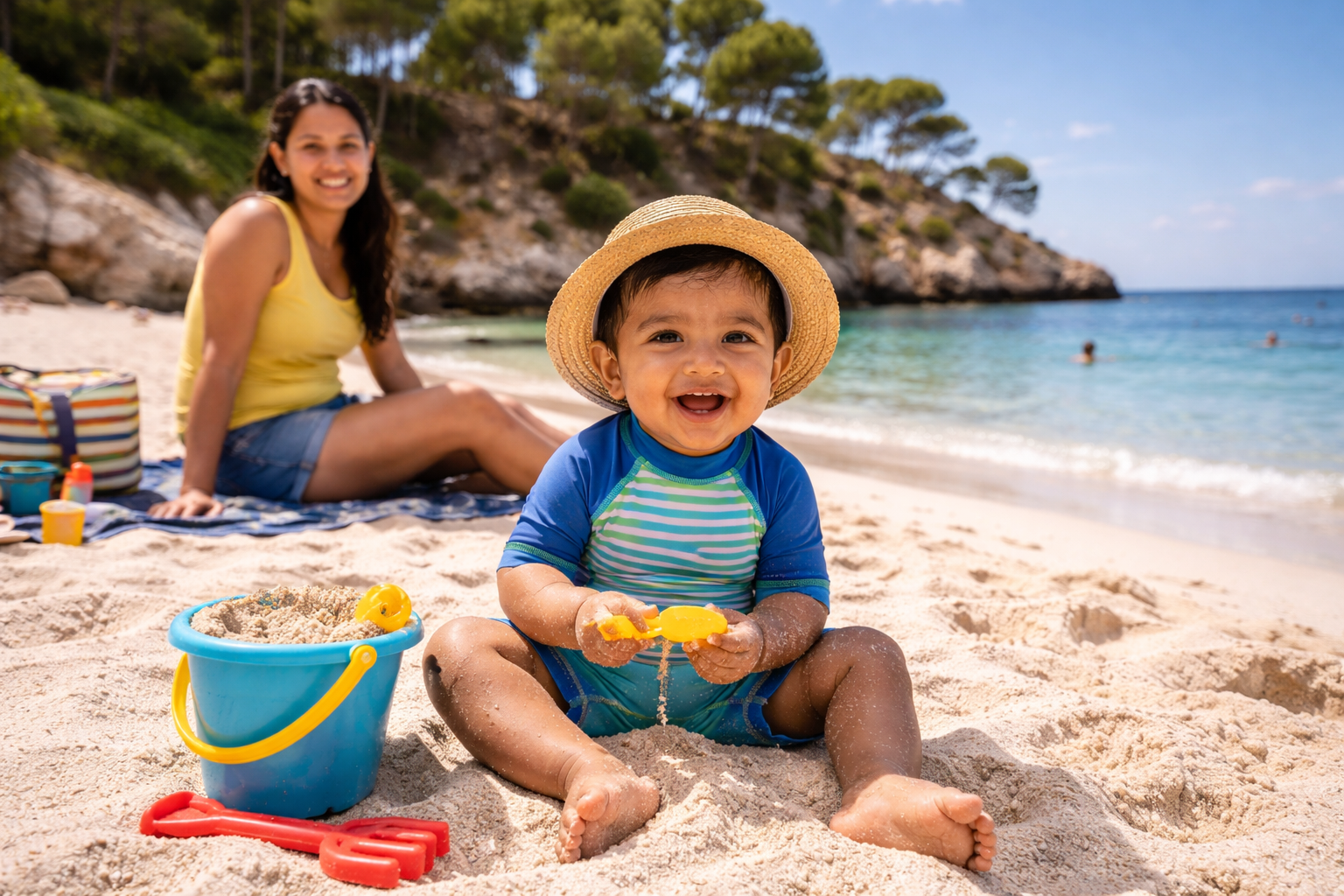
The "Shallow Water Test": What Makes a Beach Safe for Babies
Before we get into destinations, here's the single most useful filter you can apply to any beach when travelling with a baby: the shallow water test. If you can wade out 20 metres and the water is still knee-deep on an adult, it's a baby beach. If it drops off sharply within a few steps, it's not — a baby who topples forward into sudden deep water faces a genuinely frightening situation.
Beyond depth, look for: a gentle gradient (not a shelf), no strong lateral currents (flag systems exist at most European resorts — only swim when green or yellow flags are flying), clean sand rather than loose shingle, shade available from trees, parasols, or natural rock formations, and some form of lifeguard presence in peak season. The best baby beaches in Europe tick all of these boxes. The worst look beautiful in photos and are quietly stressful with a baby in tow.
Sun safety is equally non-negotiable. Babies under 6 months should not be in direct sun at all — shade, a pram sun shade, and full-coverage clothing are essential. For older babies: SPF 50+ sunscreen on all exposed skin, reapplied every two hours, UV-protective swimwear, a wide-brimmed hat, and out of direct sun between 11am and 3pm. See NHS sun safety guidance for full advice on babies and children. Shoulder season (May/June, September) makes all of this significantly easier — temperatures of 24–28°C rather than 35°C, and meaningful shade doesn't feel like a crisis. Our full guide to keeping your baby cool in hot weather covers the wider strategy beyond timing your trip.
The 5 Best European Beach Holidays With a Baby
📋 Free Baby Holiday Packing Checklist
Enter your email and we'll send the free printable checklist straight to your inbox — every category, ready to tick off before every trip.
🥇 #1: Menorca, Spain
Flight time from UK: ~2.5 hours | Best months: May–June, September
Menorca is, in our view, the single best baby beach destination in Europe. While its Balearic siblings Majorca and Ibiza have become synonymous with loud resorts and crowded beaches, Menorca took a different path. It was designated a UNESCO Biosphere Reserve in 1993, which has kept development low-key and the landscape extraordinary. The result, for baby families, is near-perfect.
The south coast beaches — Cala Turqueta, Cala Macarella, Son Bou, Cala Galdana — are sheltered coves with crystal-clear, gin-flat water that stays shallow for enormous distances. Son Bou has the longest beach on the island (over 2km) with fine sand, gentle entry, and full facilities including beach bars and sun lounger hire. Cala Galdana is more sheltered still, surrounded by pine trees that provide natural shade, with a gentle curve of calm water that genuinely looks too good to be real. Both are reachable by road with a pushchair-friendly beach entrance.
Honest warning: Some of the smaller, more remote coves require a rough track to reach — a lightweight stroller won't manage it. Save those for when your baby is in a carrier or old enough to walk. The accessible beaches are excellent; don't be lured into long treks on unmade paths with a heavy pushchair. Check our hot weather stroller guide for the most capable options on mixed terrain.
🥈 #2: Algarve, Portugal
Flight time from UK: ~2.5–3 hours | Best months: May–June, September–October
The Algarve is the most popular beach destination for UK families, and with good reason — it offers the best combination of value, variety, and accessibility of anywhere in Europe at this flight time. The beaches themselves range from vast flat stretches (Meia Praia near Lagos, Manta Rota in the east) to dramatic golden rock formations with sheltered coves between them (Praia da Marinha, Praia do Camilo). For baby families, the flatter beach sections are most practical.
The water temperature at the Algarve is reliably warm from June onwards (touching 22–24°C in peak summer, still 20°C in September), and the Atlantic swell that affects some western-facing beaches is largely absent on the south-facing stretches. Praia de Alvor and Praia da Rocha near Portimão offer wide flat sands with gentle entry, pushchair access directly from the promenade, and excellent facilities. Family resort areas around Vilamoura and Albufeira have an enormous infrastructure of child-friendly restaurants, baby equipment hire, and hotels with cots and highchairs as standard.
Honest warning: The Algarve can be extremely hot in July and August — regularly above 35°C. With a baby, May/June or September are dramatically more comfortable. The dramatic cliffside beaches you see in every travel magazine are beautiful but have steep cliff staircases — not pushchair-friendly. Stick to the flat beach sections for daily use.
🥉 #3: Sardinia, Italy
Flight time from UK: ~2.5 hours | Best months: June, September
Sardinia's beaches are, objectively, extraordinary — white sand of Caribbean quality, water that graduates from turquoise to deep blue over enormous distances, and a clarity that makes every day feel like you've stumbled into a screensaver. For babies, the gradual water depth is the key selling point: on beaches like Chia, Simius near Villasimius, and the famous La Pelosa near Stintino in the north, the water stays ankle-deep on an adult for what feels like half a mile.
Sardinia is also significantly quieter than mainland Italy's coast, and the food is exceptional — which matters when you're a tired parent trying to keep a baby happy over a two-hour lunch. Agriturismos (rural farm stays) offer a wonderful base with space, quiet, and home-cooked meals. Beach towns like Pula in the south have proper family infrastructure without feeling like package-holiday overdevelopment.
Honest warning: Sardinia is less well-served by direct UK routes than Spain or Portugal — you may need to connect through Rome or use charter flights from regional airports. Car hire is essential to reach the best beaches from most accommodation bases. The July/August peak is very hot (38°C is not unusual) and the beaches become genuinely crowded. Target June or September for the best balance.
#4: Costa Navarino / Peloponnese, Greece
Flight time from UK: ~3.5 hours | Best months: June, September
Costa Navarino is Greece's answer to the luxury family resort market — a purpose-built development on the southwest Peloponnese coast with genuinely world-class facilities, extraordinary beaches, and a family-friendly ethos that extends to everything from baby menus to dedicated children's pool areas (worth packing one of the best baby pool floats for these). This is higher-budget territory (accommodation starts at around £300/night at peak season for family rooms), but for parents who want a holiday where everything is taken care of, it delivers.
The beaches — Voidokilia, a near-perfect crescent of white sand, and the resort's own sheltered beaches — have gentle gradients, calm water protected from Atlantic swell, and lifeguard coverage. The Peloponnese more broadly is significantly quieter than the Greek islands, with a sense of unhurried pace that suits families well. Beyond the resort, the ancient sites of Olympia and Nestor's Palace are within easy driving distance for a half-day trip when beach repetition sets in.
Honest warning: Costa Navarino is a significant financial commitment. The Peloponnese in general is less well-connected from regional UK airports than the islands — you'll likely fly into Athens or Kalamata. It's a destination for parents who want a genuinely effortless holiday and are willing to pay for it.
#5: Lanzarote, Canary Islands
Flight time from UK: ~4 hours | Best months: Year-round; best avoided August peak
Lanzarote's trump card is its year-round warmth — average temperatures of 22°C in January, 28°C in August, with much more stable weather than mainland European destinations. This makes it uniquely valuable for winter-escape holidays with a baby, when the UK is grey and miserable and you need a sanity check. It's also available outside school holiday pricing windows in a way that Majorca or Tenerife isn't.
Playa Blanca in the south is the best base for baby families — the main beach and adjacent Playa Dorada are both sheltered from the wind that affects parts of the island, with calm, flat water and wide sandy stretches. Pushchair access is good from the promenade. Puerto del Carmen, the main resort town, has a longer beach and more restaurant variety, though it can be busier. The volcanic landscape — Timanfaya National Park, the Jameos del Agua caves — provides excellent day-trip material for toddlers and older babies once beach repetition sets in.
Honest warning: Lanzarote is windier than most other beach destinations on this list — the north of the island in particular can be buffeted. Stick to the sheltered south coast resorts. The volcanic black sand beaches look dramatic but heat up to uncomfortable temperatures in direct sun. The pale sand resort beaches are better for babies.
Tenerife is the stronger Canary Island when hotel choice, baby equipment and organised transfers matter most. Compare five practical options in our family hotels in Tenerife for babies guide, including a closer look at Bahia Principe Fantasia Tenerife for an all-inclusive stay.
European Beach Holiday Destinations Compared
| Destination | Flight Time | Best Beach for Babies | Water Depth | Best Months | Budget | Our Rating |
|---|---|---|---|---|---|---|
| Menorca | ~2.5 hrs | Son Bou, Cala Galdana | Excellent — very shallow | May–Jun, Sep | ££ | ⭐⭐⭐⭐⭐ |
| Algarve, Portugal | ~2.5–3 hrs | Praia de Alvor, Meia Praia | Very good — gentle gradient | May–Jun, Sep–Oct | ££ | ⭐⭐⭐⭐½ |
| Sardinia | ~2.5 hrs | Chia, La Pelosa, Simius | Excellent — very gradual | Jun, Sep | £££ | ⭐⭐⭐⭐ |
| Costa Navarino, Greece | ~3.5 hrs | Voidokilia, resort beaches | Very good — calm water | Jun, Sep | ££££ | ⭐⭐⭐⭐ |
| Lanzarote | ~4 hrs | Playa Dorada, Playa Blanca | Good — sheltered bays | Year-round | ££ | ⭐⭐⭐⭐ |

Find Baby-Friendly Hotels
Search baby-friendly hotels with free cancellation, cot requests, and family room options.
Search Hotels on Booking.comEssential Gear for a European Beach Holiday With a Baby
Getting the kit right makes the difference between a relaxed beach day and a frantic scramble for shade. Two items we'd never leave home without:

Babymoov Anti-UV Pop-Up Sun Tent
UPF 50+ | Pop-up in seconds | Ventilation panels | Fits 1–2 children
A beach tent is non-negotiable on a European beach with a baby — shade trees exist at Menorca and Sardinia but not everywhere, and hiring beach umbrellas adds up. The Babymoov pops up in under a minute, packs down into a carry bag, and provides genuine UPF 50+ shade with front-facing ventilation so it doesn't turn into a greenhouse. The zip-open front and side panels let you monitor your baby while still blocking direct sun.
Pros: Instant setup, proper UV protection, good ventilation, carries easily. Cons: Takes up space in luggage — check your airline's hold baggage dimensions. Worth it.
View on Amazon
Bugaboo Butterfly
7.3 kg | One-second fold | Full recline | UPF 50+ canopy
European beach resorts have flat seafront promenades but the beach itself won't cooperate with a heavy buggy. The Butterfly is light enough to carry down steps to the sand, folds in one motion, and fits under most aircraft seats as cabin baggage on qualifying airlines. The UPF 50+ canopy is genuinely useful in 30°C heat. We rate it as the best combination of European travel usability and beach destination practicality. See our full hot weather stroller guide for how it compares.
Pros: Incredibly fast fold, lightweight, excellent canopy, cabin-friendly. Cons: Higher price point, not suitable from birth without a separate carrycot.
View on Amazon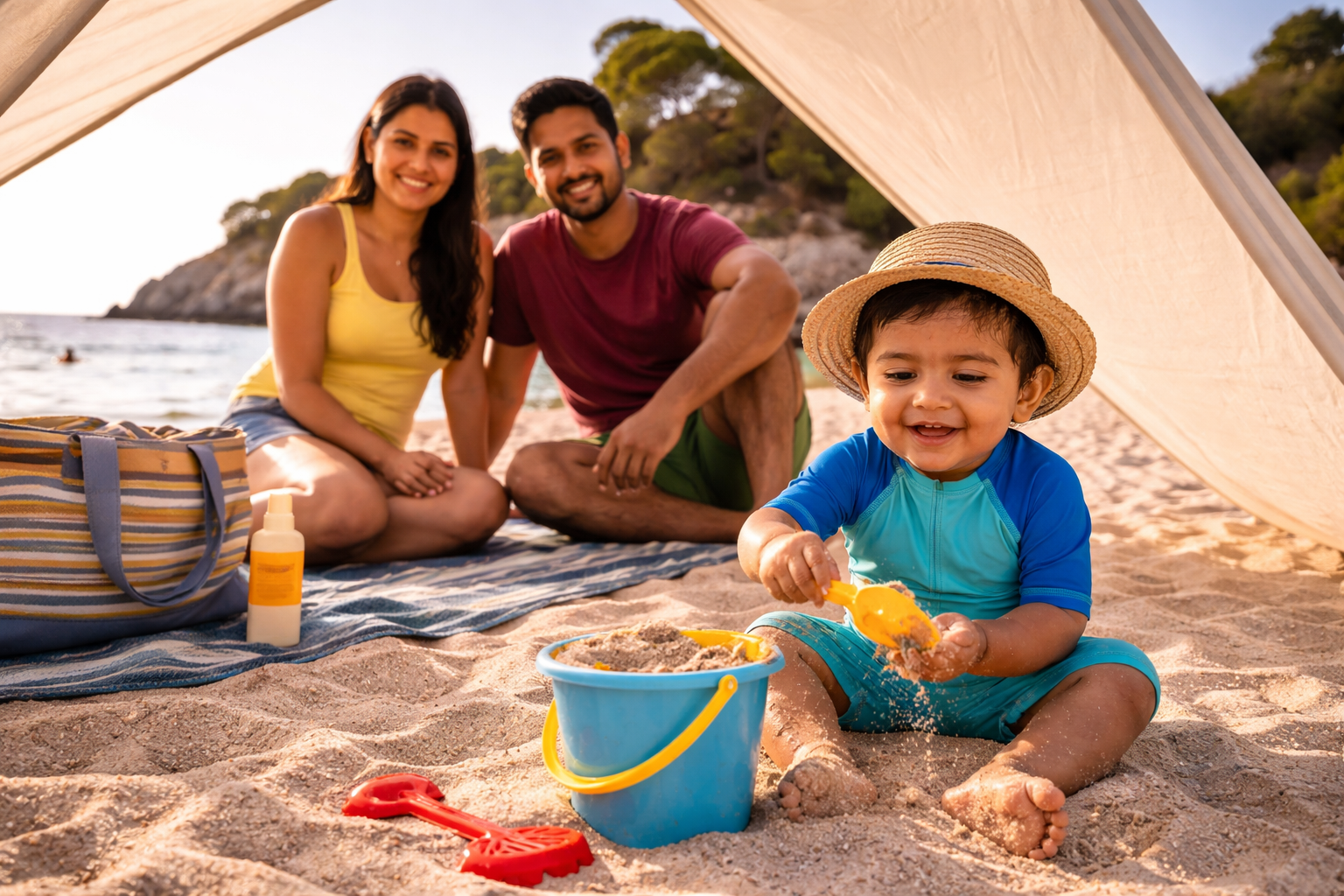
Beach Safety Checklist for Babies
Before you set up on any European beach with a baby, run through this quick checklist. It takes 30 seconds and turns a potentially anxious beach day into a relaxed one.
| Check | What to Look For | Pass / Proceed With Caution |
|---|---|---|
| Flag system | Green or yellow flag flying | Red flag = do not enter water |
| Water gradient | Still knee-deep at 20m out | Sharp drop = not safe for babies |
| Lateral currents | Watch floating objects — do they drift sideways? | Drift = rip current risk, choose sheltered cove |
| Shade availability | Trees, cliffs, beach tent, umbrellas for hire | No shade = take your own UV tent |
| Sand temperature | Test with back of your hand before putting baby down | Extremely hot sand burns — use a blanket or mat |
| Sun timing | Beach time ideally before 11am or after 3pm | Midday sun on a European beach is intense — retreat |
| Sunscreen applied | SPF 50+ on all exposed skin, reapply every 2hrs | Under 6 months: full shade only, no sunscreen needed |
| Hydration | Breastfed babies may need extra feeds in heat; formula/water for older babies | Watch for signs of overheating: flushed, very quiet, won't feed |
Getting There: Flying to European Beach Destinations With a Baby
All five destinations on this list are manageable flight times — 2.5 to 4 hours — which makes the flying portion of a European beach holiday with a baby significantly less daunting than a long-haul trip. Feed during takeoff and landing to manage ear pressure. Pack hand luggage strategically. Read our full guide to flying with a baby and our baby hand luggage checklist before you travel.
Before leaving the UK, make sure every family member has a valid GHIC card — the Global Health Insurance Card entitles you to state healthcare in EU countries on the same basis as local residents. It won't cover everything (repatriation, private care, and travel insurance are still essential), but it can save enormous stress and expense if your baby needs a doctor while abroad. Check the FCDO travel advice for your specific destination before travelling.
For the stroller, a compact lightweight model makes airport navigation dramatically easier — see our guide to the best travel strollers and advice on gate-checking your stroller if you're checking it at the gate rather than in the hold. Pack it in a stroller travel bag to protect it from baggage handling.
Need a Hire Car?
Compare car hire from all major providers — most include free cancellation and baby seat options.
Pro Tip: Shoulder Season Is the Secret
May/June or September beats July/August for baby beach holidays in every way — cooler temperatures (24–28°C rather than 35°C), significantly lower prices (often 30–40% cheaper than peak), and beaches that are half-empty rather than sardine-packed. Your baby doesn't care about school holiday dates. Take advantage of it while you still can.
What to Pack for a European Beach Holiday With a Baby
Beyond your standard holiday packing list, a European beach holiday requires some specific additions. See our complete baby holiday packing list, but for beach holidays specifically, prioritise:
- UV-protective swimwear (UPF 50+): A UV suit covers far more skin than sunscreen alone and is especially valuable for babies who rub cream off immediately
- A portable beach shade: The Babymoov tent above, or a travel parasol if weight is critical
- Swim nappies: Both reusable and disposable options — pack more than you think you'll need
- After-sun lotion: Despite your best efforts, some sunburn is likely at some point. Have it ready. See our roundup of the best baby after-sun for gentle options.
- Pushchair rain cover: Even in the Med, afternoon thunderstorms happen — and a rain cover doubles as a wind shield
- A light carrier: For beaches where the stroller won't go — see our best carriers for hot weather guide
For destinations like Lanzarote or Sardinia where you'll be hiring a car, also factor in car seat logistics. See our guide to using a car seat in Europe for hire car advice and what your rights are.
Sun & Beach Essentials
Alongside the beach tent above, these are the extras that keep baby beach days in Menorca, the Algarve or Sardinia sun-safe and comfortable.
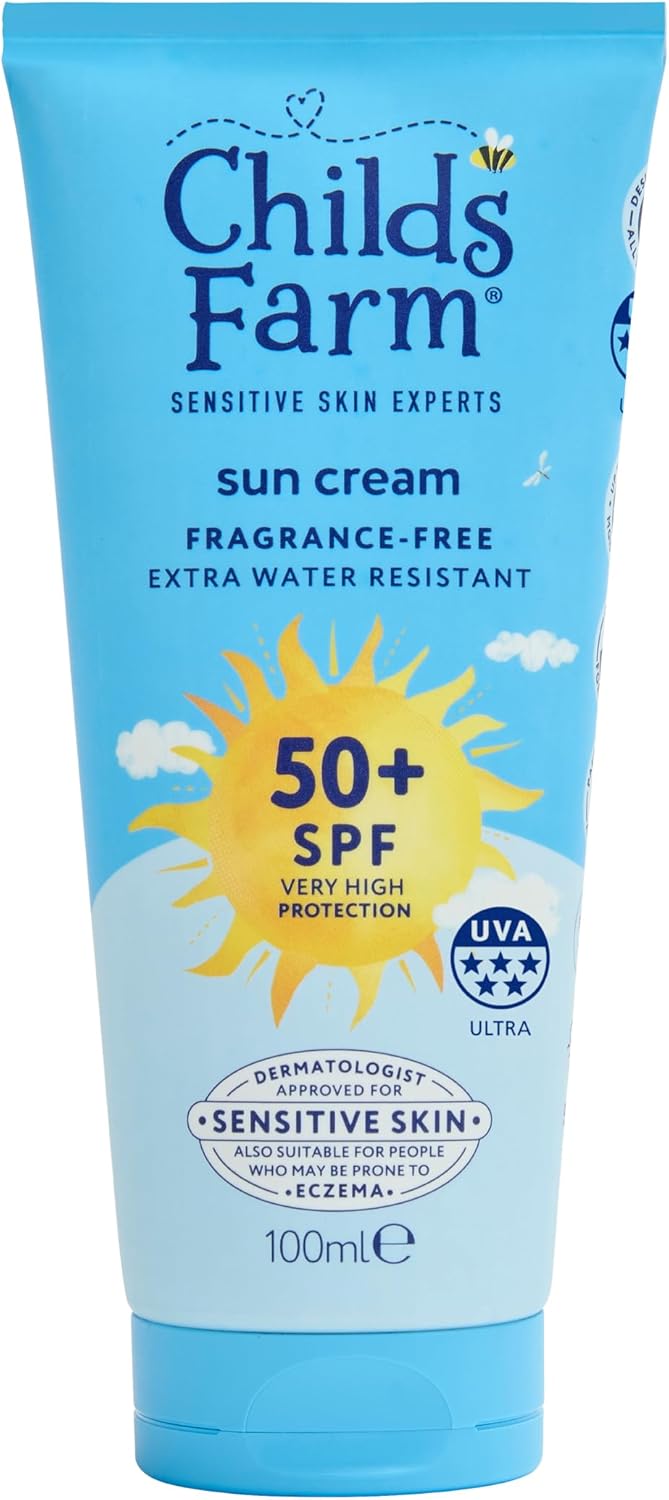
Childs Farm SPF 50+ Sunscreen
Fragrance-free SPF50+ made for babies' delicate skin (6 months+).
Check price on Amazon
Splash About UV All-in-One Swimsuit
UPF50+ all-in-one covering shoulders to knees for pool and beach.
Check price on Amazon
Splash About Happy Nappy (Reusable Swim Nappy)
Reusable swim nappy that meets most pools' double-nappy rule.
Check price on Amazon

SkyGenius Clip-On Fan
Rechargeable clip-on fan to keep the pram cool in the heat.
Check price on AmazonSleep-Abroad Essentials
Bright, unfamiliar apartments and hotel rooms are the usual reason babies won't settle by the coast. These three recreate the dark, quiet, familiar feel of home.

Tommee Tippee Sleeptight Blackout Blind
Suction-fit blackout blind for dark naps in bright hotel rooms.
Check price on Amazon
SlumberPod
A dark, private sleep canopy over the travel cot — great for jet lag.
Check price on Amazon
Yogasleep Hushh White Noise
Rechargeable pocket white noise to mask unfamiliar hotel noise.
Check price on Amazon
Don't Forget Travel Insurance
Compare family travel insurance policies — covers medical emergencies, cancellations, and lost luggage.
Compare Travel Insurance✈️ Free Baby Hand Luggage Checklist
Never forget the essentials. Enter your email and we'll send the free checklist straight to your inbox — one page, every category, ready before every flight.
Frequently Asked Questions
What is the best European beach holiday for a baby under 6 months?
Menorca in May or June is the safest choice for very young babies — mild temperatures (22–26°C), calm sheltered water for when they're old enough to dip their toes in, and no overwhelming crowds. At under 6 months, babies can't wear sunscreen and shouldn't be in direct sun at all, so shade availability and lower temperatures matter more than anything else. Avoid July/August for young babies on any Mediterranean destination.
How do I manage sun safety on a European beach with a baby?
Babies under 6 months should be in full shade at all times — no direct sun exposure. For older babies: SPF 50+ mineral sunscreen on all exposed skin, UV-protective swimwear (UPF 50+ all-in-one suit), a wide-brimmed hat, and strict avoidance of the beach between 11am and 3pm. A portable UV beach tent provides on-demand shade when trees and parasols aren't available. See the NHS sun safety guidance for full recommendations.
Is it better to fly to a beach destination or drive through France/Spain?
For most UK families, flying wins on practicality — 2.5 hours to Menorca versus 15+ hours of driving to reach comparable beaches in southern Spain or Portugal. That said, driving through France to a beach in the Vendée or Languedoc is a genuinely viable option for babies who travel well in the car, particularly for 6–12 month olds who haven't yet hit the climbing-out-of-everything stage. It avoids airport stress entirely and gives more flexibility on luggage.
Do I need travel insurance for a European beach holiday with a baby?
Yes, absolutely — and check that it covers your baby from birth, not from a minimum age. The GHIC card provides access to state healthcare but doesn't cover repatriation, private hospital treatment, or cancelled flights. Babies are notorious for developing ear infections, stomach bugs, and fever at the worst possible moments on holiday. Travel insurance that covers all family members, with no minimum age, is non-negotiable. Holiday Extras is a straightforward place to compare family travel insurance policies and check minimum age restrictions before you buy.
What's the best stroller for a European beach holiday?
A compact, lightweight stroller that folds quickly and fits in airline overhead lockers is the practical choice for beach holidays abroad. The Bugaboo Butterfly and Joolz Aer+ are the top two picks for hot weather — both have UPF 50+ canopies and fold in seconds. See our hot weather stroller guide for a full comparison. Note that strollers don't work on sand — you'll want a carrier for the actual beach portion of your day.
Can I take a baby to Ibiza or Majorca instead?
Both islands have baby-friendly beaches — Ibiza's north coast (Cala Bassa, Cala Conta) and Majorca's north (Alcudia, Port de Pollença) are significantly calmer than the party resort areas. However, the crowd levels, prices, and general noise of peak-season Majorca and Ibiza are considerably higher than Menorca. If you're comparing Balearic options, Menorca remains the recommendation for families with babies — same flight time, same water quality, dramatically different atmosphere.
Are European beach resorts good for babies in terms of food and facilities?
Modern European family resorts are generally very well set up — highchairs in restaurants, formula widely available, pharmacies in every resort town with baby essentials. In Sardinia, Portugal, and Greece, the food culture means fresh fish, rice, pasta, and simple grilled vegetables are easily available in the puréed or mashed form most 6m+ babies need. Local pharmacies stock Calpol equivalents. The practical infrastructure for babies is far better than most parents expect.
Should I take a long-haul beach holiday instead for more reliable sunshine?
For parents worried about Mediterranean weather in shoulder season, destinations like the Maldives or Zanzibar do offer more reliable conditions — but the flight time and jet lag consideration with a baby changes the equation significantly. See our long-haul guide and Dubai guide if you're weighing up the options. For most families with babies under 18 months, the European options on this list represent the sweet spot of sunshine, flight time, and manageability.
Our Verdict
If you can choose freely, pick Menorca in May, June, or September. The beaches are genuinely designed for shallow-water paddling, the atmosphere is calm and unhurried, and the flight time from most UK airports is under three hours. If budget or flight options push you towards the Algarve or Lanzarote, you'll still have an excellent holiday — both are brilliantly set up for families. The key for any European beach destination is timing: shoulder season makes a good holiday great, and avoids the heat and crowds that make July/August challenging with a baby. Check the flying guide and our packing list before you go, and don't forget that GHIC card.