
Breast Milk Through Airport Security UK: Rules, Rights & Tips (2026)
By BabyTravel UK Editorial Team · Last updated August 2026
The short answer is yes — you can take it. Here's exactly how the process works, how much you can bring, and what to do if a security officer gets it wrong.
If you're flying with expressed breast milk — or planning to pump during a trip — the question of what's allowed through UK airport security is one you need a clear answer to, not a vague one. So here it is upfront: breast milk is exempt from the 100ml liquid rule at UK airports. You can take it through security in quantities greater than 100ml. This applies whether your baby is travelling with you or not.
The rules are set by the UK Department for Transport hand luggage restrictions, and they're clear. Where things sometimes go wrong is at the security lane itself, where individual officers occasionally apply the general liquid rules without knowing the baby food and milk exemption. This guide covers the rules, the screening process, how to pack your milk for travel, where to pump at major UK airports, and exactly what to do if your milk is wrongly refused. For the full flying picture, see our flying with a baby guide.
Breast Milk at UK Airport Security: The Key Facts
- Is breast milk allowed through security? Yes — it is exempt from the 100ml liquid rule
- Does baby need to be present? No — you can carry breast milk through security whether or not your baby is travelling with you
- How much can you take? As much as you reasonably need — there is no stated maximum
- Will it be tested? It may be screened with an electronic device. You will NOT be asked to taste it
- Ice packs: also exempt when travelling with breast milk or baby food
- Key rule: remove it from your bag and present it separately at the security tray
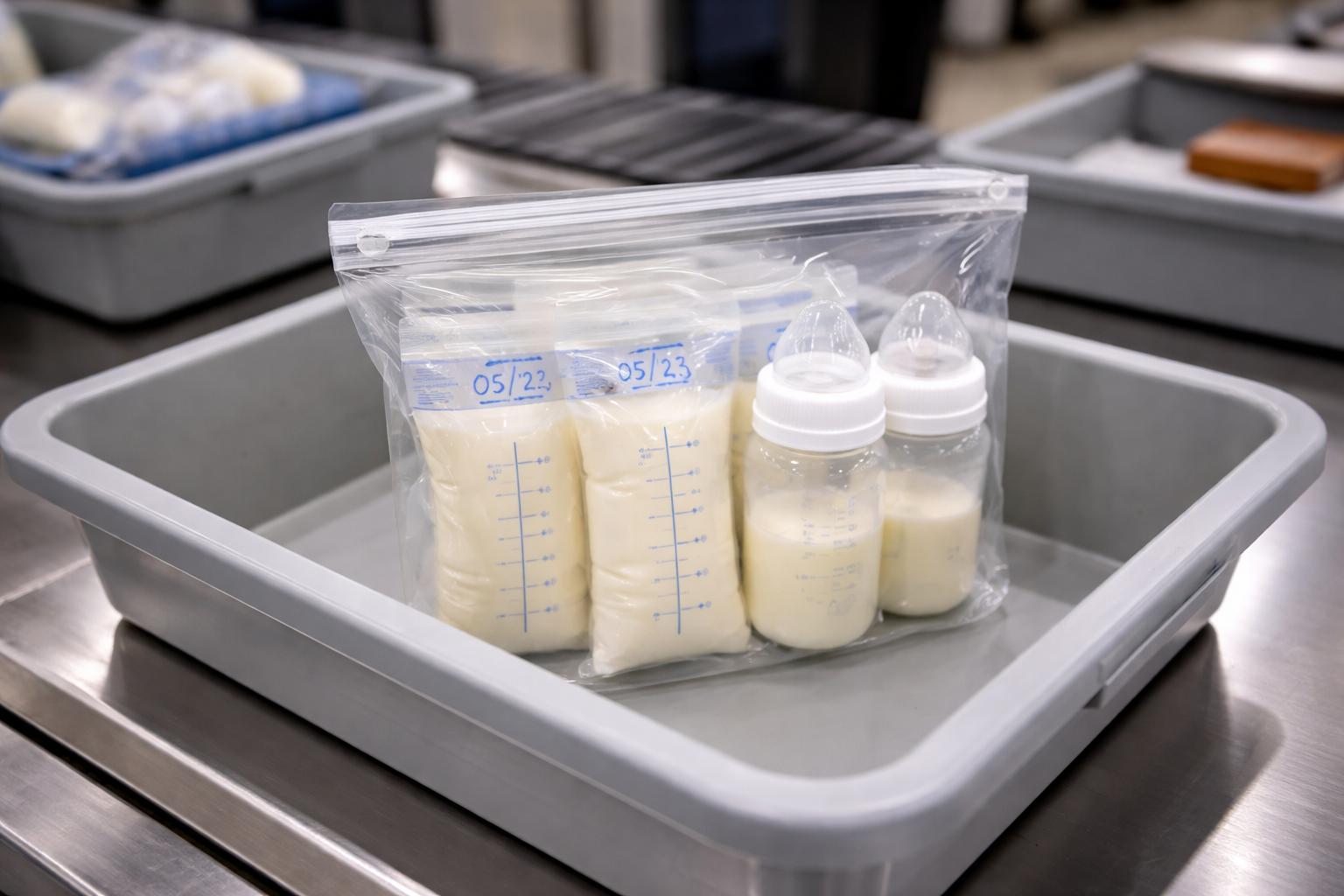
The Rules: Breast Milk at UK Airport Security
UK airports operate under Department for Transport hand luggage rules, which include a specific exemption for baby food and baby milk. Breast milk — whether expressed and refrigerated, or frozen — is classified as baby milk and is therefore exempt from the standard 100ml liquid restriction. The same exemption covers formula, cow's milk, and any other milk intended for a baby or infant.
Crucially, you do not need to have your baby with you. The exemption applies to breast milk travelling in hand luggage regardless of whether the baby is on the same flight. This matters for mothers who pump while away from their baby, or who are travelling ahead of or separately from their child.
The rules also cover ice packs. Frozen or gel ice packs used to keep breast milk cool are also exempt from the liquid rule when they are accompanying baby milk or baby food. A cool bag with ice packs and bottles of expressed milk is entirely permitted through security.
| Item | Exempt from 100ml rule? | Notes |
|---|---|---|
| Expressed breast milk (refrigerated) | ✅ Yes | Any quantity. Remove from bag for screening. |
| Frozen breast milk | ✅ Yes | Any quantity. Will be screened. Do not refreeze once thawed. |
| Infant formula (powder) | ✅ Yes | Powder is not a liquid — no restriction applies. |
| Prepared formula (liquid) | ✅ Yes | Exempt as baby milk. Any reasonable quantity. |
| Ice packs (for breast milk) | ✅ Yes | Exempt when accompanying baby milk or food. |
| Breast pump | ✅ Yes | Not a liquid — standard hand luggage rules apply. Electric pumps are fine. |
| Standard drinks / water | ❌ No | Must be 100ml or under, or purchased airside. |
How Security Screening Works for Breast Milk
📋 Free Baby Holiday Packing Checklist
Enter your email and we'll send the free printable checklist straight to your inbox — every category, ready to tick off before every trip.
When you reach the security lane, take your breast milk out of your bag and place it separately in a tray — just as you would with liquids. Tell the security officer what it is. Most officers know the rules and will process it quickly. At some lanes, the milk will be passed through the X-ray scanner. At others, an officer may use an electronic testing device to screen it — this is a quick process and is entirely routine.
One myth worth addressing directly: you will not be asked to taste your breast milk. This practice was occasionally reported years ago and is not current policy. If you are asked to taste it, politely decline, and ask to speak with a supervisor. The Department for Transport guidance does not require this, and a supervisor will confirm that immediately.
If you're carrying a larger quantity — a full cool bag of frozen milk for a longer trip, for example — the process takes a little longer but the milk should all be permitted. Packing it clearly labelled (see below) speeds things up and reduces the chance of any confusion at the lane.
Our Tip
At busy airport security lanes, proactively tell the officer "I have breast milk in here" as you place your tray on the belt. This flags it early and means you're not stopped and asked to unpack mid-queue. A small thing that saves genuine stress when you're also managing a baby, a buggy, and hand luggage.
How Much Breast Milk Can You Take Through Security?
There is no stated maximum quantity in the UK rules. The guidance says you can take "sufficient quantities" for the journey. In practice, security officers rarely question reasonable amounts — a cool bag with several bottles or storage bags for a day's journey is entirely uncontroversial.
If you're carrying a particularly large quantity (for example, a week's supply of frozen milk you've pumped ahead of a trip), expect the process to take a few extra minutes at security. It should all be permitted, but having it organised and clearly labelled helps. If you're concerned, arrive with extra time before your flight — not because you expect a problem, but because dealing with any security query calmly is easier when you're not running for a gate.
How to Pack Breast Milk for a Flight
Refrigerated Breast Milk
Sealed bottles or breast milk storage bags in an insulated cool bag with ice packs. Sealed containers are better than open-top bottles, which can spill if the bag is inverted or handled roughly by security. Clear bags or bottles mean the contents are immediately visible, which speeds up screening. Label each container "breast milk" — not legally required, but genuinely helpful.
Frozen Breast Milk
Frozen breast milk in a well-insulated cool bag with enough ice packs to maintain temperature for the journey duration. On a short-haul flight, a good insulated bag and solid ice packs should keep milk frozen or at least very cold for 4–6 hours. Expect partial thawing on a longer journey. Once thawed, breast milk should be used within 24 hours and must not be refrozen. If your milk thaws during the journey, use it as soon as possible on arrival.
What to Label
Labelling isn't a legal requirement, but "BREAST MILK" written clearly on a strip of masking tape on each bottle or bag is worth doing. It removes any ambiguity at the security lane and can prevent your milk being confused with other liquids. It takes about 30 seconds to do at home before you leave.

Insulated Breast Milk Travel Cooler Bag — Worth the Investment
A purpose-built insulated cooler bag for expressed milk is one of the most practical items for any trip involving breast milk. A dedicated bag keeps milk at the right temperature for several hours, holds both standard bottles and flat storage bags, and presents cleanly at security without looking like general hand luggage. The hard-sided insulated inner makes it genuinely effective rather than just decorative cooling.
Pros: maintains temperature for 6+ hours with ice packs; compact enough for hand luggage; leakproof inner; easy to wipe clean after spills. Typically around £15–£30.
Cons: ice packs still need to be in the freezer the night before — last-minute packing won't give you full cooling performance. Always freeze your ice packs properly ahead of travel day.
View on Amazon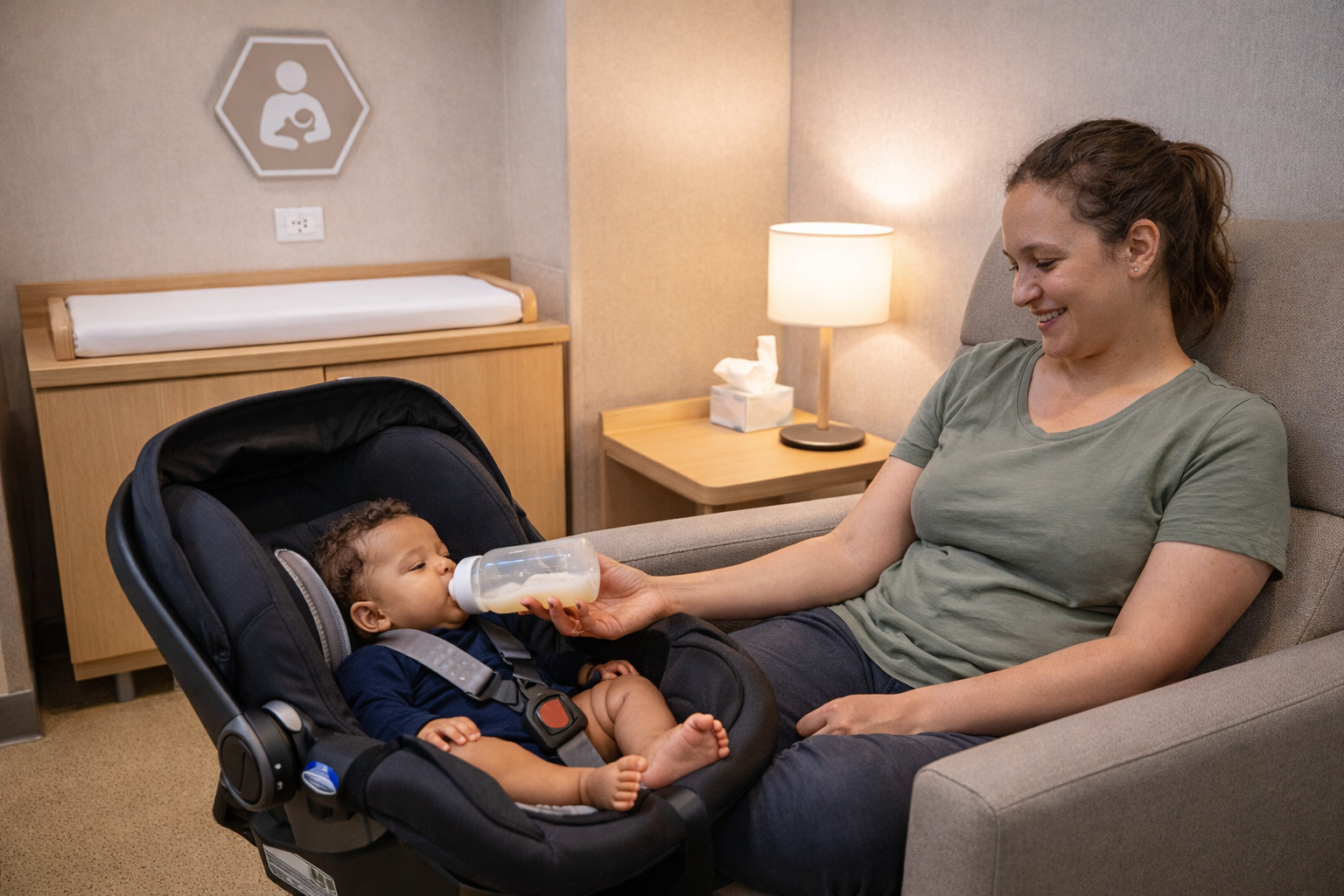
Pumping at the Airport: UK Facilities by Airport
Under the Equality Act 2010, you have the right to breastfeed or express milk anywhere you're legally allowed to be. Airport terminals are public spaces, and no one can ask you to stop breastfeeding or pumping in them. In practice, most parents prefer a private space — and most major UK airports now provide dedicated nursing rooms or family rooms.
| Airport | Nursing / Pumping Facilities | Location |
|---|---|---|
| Heathrow | Family lounges with nursing areas in most terminals. Dedicated baby care rooms airside. | Check airport maps — signposted in each terminal |
| Gatwick | Baby care rooms airside in both North and South terminals with private nursing areas. | Airside in both terminals; check airport maps |
| Manchester | Baby changing rooms with private nursing areas in Terminals 1, 2, and 3. | Near main family facilities in each terminal |
| Edinburgh | Family room with nursing area landside and airside. Reasonably well appointed. | Check airport facilities map on arrival |
| Birmingham | Baby care rooms in the terminal with nursing provision. | Near family facilities in main terminal |
| Stansted | Limited — basic changing provision but dedicated nursing rooms are sparse. Plan accordingly. | Main terminal — check signage on arrival |
| Bristol | Baby care rooms available. Smaller airport so provision is more limited than major hubs. | Main terminal facilities area |
Facilities vary and are updated over time — it's worth checking your specific airport's website before you travel. Most airports list their family facilities under "Travelling with children" on their passenger information pages. If a dedicated room isn't available, any accessible toilet with a fold-down changing station offers a minimum of privacy.
Breastfeeding and Expressed Milk on the Plane
You can breastfeed at any point during a flight, including during taxi, takeoff, and landing. Feeding during ascent and descent is particularly useful as the swallowing motion helps babies equalise ear pressure — a genuine benefit beyond the obvious. No airline can prevent you from breastfeeding on board.
Expressed milk can be stored in your overhead bin in your cool bag throughout the flight. Some cabin crew will offer to refrigerate milk if you ask — this is a courtesy rather than a standard service, so don't plan around it. If the crew are able to help, great. If not, a good insulated bag with ice packs handles a standard short-haul flight without issue.
If you need to pump during a longer flight, the aircraft lavatory is the practical option. It's cramped, but feasible for a battery-powered portable pump. A hands-free or wearable pump (like the Elvie or Willow) is considerably more practical at altitude than a traditional double pump — if you're planning to fly regularly while still feeding, it may be worth considering for travel specifically.
Breast Milk and International Travel: What Changes
UK rules apply at UK airports. The exemption for breast milk is well established in UK, EU, US, Canadian, and Australian airports — broadly, most major Western destinations apply the same or equivalent rules. However, rules vary at airports in other countries, and some security lanes apply the liquid rule more strictly regardless of guidance.
If you're connecting through a non-UK airport mid-journey, research that country's specific rules before you travel. The safest approach for a connecting flight: carry documentation or be prepared to explain calmly at the lane. The rules are on your side in most countries; the issue is occasionally individual officer awareness. Arriving at the security lane with extra time and a calm demeanour makes any conversation significantly easier.
For US travel specifically, the TSA explicitly exempts breast milk from liquid restrictions in quantities greater than 3.4oz. EU airports follow the same exemption framework. For specific airline and airport policies when flying, our air travel with a baby hub and baby hand luggage checklist cover the full picture.
If you're travelling solo with your baby or you and your child have different surnames, our Single Parent & Different Surname Travel Pack includes ready-to-use consent letter templates and a supporting documents checklist — £7.99 as an instant download.
What to Do If Security Gets It Wrong
It's rare, but it does happen: an individual security officer applies the 100ml liquid rule to breast milk without knowing the exemption. If this happens to you, stay calm and take the following steps.
First, clearly state that breast milk is exempt from the liquid rule under UK Department for Transport hand luggage regulations. This is not an argument — it's a factual statement of policy. Most officers, when reminded, will check and confirm. Second, if the officer insists, ask to speak with a supervisor or team leader. The supervisor will almost certainly know the correct rules and resolve the situation.
If your milk is confiscated incorrectly, file a written complaint with the airport after your trip. Most airports take these complaints seriously as it reflects on their security training. You are entitled to compensation for wrongly confiscated baby food items, though in practice most issues are resolved at the lane once a supervisor is involved.
Pro Tip
Screenshot the Gov.uk hand luggage restrictions page for baby items before you travel and save it to your phone's camera roll. If you encounter a query at security, you can show the officer the official guidance immediately without needing a data connection. A simple precaution that takes ten seconds.
✈️ Free Baby Hand Luggage Checklist
Never forget the essentials. Enter your email and we'll send the free checklist straight to your inbox — one page, every category, ready before every flight.
Frequently Asked Questions
Can I take breast milk through UK airport security?
Yes. Breast milk is explicitly exempt from the 100ml liquid rule at UK airports under Department for Transport hand luggage regulations. You can take expressed or frozen breast milk in any reasonable quantity through security, whether or not your baby is travelling with you. Remove it from your bag and present it separately at the security lane.
Does my baby need to be travelling with me to bring breast milk through security?
No. The exemption applies to breast milk regardless of whether your baby is on the same flight. Mothers travelling for work who are pumping and transporting milk can take it through security without their baby present.
Will I be asked to taste my breast milk at airport security?
No. This is a persistent myth. UK Department for Transport guidance does not require or authorise security officers to ask you to taste breast milk. If you are asked to do so, politely decline and request a supervisor. This will resolve the issue immediately.
How much breast milk can I take on a plane?
There is no stated maximum in UK rules. You can take as much as you reasonably need for your journey. In practice, security officers process reasonable quantities (several bottles or a cool bag of storage bags) without question. Very large quantities may take a few extra minutes to screen but should all be permitted.
Can I take ice packs for breast milk through UK security?
Yes. Frozen or gel ice packs used to keep breast milk or baby food cool are exempt from the liquid rule when they are accompanying baby milk or food. A cool bag containing expressed milk and ice packs is entirely permitted.
Can I breastfeed on a plane?
Yes — at any point during the flight, including during takeoff and landing. No airline can prevent you from breastfeeding on board. Feeding during ascent and descent is particularly useful as it helps babies equalise ear pressure. See our flying with a baby guide for more on managing feeds during a flight.
Which UK airports have nursing rooms?
Most major UK airports have dedicated nursing or family rooms — Heathrow, Gatwick, Manchester, Edinburgh, and Birmingham all have reasonable provision, generally in both the departure and airside areas. Stansted is the most limited of the major hubs. Check your specific airport's website before travelling, as facilities can change and some are better signposted than others.
What are the rules for breast milk on international flights?
UK rules apply at UK airports. Most Western countries — including EU member states, the US, Canada, and Australia — apply equivalent exemptions for breast milk. Rules vary elsewhere. If connecting through a non-UK airport, check that country's specific guidance in advance. Keep the milk clearly labelled and allow extra time at security for any queries.
The Key Takeaway
Taking breast milk through UK airport security is straightforward when you know the rules: it's exempt, there's no maximum quantity, ice packs travel with it, and you don't need your baby present. Remove it from your bag at the lane, label it clearly, and if anyone queries it, the Gov.uk guidance backs you up. Formula and breast milk rules also vary once you're on board — see our airline-specific guides for Ryanair, easyJet, and British Airways for details on warming feeds and onboard baby provisions. For full flying preparation — from hand luggage packing to managing feeds in the air — our first flight with a baby guide and baby holiday packing list cover everything you need.