
Taking a Car Seat on a Plane: Do You Need It? (UK Guide 2026)
By BabyTravel UK Editorial Team · Last updated September 2026
Much of the online advice on this topic is US-centric and doesn't apply to UK carriers. Here's what the rules actually are for British families flying from the UK.
Car seats on planes is one of those topics where the internet confidently gives you advice that turns out to be for a different country. Most of the articles you'll find are written for US travellers, where FAA rules apply and the culture around child restraints in aircraft is quite different from UK practice. If you've been searching this topic and wondering why none of it seems to add up with your easyJet booking, that's why.
This guide covers the actual UK picture: what UK and European airlines allow, what you're legally required to do (less than you probably think), what aviation safety bodies say about what's safest, and the honest practical assessment of when it's worth the considerable hassle. Our guide to flying with a baby covers the broader picture; this is specifically about the car seat question.
Car Seat on a Plane: Key Points
- You are NOT required to bring a car seat for a flight on UK/European airlines — lap infant travel is permitted for under-2s
- If you buy your baby their own seat, you can use an approved car seat on the aircraft — but it must carry specific aircraft approval markings
- Not every car seat is approved for aircraft use — check for the "certified for use in aircraft" label before assuming yours qualifies
- A child aviation harness is a lightweight strap alternative for children over 10kg / 1 year — accepted by many (not all) airlines
- On a 2-hour short-haul flight, the car seat is almost always more hassle than it's worth — it makes more sense for long-haul
If you are choosing a seat specifically for cabin use, compare our current shortlist of lightweight airline-approved car seats available in the UK. The shortlist distinguishes an exact certified model from a similarly named road-only version.
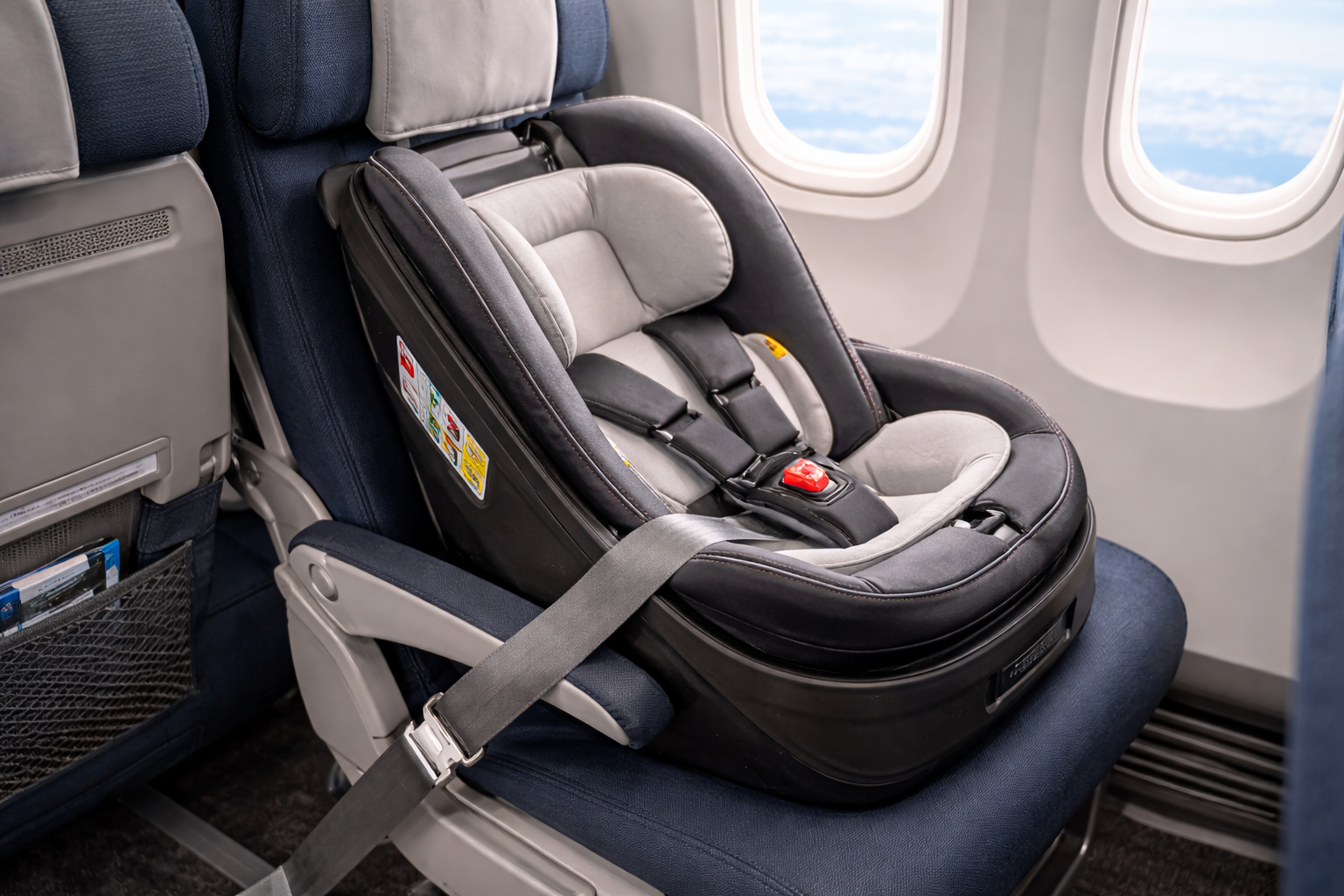
The Basic Rules: What UK Airlines Actually Require
On UK and European airlines, babies under 2 years old can travel on a parent's lap as a "lap infant." This is permitted on the basis that they use a loop belt — an extension strap that clips onto the parent's existing seatbelt, securing the infant loosely across the adult's lap. It is not a full harness or a child restraint system. It is, objectively, the least safe way for a child to travel. But it is legal, permitted by all major UK carriers, and what the vast majority of families flying easyJet, Ryanair, British Airways, and Jet2 do.
You are not required to purchase a separate seat for your baby, and you are not required to bring a car seat for the flight itself. The car seat requirement applies to car travel — not air travel. Many parents are surprised to discover this, particularly having invested heavily in a good car seat at home.
If you choose to purchase a separate seat for your baby (which gives them more space and significantly improves the journey for older babies and toddlers), you have two additional options: using an approved car seat in the seat, or using a CARES harness. Both are covered in detail below.
Is a Car Seat Safer Than Lap Infant Travel?
📋 Free Baby Holiday Packing Checklist
Enter your email and we'll send the free printable checklist straight to your inbox — every category, ready to tick off before every trip.
Yes, objectively. The UK Civil Aviation Authority (CAA) and the US Federal Aviation Administration (FAA) both recommend that children be restrained in an approved child restraint system during flight. In turbulence, which can be sudden and severe, a lap infant can be thrown from a parent's arms. An approved car seat or CARES harness keeps the child secured to the aircraft structure regardless of movement.
We're presenting this fact without a side of guilt. The reality is that the difference in risk on a 2-hour short-haul flight is small — turbulence significant enough to cause injury is rare, and the overwhelming majority of families fly safely with lap infants every year. If you're flying long-haul or anticipate a bumpy route, the safety argument for a restraint system becomes more meaningful. On a 2-hour European flight, it's a genuine trade-off between a very small safety improvement and significant logistical complexity. You get to make that call.
Comparing Your Options
| Option | Safety | Cost | Convenience | Weight to carry | Best for |
|---|---|---|---|---|---|
| Lap infant (loop belt) | Lowest (but permitted) | Cheapest — no extra seat needed | Most convenient | N/A | Short flights, young infants, budget-conscious families |
| Own seat + approved car seat | Highest | Most expensive — extra seat + car seat weight/bulk | Least convenient | Heavy (7–15 kg depending on seat) | Long-haul; toddlers who sleep better in a familiar seat |
| Own seat + aviation harness | High | Moderate — extra seat + one-off harness cost (~£70) | More convenient than car seat | Very light (~0.5 kg) | Children 10 kg+ / 1 year+; long-haul; families wanting safety without bulk |
Airline-Approved Car Seats: What You Need to Know
Not every car seat is approved for use in an aircraft. This is a crucial distinction that catches many parents out. Your excellent Group 0+ car seat at home may be perfectly safe on UK roads, but unless it carries specific aircraft approval markings, it cannot legally be used as a child restraint on a flight.
What Does "Aircraft-Approved" Mean?
A car seat approved for aircraft use must carry a specific certification label. In the UK and EU, this typically means a label stating "Certified for use in aircraft" or "For use in aircraft" alongside the relevant technical standard reference. Some seats carry multiple certifications — a seat approved to both EU road standards and EASA (European Union Aviation Safety Agency) aircraft standards will have labels showing both. Look for the aircraft certification specifically — road certification alone is not enough.
US-made seats often carry FAA TSO-C100b certification, which is the US standard. Some airlines accept FAA-certified seats; others require the EU EASA standard. If you're using a US-certified seat on a European carrier, verify with the specific airline before travel — policies differ.
Approved Car Seats Available in the UK
The following infant car seats are commonly cited as aircraft-approved and available through UK retailers. Verify the specific model's certification before purchase, as product lines update and approval status should be confirmed at the time of buying.
| Car Seat | Weight Range | Aircraft Approval | Approx Price | Notes |
|---|---|---|---|---|
| Maxi-Cosi CabinoFix | 0–13 kg (Group 0+) | EASA / EU aircraft certified | ~£120–£150 | Popular UK choice; designed with air travel in mind; narrower profile for aircraft seat |
| BeSafe iZi Go Modular i-Size | 0–13 kg (Group 0+) | EU aircraft certified | ~£280–£320 | Norwegian brand with strong safety reputation; part of a modular travel system |
| Doona Infant Car Seat & Stroller | 0–13 kg (Group 0+) | FAA + EU aircraft certified | ~£350–£400 | Unique combined car seat and stroller; its own wheels fold out; particularly useful for travel |
| Child Aviation Safety Harness (CARES type) | 10–20 kg (approx 1–4 years) | FAA TSO-C100b; many EU airlines | ~£60–£80 | Not a car seat — strap system only; see dedicated section below |
Always confirm current certification status with the retailer or manufacturer at time of purchase, as specifications can change between model years.

Maxi-Cosi CabinoFix (Most Accessible Aircraft-Approved Seat)
The CabinoFix is the most commonly available aircraft-approved infant car seat in the UK — designed specifically with air travel in mind, with a narrower profile that fits better in an aircraft seat than a standard car seat. Covers 0–13kg (Group 0+). Around £120–£150.
Pros: Designed for air travel, well-known brand, narrower than most car seats, widely available.
Cons: Still a full-size infant car seat — heavy and bulky to carry; requires its own aircraft seat.

BeSafe iZi Go Modular i-Size (Best Safety Pedigree)
Norwegian brand BeSafe has one of the strongest safety reputations in the child restraint industry. The iZi Go Modular is an aircraft-approved Group 0+ infant car seat that also forms part of a wider modular travel system — the same seat can be combined with different bases and frames as your child grows. Around £280–£320.
Pros: Excellent safety credentials, aircraft-approved, modular system compatibility, well-tested in independent crash tests.
Cons: Premium price; less widely stocked in UK high street retailers than Maxi-Cosi.
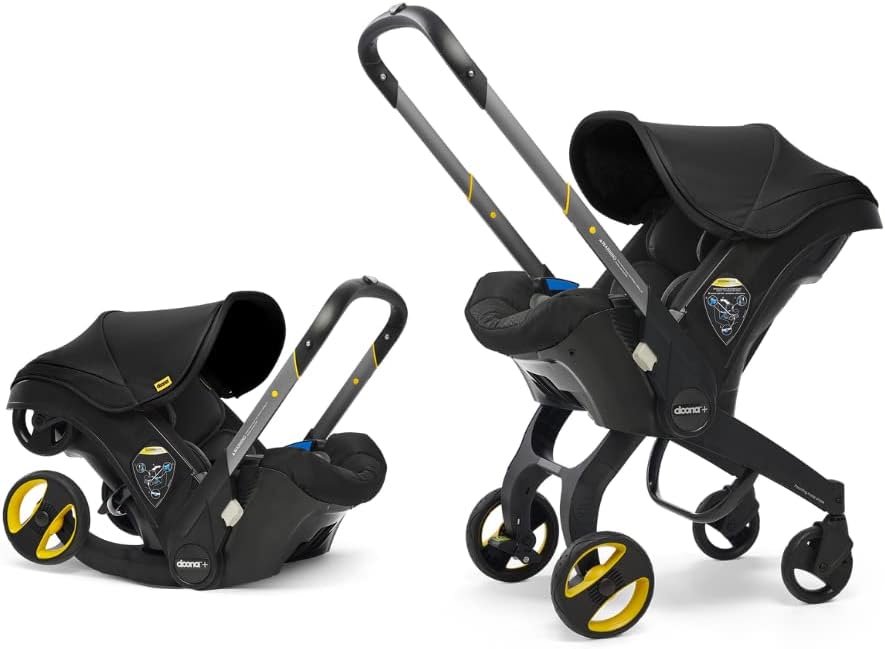
Doona Infant Car Seat & Stroller (Best for Dual Use)
The Doona is unique: it's a full Group 0+ infant car seat with integrated stroller wheels that fold out when you need them. Aircraft-approved (FAA and EU). The appeal for travellers is obvious — it functions as both car seat and stroller without requiring two separate products. Around £350–£400.
Pros: Car seat and stroller in one, aircraft-approved, eliminates need to carry two products.
Cons: Heavier than a standalone car seat or stroller; expensive; still requires a purchased seat on the aircraft to use in flight.
The Child Aviation Safety Harness: The Lightweight Alternative
A child airplane safety travel harness is worth knowing about if you want an approved in-flight restraint without carrying a full car seat. The genuine product in this category is the AmSafe CARES Child Aviation Restraint System. Our complete CARES guide compares current airline rules, fitting limits and counterfeit checks.
How the Aviation Harness Works
A horizontal strap wraps around the aircraft seatback and supports two shoulder straps. The aircraft's existing lap belt passes through the lower loops at hip level. The system folds flat and weighs around 500g, making it much easier to carry than a hard car seat.
Who Can Use the Aviation Harness
The standard CARES harness is certified for a child weighing 10 to 20kg, no more than 100cm tall and able to sit upright unaided in a forward-facing seat. A child outside any of those limits needs another arrangement agreed with the airline; do not extend the range because the straps appear to buckle.
Which Airlines Accept It
Airline acceptance and seat placement are separate from certification. British Airways restricts CARES to the last row of its economy and premium-economy cabins, Ryanair requires advance contact and does not permit its listed supports for under-twos, and Emirates asks for at least 48 hours' notice. Check the carrier operating each sector.
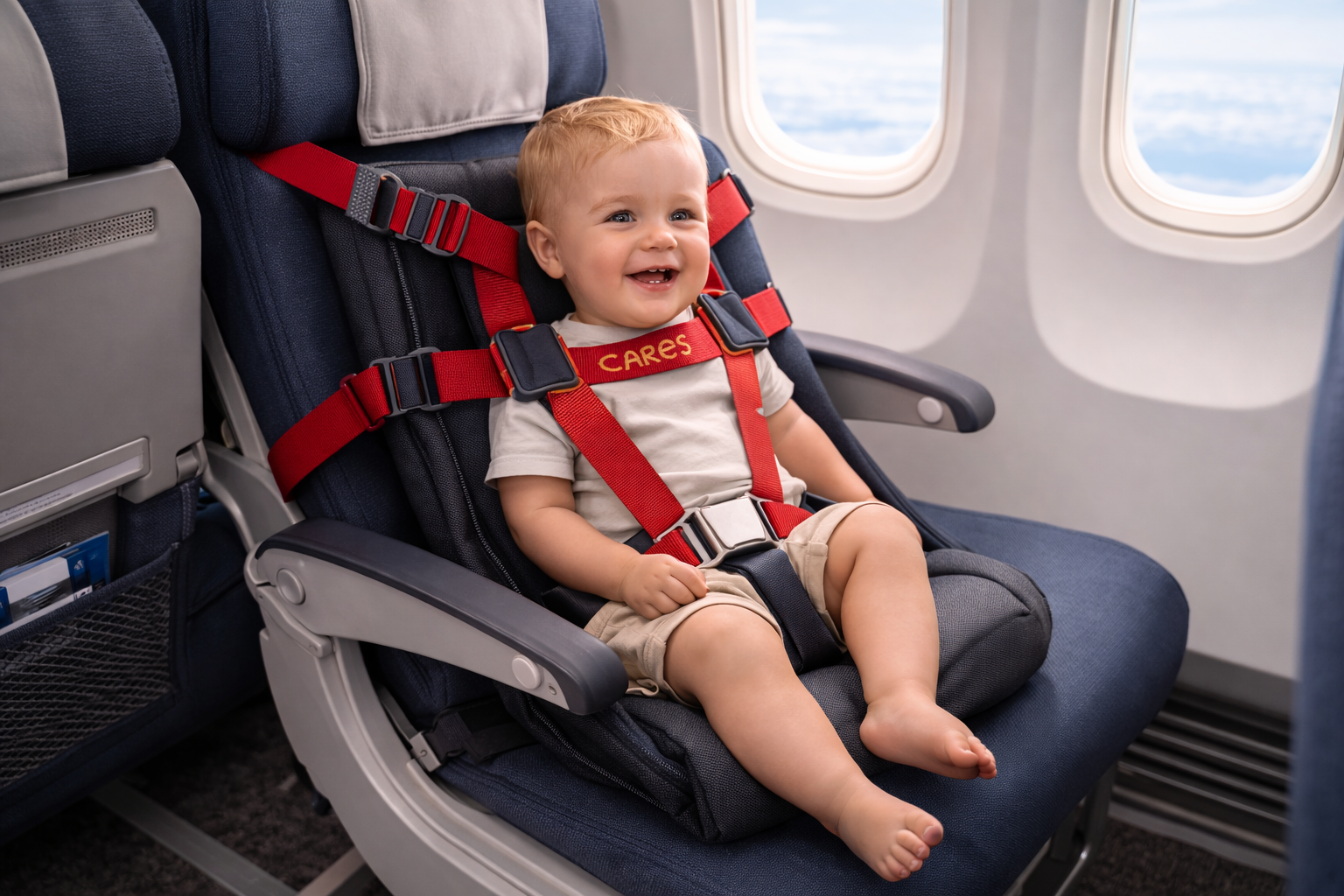

Genuine AmSafe CARES (Best Lightweight Safety Option)
The original aviation-specific restraint weighs about 500g and fits the standard certified range of 10–20kg and up to 100cm. Check for AmSafe branding and the permanent aircraft-approval label; the FAA warns that unapproved copies are sold online.
Pros: Compact, certified for aircraft use and suitable during all flight phases where the airline accepts it.
Cons: Not for cars, taxis or coaches; exact child limits and airline seating rules apply.
When Is It Actually Worth Bringing a Car Seat?
Let's be direct about the practical reality, because the answer depends heavily on the type of trip you're taking.
Short-Haul Flights (Under 4 Hours)
On a 2–3 hour easyJet flight to Majorca, the car seat is almost certainly more hassle than it's worth. A full-size infant car seat is heavy, bulky, and takes up the entire aircraft seat. Getting it installed correctly, managing your baby in an adjacent seat instead of on your lap, and then uninstalling and carrying it off at the other end adds significant stress to an already demanding travel day. The safety benefit on a 2-hour flight is real but marginal. Most experienced travelling parents forgo the car seat on short-haul and use the freed-up energy for managing the actual journey.
Long-Haul Flights (Over 5 Hours)
Long-haul is where the calculation shifts. A toddler on a 10-hour overnight flight who sleeps better in their familiar car seat is a genuinely compelling case for bringing it. The cost of an extra seat is significant, but so is the benefit of a settled, safely secured toddler for the bulk of a long night flight. For families who travel long-haul frequently, a child aviation harness represents a reasonable middle ground — better safety than a lap belt, far more portable than a car seat, at the cost of a child seat on the booking.
The Bassinet Alternative on Long-Haul
Worth mentioning: on long-haul flights with bulkhead (front-row) seating, most airlines offer a bassinet for infants — a small fold-down cot that attaches to the bulkhead wall. This is not a car seat equivalent for safety, but it gives young infants a flat sleep space for long flights and is far more practical than trying to install a car seat. Book bulkhead seats early — they go quickly. Eligibility is typically up to 10–12kg.
If You're Not Using the Car Seat on the Plane: Your Options
You need a car seat at your destination for any car travel — hire cars, taxis, or your own vehicle. The question is how to get it there without using it as an aircraft restraint. You have three options:
Gate-Check the Car Seat
Most UK airlines treat a car seat as an essential baby item and accept it for gate-check free of charge (one per infant passenger), alongside the stroller. You use it until the aircraft door, the ground crew load it in the hold, and you collect it at the aircraft door or baggage reclaim. This is the most convenient option for most families. The downside is that car seats can be dirty or occasionally damaged in hold handling — a car seat travel bag significantly reduces this risk. See our guide to packing baby equipment for air travel for the principles.
Check the Car Seat in the Hold
Checking the car seat as part of your hold luggage is the higher-risk option — more handling, greater exposure to rough conditions. If you're doing this, a padded car seat travel bag is strongly recommended. A car seat bag wraps and protects the seat from dirt, scuffs, and minor impacts in the hold. It also makes it easier to identify on the baggage belt.

Car Seat Travel Bag (For Hold-Checked Seats)
A padded, waterproof bag that protects your car seat in hold luggage. Worth it for any car seat being checked in the hold — reduces dirt, scuffs, and minor handling damage considerably. Check compatibility with your specific seat before buying. Typically around £20–£35.
Pros: Protects from dirt and minor damage; makes seat identifiable at baggage reclaim; some have wheels for easier transport.
Cons: Extra item to manage at the airport; unnecessary for gate-checked seats in most cases.
Rent a Car Seat at Your Destination
Most car hire companies across Europe offer child car seats as an add-on, typically at £5–£10 per day. The obvious appeal is not having to carry your car seat at all. The drawbacks are real, though: the seat you receive may be different from what you use at home (different installation, different harness, unfamiliar to your child), quality and cleanliness vary between hire companies, and you can't inspect or choose the specific seat in advance. For older toddlers using a booster-type seat, rental is often fine. For young infants in a rear-facing Group 0+ seat, many parents prefer to bring their own rather than rely on the quality of a hire company's stock.
✈️ Free Baby Hand Luggage Checklist
Never forget the essentials. Enter your email and we'll send the free checklist straight to your inbox — one page, every category, ready before every flight.
Frequently Asked Questions
Do UK babies need their own seat on a plane?
No. On UK and European airlines, babies under 2 years old can travel on a parent's lap as a lap infant, secured only by a loop belt extension. You are not legally required to purchase a separate seat for your baby. If you do purchase a separate seat, you can use an approved car seat or CARES harness in it, but this is a choice, not a requirement.
Can I use my normal car seat on a plane?
Only if it carries specific aircraft approval markings. Your road-approved car seat may be excellent on UK roads, but it is not automatically approved for aircraft use. Look for a label saying "Certified for use in aircraft," "For use in aircraft," or the relevant EASA/FAA certification reference. If your seat doesn't have this marking, it cannot legally be used as a restraint on a flight — even if you purchase a separate seat for your child.
What is a child aviation harness and is it safe?
A child airplane safety travel harness (based on the AmSafe CARES design) is a strap-based aviation restraint system approved by the FAA (TSO-C100b) and accepted by most major airlines. It attaches to the aircraft seatback and provides shoulder and lap restraint for children weighing 10–20kg (approximately 1–4 years). It is objectively safer than a lap belt alone for a child in their own seat. It is not equivalent to a full car seat in protection level, but it represents a meaningful safety improvement over unrestrained lap infant travel, in a package that weighs 500g.
Is it worth bringing a car seat on a short-haul flight?
For most families on most short-haul European flights, no. The car seat takes up the entire aircraft seat (requiring a paid child seat ticket), is heavy and bulky to carry through the airport, needs correct installation in the aircraft, and the safety benefit on a 2–3 hour flight is real but small. On a long-haul flight with a toddler who sleeps better in a familiar seat, the calculation is different. A child aviation harness is a better short-haul option for children over 10kg if you want improved restraint without the full car seat burden.
Does easyJet / Ryanair accept a car seat on a plane?
Both easyJet and Ryanair allow infants to travel as lap passengers. If you purchase a seat for your baby, you can use an aircraft-approved car seat in it. The car seat must carry the appropriate certification label. Check the most current policy on your specific carrier's website, as policies update. For gate-checking the car seat to use at your destination, both carriers accept one car seat per infant passenger free of charge as an essential baby item.
What happens if I check my car seat in the hold and it gets damaged?
Report damage immediately at the airline's baggage services desk before leaving the airport — the same process as for a stroller. Get a Property Irregularity Report (PIR) reference number. Photograph the damage before touching the seat. Under the Montreal Convention, airlines are liable for damage to hold luggage, and a car seat is a significant item in this respect. A travel bag significantly reduces the likelihood of damage in the first place. If your travel insurance covers baggage damage, that may be a faster route to resolution than the airline's own claims process.
Can I rent a car seat at my European destination?
Yes, most European car hire companies offer child seats as an add-on. Costs vary but typically run £5–£10/day. The limitations: you can't choose the specific seat in advance, quality varies, and the seat will be unfamiliar to both you and your child. For older toddlers in forward-facing seats, rental is often fine. For young infants in rear-facing infant seats, many parents prefer to bring their own to ensure it meets their standards and that they know how to fit it correctly.
Where can I find official UK guidance on child seats and aircraft?
The UK Civil Aviation Authority (CAA) publishes guidance on travelling with children by air, including on child restraint systems. For CARES harness specific information, the manufacturer AmSafe maintains current acceptance information at amsafe.com.
The Bottom Line on Car Seats and Planes
You don't need to bring a car seat on a plane, and on a short-haul flight most families are better off without one. The car seat question becomes relevant — and potentially worth the effort — on long-haul flights where your child benefits from familiar restraint for a multi-hour journey. For families in that category, a child aviation harness offers a useful middle ground: proper restraint in the aircraft seat at a fraction of the weight and cost of a full car seat. The car seat itself makes most sense for infants on long-haul where the seat doubles as familiar sleeping environment.
Whatever your restraint plan on the aircraft, you'll still need a car seat at your destination for any car travel. For that, the options are gate-checking your own (with a protective bag if going in the hold), or renting locally — a reasonable choice in Europe for older children in forward-facing or booster seats. For everything else about your flight, our first flight with a baby guide and the air travel hub have the full picture.