
How to Pack a Stroller for Air Travel: Gate Check, Cabin & Hold (2026)
By BabyTravel UK Editorial Team · Last updated March 2026
The what (airline policies) is covered in our companion guide. This is the how: exactly what to do with your stroller from home to the aircraft door and back again.
Taking a stroller on a plane is one of those things that sounds more complicated than it is — once you've done it once, you wonder what you were worried about. But the first time, standing at check-in wondering whether you should fold it now or at the gate, whether the bag will survive the hold, and what happens if it comes out damaged at the other end, it can feel like a lot of unknowns at once.
This guide is the practical companion to our guide to taking a stroller on a plane, which covers what the airlines actually allow: size limits, fees, which carriers accept cabin strollers, and current policies. This article covers the how — exactly what to do before you leave home, at the airport, at the gate, and at the other end. By the end, it should feel straightforward.
Packing a Stroller for Air Travel: Key Points
- Gate-check is the default for most strollers — you use it until the aircraft door and collect it there (or at baggage reclaim)
- A stroller travel bag is worth it for hold-checked or premium strollers — less essential for gate-check on a short-haul flight
- Remove all accessories before handing over: cup holders, phone mounts, footmuffs, anything detachable
- Label it clearly with your name and flight number — strollers without labels can end up on the wrong flight
- If it arrives damaged, report it before leaving the airport — airlines are liable for gate-checked items
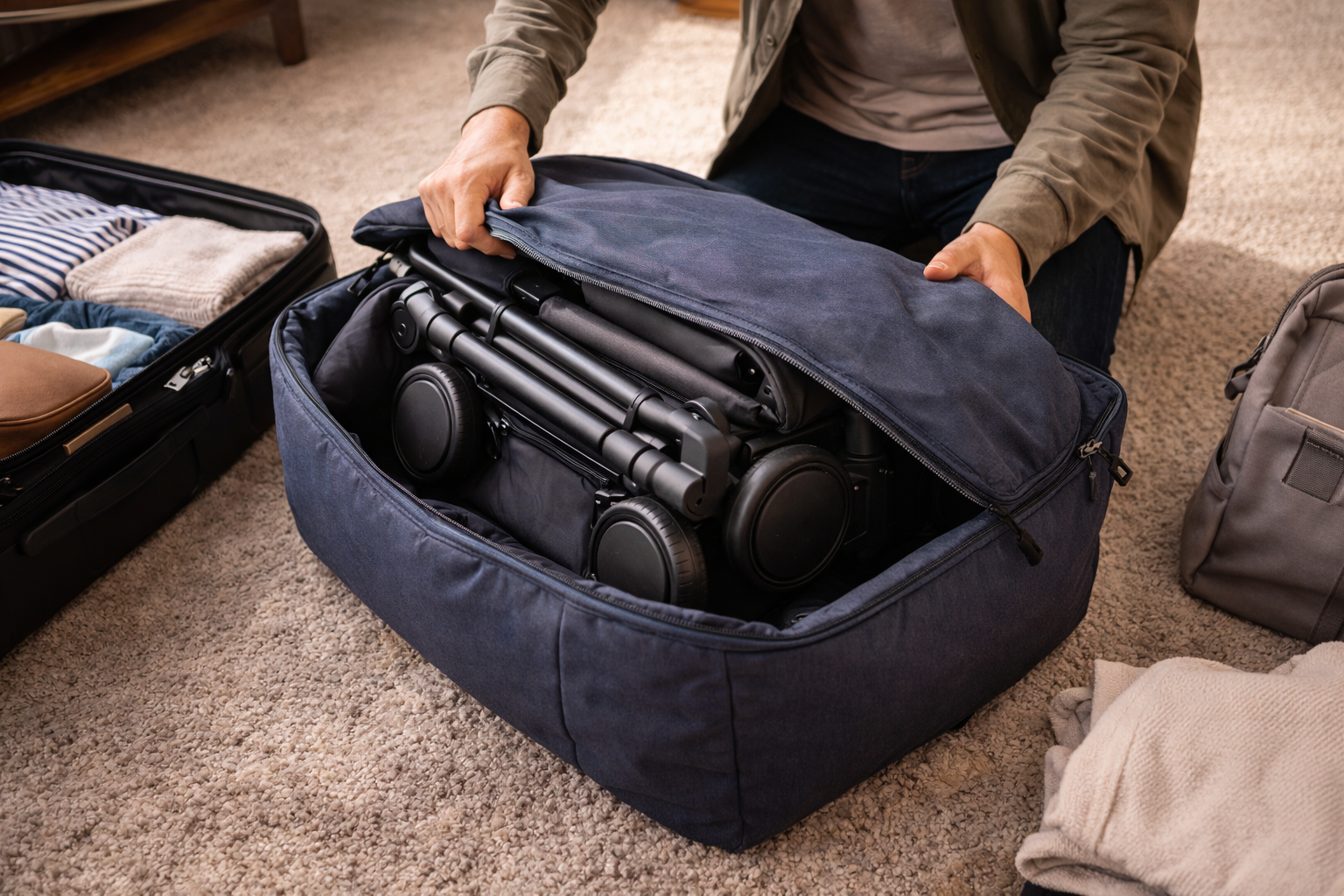
Gate Check, Cabin, or Hold: What Are Your Options?
Before anything else, it helps to understand the three routes your stroller can take on a flight — because the preparation, protection, and logistics are different for each.
| Option | How it works | Protection level | Cost | Best for |
|---|---|---|---|---|
| Gate check | Use until aircraft door, handed to ground crew, returned at door or baggage reclaim | Low — exposed to handling, possible dirt/damage | Usually free (most airlines treat as essential baby item) | Most families on most flights; easiest option |
| Cabin carry | Stroller fits in overhead bin or under seat; never leaves your sight | High — no external handling | Free if within cabin baggage allowance | Ultra-compact strollers (Cybex Libelle, etc.); depends on aircraft |
| Hold luggage | Checked in at the desk with main luggage; goes in aircraft hold | Low — most handling, greatest damage risk | May be free as essential baby item, or charged as extra bag | Full-size pushchairs that can't gate-check; long-haul with different stroller at destination |
For most families taking a travel or compact stroller on a short-haul European flight, gate-checking is the right call — it's free, simple, and means you have your stroller until the last possible moment. The sections below cover each option in detail, with particular focus on gate-checking since that's what the majority of families will do. For a full breakdown of which airlines accept what, including cabin stroller policies and fee structures, see our companion guide to taking a stroller on a plane.
How Gate-Checking Works: Step by Step
📋 Free Baby Holiday Packing Checklist
Enter your email and we'll send the free printable checklist straight to your inbox — every category, ready to tick off before every trip.
Gate-checking sounds more formal than it is. Here's the process from start to finish:
Step 1: At Check-In
When you check in (online, at a kiosk, or at the desk), let the airline know you're bringing a stroller. Most UK airlines record this automatically when you add a baby to the booking, but it's worth confirming. Some airlines issue a gate-check tag at the check-in desk; others issue it at the gate itself. If you get a tag at check-in, attach it to your stroller and keep the receipt portion.
Step 2: Through Security
Fold the stroller and put it through the X-ray machine on the conveyor. Baby goes in the carrier or is carried by your travel companion. The stroller is treated like any other piece of equipment — you don't need to remove it from a bag if it fits through the scanner. Most compact travel strollers go through easily when folded flat.
Step 3: Airside — Use the Stroller Normally
Once through security, unfold and use the stroller as normal. This is one of the most underrated advantages of gate-checking: you have use of the stroller through the entire airport, including the walk to your gate, any waiting time, and the gate area itself. Baby can nap, you can load the basket with your cabin bags, and you're not carrying a baby one-armed through a terminal for an hour.
Step 4: At the Gate — Getting the Tag
If you didn't get a gate-check tag at check-in, you'll get it at the boarding gate. The gate agent scans your boarding pass and attaches a pink or orange tag to your stroller. Keep any receipt portion — this is your proof of handover and is important if the stroller is damaged or delayed.
Step 5: At the Aircraft Door
When you board, fold the stroller at the top of the jetway (the covered walkway to the aircraft) or at the aircraft door. The ground crew will collect it and load it into the aircraft hold. At this point, you carry your baby onto the aircraft yourself — this is where your carrier earns its value. Having baby in a carrier at this moment means both hands are free for boarding passes, bags, and navigating the aisle.
Step 6: Collecting Your Stroller
This is the variable step. On some routes and with some airlines, your stroller is returned to the aircraft door at your destination — meaning you can use it as soon as you step off the plane. On others, it goes to baggage reclaim with the hold luggage. Both are common, and there's often no reliable way to know in advance which will happen. Assume baggage reclaim and be pleasantly surprised if it's at the door.
Our Tip
On busy flights from smaller aircraft or at congested airports, the stroller may have less space in the hold and more opportunity for rough handling. If you're travelling with an expensive stroller — anything over £400 — a travel bag is worth the small hassle and cost. If it's a budget compact stroller and the flight is short-haul, a bag is optional.
Do You Need a Stroller Travel Bag?
The honest answer is: it depends on the stroller, the route, and how risk-averse you are. Here's the breakdown:
You probably do need a bag if:
- Your stroller costs £400 or more — the cost of a bag is trivial versus the repair or replacement cost
- You're checking the stroller into the hold rather than gate-checking — hold luggage receives significantly more handling
- You're flying frequently — repeated gate-checks accumulate dirt, scuffs, and minor damage that a bag prevents
- Your stroller has exposed fabric or delicate components that collect grime easily
You can probably skip the bag if:
- It's an inexpensive compact stroller and a short-haul gate-check — the handling is usually gentle enough
- You want to minimise what you're carrying at the airport — a stroller bag is an extra item to manage
- You're flying with a carrier-dominated setup and the stroller is secondary kit
If you do buy a bag, there are two worth considering in particular. The Bramble XL is a proper padded bag designed specifically for stroller travel — waterproof outer, reinforced handles, large enough for most compact and mid-size strollers. The J.L. Childress is the lighter, more affordable option: less padding, but it keeps the stroller clean and gives handlers a clear visual cue that this is a piece of baby equipment to treat carefully.
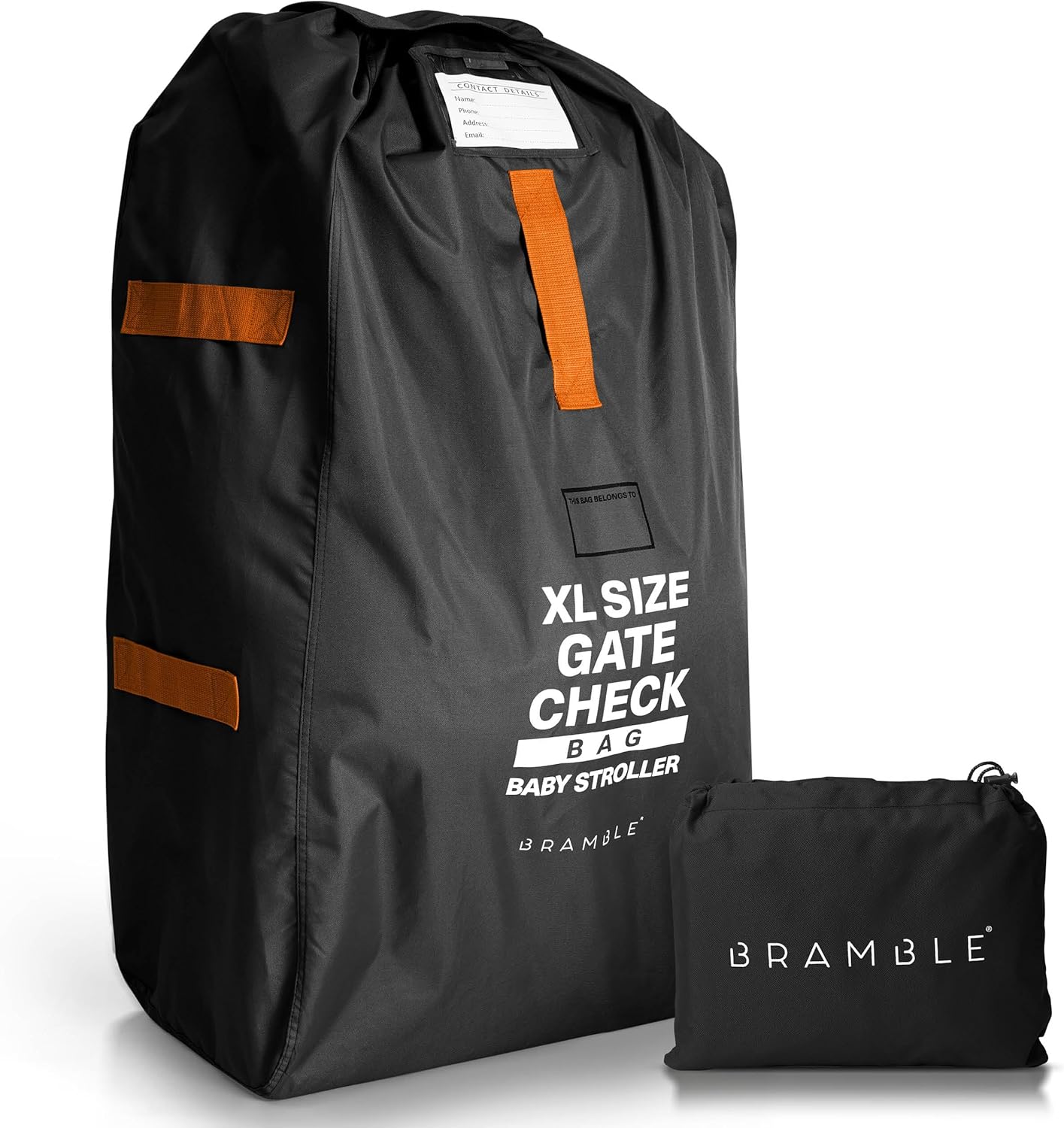
Bramble XL Stroller Bag for Airplane (Best All-Round)
Waterproof outer fabric, reinforced carry handles, and enough capacity for most compact-to-mid-size travel strollers. Designed specifically for airport use — the shape keeps the stroller protected through gate-check handling without being bulky to carry when empty. Around £25–£35.
Pros: Waterproof, durable, well-shaped for stroller handling, visible and identifiable at reclaim.
Cons: An extra item to carry; adds time at the gate during handover.

J.L. Childress Gate Check Bag (Best Budget Option)
A lightweight, low-cost gate-check bag that keeps your stroller clean and gives airport ground crew a clear visual cue to handle it as baby equipment. Less padding than the Bramble but good enough for most short-haul gate-check scenarios. Around £15–£20.
Pros: Very affordable, lightweight, keeps stroller clean, widely available.
Cons: Minimal padding — better for gate-check than hold luggage.
How to Prepare Your Stroller Before the Flight
Taking five minutes to prepare your stroller properly at home or in the terminal reduces the chance of lost accessories and simplifies the handover process. Here's the pre-flight checklist:
- Remove all accessories. Cup holders, phone mounts, parent organisers, footmuffs, sun hoods, rain covers, basket contents — anything that can be detached, should be. Accessories can fall off in handling, get crushed, or end up separated from the stroller. Pack them in your cabin bag or checked luggage.
- Remove everything from the basket. The basket is not a safe place to store items in transit. Even items that seem secure can be lost or damaged. Empty it completely before handover.
- Fold the stroller and lock the fold. Most modern travel strollers have a fold-lock mechanism. If yours does, use it — an unlocked stroller can spring open in the hold and sustain damage.
- Attach a luggage label with your name and flight number. Don't rely on the gate-check tag alone. Your own label ensures that if the airline tag falls off, your stroller can still be identified and returned to you. A proper luggage label threaded through the frame is better than a sticky label.
- Photograph your stroller before handover. Take a quick photo on your phone showing the condition of the stroller before you hand it over at the gate. This is your evidence if you need to make a damage claim at the other end.
- Keep your gate-check tag receipt. Don't let it go in the pocket of your stroller or in the basket. Keep it in your wallet, boarding pass folder, or phone case. You'll need it if there's a problem at the other end.
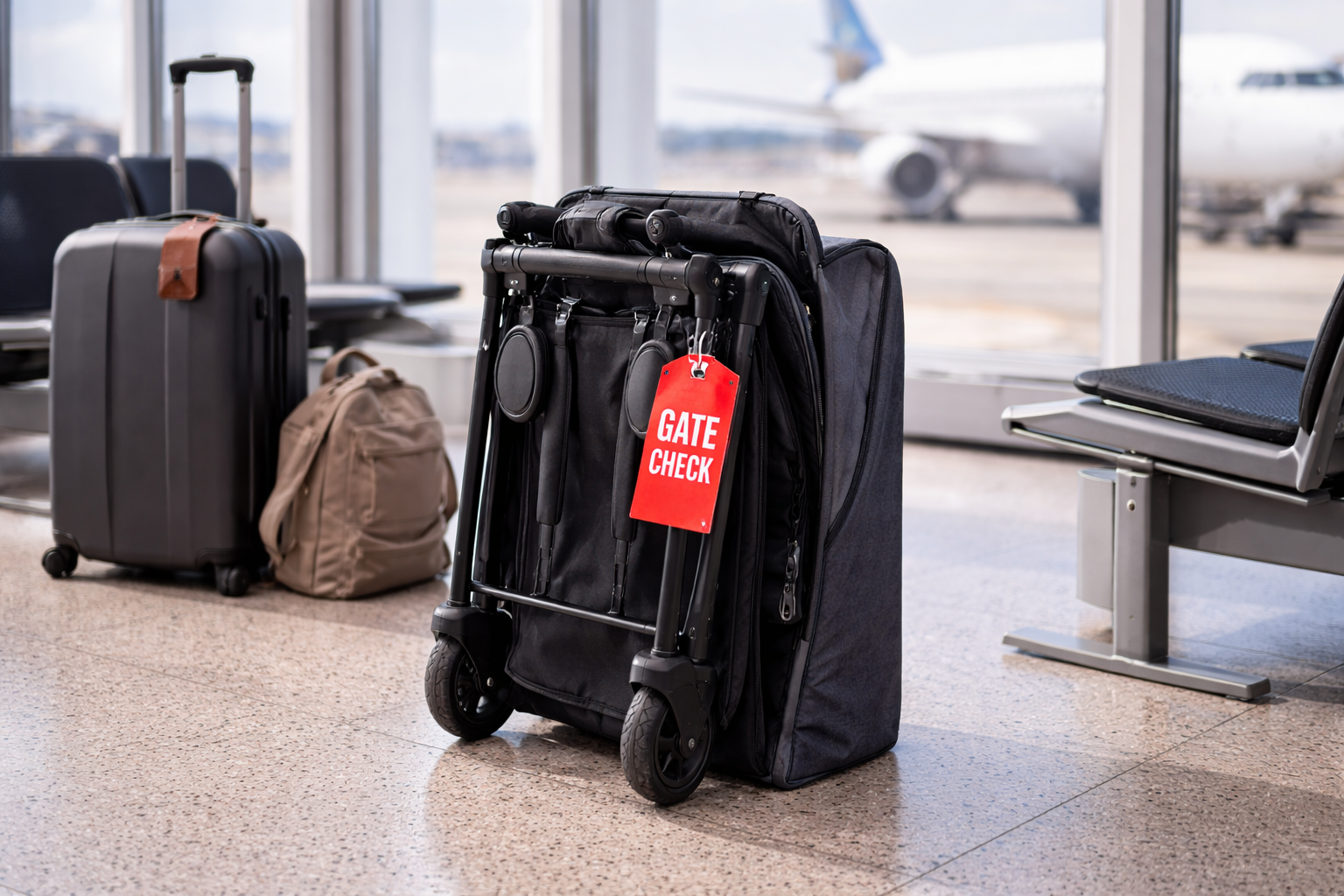
Cabin Strollers: Which Actually Fit Overhead?
Some ultra-compact strollers are small enough to be carried on as cabin baggage and stored in the overhead bin. The Cybex Libelle is the most widely cited example — at around 29×47×23cm folded, it's within the carry-on dimensions accepted by most European airlines. The Babyzen YOYO² is another that's occasionally accepted as cabin baggage, though it's a closer call depending on the aircraft.
The important caveat is that "cabin-friendly" in marketing materials doesn't guarantee a space in the overhead bin in practice. Overhead bin space varies by aircraft type, by how full the flight is, and by whether passengers ahead of you on the boarding queue have already filled the available space. Even if your stroller theoretically fits, you may be asked to gate-check it anyway on a busy flight. A cabin stroller plan should always have a gate-check plan B.
Our cabin-friendly strollers guide covers which models are genuinely small enough and which airlines are most likely to accept them in the cabin. Worth reading before you make a buying decision based on cabin-carry capability.
One important note: even when a stroller fits in the overhead bin, it still needs to fold quickly and easily in the aisle during boarding with other passengers waiting. If your stroller requires two minutes and both hands to fold, it's going to be stressful regardless of the dimensions. Practice the fold at home until it's under 30 seconds.
Realistic expectation-setting
Bin space on popular short-haul routes fills up fast, particularly if you're not in a priority boarding group. On a typical easyJet or Ryanair flight where every passenger has a carry-on, the overhead bins are full within the first 20 rows of boarding. If cabin-carry matters to you, book priority boarding — it's usually worth the extra £5–£8 when you have a baby and need to secure space quickly.
Between Gate-Check and Landing: Managing Without the Stroller
The moment you hand your stroller to the ground crew at the aircraft door, you're carrying your baby through the aircraft and airport without it. For many parents, this is the bit they're most anxious about — and it's genuinely the moment where a baby carrier earns its place as essential kit rather than optional extra.
With baby in a carrier on your chest, both hands are free for boarding passes, bags, and manoeuvring in the aircraft aisle. Baby is close, contained, and usually calm in the carrier — the secure, warm position tends to be calming for most babies. Once you're seated, you can take baby out of the carrier and feed, settle, or entertain as normal. Our carriers and slings guide has the travel-specific models worth considering.
On arrival, if the stroller comes back at the aircraft door, the carrier-to-stroller transition is simple — a few seconds and you're ready to navigate the terminal. If it goes to baggage reclaim, you'll spend 15–30 minutes with baby in arms or carrier before getting the stroller back. Build this into your mental model of the arrival so it doesn't feel like a disruption. Our first flight with a baby guide covers the full airport arrival process in detail.
What to Do if Your Stroller Arrives Damaged
It's not common, but stroller damage in the hold happens. The most frequent scenarios are: dirt and minor scuffs (almost inevitable after enough flights), damage to wheels or the fold mechanism, and in rare cases, significant structural damage from rough handling. Here's what to do:
Report Damage Before Leaving the Airport
This is the single most important rule. Once you leave the airport, establishing when the damage occurred becomes significantly harder, and airlines can — and do — refuse claims on the basis that they can't verify the damage happened in their care. If your stroller arrives damaged, go directly to the airline's baggage services desk before you go through customs or exit the terminal. Do not leave.
Document Everything at the Airport
Take photographs of the damage in the baggage hall before touching the stroller. Show the gate-check tag receipt as proof of handover. The airline should give you a Property Irregularity Report (PIR) — a damage claim reference number. Get this before you leave. Without a PIR number, a subsequent damage claim is very difficult to pursue.
Airlines Are Liable for Gate-Checked Items
Under the Montreal Convention, which governs international air travel, airlines are liable for damage to items they accept for carriage — including gate-checked strollers. The liability limit is around 1,288 Special Drawing Rights (approximately £1,300–£1,400). For a damaged stroller worth less than this, the airline should cover repair or replacement costs. The process involves the PIR, the original purchase receipt for the stroller, and potentially repair quotes if the damage is repairable. It can take several weeks, but it is a legitimate route to compensation if your stroller is damaged.
Travel insurance often covers stroller damage too — check your policy, as it may be a faster or more straightforward route than the airline's own process, particularly for higher-value strollers.
✈️ Free Baby Hand Luggage Checklist
Never forget the essentials. Enter your email and we'll send the free checklist straight to your inbox — one page, every category, ready before every flight.
Frequently Asked Questions
Is gate-checking a stroller free?
On most UK and European airlines, yes. Most carriers treat strollers as an essential baby item and accept one stroller per infant passenger for free, either gate-checked or in the hold. This includes easyJet, Ryanair, British Airways, and Jet2. Policies vary, and some airlines have weight or size restrictions — check before you fly. Our taking a stroller on a plane guide has current policy details for the main carriers.
Does a gate-checked stroller get damaged?
Minor dirt and scuffs are common after multiple gate-checks. More significant damage is relatively rare but does happen — usually to wheels, fold mechanisms, or exposed fabric. A stroller travel bag significantly reduces the risk of dirt and minor damage. For a premium stroller on a hold-checked route, a padded bag is strongly recommended. Photograph your stroller before every flight so you have a clear before/after record if a claim is needed.
When do you get your stroller back after gate-checking?
This varies by airline, airport, and aircraft type. On many short-haul routes the stroller is returned to the aircraft door at your destination — meaning you collect it as you step off the plane. On other routes it goes to baggage reclaim with the hold luggage. There's often no reliable way to know in advance. Budget for a 20–30 minute wait at baggage reclaim as the worst case, and be pleasantly surprised if it's waiting at the door.
Can I put a stroller in the overhead bin?
Some ultra-compact strollers (Cybex Libelle, sometimes the Babyzen YOYO² or Silver Cross Clic) are small enough to fit in the overhead bin on certain aircraft. Whether there's space depends on the aircraft type and how full the flight is. Even if your stroller fits, bin space fills quickly on popular routes — priority boarding significantly improves your chances. Check the specific dimensions required by your airline and the folded dimensions of your stroller before assuming cabin carry is possible.
What do I do between the gate and my seat when the stroller is handed over?
A baby carrier is the practical answer. With baby in a carrier on your chest, both hands are free for boarding passes, bags, and moving through the aircraft. Most babies settle quickly in a carrier. Take the carrier out of your bag before you reach the aircraft door so it's ready to use during the transition — fumbling with a carrier in the jetway with a queue behind you is stressful. See our carrier guide for travel for the best options for flights.
Do I need a stroller bag for a short-haul gate-check?
For a short-haul flight with a budget or mid-range stroller, a bag is optional but not essential. For a premium stroller (£500+) or any hold-checked route, a bag is worth the small additional hassle and cost. The J.L. Childress lightweight bag is a good middle ground — inexpensive, keeps the stroller clean, and doesn't add much to what you're carrying. The Bramble XL is better for strollers you want to properly protect on repeated trips.
Can the airline refuse to gate-check my stroller?
In rare cases, yes — particularly on small aircraft with limited hold space, on very full flights, or if the stroller exceeds the airline's size or weight policy. If you're travelling on a smaller regional aircraft or a very budget carrier, check the specific policy in advance. On standard short-haul jets (Boeing 737, Airbus A320/A321), gate-checking a compact travel stroller is virtually always accepted.
What happens if my stroller goes missing?
Rare, but it happens. Report it immediately at the baggage services desk before leaving the airport. You'll be given a reference number for a delayed baggage claim. Airlines typically locate missing items within 24–48 hours on well-connected routes. Keep all documentation — your gate-check tag receipt, your PIR reference, and receipts for any expenses incurred as a result of the delay (e.g., hiring a stroller locally). Under the Montreal Convention, airlines are liable for delayed items as well as damaged ones.
The Bottom Line on Stroller Air Travel
Gate-checking is simpler than it sounds, and for most families travelling with a compact stroller it's the right choice — free, practical, and gives you use of the stroller right until you board. The preparation that makes the biggest difference is stripping the stroller of all accessories before handover, attaching a clear luggage label, photographing it, and keeping your gate-check tag receipt. Everything else flows from that.
For what the airlines actually allow — size limits, cabin policies, fees by carrier — the full detail is in our companion guide to taking a stroller on a plane. And for the rest of your air travel with a baby preparation, the hub has everything in one place.