
Do Babies Need Ear Protection for Flying?
By BabyTravel UK Editorial Team · Last updated March 2026
It's one of the most common questions before a first flight with a baby. You've seen the noise-cancelling earmuffs designed for infants, you've worried about your baby's ears during takeoff, and you want to know whether you should buy something before you go. The answer is simpler than the product market suggests.
The Quick Answer
- ✈️ For ear pressure: No — earmuffs do not help. Feed during takeoff and landing instead.
- 🔊 For cabin noise: Maybe — earmuffs can help sensitive babies sleep on louder flights, but aren't necessary for most.
- 🍼 Best thing to do: Have a breast, bottle, or dummy ready for takeoff and landing.
- 😴 If baby is asleep: Leave them — don't wake to feed unless they show signs of distress.
- 🤒 Baby has a cold? Speak to your GP before flying — congestion makes pressure equalisation harder.
The Most Important Distinction: Pressure vs Noise
Parents searching for "baby ear protection for flying" are usually worried about two different things — but they conflate them. Sorting these out makes everything else clearer.
| Concern | Cause | Solution | Do Earmuffs Help? |
|---|---|---|---|
| Ear pressure / pain | Altitude changes during ascent and descent affecting the middle ear via the Eustachian tube | Feeding (breast, bottle, or dummy) — sucking and swallowing equalises the pressure | ❌ No — earmuffs are external and cannot affect middle ear pressure |
| Cabin noise | Engine noise during the flight — typically 80–85 dB on most commercial aircraft | Earmuffs designed for infants (noise-reducing, not isolating) — optional comfort measure | ✅ Yes — earmuffs reduce ambient noise and may help sensitive babies settle |
These are two completely separate issues. Earmuffs address the second. Nothing you can put on the outside of your baby's head addresses the first. The only thing that helps with ear pressure is swallowing — and the easiest way to make a baby swallow on cue is to feed them.
What Actually Helps With Ear Pressure
📋 Free Baby Holiday Packing Checklist
Enter your email and we'll send the free printable checklist straight to your inbox — every category, ready to tick off before every trip.
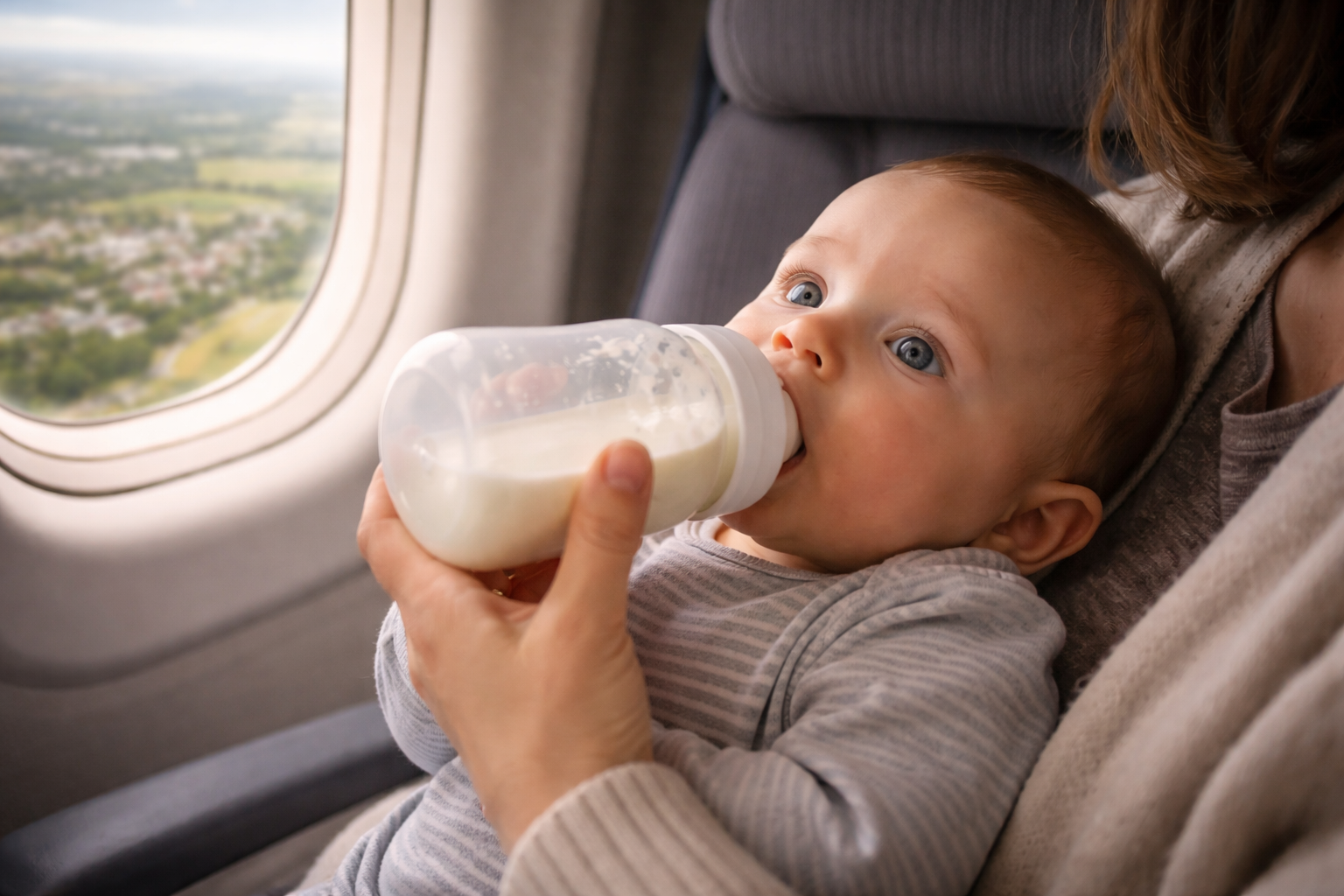
Feeding during takeoff and landing is the gold standard for managing a baby's ear pressure on a flight. Breastfeeding, a bottle, or a dummy all work — the sucking and swallowing action opens the Eustachian tubes and allows the pressure in the middle ear to equalise. This is the same mechanism that makes adults yawn or chew gum during descent.
Have whatever you're using ready before the aircraft begins its takeoff roll or starts its final descent. Don't wait for the cabin to start pressurising and your baby to show signs of discomfort — feed proactively through the transition. Most flights, this will be completely uneventful.
If your baby is asleep during ascent or descent, leave them. Waking a sleeping baby on an aircraft to feed when they're not distressed is a much worse idea than it sounds in theory. Sleeping babies often equalise pressure naturally through jaw movements during sleep. Only intervene if they wake in obvious distress.
Signs of Ear Discomfort to Watch For
Most babies travel without any ear issues. The ones who struggle tend to show a recognisable pattern: sudden distress during the first few minutes of ascent, or during the final descent before landing, which eases once the aircraft levels off or the wheels touch down. This distinguishes ear pain from general grumpiness — the timing and the resolution are distinctive.
Specifically, look for: sudden crying during ascent or descent that wasn't present at cruising altitude, pulling or rubbing at one or both ears, or unusually inconsolable distress that's different in character from their normal tired or hungry cry. If this happens, offer a feed or dummy, try gently massaging the jaw, and keep calm — it nearly always passes within a few minutes as pressure equalises. See the NHS guidance on earache in children if you're concerned about ongoing symptoms after landing.
Do Baby Earmuffs Actually Help? (For Noise)
This is where the answer shifts from "no" to "it depends." For ear pressure: no, earmuffs do nothing. For cabin noise — the sustained 80-something decibel engine hum of a commercial flight — noise-reducing earmuffs may genuinely help some babies sleep better, particularly on longer flights or on older, noisier aircraft.
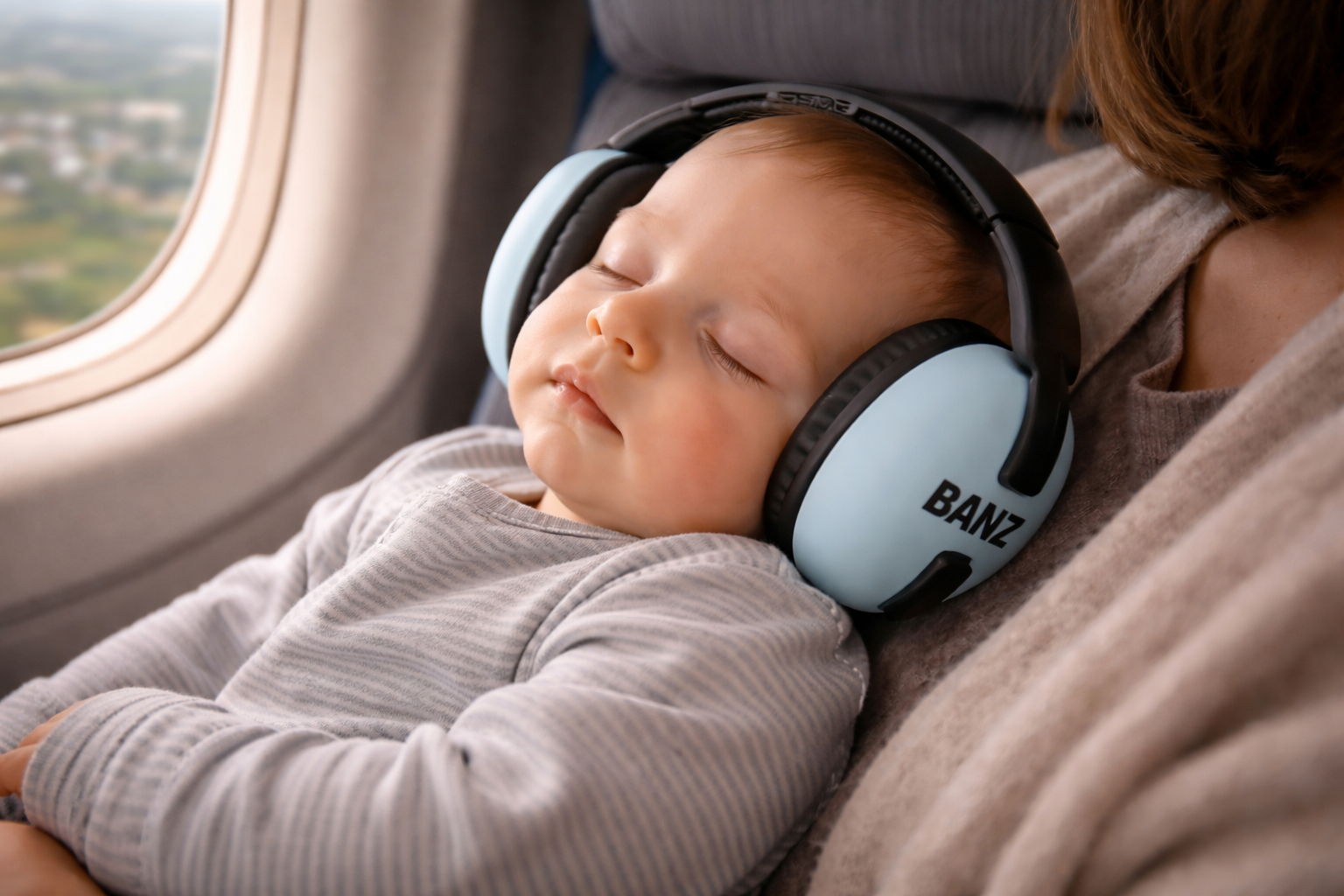
Products like the Banz Baby Earmuffs are designed specifically for infant hearing protection in noisy environments. They're not designed to treat or prevent flight ear pressure — they're designed to reduce ambient noise to a level that's more comfortable for a baby's sensitive hearing. Some parents find them useful; many find their baby rejects them or simply doesn't need them. They're not medically necessary for any baby who tolerates noise reasonably well.
If you're considering earmuffs, ask: is my baby unusually sensitive to loud noise generally? Does loud noise wake them easily from sleep? Are we flying on a long-haul route where sustained cabin noise for 8+ hours is a real concern? If yes to any of these, they may be worth trying.

Banz Baby Earmuffs — For Noise Reduction on Flights
Designed for infant hearing protection | From birth | Around £20–£30
Designed specifically for babies and young children, the Banz earmuffs reduce ambient noise to a safer level without fully isolating — baby can still hear you talking, just at a reduced volume. Lightweight, soft-cushioned, and designed to sit comfortably on small heads. Worth considering for long-haul flights or particularly noise-sensitive babies. Will not help with ear pressure — that's fed-through, not worn.
- ✅ Purpose-built for infant hearing — fits from birth
- ✅ Reduces cabin noise without full isolation — baby still hears your voice
- ✅ Lightweight with soft cushioning for small ears
- ❌ Does not help with ear pressure changes — that needs feeding/sucking
- ❌ Some babies resist wearing them — no way to know until you try
White Noise as a Settling Tool on Flights
Separate from earmuffs entirely, some parents find that playing white noise helps settle a baby during the flight — not to mask cabin noise for the baby's hearing, but because white noise is a familiar sleep cue from home. If your baby falls asleep to white noise at home, having a familiar sound source on the flight can help them transition to sleep in an unfamiliar environment.
A compact portable white noise machine is useful here — not attached to your phone (which you'll need for other things), not reliant on an app that might buffer or lose connection. Something small that sits in your lap or on the tray table and just runs.

Dreamegg D11 White Noise Machine — For Settling on the Plane
USB rechargeable | 11 sounds | Compact | Around £20–£30
If your baby uses white noise to sleep at home, this is the travel version — small enough to fit in your hand luggage, USB rechargeable (charges in flight on the seat USB port), and reliable enough to run continuously through a long-haul flight without fuss. The D11 is one of the most recommended portable white noise machines for travel because it's genuinely compact and the sound quality is good rather than tinny.
- ✅ Compact — fits in a jacket pocket or nappy bag side pouch
- ✅ USB rechargeable — charges from the seat USB port mid-flight
- ✅ 11 sounds including white noise, fan noise, and rain
- ✅ Consistent volume — doesn't fade or vary
- ❌ No automatic shut-off on all settings — check the mode before you fall asleep
- ❌ Small speaker — less effective in a louder cabin environment without being close to baby
When to Talk to Your GP Before Flying
For most healthy babies, flying is straightforward and ear pressure is a minor issue resolved by feeding. The situations where it's worth talking to your GP first:
- Current cold or upper respiratory infection — nasal congestion blocks the Eustachian tubes and makes pressure equalisation harder and more painful. Flying with a congested baby is possible but more uncomfortable for them.
- Recent ear infection (otitis media) — the middle ear may still be inflamed, making pressure changes more painful. Your GP may advise waiting a week or two post-infection.
- History of repeated ear infections — if your baby has had several ear infections, their Eustachian tube function may be less reliable. Worth flagging.
- Grommets — if your baby has had grommets fitted, there are specific guidelines for flying. Your GP or ENT consultant will advise.
In most cases flying is still fine, but a five-minute conversation with your GP is worth it before a long-haul flight if any of these apply. See the NHS ear infections page for more on when ear problems need medical attention.
For the full picture on flying with a baby — including airport logistics, what to pack, and managing the flight itself — see our main guide. The hand luggage checklist covers everything worth having accessible in the cabin.
✈️ Free Baby Hand Luggage Checklist
Never forget the essentials. Enter your email and we'll send the free checklist straight to your inbox — one page, every category, ready before every flight.
Frequently Asked Questions
Do babies need ear protection for flying?
No — babies do not need earmuffs or earplugs to manage ear pressure during a flight. The most effective approach is feeding (breast, bottle, or dummy) during takeoff and landing. Some parents choose noise-reducing earmuffs as a comfort measure for cabin noise, but they're not medically necessary and do nothing for pressure changes.
What is the best way to help a baby's ears on a plane?
Feed during takeoff and landing. Breastfeeding, a bottle, or a dummy all work — the sucking and swallowing action opens the Eustachian tubes and equalises middle ear pressure. Have it ready before the cabin starts pressurising rather than waiting for distress signals.
Do baby earmuffs help with ear pressure on planes?
No. Earmuffs are external devices that reduce ambient noise. They cannot affect the pressure in the middle ear, which is the cause of flight ear pain. Don't buy earmuffs thinking they'll prevent ear pain during takeoff and landing — they won't. Feeding is the only effective intervention for pressure.
What are the signs of ear discomfort in a baby on a plane?
Sudden crying during ascent or descent that stops at cruising altitude, pulling or rubbing at the ears, or distress that's different from their usual tired or hungry cry. The timing is the tell — if it starts during pressure changes and eases when the aircraft levels off, that's ear pressure. Offer a feed or dummy and it usually passes quickly.
Can I take my baby on a plane if they have a cold?
Usually yes, but a cold makes pressure equalisation harder because nasal congestion blocks the Eustachian tubes. Speak to your GP if your baby is noticeably congested — they may recommend saline drops before the flight. For a mild sniffle, feeding during takeoff and landing is usually sufficient.
Are baby earmuffs worth buying for flights?
For noise reduction only — possibly, if your baby is particularly sensitive to loud noise or you're flying long-haul on a noisy aircraft. They're not necessary for most babies on short-haul flights. If your baby is unbothered by noise generally and settles fine in the pram or car despite ambient sound, you probably don't need them.
At what age can babies wear earmuffs on a plane?
Purpose-built infant earmuffs like the Banz range are designed from birth. Always check the manufacturer's specific age guidance and ensure the fit doesn't put excessive pressure on the skull. If baby finds them distressing to wear, remove them — a distressed baby without earmuffs is better than a distressed baby with them.
Should I wake my baby to feed during descent?
Not usually. If your baby is sleeping peacefully during descent, let them sleep. Sleeping babies often equalise naturally. Only intervene if they wake showing signs of ear discomfort — crying, pulling at ears, inconsolable distress during the pressure-change window.
The Bottom Line
For ear pressure: feed during takeoff and landing. That's it. For cabin noise: noise-reducing earmuffs are an optional extra for babies who are particularly sensitive, but most manage fine without them. Don't let the product market convince you that flying with a baby requires specialist hearing equipment — it doesn't. A breast, bottle, or dummy is the most effective ear protection on the market.