
Our First Holiday With a Baby: What We Wish We'd Known
By BabyTravel UK Editorial Team · Last updated March 2026
10 honest lessons from a trip that was chaotic, exhausting, and completely worth it.
We planned our first holiday with a baby the same way we'd planned every holiday before her: spreadsheet, itinerary, restaurant reservations. We were, in retrospect, adorably naïve. The spreadsheet survived contact with the baby for approximately three hours. The restaurant reservations did not survive the first evening at all.
What followed was one of the most tiring weeks of our parenting lives — and, weirdly, one of the best holidays we've ever had. We've been back many times since, and each trip has been noticeably easier than the last. But it's that chaotic, overpacked, under-prepared first one that taught us the most. If you're about to take the plunge with your own little one, here is everything we wish someone had told us beforehand. Think of it as the debrief from a friend who's been there — not the glossy version, the real one.
For the practical groundwork before you go, our full first holiday with a baby guide covers all the logistics. This is the emotional debrief that sits alongside it.
1. We Packed Like We Were Emigrating
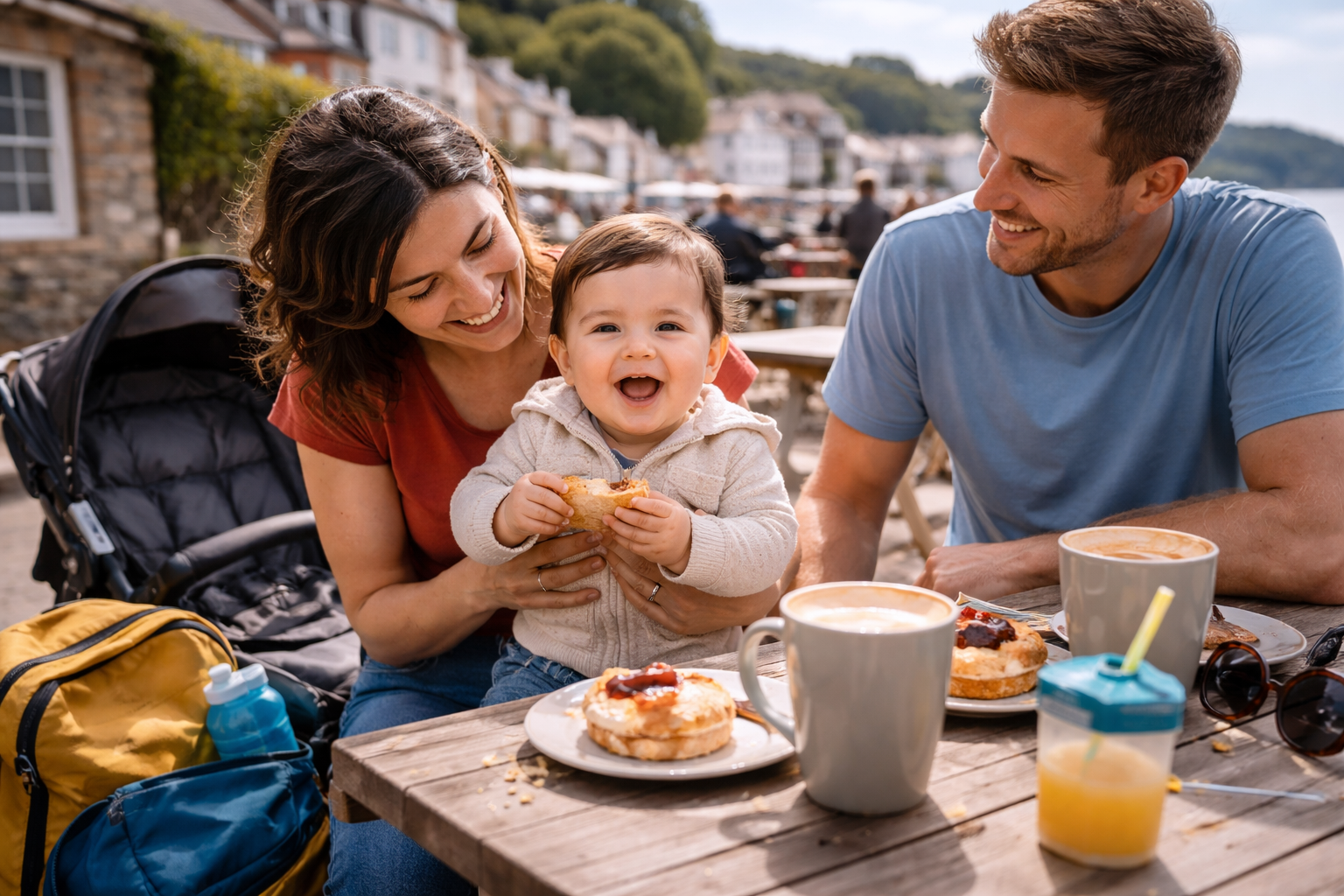
Our boot was so full we couldn't see out of the rear window. We had enough nappies for a fortnight. Two bouncy chairs. A travel swing. Every teether she had ever shown a passing interest in. A first aid kit that would have served a small hospital.
We used about a third of it. Every UK supermarket — and most European ones — sells Pampers, Calpol, Sudocrem, and Aptamil. The first aid kit gathered dust. One of the bouncy chairs never left the car.
The lesson we learned (slowly, over several trips) is this: pack for sleep, for feeding, and for the first 24 hours. Everything else either isn't needed or can be bought at the destination. Our baby holiday packing list has the genuinely essential items — and just as importantly, the things you can safely leave at home.
2. The First Night Is Always Terrible
We knew this might happen. We'd read about it. We were not remotely prepared for it. Our daughter screamed for two hours in the travel cot. New room, new shadows on the ceiling, new smells, different temperature. She was entirely right to be suspicious — nothing about the environment was familiar to her.
By night two, she slept almost normally. By night three, she slept better than she did at home (we think the sea air has something to do with it). But night one was a write-off, and the mistake we made was booking an activity for 10am the following morning. We arrived at it hollow-eyed and functioning on two hours of sleep.
Plan nothing for the first morning. Nothing. Give yourselves the space to recover from the first night before you attempt anything that requires being a functional adult. It is not wasted time — it is essential buffer.
3. We Tried to Do Too Much
📋 Free Baby Holiday Packing Checklist
Enter your email and we'll send the free printable checklist straight to your inbox — every category, ready to tick off before every trip.
Our pre-baby holiday template was three activities, two nice restaurants, a scenic drive. We'd mentally applied this template to our baby holiday without adjusting for the rather significant variable of a baby being present.
Day one: we managed one activity (a 45-minute walk that ended at a café), missed the restaurant booking because of a nap emergency, and cancelled the scenic drive because it was dinnertime and she was done. We were furious at ourselves. Then we went back to the cottage, had a quiet evening, and realised that the walk and the café had actually been quite lovely.
One thing per day is the correct amount. On some days, no planned things at all — just see where the day takes you. Babies who are experiencing new places are genuinely entertained by almost everything; you don't need to stack up the activities. Trust the surroundings.
4. The Routine Survived (Mostly)
We were terrified of "ruining" her sleep routine. We'd worked hard for it. We guarded it ferociously at home. The thought of dismantling months of careful effort in one week of holiday felt catastrophic.
It bent. It did not break. The single most effective thing we did — the thing we now do on every trip without exception — was keeping the bedtime sequence exactly identical to home. Same bath, same pyjamas, same milk, same song, same order, every night. The sequence is the cue. The location becomes almost irrelevant once the sequence is established.
Our keeping the routine on holiday guide goes deep on this, including the specific strategies that work at different ages. We'd read it, implemented about 60% of it, and been relieved to discover that 60% was enough.
5. Nobody Cared About the Baby Crying
This one took us embarrassingly long to learn. On our first evening out, she cried in the restaurant for about four minutes. Four minutes. We were mortified. We took turns walking her around the car park. We apologised to nearby tables. We considered leaving.
We looked around at the other diners afterwards. The family three tables over hadn't even looked up. The couple near the window had their AirPods in. The older couple behind us actually caught our eye and smiled — the particular smile of parents who have been exactly where you are.
Your anxiety about other people's reactions to your baby is, almost universally, dramatically worse than their actual reactions. Most people are either parents themselves, or they are so absorbed in their own evening that your baby barely registers. Breathe. You are not ruining anyone's night.
6. The Carrier Was More Useful Than the Stroller
We brought both, which was the right call. But we used the carrier for roughly 70% of the trip — the stroller handled the flat seafront promenade and the travel back to the car. Everything else, the carrier managed better.
Narrow village paths, a cobblestoned high street, the beach (pushchair wheels and sand are enemies), a farm visit with muddy ground, a crowded market. The carrier navigated all of it without a second thought. The stroller would have required strategy meetings and possible surrender for each of those situations.
If you're still deciding how the two fit together, our sling vs pushchair for travel guide is the most honest breakdown we've managed to write. And our carrier hub covers which ones are worth the investment for travel specifically.
7. We Forgot the Blackout Blind
The cottage listing said "blackout curtains." The curtains were, generously described, a warm cream linen that politely suggested to the morning light that it might want to slow down a little. The morning light did not slow down. Our daughter woke at 5:15am to a room that was genuinely bright.
We spent twenty minutes fashioning a blackout solution from a black bin bag and a roll of gaffer tape we found in the kitchen drawer. It worked. Barely. It held for three more mornings and we felt an absurd amount of pride about this. But we have never once forgotten a portable blackout blind since.
It is not optional kit. It is one of the three or four genuinely essential travel items for a baby. See lesson one about overpacking — the blackout blind is on the very short list of things that actually earns its place in the boot.

Tommee Tippee Sleeptight Portable Blackout Blind
The one we now never leave without | Fits most standard windows | Around £25
After the bin bag incident, we tried three different portable blackout solutions before landing on the Sleeptight. The suction-cup system creates a genuine seal — not "reduced light," actual darkness — and it packs flat into a carry bag that takes up almost no space. Holiday cottage curtains have never troubled us since.
- ✅ Creates a true blackout — not just "dims" the room
- ✅ Strong suction cups; stays up all night without repositioning
- ✅ Packs flat and lightweight — no reason not to take it
- ❌ Doesn't cover unusually shaped or very large windows
- ❌ Can leave faint suction marks on some window surfaces
8. Self-Catering Was the Right Call
We'd debated hotel versus cottage right up until the week before. The hotel felt easier — no cooking, someone else cleaning, room service. The cottage felt complicated — logistics, shopping, making our own beds.
We chose the cottage, largely because it was cheaper, and discovered it was the right choice for reasons we hadn't anticipated. We could cook her food exactly as she liked it. We did laundry at midnight when she was asleep and had clean muslins ready by morning. When she went down at 7pm, we ate dinner in the living room, watched something on a laptop, and had an actual evening together. A hotel room would have given us none of that.
Our holiday park vs cottage guide breaks down when each option works best, and our baby-friendly cottages guide covers what to actually look for in a listing (because "baby-friendly" means wildly different things to different property owners).
9. The Baby Loved It More Than We Expected
This one genuinely surprised us. We'd been so focused on surviving the logistics that we hadn't quite prepared for how completely our daughter would respond to everything new around her.
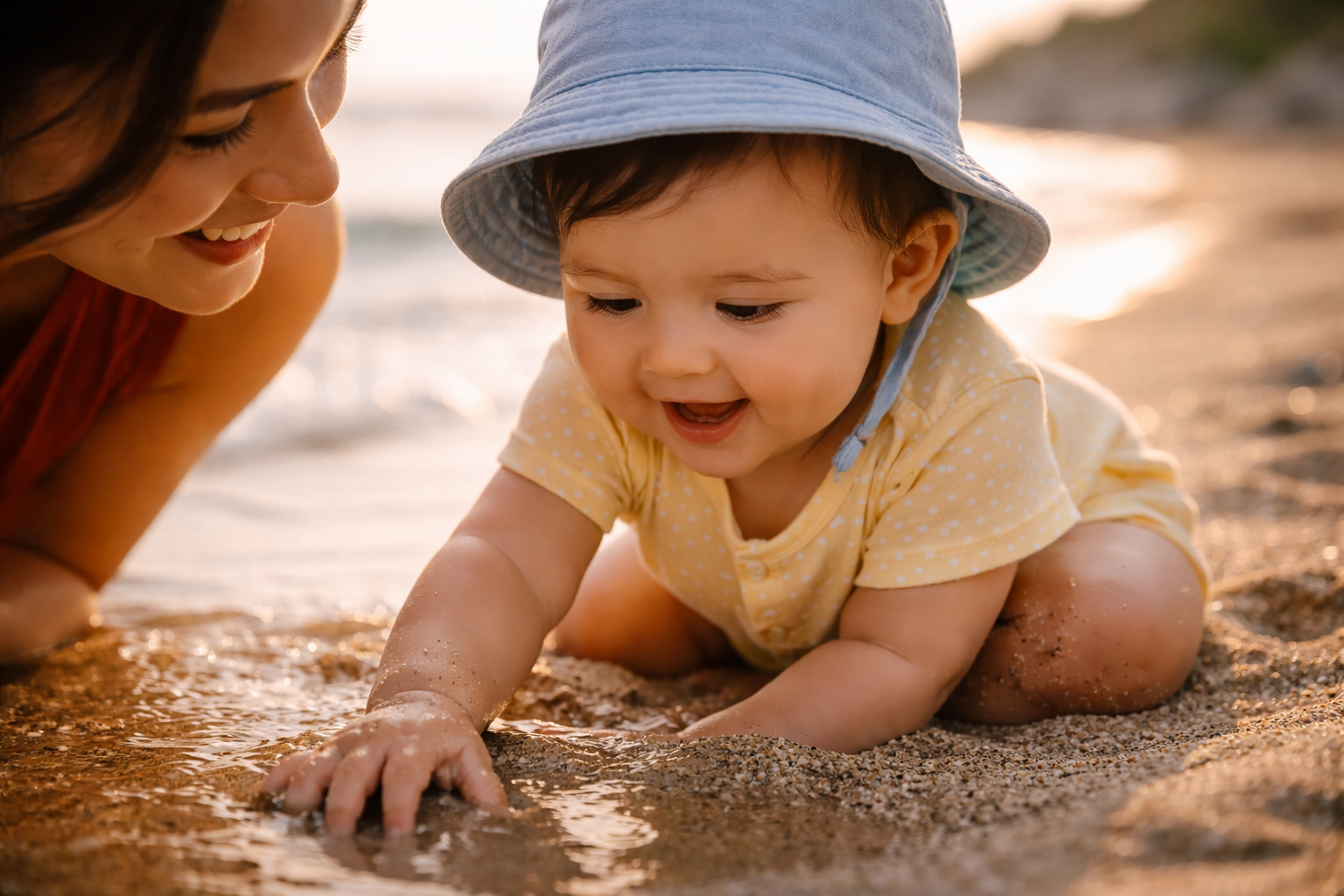
The sand between her toes on that first beach morning — she sat completely still for a full minute, just running it through her fingers, with an expression of pure concentration. The sound of waves. Watching ducks on a pond. The wind on her face on the seafront. A cow in a field that she pointed at for approximately four years.
Babies don't need theme parks. They don't need complex itineraries or educational experiences or Instagram-worthy destinations. They need novelty, and novelty is absolutely free. A beach, a field, a market, a harbour full of boats. New things to look at, smell, touch, and hear. The world is entirely new to them — your job is just to show up somewhere different from home.
10. We'd Do It All Again (And We Did)
The trip was not relaxing. Not even close. It was tiring in a way that was qualitatively different from the tiredness of normal parenting, because there was no familiar home environment to retreat to, no routine to fall back on, no shortcuts. Everything required more effort than it would have done at home.
And watching her see the sea for the first time was worth every single overplanned, underslept, logistically nightmarish minute of it. We booked the next trip before we'd even got home. The second one was noticeably better. The third was almost easy.
You figure out your travel style as a family through doing it. There is no shortcut to that learning. The first trip is the necessary, chaotic, wonderful beginning.

Dreamegg D11 Portable White Noise Machine
Recreates the home sleep environment anywhere | USB rechargeable | Around £30–£35
White noise is one of the most reliable tools for bridging the gap between home sleep and holiday sleep — especially in the early nights when the new environment is at its most unsettling. The D11 clips directly onto the travel cot, runs on USB, and is compact enough to forget it's in your bag. It became a permanent fixture in our travel kit after the first trip.
- ✅ Clips onto travel cot rail — no surface needed, sound right at the baby
- ✅ USB rechargeable with good battery life for a full night
- ✅ Multiple sound options; volume range suitable from quiet to louder holiday settings
- ❌ Small speaker — sufficient for a bedroom but not a large open-plan space
- ❌ No app control; manual adjustments only
10 Lessons at a Glance
What We Wish We'd Known
- 📦 Pack less. Every supermarket sells nappies. Pack for sleep, feeding, and the first 24 hours only.
- 😴 Expect a rough first night. Plan nothing for the first morning. It gets dramatically better from night 2.
- 📅 One activity per day is enough. On some days, none at all is fine.
- 🔁 Keep the bedtime sequence identical to home. The sequence is the sleep cue — not the location.
- 👥 Nobody cares about the crying as much as you do. Other parents are sympathetic; everyone else has AirPods in.
- 🎽 The carrier will probably surprise you. Cobblestones, beaches, crowds — it handles things the stroller can't.
- 🪟 Never forget the blackout blind. Cottage curtains lie. Always bring your own.
- 🏡 Self-catering beats hotels at this stage — separate bedrooms, your own kitchen, real evenings together.
- ✨ The baby will love it more than you expect. Novelty is free. The world is entirely new to them.
- ❤️ The second trip will be easier. The third will be almost easy. Keep going.
✈️ Free Baby Hand Luggage Checklist
Never forget the essentials. Enter your email and we'll send the free checklist straight to your inbox — one page, every category, ready before every flight.
Frequently Asked Questions
What is the best age for a first holiday with a baby?
There is no single answer — it depends more on your confidence as a parent than on the baby's age. That said, the 3–6 month window is popular because babies are feeding well, not yet mobile, and genuinely portable. Newborns (under 12 weeks) can travel but feeding and sleep are still being established. Older babies (6–12 months) are active and engaging but nap logistics become more complex. Our first holiday guide covers the age-specific considerations in detail.
How do you keep a baby's routine on holiday?
Focus on the sequence rather than the clock. The same steps in the same order — bath, pyjamas, milk, song, sleeping bag — are a stronger sleep cue than a specific time. Let the timing shift by 30–60 minutes without stressing. Protect at least one proper nap in a darkened room each day. See our routine guide for the full approach.
What should you not forget to pack for a first holiday with a baby?
The three things most parents wish they hadn't forgotten: a portable blackout blind (cottage curtains are rarely genuinely dark), a white noise machine (new environments are noisy), and the baby's familiar comforter or comforter toy. Everything else — nappies, formula, Calpol — can be bought locally in the UK and across Western Europe.
Is it worth going on holiday with a baby?
Yes — with the caveat that it is not a relaxing holiday in the conventional sense. It is a family trip with a baby in it, and that is a different thing. The rewards are real: watching your baby experience new things for the first time is genuinely wonderful. And the travel skills you build as a family make every subsequent trip easier. Most parents who do it once do it again, and usually sooner than they expected.
Should you fly or drive for a first holiday with a baby?
Driving has a significant advantage for a first trip: you can pack everything, you control the timing, and you can stop whenever you need to. A first UK road trip is one of the best ways to build travel confidence before flying. That said, a 2–3 hour European flight is perfectly manageable — it is often comparable in total travel time to driving to Cornwall or Devon from the Midlands. Our UK vs abroad guide helps you weigh up the options honestly.
How do you get a baby to sleep in an unfamiliar place?
Three things help most: recreating the sensory environment from home (blackout blind, white noise, familiar sleeping bag), keeping the bedtime sequence identical, and offering more physical reassurance than you would at home — staying in the room until they fall asleep is not a regression, it's appropriate for an unfamiliar environment. Expect the first night to be rough regardless. It almost always improves significantly from night two. The routine guide and our guide for when sleep goes wrong on holiday cover this in more depth.
What do you do if things go wrong on a baby holiday?
Slow everything down. Cancel the plans for the day. Go back to basics — familiar food, familiar routine, lots of time in the buggy or carrier doing nothing in particular. Most baby holiday crises (sleep regression, illness, routine collapse) resolve faster when you reduce stimulation rather than push through it. Give yourself permission to have a do-nothing day — it usually resets things more effectively than any other strategy.
Is a cottage or a hotel better for a first baby holiday?
For most families with a baby, a self-catering cottage or apartment beats a hotel. Separate bedrooms mean the baby's 7pm bedtime does not become your bedtime. A full kitchen means you can prepare food exactly how your baby likes it and not spend every meal in an expensive restaurant hoping the baby cooperates. A washing machine handles the inevitable laundry without drama. Hotels work brilliantly for short city-break stays of 1–2 nights; for a week, self-catering almost always wins. Our hotel vs self-catering guide covers this in full.
One Last Thing
Whatever happens on your first trip — however many things go sideways, however many nap windows get missed, however many restaurant bookings you have to abandon — you are doing it. You are figuring out how to see the world with your baby, and that is genuinely worth doing. The learning curve is steep and the first trip is the hardest. Everything after it is incrementally, noticeably better.