
How to Handle Baby's Nap Time on Holiday (Without Losing Your Itinerary)
By BabyTravel UK Editorial Team · Last updated March 2026
The nap vs activity tension is the central conflict of every family holiday. Do you go back to the cottage so baby can sleep in the cot, or do you skip the nap and go to the beach? Both choices have consequences — and most parents have lived through both. This guide offers a middle path: a framework for protecting the naps that actually matter while still doing the things you came for.
⚡ Quick Answers
- Protect the anchor nap — the main daytime nap — in the cot, every day
- Secondary naps can happen in the buggy, carrier, or car — good enough
- Emergency nap: buggy + walk + white noise when everything's gone wrong
- Darkest room trick: the bathroom — often darker than the bedroom, fits a travel cot
- Sample day structure: morning activity → cot nap after lunch → gentle afternoon
- When to skip: once-in-a-lifetime experiences only — and plan for the consequences
The Nap vs Activity Tension
Let's name this directly, because every guide that says "just be flexible" is dodging the real question.
Skipping the nap to squeeze in more holiday time means an overtired baby by 3pm — one who's fractious, clingy, and liable to melt down at the exact moment you're trying to order food or get back to the car. The overtiredness then compounds: a baby who didn't nap well is harder to settle at bedtime, wakes earlier the following morning, and starts the next day already behind on sleep.
Going back to the accommodation for a cot nap means losing 1.5–2 hours of holiday time. That's real. It can feel genuinely frustrating when you're somewhere beautiful and the window is short.
The solution isn't to pretend the tension doesn't exist — it's to have a clear strategy that minimises what you sacrifice. That strategy starts with understanding that not all naps are equally important.
The Nap Hierarchy
📋 Free Baby Holiday Packing Checklist
Enter your email and we'll send the free printable checklist straight to your inbox — every category, ready to tick off before every trip.
Not all naps carry the same weight. Understanding the difference between them changes how you plan your holiday days.
1. The Anchor Nap — Protect This at All Costs
The anchor nap is the most important sleep of the day. For most babies it's the longest nap — typically the late-morning nap for younger babies, or the post-lunch nap for babies on one nap a day. This is the nap that determines whether the rest of the day is manageable.
The anchor nap should happen in the cot, in a darkened room, with the same sleep cues you use at home: sleeping bag, white noise, and ideally a blackout blind. Done well, it delivers 1–2 hours of deep, restorative sleep. A baby who has had a good anchor nap is a genuinely different creature in the afternoon.
Build your holiday day around this nap. It's not a concession — it's the thing that makes the rest of the day work.
2. The On-the-Go Nap — Good Enough
The secondary nap (for babies still on two naps) or any nap that falls inconveniently outside the accommodation is the on-the-go nap. This one can and should happen wherever it happens — buggy, carrier, car, sling. It won't be as long or as restorative as the anchor nap, but it bridges the gap and takes the edge off.
Don't stress about making this nap perfect. A 25-minute buggy nap is worth having. A 20-minute car nap counts. If it happens during the drive back from the beach, that's efficient scheduling, not a failure.
3. The Emergency Nap — Accept Whatever You Get
The emergency nap happens when everything has gone wrong — the anchor nap was short, the afternoon activity ran long, baby is overtired and melting down, and you're still 40 minutes from the cottage. Push baby in the buggy and walk until they sleep. Accept whatever 15–25 minutes arrives. It takes the edge off enough to get you home in one piece.
This isn't a failure of planning — it happens to everyone. It just helps to know what you're dealing with and deploy it calmly rather than frantically.
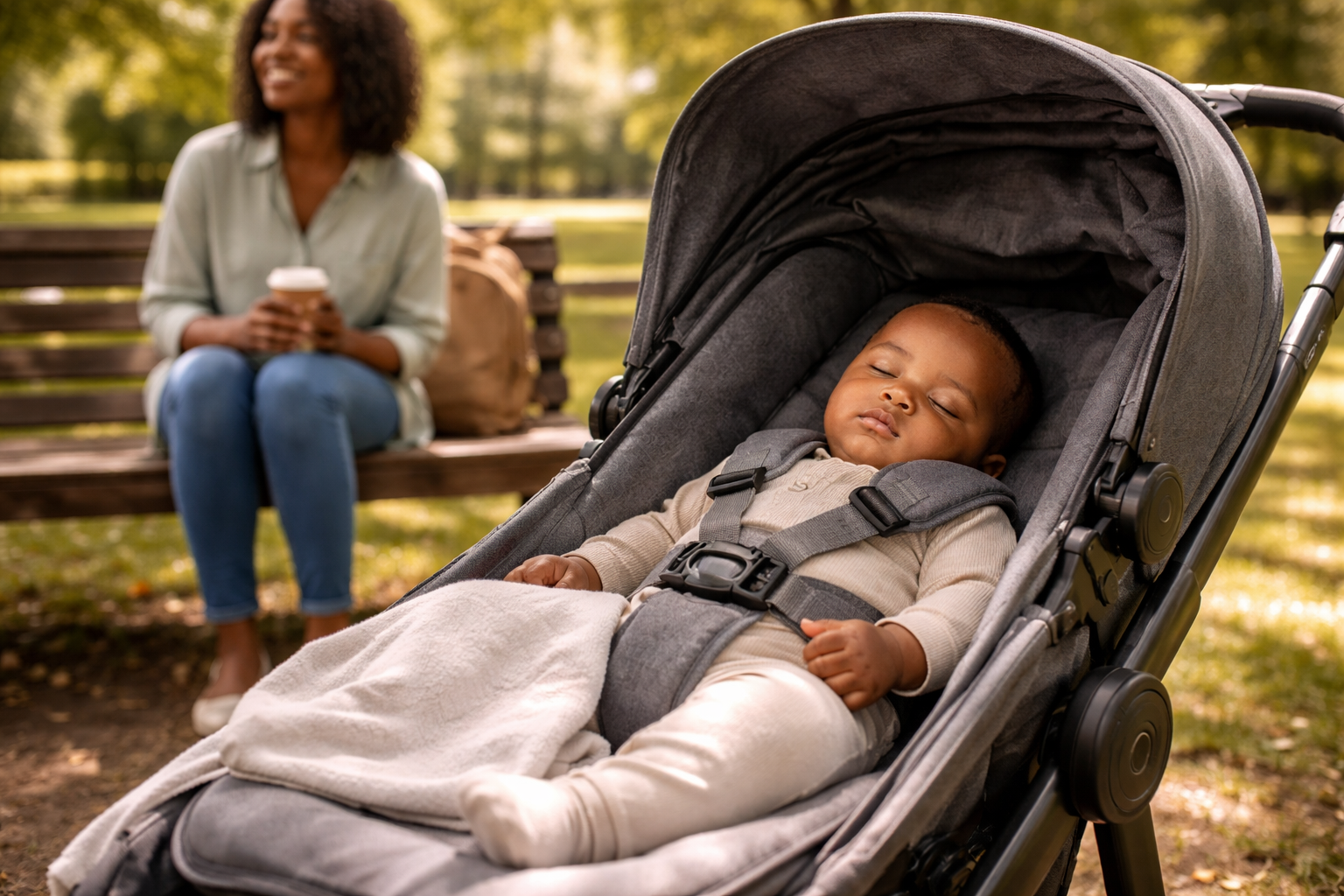
Our Tip: A buggy nap in a park while you sit on a bench with a coffee is a legitimate, genuinely pleasant holiday activity. Build it into the day rather than treating it as lost time.
Naps by Age on Holiday
Nap needs change significantly across the first two years. Here's what to expect at each stage.
| Age | Number of naps | Anchor nap | On-the-go nap | Flexibility |
|---|---|---|---|---|
| 0–4 months | 3–4 naps | Flexible — no strong anchor yet | Will sleep almost anywhere | High — easiest nap stage for holidays |
| 4–8 months | 2–3 naps | Morning nap (in cot) | Afternoon nap — buggy or car | Moderate |
| 8–15 months | 2 naps → transitioning to 1 | Morning nap (in cot) | Short afternoon nap — buggy | Lower — skip morning nap at your peril |
| 15–24 months | 1 nap (post-lunch) | After-lunch nap — THIS is the one (in cot) | N/A — one nap only | Low — skip it and the afternoon is grim |
| 2+ years | 1 nap or dropping | After-lunch (if still napping) | N/A | If dropping naps: plan for early bedtime instead |
The 0–4 month note: newborns and very young babies will sleep in prams, carriers, arms, and car seats with relative ease. The first few months are actually the least complicated nap stage for holiday travel — before more established sleep associations develop. If you're considering your first holiday, this is a genuine window.
The 15–24 month note: this age group has the least flexibility. One nap, after lunch, in the cot. Skip it and the afternoon deteriorates reliably. The pattern that works is: morning activity, back for lunch, nap in the cot for 1–2 hours, gentle afternoon activity. Most parents at this stage describe the post-lunch nap as genuinely non-negotiable on holiday.
Buggy Nap Strategies
When the on-the-go nap needs to happen, the buggy is the most reliable vehicle. These details make the difference between a baby who settles in the pram and one who doesn't.
- Recline fully. Most travel pushchairs have a near-flat recline — use it. A seated baby rarely naps; a reclined one has a fighting chance.
- Block the light. Drape a muslin loosely over the hood, or use a dedicated buggy sun cover. Leave airflow — don't seal the pram entirely. Even partial shade makes a difference to how quickly baby settles.
- White noise in your pocket. A white noise track playing from your phone in your jacket pocket or bag travels with you and provides consistent audio background. This is more consistent than hoping a nearby café has the right ambient noise level.
- Steady rhythm. Walk at a consistent pace. Stop-start walking — pausing at windows, waiting to cross roads, stopping to talk — disrupts the rhythm that's helping baby drift off. Find a flat, quiet route and just walk. A park loop is ideal.
- Time it right. Start the buggy nap when baby shows first tired signs — eye rubbing, yawning, quieting down. If you wait until they're already overtired and fractious, buggy naps become much harder to achieve.
A note on strollers for buggy naps: not all travel pushchairs recline adequately. If a buggy nap is a meaningful part of your holiday strategy, check the recline depth before you travel. Our lightweight stroller guide flags recline specs for the main options.
Carrier Nap Strategies
For babies under around 10 months, a carrier nap can work beautifully. The warmth, closeness, and movement of being carried against a parent's chest mimics the womb environment in ways that reliably send younger babies to sleep. You keep your hands free and can keep walking, browsing, or sitting somewhere pleasant while they sleep.
After around 10 months, carrier naps become less consistent. Older babies are more aware, more resistant to the reclined position, and heavier — a 10kg toddler sleeping against your chest for 90 minutes is physically demanding. For this age, the buggy or cot is a more reliable option. See our carrier guide for travel for specific carrier recommendations by age and weight.
Always maintain safe carrying position during carrier naps: face visible, chin off chest, head supported, and close enough to kiss.
Setting Up the Dark Room for Cot Naps
The anchor nap works best when the sleep environment is close to what baby has at home. Four elements matter most:
Darkness. Holiday accommodation curtains are almost never adequate. A blackout blind is the most impactful single item you can pack for sleep — more so than any gadget, product, or sleep training strategy. The travel cots and sleep solutions hub has full recommendations. Install the blind before baby's first nap rather than fiddling with suction cups in a dark room at 7pm.
White noise. Familiar audio from home is a powerful sleep cue. A portable white noise machine provides consistent sound that also masks the unfamiliar noises of holiday accommodation — creaking floorboards, voices from adjacent rooms, traffic patterns that differ from home.
Sleeping bag. The same sleeping bag they use at home. The familiar texture, smell, and restriction of movement are genuine comfort signals. Don't substitute a blanket on holiday — pack the sleeping bag even if it takes up space.
Routine cues. Even a brief version of the nap routine from home — a song, a cuddle, the same words you use — signals sleep in a way that nothing else does. It takes 3 minutes and makes a measurable difference. Our full routine guide goes deeper on this.
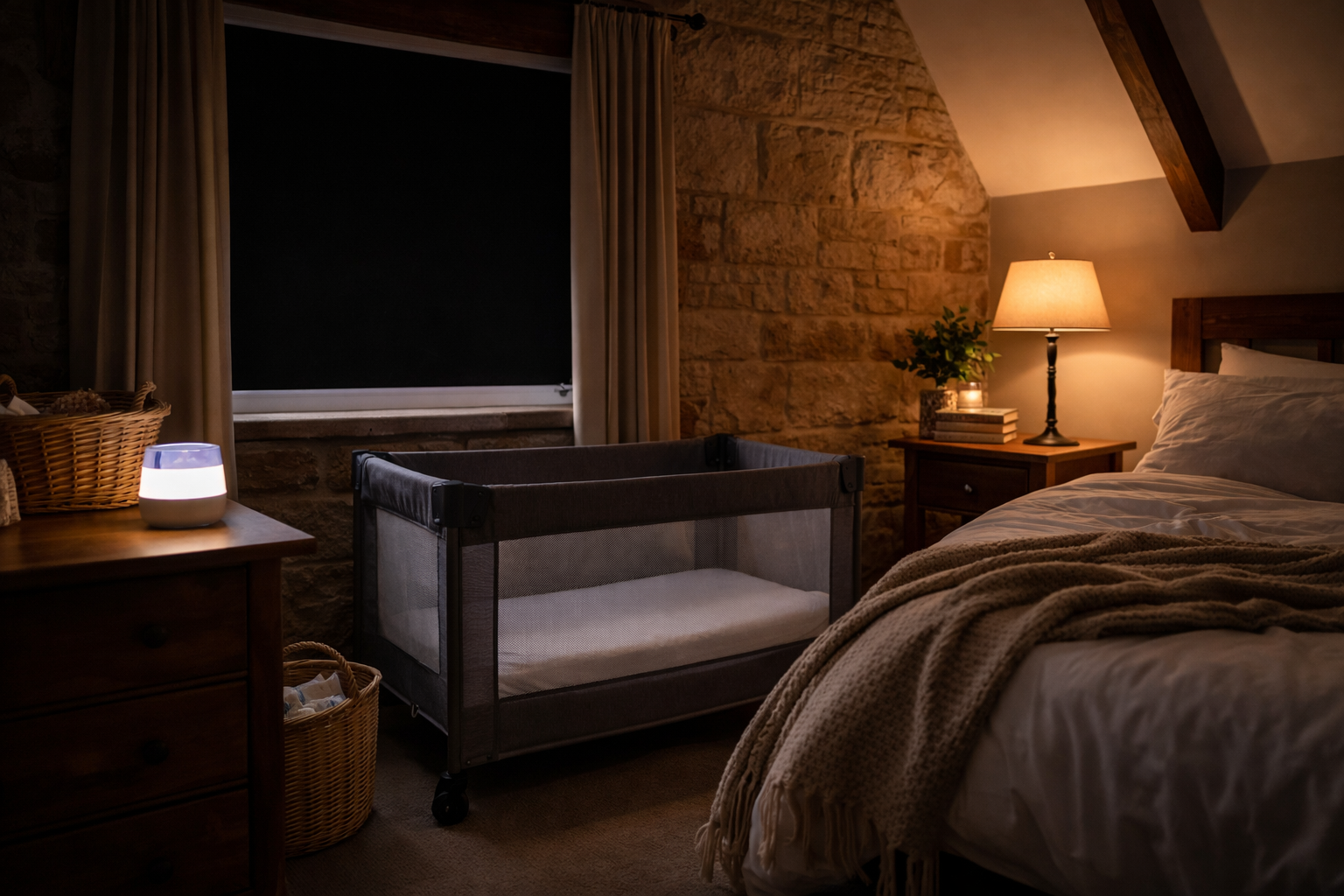
Our Tip: If the bedroom doesn't get dark enough even with a blackout blind, try the bathroom. It sounds strange but it works — bathrooms typically have no windows or very small frosted ones, making them the darkest room in many holiday cottages and hotel rooms. A travel cot fits in most bathroom spaces, and the ambient warmth is fine. Some parents swear by it.

Tommee Tippee Portable Blackout Blind
The single most impactful sleep item you'll pack
Suction cups to almost any window surface, blocks effectively to near-full darkness, and rolls into a compact pouch for packing. Referenced in more reader recommendations on this site than any other single product. Install it before the first nap so there's no fiddling at bedtime. Check the edges for light leaks once in place.
- ✅ Near-total darkness on most standard windows
- ✅ Compact — fits easily in a changing bag side pocket
- ✅ Suction cups hold well on most glass surfaces
- ❌ Can be fiddly to position on non-standard or textured window frames
- ❌ Suction cups may not hold on frosted or older glass — test before relying on it

Dreamegg D11 White Noise Machine
Portable sleep cue that travels everywhere
A familiar white noise sound from home is one of the most effective sleep cues available — it signals sleep and masks the unfamiliar sounds of holiday accommodation. The D11 is compact, USB rechargeable, and clips to a pram or travel cot. A night light mode is useful for nappy changes without fully waking baby.
- ✅ USB rechargeable — no fiddling with batteries abroad
- ✅ Compact enough to fit in a changing bag pocket
- ✅ Multiple sound options — white noise, rain, lullabies
- ✅ Clip attachment works on pram, travel cot, or headboard
- ❌ Timer function turns it off automatically — disable this for longer naps
- ❌ Volume can be limited in very noisy environments
Planning the Day Around the Nap
The framework that works for virtually every age and every destination:
| Time | 0–4 months | 4–8 months | 8–15 months | 15–24 months |
|---|---|---|---|---|
| 6–9am | Wake, feed, short awake window then nap 1 | Wake, feed, awake window | Wake, feed, awake window | Wake, feed |
| 9–11am | Nap 1 (buggy or cot) | Nap 1 in cot (anchor) | Main morning activity — best awake window | Main morning activity — best awake window |
| 11am–1pm | Main activity during awake window | Main morning activity | Continue activity or head back | Continue activity, start heading back |
| 12–2pm | Nap 2 (cot or buggy) | Lunch + nap 2 (buggy) | Lunch back at accommodation | Lunch back at accommodation |
| 2–4pm | Activity or café stop | Gentle afternoon activity | Anchor cot nap (1–1.5 hrs) | Anchor cot nap (1–2 hrs) |
| 4–7pm | Wind down, feeds, bedtime | Gentle activity, wind down | Gentle afternoon activity, dinner, bedtime | Gentle afternoon activity, dinner, bedtime |
The pattern is consistent across ages: put the best activity in the morning when baby is freshest, protect the main nap in the afternoon (or midday for younger babies), and keep the post-nap period gentle. You get a proper morning out, a well-rested baby, and a manageable evening. That's a good holiday day.
When to Skip the Nap
Sometimes the activity is worth it. A whale-watching boat trip that departs at 11am, a family gathering that runs through lunchtime, a once-in-a-trip beach day at the most beautiful spot on the coast — these things matter. You don't have to build your entire holiday around the nap schedule.
The conditions for a deliberate nap skip: it's a genuine occasion rather than a habitual convenience, and you consciously plan for the consequences. An earlier bedtime (sometimes much earlier — a 6pm bedtime the night of a missed nap is not unusual), a possible middle-of-the-night wake, and a baby who needs more patience that evening.
Make it a decision, not an accident. "We're skipping the nap today because we're visiting Great-Grandma and it's worth it" is entirely different from "I just noticed it's 3pm and she hasn't slept since this morning." The first is manageable. The second is just an overtired baby with no plan.
For more on managing sleep across the whole holiday — bedtime routine, night wakings, and the first night in a new place — see our companion guide on keeping baby's routine on holiday and the guide for babies who won't sleep away from home.
✈️ Free Baby Hand Luggage Checklist
Never forget the essentials. Enter your email and we'll send the free checklist straight to your inbox — one page, every category, ready before every flight.
Frequently Asked Questions
Should I skip naps on holiday so we can do more?
Occasionally, for a genuine occasion — yes. Routinely skipping naps to squeeze in more activity almost always backfires. An overtired baby makes everything harder: worse afternoon behaviour, a rougher bedtime, and an earlier wake the next morning. Protect the anchor nap, do your activities in the morning and after the nap, and you genuinely get to do more rather than less.
How do I get my baby to nap in a buggy on holiday?
Full recline, muslin over the hood to block light, white noise from your phone pocket, and a steady walking rhythm on a flat route. Timing matters — start when baby first shows tired signs, not when they're already overtired. A park loop with a coffee is the ideal format. Our stroller guide flags which travel pushchairs have adequate recline for napping.
What is the anchor nap and why does it matter?
The anchor nap is the most important sleep of the day — the longest one, done in the cot in a dark room with sleep cues from home. A well-rested baby after a good anchor nap has a genuinely different afternoon compared to one who skipped it. Plan your holiday day around this nap rather than trying to fit it in around everything else.
How do I keep a holiday bedroom dark enough for naps?
A portable blackout blind is the most reliable solution — the Tommee Tippee Sleeptight (above) handles most standard windows. If the bedroom still has gaps, try the bathroom — often the darkest room in the accommodation and a travel cot fits easily. See the full packing list for all the sleep items worth bringing.
Can babies nap in a carrier on holiday?
Yes, reliably up to around 10 months. The motion and warmth usually send younger babies to sleep. Less consistent for older, heavier babies who resist the reclined position. Always ensure safe carrying position — head visible, chin off chest, close enough to kiss. See our carrier travel guide for recommendations by age.
How do I structure a holiday day around baby's nap?
Best activity in the morning during the peak awake window → back for lunch → anchor cot nap → gentle afternoon activity. This works for every age from 4 months upwards. You get proper morning time, a good nap, and a relaxed afternoon. It's not restrictive — it's the structure that makes everything else run smoothly.
What do I do if my baby is overtired and far from the accommodation?
Deploy the emergency nap: buggy, walk, white noise on your phone. Accept whatever 20–25 minutes you get — it takes the edge off. If no buggy: carrier. If neither: get back to the accommodation by any means necessary. Overtired babies don't improve spontaneously; they need sleep.
When is it okay to skip a nap on holiday?
When it's a genuine occasion and you consciously plan for the consequences: earlier bedtime, possible night wake, more patience required that evening. A deliberate skip is manageable. An accidental one — where you suddenly notice it's mid-afternoon and baby hasn't slept — is much harder. If you're going to skip, decide in the morning and plan accordingly.
Will holiday ruin my baby's sleep routine?
Almost certainly not permanently. Most babies return to their normal sleep pattern within a few days of getting home — sometimes overnight. A disrupted week on holiday is worth it. The bigger risk is letting the disruption spiral: too many late nights, skipped naps piling up, overtiredness feeding on itself. Protect the anchor nap and a reasonable bedtime and you give the routine the best chance of surviving the trip. Our guide to keeping baby's routine on holiday covers the full picture beyond just naps.
Where does a 1-year-old sleep when travelling?
Usually a travel cot — either provided by the hotel or self-catering accommodation, or one you bring yourself. At 1 year, most babies sleep well in a familiar travel cot from home; if yours is used to a particular cot, bringing it avoids any adjustment period. Hotels provide cots on request (always confirm in advance), self-catering properties often include one, and camping sites sometimes loan them. See our travel cot guide for the best options by age and use case.
The Bottom Line
Naps on holiday don't have to be all or nothing. Protect the anchor nap in the cot each day, let secondary naps happen wherever they happen, and treat the occasional deliberate skip as a conscious choice with known consequences. The day structure that works — morning activity, post-lunch cot nap, gentle afternoon — isn't a restriction on your holiday. It's the framework that keeps it enjoyable for everyone.