
How to Set Up a Travel Cot Easily: Step-by-Step Guide for UK Parents
By BabyTravel UK Editorial Team · Last updated March 2026
Arriving at your holiday accommodation with an overtired baby and a travel cot you've never assembled before is a special kind of stressful. Setting up a travel cot easily is genuinely achievable — but most cots have one or two non-obvious steps that trip parents up the first time. This guide walks you through the general process, covers model-specific quirks, and includes everything you need for a safe, comfortable sleep environment.
- Always practise the setup at home before your trip — it's much harder in an unfamiliar room
- The most common problem: the base won't lock — push the centre firmly downward
- Pop-up cots (Bugaboo Stardust, Maxi-Cosi Iris) are fastest; traditional frame cots take 2–5 minutes
- Only the firm included mattress and a fitted sheet should go in the cot — no pillows or duvets
- Check the cot meets UK safety standards before each trip
Before You Start: Choose the Right Location
Before you open the carry bag, take a moment to choose where you're placing the cot. You want a flat, stable floor surface away from radiators, windows, direct sunlight, and anything your baby could grab from inside the cot. If the room has curtains that don't block much light, identify where you'll position your portable blackout blind — setting that up before the cot makes bedtime much smoother.
Also check for hazards at baby's reach level: lamp cords, plug sockets, low shelving. You'll be glad you spotted them before midnight rather than during a 3am wake-up.
How to Set Up a Traditional Frame Travel Cot: Step by Step
The process below applies to most traditional folding travel cots (BabyBjörn, Joie, Silver Cross Slumber, Graco, etc.). There are small variations between models, so always check your specific manual — but this covers the general sequence.
- Unpack and lay flat. Take the cot out of its carry bag and unfold it onto the floor. Let the frame open out naturally rather than forcing it.
- Extend and lock the side rails. Pull each side rail upward until you hear or feel it click firmly into position. On most models, all four sides need to lock before the base will seat correctly. Don't rush this step — a partially extended rail is the most common cause of a base that won't lock.
- Set the base position. If your cot has multiple base heights (useful for newborns), slot it into the higher position first. For older babies who can stand, use the lower position.
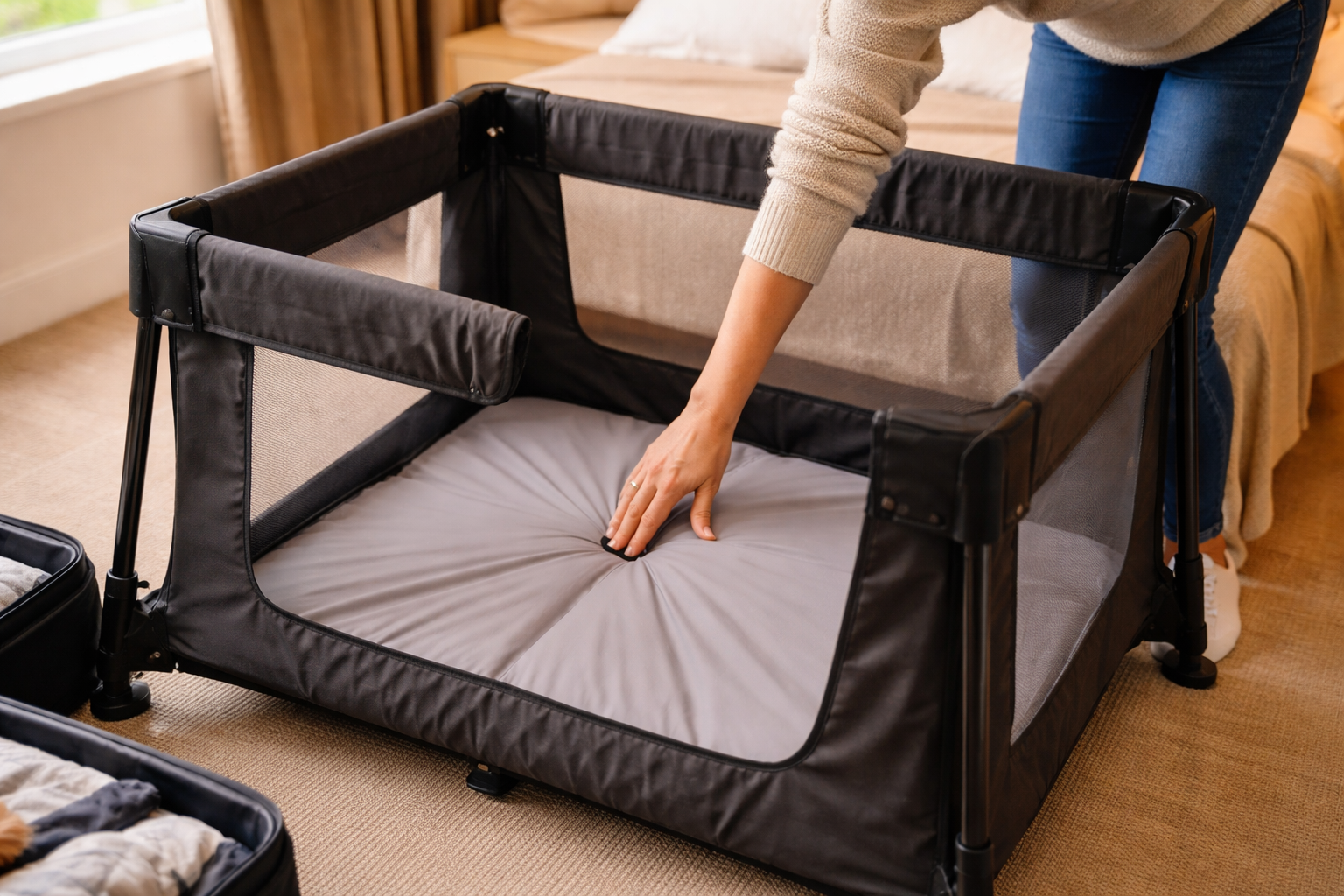
- Lock the base. This is the step that catches most parents out. Place the base panel onto the frame supports, then press down firmly in the centre — not the edges. On most models, it needs a deliberate, solid push to click into place. You should hear a clear click.
- Shake test. Give the assembled cot a firm shake. There should be no wobble, no loose joints, and the base should not move. If anything feels unstable, check all the locking points again before use.
- Add the mattress and fitted sheet. Place the included mattress onto the base. It should fit snugly with no gaps larger than 25mm around the edges. Add a fitted sheet — pack-n-play or travel cot fitted sheets are widely available. Do not add any extra padding or mattress toppers.
How Pop-Up Travel Cots Work
📋 Free Baby Holiday Packing Checklist
Enter your email and we'll send the free printable checklist straight to your inbox — every category, ready to tick off before every trip.
Pop-up travel cots like the Bugaboo Stardust and Maxi-Cosi Iris work on a different principle — a spring-loaded mechanism that opens the cot when you release it from its packed bag. Setup is usually as simple as removing it from the carry bag, gripping the sides, and flicking it open. It's genuinely fast.
The trade-off comes when packing away. Pop-up cots fold in a figure-of-eight motion (similar to a pop-up tent) and can feel counterintuitive the first time. Watch a YouTube video for your specific model before your first trip — it'll save you twenty minutes of frustration on the way home.
Travel Cot Setup: Common Mistakes
| Mistake | What Happens | How to Fix It |
|---|---|---|
| Base won't click into place | Cot feels wobbly; base moves | Check all side rails are fully locked first; press centre of base firmly |
| Side rails won't extend | Frame stays partially folded | Check for a release clip or button at each corner; these need to be disengaged before extending |
| Mattress has gaps at edges | Safety risk — babies can get limbs or head trapped | Use only the mattress supplied with the cot, or one certified to fit that exact model |
| Adding extra bedding | Overheating and suffocation risk | Use only a well-fitting sleeping bag; no duvets, pillows, or bumpers |
| Placing near a heat source | Overheating risk | Position away from radiators, direct sunlight, and warm air vents |
| Forgetting to practise at home | Difficult setup in dark hotel room | Do at least one full setup and pack-away at home before travelling |
Which Travel Cots Are Easiest to Set Up?
If ease of assembly is a priority — particularly if you're travelling solo with a baby — it's worth choosing a cot specifically for its setup simplicity. Here's how the popular options compare.

Premium lightweight travel cot | ~5kg | From birth to 3 years | Around £350
- Intuitive, quick assembly — praised by parents for ease
- Exceptional quality mattress included
- Very lightweight at ~5kg
- Compact fold for travel
- Premium price (~£350)
- No raised bassinet level
- Smaller sleeping area than some rivals
The BabyBjörn Travel Cot Light is consistently rated as one of the most intuitive travel cots to assemble — parents regularly comment that it "just clicks together" without the usual wrestling match. The quality of the included mattress is noticeably better than budget options, which matters if your baby is a light sleeper or you're using the cot for multiple weeks. A solid choice if the price is within budget.

Pop-up travel cot and bassinet | From birth to 9kg (bassinet) / 15kg (cot) | Around £200
- Pop-up mechanism — opens in seconds
- Raised bassinet for young babies
- Breathable mesh sides
- Grows with baby from birth to ~3 years
- Pop-up fold-away takes practice
- Heavier than BabyBjörn
- Included mattress is fairly basic
The Maxi-Cosi Iris is worth considering if you want the fastest possible setup. The pop-up mechanism means the cot is ready in seconds — genuinely useful when you arrive late after a long journey. It functions both as a raised bassinet for newborns and a full travel cot as your baby grows. Worth noting: watch a packing-away video before your trip, as the fold-back mechanism takes a few attempts to get smooth.
Safe Sleep in a Travel Cot: The Essentials
Setting up correctly is only half the job. Safe sleep matters just as much on holiday as at home. The Lullaby Trust's safe sleep guidance applies fully to travel cots:
- Feet to foot: Place your baby with their feet at the bottom of the cot
- Firm, flat mattress only: No extra padding, toppers, or folded blankets under the sheet
- Clear sleeping space: No pillows, duvets, bumpers, or soft toys
- Sleep on their back: Until they can roll independently
- Room temperature 16–20°C: Use a sleeping bag rated for the temperature, not loose blankets
- Smoke-free environment: Never smoke near a sleeping baby
Pack a travel thermometer so you can check the room temperature wherever you stay. Holiday accommodation — particularly older cottages and apartments abroad — can vary widely, and adjusting your baby's sleeping bag tog rating accordingly makes a real difference to how well they settle.
Packing the Travel Cot Away
Packing away is where most parents struggle, particularly with traditional frame cots. The general process is the reverse of setup: remove the fitted sheet and mattress, release the base (usually by lifting the central button or pressing the centre from underneath), fold the sides inward, and compress the frame back into its bag.
The BabyBjörn Travel Cot Light packs away especially cleanly — the base folds flat without a separate release step, which simplifies the process considerably. If you're choosing between similar models, the pack-away experience is worth factoring in — YouTube videos of real parents packing specific models are genuinely helpful.
For more on choosing the right travel cot in the first place, our best travel cots for small spaces guide covers the key models in detail. If you're worried about overnight sleep safety in a travel cot, our dedicated piece on whether babies can safely sleep overnight in travel cots covers the guidance from the Lullaby Trust in full. And for a broader roundup of the best options across all price points, see our best travel cots for newborns UK guide.
✈️ Free Baby Hand Luggage Checklist
Never forget the essentials. Enter your email and we'll send the free checklist straight to your inbox — one page, every category, ready before every flight.
Frequently Asked Questions
How long does it take to set up a travel cot?
Most traditional folding travel cots take 2–5 minutes once you know the process. Pop-up cots like the Bugaboo Stardust can be ready in under a minute. The first setup always takes longer — practise at home before your trip so you're not figuring it out in a dark hotel room with an overtired baby.
Why won't my travel cot base lock into place?
This is the most common setup frustration. On most models, the base locks by pressing down firmly in the centre — it needs a deliberate push, not a gentle press. If it still won't lock, check the side rails are fully extended and clipped in first. An unlocked rail prevents the base from seating correctly.
Can I use a travel cot for my newborn?
Yes — as long as the cot meets current UK safety standards and the mattress is firm and fits snugly. For very young babies, a travel cot with a raised bassinet level makes settling and lifting much easier and is gentler on parents' backs. Always follow the manufacturer's minimum weight guidance.
Is it safe for my baby to sleep in a travel cot every night?
Travel cots meet the same safety standards as home cots and are safe for regular overnight use, provided the mattress is firm and fits correctly. The main practical consideration for extended use is mattress quality — budget travel cots often come with thinner mattresses that are fine occasionally but less comfortable for longer trips.
How do I stop a travel cot mattress from sliding?
If your travel cot mattress slides around, it may be slightly too small for the cot base — a snug fit is essential for safety. Check the mattress dimensions against the cot manufacturer's guidance. A correctly sized mattress should not need to be held in place. See our best mattress for travel cot UK guide for approved upgrade options.
How do I fold a travel cot back up?
Packing away is usually the reverse of setup. Remove bedding and the mattress first, then release the base (usually a central push or lift mechanism), fold the sides inward, and collapse the frame. On most models, pressing down firmly on the centre of the raised base releases it. Practise at home first — it gets much easier after the second time.
What should I put in the travel cot?
Only the firm, fitted mattress and a fitted sheet. The Lullaby Trust advises against pillows, duvets, bumpers, or soft toys in the sleep space. For warmth, use a baby sleeping bag rated appropriately for the room temperature — around 16–20°C is ideal for most babies.
Which travel cots are easiest to set up?
Pop-up style cots (Bugaboo Stardust, Maxi-Cosi Iris) are the fastest — some open in seconds with a single release. Among traditional frame cots, the BabyBjörn Travel Cot Light is consistently praised for intuitive assembly. If ease of setup is your top priority, watch YouTube setup videos for your shortlisted models before buying.
Final Thought
The first travel cot setup always takes longer than expected — but by the second or third time, most parents have it down to a couple of minutes. Practise at home, watch the model-specific video once, and you'll arrive at your holiday accommodation prepared. Your baby's sleep — and your own — will thank you for it.