
Best Travel Cot Mattress UK 2026: 5 Safe-Fit Options
By BabyTravel UK Editorial Team · Last updated September 2026
The best travel cot mattress is the one that fits your particular cot exactly while providing a firm, flat sleep surface. A thicker or softer mattress is not automatically safer or more comfortable, and a gap around the edge is a reason to choose a different size.
This guide compares five UK options by dimensions, firmness, breathability, cleaning and how easily each mattress packs for a holiday. If you also need the cot itself, compare our best travel cots in the UK before buying a mattress separately.
Quick answer
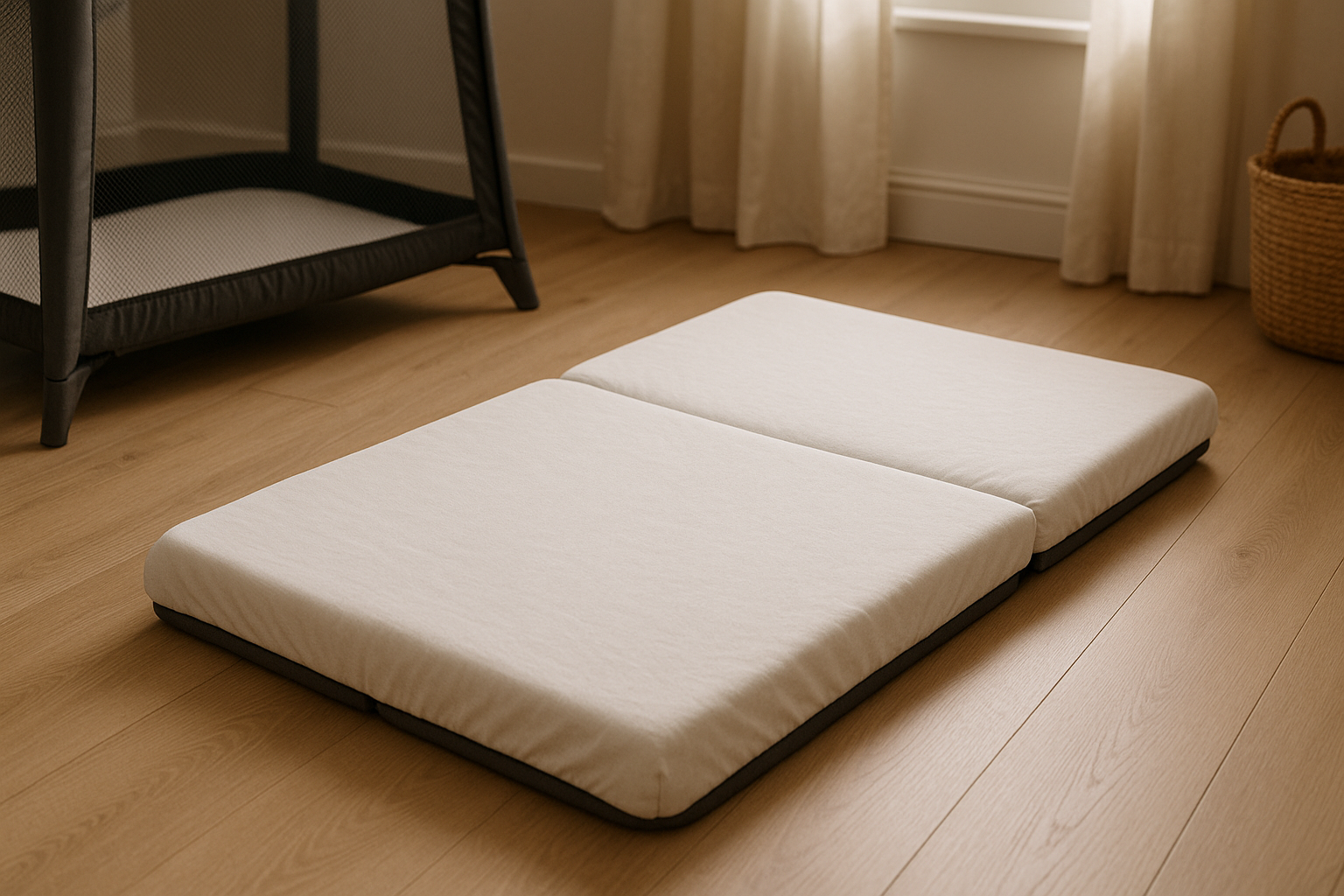
Choose by exact cot-base dimensions first. Baby Elegance is our most useful folding all-rounder, Hauck Sleeper suits common 120 x 60cm travel cots, Kinder Valley fits compact 100 x 50cm cots, and the 84 x 50cm ATH Collection option is for smaller bases. The Little Green Sheep is the premium natural-material choice when the listed size matches your cot.
Best travel cot mattresses at a glance
| Best for | Product | Listed size | Check price |
|---|---|---|---|
| Best overall | Baby Elegance Travel Cot Mattress | 100 x 70 x 3cm | Amazon |
| Compact cot | Kinder Valley Kinder Flow Mattress | 100 x 50cm | Amazon |
| Standard-size travel cot | Hauck Sleeper | 120 x 60 x 5cm | Amazon |
| Smaller cot base | ATH Collection Quilted Foam Mattress | 84 x 50 x 5cm | Amazon |
| Natural materials | Little Green Sheep Natural Travel Cot Mattress | Check chosen listing | Amazon |
Measure your travel cot before ordering
Remove any bedding and measure the internal sleeping area at mattress level. Record the length and width in centimetres, then check the manufacturer's instructions to see whether a replacement mattress is permitted and which maximum size or thickness it specifies. Do not rely on labels such as "standard travel cot" because the products above range from 84 x 50cm to 120 x 60cm.
The mattress should lie flat without buckling, overlap or a gap that could trap your baby's face or limb. Use a fitted sheet made for that exact mattress, and do not stack the replacement on top of the original base unless the cot manufacturer explicitly permits it. The Lullaby Trust mattress guidance recommends a firm, flat, waterproof sleep surface that is in good condition.
Top product breakdowns
📋 Free Baby Holiday Packing Checklist
Enter your email and we'll send the free printable checklist straight to your inbox — every category, ready to tick off before every trip.

Baby Elegance Travel Cot Mattress (Best Overall)
The Baby Elegance measures 100 x 70 x 3cm and folds into the supplied carry bag, which makes it practical for compact travel cots and repeated weekends away. Its supportive fibre core and breathable construction keep the mattress light, while the removable machine-washable cover is easier to manage after a leak than a wipe-only surface.
Pros: foldable, carry bag included and washable cover. Cons: 100 x 70cm is not a universal size, and the fold lines make it less suitable for any cot that requires a completely rigid one-piece mattress.
Typical price: around £35–£55. Confirm the cot maker permits a 3cm replacement mattress before ordering.

Kinder Valley Kinder Flow Mattress (Best for a 100 x 50cm Cot)
This 100 x 50cm mattress is designed for compact cot spaces rather than the larger 120 x 60cm travel-cot format. The water-resistant, removable machine-washable cover is useful for longer stays, and the ventilated Kinder Flow construction is the main reason to shortlist it for a compact cot that accepts this exact size.
Pros: washable cover, useful compact dimensions and breathable construction. Cons: it will be too narrow for many full-size travel cots and is less convenient to carry than a mattress sold with its own travel bag.
Typical price: around £25–£40. Measure the base carefully because a 10cm width difference is significant in a baby's sleep space.

Hauck Sleeper (Best 120 x 60cm Folding Mattress)
The Hauck Sleeper measures 120 x 60 x 5cm and folds into a compact carry bag. It fits many larger rectangular travel cots and doubles as a play mat, so it is a practical choice for car holidays and grandparents' houses where luggage weight matters less than easy storage.
Pros: common 120 x 60cm footprint, three-part fold and carry bag. Cons: the 5cm depth is thicker than some cot instructions permit, and the foam filling needs time to dry if moisture reaches the core.
Typical price: around £30–£45. Match all three measurements to the cot instructions rather than checking length and width alone.

ATH Collection Quilted Foam Mattress (Best for a Smaller Cot)
At 84 x 50 x 5cm, this is the smallest mattress in the comparison. It has a quilted removable washable cover and a foam core, making it a lower-cost option for compact cots that specify this less common footprint.
Pros: modest price, washable cover and useful size for smaller cot bases. Cons: the listing describes a cot mattress rather than a universal travel-cot replacement, and it is unsuitable for any base larger than 84 x 50cm.
Typical price: around £20–£35. Only choose it when the cot's internal measurement and permitted mattress depth match.
Little Green Sheep Natural Travel Cot Mattress (Best Premium)
Why it stands out: this model uses coir and natural latex beneath an organic cotton cover, so it will appeal to parents who prefer natural materials and expect to use the mattress regularly.
Check before buying: choose the listing that matches the dimensions permitted for your cot. It costs considerably more than the foam and fibre choices, so it makes most sense for frequent stays rather than a single holiday.
What else you may need alongside the mattress
A good mattress is the foundation, but a couple of low-cost extras keep it protected and complete the safe sleep setup.
- Travel cot fitted sheets (95×65cm) — suitable only for a mattress with matching dimensions. Pack two so one is available if the other becomes wet. Around £10–£15 a pack. Check price on Amazon
- Waterproof mattress protector — shields the mattress from leaks and spills, and dries far faster than a soaked foam core. Around £8–£12. Check price on Amazon
- Grobag baby sleeping bag — the safe alternative to loose blankets, in the right tog for the room temperature. Around £25–£40. Check price on Amazon
Can you add a mattress to a travel cot?
Check the travel cot instructions before adding anything. Many travel cots are supplied with a thin, firm padded base that is part of the cot's safety-tested design. If the manufacturer says to use only that base, adding a separate mattress is not appropriate, however uncomfortable the original may look to an adult.
If the instructions allow a separate mattress, use the size and maximum depth stated for that exact cot. Do not put a new mattress on top of the supplied mattress or pad unless the manufacturer specifically tells you to do so. Stacking two layers can create a softer surface, raise the sleeping height and leave gaps around the edges.
The same safer-sleep basics apply away from home. The NHS safer sleep advice says a baby's mattress should be firm, flat and waterproof, while the cot should remain clear of pillows, bumpers, toys and loose bedding.
Which travel cot mattress size do you need?
There is no single UK travel cot mattress size. A large rectangular cot may take a 120 x 60cm mattress, while compact and bedside-style travel cots can be considerably smaller. Even two mattresses described as “compact” may differ by 10cm in width.
- Find the cot's model name and check its instructions for the permitted mattress size and depth.
- Set the cot up fully on a level floor and measure the sleeping area inside the frame.
- Compare length, width and depth with the mattress listing. Check the actual variant selected, as one listing may offer several sizes.
- Once the mattress arrives, place it in the cot before removing packaging or washing the cover. It should lie flat and reach the edges without being forced into the corners.
A fitted sheet can change the way a folding mattress sits. Put the sheet on during your fit check and make sure it does not pull the corners upwards or squeeze the folding panels together. If it does, the sheet is too small even if you can stretch it over the mattress.
Foam, fibre or natural materials?
| Mattress type | Useful for | What to consider |
|---|---|---|
| Foam | Affordable mattresses and occasional trips | Check firmness, cover quality and whether the foam returns to shape after storage |
| Fibre | A lighter mattress that is easier to carry | Check that support remains even and the edges do not flatten with use |
| Natural fibres | Frequent use and parents who prefer natural materials | Usually costs more and still needs the same exact fit and waterproof protection |
Material alone does not tell you whether a mattress is suitable. A premium natural mattress in the wrong size is a worse choice than a modestly priced foam or fibre mattress that is permitted by the cot maker and fits correctly. Look at the complete specification, including the cover, seams and stated age range.
Are folding travel cot mattresses comfortable?
A folding mattress is easier to fit into a car boot or store at a relative's house, but the joins between its panels should close neatly when it is laid flat. Deep channels, curled edges or panels that sit at different heights are reasons to stop using it and contact the retailer or manufacturer.
Do not try to level a fold with towels, blankets or a second topper underneath. The Lullaby Trust's safer sleep on holiday guidance says travel cot mattresses can be thinner than conventional cot mattresses and warns against adding folded blankets or quilts to make them feel softer.
When a folded mattress has been stored for a while, open it before bedtime and follow its care instructions. It should settle flat without needing to be weighted down. If it remains bent, damaged or uneven, do not improvise a repair for that night's sleep.
Waterproof covers, sheets and night-time accidents
A removable washable cover is helpful, but check whether the mattress itself is described as waterproof or whether it needs a separate protector. A protector should be the correct size and sit smoothly beneath a single fitted sheet. Avoid thick quilted toppers or anything that makes the surface soft.
For a trip, two fitted sheets are more useful than one expensive sheet. Pack the spare somewhere you can reach without unpacking the whole car or suitcase. If the cover becomes wet, replace it with a clean, dry one rather than placing a towel beneath your baby.
The 95 x 65cm sheets linked above are only suitable for a mattress with those measurements. Buy sheets by the mattress dimensions, not by the words “travel cot” on the packet.
How practical is a separate mattress for travel?
A separate mattress makes most sense for car journeys and regular stays with grandparents, where its size is less of a problem. A 120 x 60cm folding mattress is still a sizeable piece of luggage, even when it is divided into three panels. Check the packed measurements as carefully as the open size.
For train travel, consider whether you can carry the cot, mattress, changing bag and your child at the same time. On a flight, a travel cot and mattress may count towards checked baggage rather than a free pushchair allowance. Confirm the airline's current baggage rules and use a protective bag if the mattress will go in the hold.
If the mattress will live at a relative's house, store it flat or in the position recommended by the manufacturer, somewhere clean, dry and smoke-free. Keep the carry bag for transport, but do not seal a damp mattress inside it.
Which option suits your trip?
For occasional weekends away: a lower-cost folding mattress can be enough, provided the cot instructions allow it and the dimensions match. A washable cover is worth prioritising because you may not have access to your usual laundry setup.
For regular stays with family: consider leaving a correctly sized mattress there. This avoids carrying it on every visit and lets you choose a one-piece model if that is suitable for the cot.
For a long UK holiday: cleaning and drying are as important as packed size. A removable cover and a spare fitted sheet make it easier to deal with leaks without losing the sleep space for the following night.
For flying: first decide whether the supplied cot base is sufficient and approved for use on its own. Taking an extra mattress can add an awkward checked item, and hotel cot dimensions are rarely guaranteed unless the accommodation gives you the make and model in advance.
When should you replace a travel cot mattress?
Inspect it when you unpack and again before storing it. Replace it if the surface has become soft or uneven, the cover is torn, the edges are crumbling, the panels no longer lie level or there are stains or a persistent damp smell that cleaning does not remove.
A mattress passed between siblings can be reused only if it remains firm, flat, clean, dry and undamaged. If you do not know how a second-hand mattress was stored, buying new removes that uncertainty. Measure again before reordering because manufacturers sometimes sell several cots with very similar names.
Problems you may discover after arrival
The mattress does not lie flat
Remove the sheet and check whether it is pulling at the corners. If the mattress is still raised or distorted, compare it with the permitted cot dimensions and follow the maker's unpacking instructions. Do not put your baby on it while it is uneven.
There is a gap at one end
Do not fill the space with a blanket or towel. A visible gap means the mattress is not the correct fit for that cot. Use the cot only as its manufacturer instructs and arrange a correctly sized replacement if one is allowed.
The cover is wet and will not dry
Use a clean, dry approved sleep surface instead. This is why a spare cover or protector is useful on longer trips. Never cover dampness with another sheet and assume the layers underneath will dry overnight.
The hotel cot is a different size
Do not force your mattress into it or use it when it leaves a gap. Ask the accommodation whether it has the original mattress for that cot. For future stays, request the cot brand and internal dimensions before deciding whether to bring your own.
Related reading
- Best travel cots in the UK
- Lightweight folding cots for holidays
- How to set up a travel cot
- Must-have baby travel accessories
✈️ Free Baby Hand Luggage Checklist
Never forget the essentials. Enter your email and we'll send the free checklist straight to your inbox — one page, every category, ready before every flight.
FAQ
How thick should a travel cot mattress be?
Use the thickness allowed in the instructions for your exact travel cot. Thickness is not a measure of safety or quality on its own. The mattress needs to be firm, flat, waterproof and correctly fitted.
Can I put an extra mattress in a travel cot?
Only if the cot manufacturer permits a separate mattress and gives suitable dimensions. Do not automatically place an extra mattress on top of the padded base supplied with the cot.
Can I use a normal cot mattress in a travel cot?
Usually not. Standard cot mattresses are often too large, too thick and difficult to transport. Use one only when the travel cot instructions allow it and every measurement matches.
Can I use a mattress topper to make a travel cot softer?
No. Babies need a firm, flat sleep surface, and adding a soft topper changes the intended setup. Follow the cot manufacturer's instructions rather than trying to make the mattress feel like an adult bed.
Does a travel cot mattress need a waterproof cover?
Safer-sleep guidance recommends a waterproof mattress. If waterproofing is provided by a separate protector, it must fit securely and lie flat beneath the fitted sheet.
How do I know whether the mattress fits properly?
It should lie completely flat and meet the cot edges without buckling or leaving a space where a baby's face or limb could become trapped. Check it with the fitted sheet in place as well.
Can a baby sleep on a folding mattress?
Yes, when the travel cot manufacturer permits that mattress and it opens into a firm, flat, correctly fitted surface. Stop using it if the panels become uneven or the joins open into deep gaps.
Should I take my own mattress for a hotel travel cot?
Ask the hotel for the cot make, model and mattress condition first. Bringing your own is only useful if the hotel confirms that it is allowed and the dimensions match exactly; otherwise the mattress may be unusable when you arrive.
Our verdict
Start with the travel cot manual, then measure. If an additional mattress is permitted, choose the exact size before comparing price, materials or how neatly it folds. Baby Elegance is the most convenient all-rounder in this list, while the Hauck Sleeper is the clearest option for a cot that specifically accepts a 120 x 60 x 5cm mattress.