
Managing Baby's Feeding on Holiday: Breastfeeding, Bottles & Weaning (2026)
By BabyTravel UK Editorial Team · Last updated August 2026
Feeding is the second biggest parental worry on holiday after sleep — and it's surprisingly underserved in baby travel content. Most guides either assume you're breastfeeding or skip the practical detail entirely. This one covers all three feeding stages without any judgement about which you're using, because the logistics are genuinely different and all of them are manageable with a bit of preparation.
⚡ Quick Answers
- Breastfeeding on holiday: the logistically easiest option — no equipment, available anywhere, right temperature always
- Bottle warming on the go: thermos of hot water filled in the morning — reliable all day
- Formula abroad: Aptamil is available across Western Europe; bring enough for 2 days then buy locally
- Sterilising: Milton cold-water bags are the lightest travel option
- Weaning in restaurants: plain pasta, mashed potato, soft veg — most kitchens will help
- Pouches: pack 2–3 per day as backup — they're a travel strategy, not a shortcut
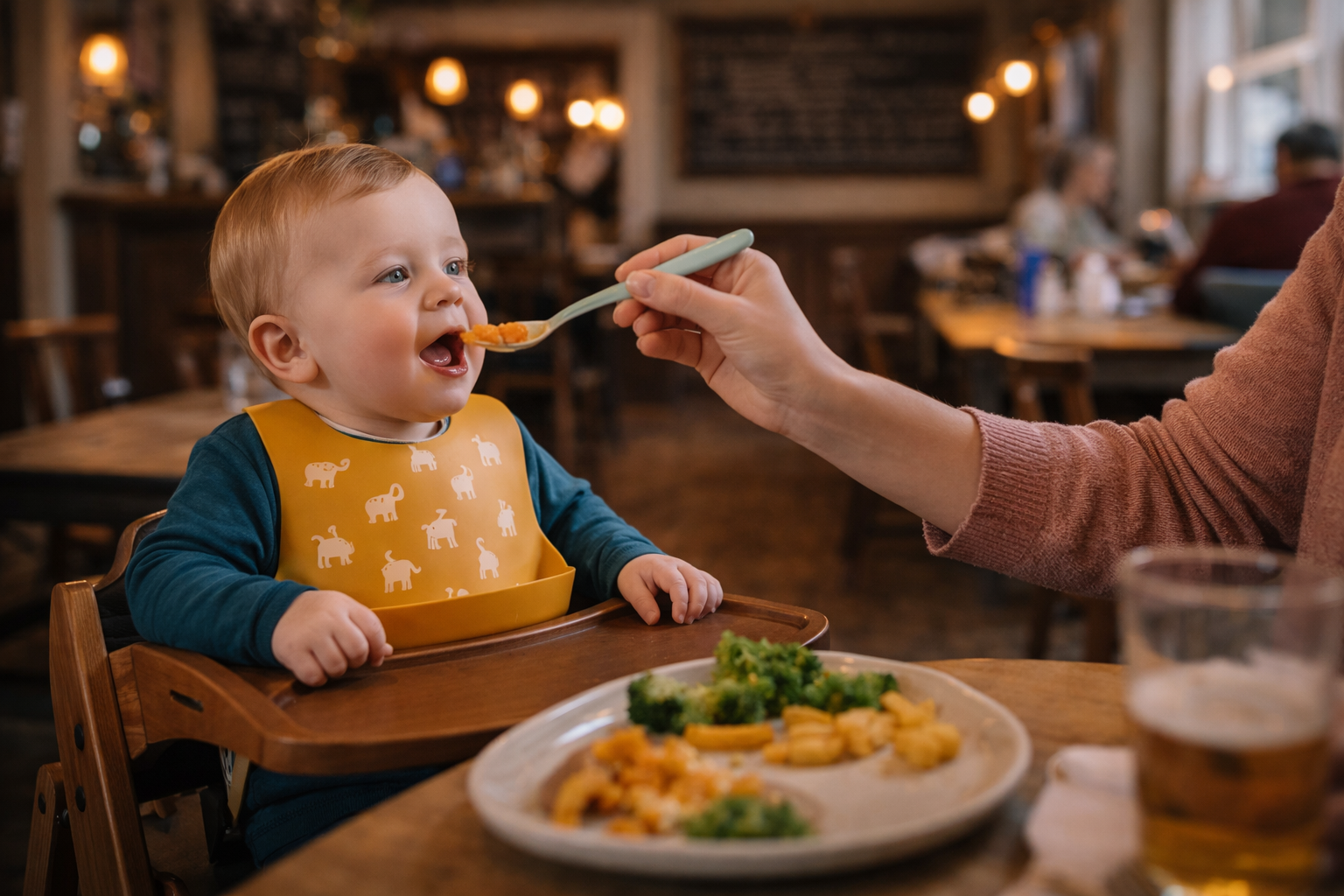
Breastfeeding on Holiday
Breastfeeding is the logistically simplest feeding option for travel. No equipment to sterilise, no formula to measure, no bottles to warm — the feed is always at the right temperature, immediately available, and requires nothing except finding a comfortable place to sit.
Your Legal Rights in the UK
Under the Equality Act 2010, you have a legal right to breastfeed anywhere in the UK — a restaurant, a café, a museum, a shop. No business can ask you to stop, cover up, or move to a different area. This right applies regardless of your baby's age. If you're ever challenged (it's rare, but it happens), you're within your rights to continue and to report the incident to the business.
Breastfeeding in public abroad is generally well-accepted across Western Europe — France, Spain, Italy, the Netherlands, and Scandinavia are all comfortable environments for nursing in public. Attitudes vary more in parts of Southern and Eastern Europe, where a lightweight nursing cover can help if you prefer more privacy, though it's never legally required.
Breastfeeding on Planes
Breastfeeding on a plane is completely fine at any point in the flight. Feeding during takeoff and landing is actively helpful — the swallowing action reduces ear pressure for your baby in the same way swallowing helps adults. See our guide to breast milk at airport security for the rules on pumped milk in hand luggage.
Practical Tips for Nursing on Holiday
- Table seats in cafés and restaurants give more space and manoeuvring room than booths
- Outdoor café seating is often the most relaxed option — more air, more space, less self-consciousness
- A lightweight nursing cover (like a large muslin) offers privacy if you want it, without being hot or restrictive
- Feeding positions that worked at home work on holiday — pack a small travel pillow if you rely on one
- Stay hydrated in hot weather — breastfeeding increases fluid needs and heat amplifies this
Bottle Feeding on Holiday
📋 Free Baby Holiday Packing Checklist
Enter your email and we'll send the free printable checklist straight to your inbox — every category, ready to tick off before every trip.
More logistics than breastfeeding, but entirely manageable. The main variables are formula supply, bottle warming, and sterilisation. Sort these three things before you travel and the rest follows.
Formula Supply
Bring enough formula for the journey and the first two days. After that, buy locally. This approach keeps your luggage lighter and means you're not stressed about running out.
Within the UK, all major formula brands are available everywhere — Aptamil, SMA, Cow & Gate, and Hipp Organic are stocked at most supermarkets and many petrol stations. Abroad, Aptamil is the most widely available UK-familiar brand across Western Europe, though packaging varies. If your baby is on a specific specialist formula (e.g., for reflux or allergies), bring the full supply — don't rely on finding it locally. Our guide to packing formula for flights has the detail on what's allowed in hand luggage and how to pack it.
Ready-made cartons are the best travel option. No measuring, no mixing, no sterilising — open, pour, feed. They're more expensive than powder but the convenience on holiday is significant. Use them for the first day or two, especially on travel days, then switch to powder once you're settled.
Warming Bottles on the Go
A thermos of hot water is the simplest, most reliable portable bottle-warming solution. Fill it with boiling water in the morning and it stays hot enough to warm a bottle well into the afternoon. When you need a feed, pour hot water into a cup and stand the bottle in it for 3–5 minutes. Always test the temperature on your wrist before feeding — it should feel barely warm, not hot.
Most UK restaurants and cafés will warm a bottle if you ask politely. Hotels can provide a jug of hot water on request. Self-catering accommodation is easiest of all — you have full kitchen access. If you need predictable warming away from facilities, compare our portable travel bottle warmer recommendations, including rechargeable and simple flask options.
Pro Tip: Never warm a bottle in a microwave — it creates hot spots in the formula that can burn your baby's mouth even when the outside of the bottle feels fine. Always use warm water and always test on your wrist.
Sterilising Bottles on Holiday
Three methods work well for different accommodation types:
- Milton cold-water sterilisation bags. The lightest and most versatile option. Add a tablet, fill with cold water, leave for 15 minutes. Works in any accommodation, no microwave or electricity needed. The gold standard for travel.
- Microwave steriliser bags. Works well if accommodation has a microwave. Reusable, compact, and quick. Not suitable for metal teats.
- Sterilising tablets in a sealed container. A large zip-lock bag or a plastic tub from a supermarket serves as a sterilising vessel. Budget method, but effective. Useful if you run out of dedicated bags.
Sterilise once a day, keep bottles covered, and you have everything covered. You don't need an electric steriliser on a UK or European holiday.
Water for Formula Abroad
UK tap water is safe for formula preparation. Across most of Western Europe, tap water is also safe — France, Germany, Spain, the Netherlands, and Scandinavia are all fine. In countries where you're less certain, use still bottled water. Choose low-sodium still water (under 200mg per litre of sodium) — sparkling and high-mineral water aren't suitable for formula preparation. The NHS infant formula guidance has the full detail on safe preparation.
Weaning on Holiday (6+ Months)
Weaning on holiday is messier than weaning at home. Accept that upfront and it becomes much less stressful.
Eating Out With a Weaning Baby
Most UK restaurants can produce something suitable for a weaning baby if you ask. The most reliable options: mashed potato, plain pasta with butter, steamed or boiled vegetables, plain rice, soft bread. Mediterranean cuisine is particularly well-suited to baby-led or puréed weaning — pasta, beans, soft fish, and vegetables are standard menu items in Italian, Greek, and Spanish restaurants.
A portable clip-on highchair changes restaurant eating with a weaning baby. Many cafés and pubs have highchairs, but not all of them are clean, the right height, or available at peak times. A clip-on that you bring yourself means consistency wherever you eat.
The practical kit for restaurant weaning: a silicone bib (wipes clean instantly), a suction base bowl or plate (resists being swept off the table), a short soft-tipped spoon, and a couple of food pouches as backup. Pack all of this in a small zip-lock bag that stays in your changing bag throughout the holiday.
Self-Catering: The Easiest Option for Weaners
Self-catering is genuinely the most comfortable base for weaning babies — you have full kitchen access, you can batch-cook familiar foods, and mealtimes happen on your schedule. Most UK supermarkets near popular holiday destinations stock a good range of baby food: Ella's Kitchen, HiPP Organic, and Organix are widely available. Buy locally rather than packing heavy glass jars.
For accommodation options, see our guides to the best baby-friendly cottages and hotels vs self-catering with a baby.
Pouches as Travel Insurance
Shop-bought pouches are not a feeding failure — they are a travel strategy. They don't require refrigeration until opened, they're portion-controlled, they travel without leaking, and they've saved countless holiday mealtimes when the restaurant was slow, the accommodation kitchen was unusable, or 5pm arrived before anyone had cooked anything.
Pack 2–3 per day as backup. Use them when meals don't work out, not as replacements for proper meals when meals do work. By the end of a week's holiday, you'll probably have used roughly half of what you packed — which is exactly the right amount to bring.

Inglesina Fast Table Chair (Portable Highchair)
Consistent seating wherever you eat
Clips to almost any table edge, supports babies from 6 months to 15kg, and folds flat into its own carry bag. No legs means it doesn't take up floor space in a cramped restaurant. One of the most practical additions to any weaning family's travel kit — you stop relying on whatever the café happens to have available.
- ✅ Fits almost any table — café, pub, restaurant, relative's house
- ✅ Folds flat with carry bag — fits in the bottom of a buggy basket
- ✅ Suitable 6 months to 15kg — a long useful lifespan
- ❌ Requires a table edge to grip — won't work on very thick or thin surfaces
- ❌ No tray — baby eats from the table surface directly
What to Pack for Feeding on Holiday
| Breastfeeding | Bottle feeding | Weaning (6+ months) |
|---|---|---|
| Breast pads (disposable) | 2–3 bottles | Portable highchair (clip-on) |
| Nipple cream | Formula — 2 days' supply + buy locally | Silicone bibs × 2 (wipe-clean) |
| Lightweight nursing cover (optional) | Pre-measured formula dispensers | Suction base bowl or plate |
| Travel nursing pillow (if used) | Thermos for bottle warming | Soft-tipped baby spoons × 2 |
| Muslins × 3 | Milton cold-water sterilisation bags | 5–10 food pouches (backup) |
| — | Bottle brush (compact travel size) | Small cool bag for fresh foods |
| — | Ready-made cartons for travel day | Muslin cloths × 3 (meal mop) |
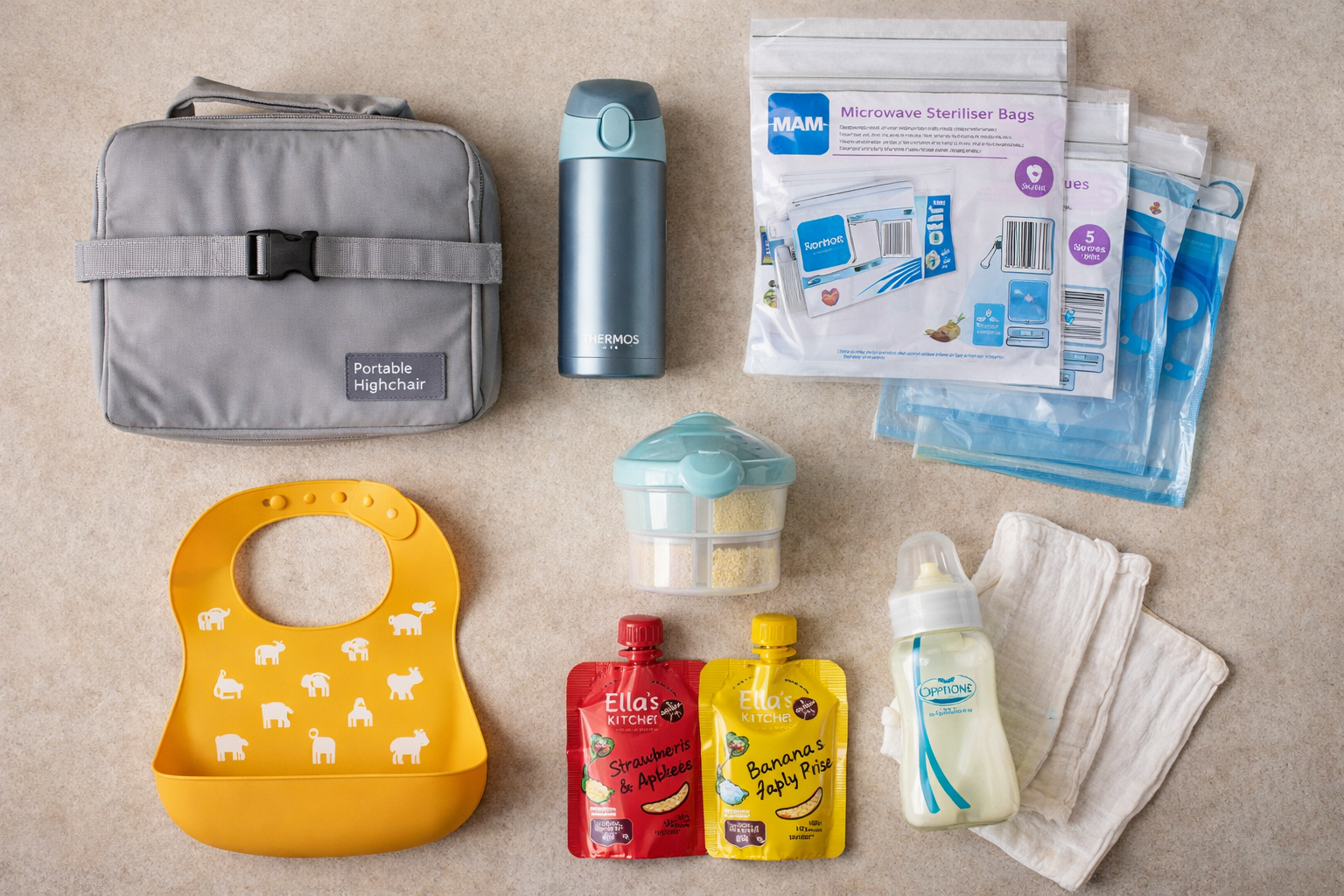
Feeding Scenarios and Solutions
| Scenario | Challenge | Solution |
|---|---|---|
| Bottle feed needed while out | No way to warm bottle | Thermos of hot water in bag; restaurant will help; ready-made carton if stuck |
| Formula running low abroad | Can't find familiar brand | Aptamil widely available in European supermarkets; local equivalent for 2–3 days is fine |
| Weaning at a restaurant with no highchair | Nowhere safe to sit baby | Clip-on portable highchair; lap feeding for younger babies; look for a sturdier café next time |
| Baby refuses food at restaurant | Nothing suitable on the menu | Deploy backup pouch; order plain bread as a tide-over; eat properly at accommodation |
| Sterilising at accommodation with no microwave | No electricity-dependent steriliser | Milton cold-water bags — just cold water and a tablet, no equipment needed |
| Breastfeeding in unfamiliar public space | Feeling uncertain about location | You have a legal right anywhere in the UK; choose outdoor seating or a quiet corner; use a cover if it helps you feel more comfortable |
| Baby with food allergy at foreign restaurant | Language barrier, unknown ingredients | Print allergy translation card in local language; carry safe foods as backup; allergen info is legally required in UK and EU restaurants |
Managing Food Allergies on Holiday
If your baby has a diagnosed food allergy, some extra preparation makes holidays much less stressful.
Bring a 2–3 day supply of safe foods so you're not dependent on finding the right products immediately on arrival. UK and EU law requires restaurants to provide allergen information on request — in the UK, the 14 major allergens must be declared on menus or available from staff. In Europe, the same EU allergen regulations apply across member states.
For travel abroad, allergy translation cards in the local language are an excellent tool — they explain the specific allergy clearly and can be shown to kitchen staff. Free printable versions for most major allergens and languages are available online.
Always carry any prescribed antihistamine or EpiPen and ensure it's in hand luggage (accessible mid-flight), not in the hold. Inform the airline of the allergy at booking. The NHS food allergy guidance has detailed advice on management and what to do in an emergency.

Munchkin Miracle 360 Trainer Cup
No-spill drinking for weaning babies from 6 months
The 360-degree rim means baby can drink from any part of the edge — no spout to chew and no spills in the changing bag. Genuinely useful from the start of weaning through to around 18 months. Dishwasher safe, available in a range of sizes, and well-tolerated by babies who refuse traditional sippy cups. A solid choice for holiday water and milk feeds.
- ✅ No spout — drinks from any point on the rim
- ✅ Leak-proof when closed — safe in a changing bag
- ✅ Dishwasher safe — easy to clean in holiday accommodation
- ❌ Requires a specific drinking technique — some babies take a few days to learn it
- ❌ Lid can be stiff to remove for refilling with smaller hands
✈️ Free Baby Hand Luggage Checklist
Never forget the essentials. Enter your email and we'll send the free checklist straight to your inbox — one page, every category, ready before every flight.
Frequently Asked Questions
Can I breastfeed in public on holiday in the UK?
Yes — the Equality Act 2010 gives you the legal right to breastfeed anywhere in the UK. No one can ask you to stop or move. In practice, UK cafés and restaurants are generally welcoming. Outdoor seating and table seats tend to be the most comfortable spots. A lightweight muslin cover is optional but can help some parents feel more at ease.
Can I get formula abroad on holiday?
Yes. Aptamil is widely available across Western Europe. SMA and Cow & Gate are harder to find outside the UK but local equivalents bridge the gap for a few days. Bring enough for the journey and your first two days, then buy locally. Ready-made cartons are the most convenient format for the travel day itself.
How do I warm a bottle when out and about on holiday?
A thermos of hot water from the morning stays warm enough to heat a bottle for most of the day. Stand the bottle in a cup of hot water for 3–5 minutes. Most restaurants will help if you ask. Never use a microwave — it creates hotspots. Always test temperature on your wrist before feeding.
How do I sterilise bottles on holiday?
Milton cold-water sterilisation bags are the lightest, most versatile option — cold water plus a tablet, no equipment needed. Microwave steriliser bags work if accommodation has a microwave. Sterilising tablets in a sealed plastic container is the budget backup. Sterilise once daily and keep bottles covered.
What water should I use to make formula abroad?
UK tap water is safe. Across most of Western Europe tap water is also fine. When uncertain, use still bottled water with low sodium (under 200mg/l). Never use sparkling or high-mineral water for formula. See the NHS infant formula guidance for full preparation advice.
How do I manage weaning in restaurants on holiday?
Ask for something plain and soft — mashed potato, pasta, steamed veg, plain rice. Bring a clip-on portable highchair, a silicone bib, a suction bowl, and 2–3 pouches as backup. Accept that it will be messy. The self-catering cottage option makes weaning significantly easier if restaurant feeding feels like too much.
Are food pouches okay to use on holiday?
They're a travel strategy, not a shortcut. Pouches need no refrigeration, travel well, and save you when restaurant meals don't work out. Pack 2–3 per day as backup. Available in most UK supermarkets and across European holiday destinations. There is no feeding hierarchy that makes a HiPP pouch a worse choice than a stressed, rushed, unfamiliar meal cooked at 5pm.
How do I manage a baby with food allergies on holiday?
Bring a 2–3 day safe food supply. UK and EU restaurants are legally required to provide allergen information. Use printed allergy translation cards for foreign restaurants. Carry antihistamine or EpiPen in hand luggage, not the hold. Inform your airline at booking. The NHS food allergy guidance covers emergency management in detail.
The Bottom Line
Feeding on holiday is more about preparation than improvisation. A thermos, a set of Milton bags, a clip-on highchair, and a bag of backup pouches cover almost every scenario. Breastfeeding parents have the fewest logistics; formula feeders have a clear system once it's in place; and weaning parents need the most kit but are rewarded with the most flexibility about where and what baby eats. For the full kit breakdown by holiday type, see our complete holiday packing list and the first holiday guide.