
Motorway Services Baby Changing UK: Best Stops for Families (2026)
By BabyTravel UK Editorial Team · Last updated March 2026
Every parent has frantically googled this approaching junction 15. Here's the definitive guide to which services are worth stopping at — and which to plan around.
The 2-hour car seat rule means you're stopping every 90 minutes to 2 hours on any long journey. That stop needs to do real work: somewhere clean to change the baby, somewhere to feed, and ideally 10 minutes of floor time for everyone to decompress before getting back in the car. Not all motorway services deliver this. The gap between the best and worst is large enough to be worth planning around. This guide ranks the major UK operators, covers what to realistically expect from a service station baby change, and identifies the best stopping points on the routes most families drive.
For broader guidance on managing long car journeys with a baby, see our car travel and road trips guide. For keeping babies entertained between stops, our car entertainment guide has everything you need.
Motorway Services Baby Changing: Key Facts
- Best operator overall: Welcome Break — generally the cleanest and most consistently equipped
- Most variable: Moto — some excellent recently refurbished sites; others dated
- Always bring: your own changing mat — the fold-down tables are hard plastic and often wet
- Most important route stop: M5 — the busiest family holiday route in England in summer
- Emergency option: supermarket car parks almost always have customer toilets with baby changing
Why Motorway Services Matter More With a Baby
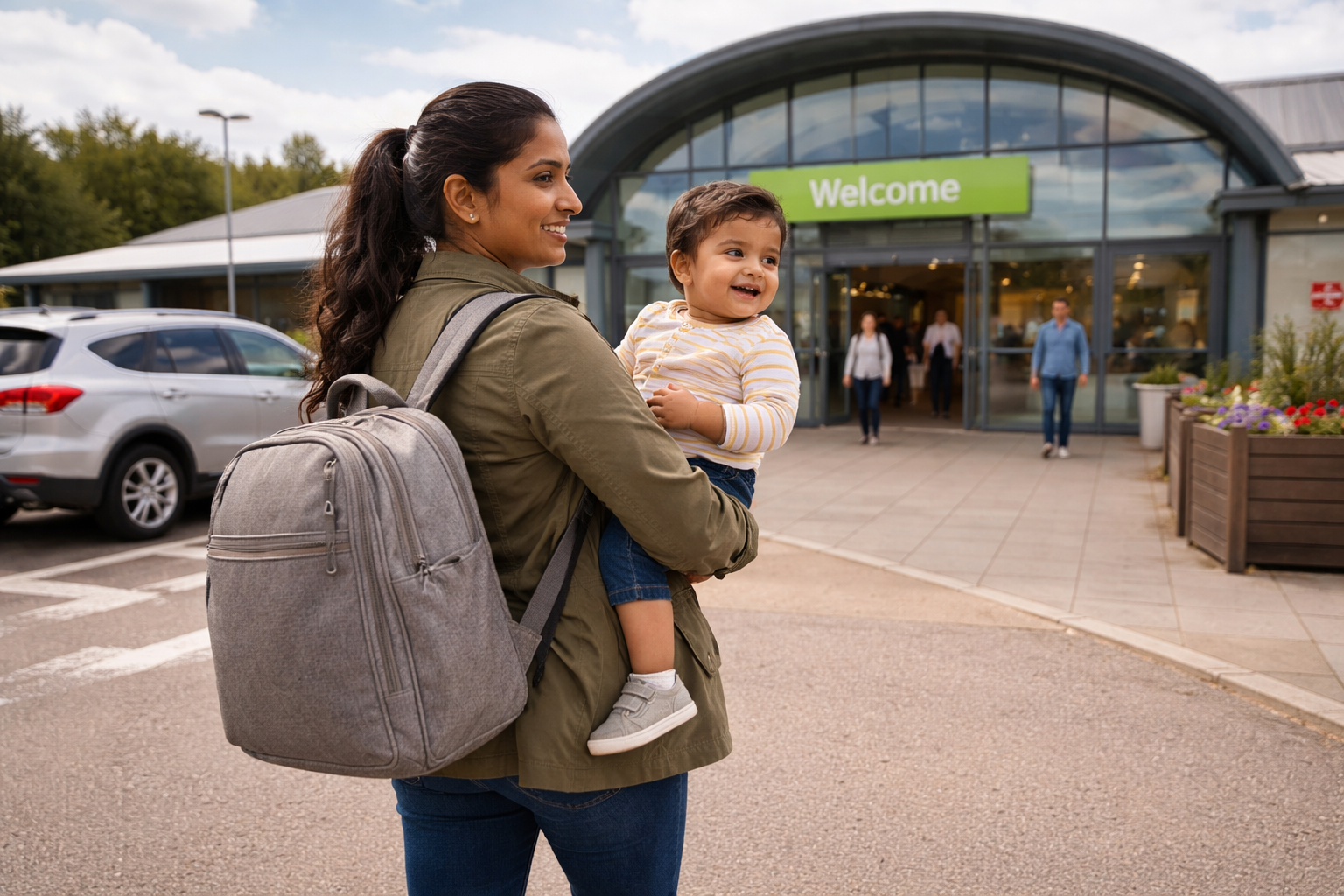
Before children, a motorway stop meant a coffee and a disappointing sandwich. With a baby in the car, it becomes a logistical operation. You need to change a nappy — ideally on a clean, stable surface with space to manoeuvre. You may need to feed (breastfeed or warm a bottle). The baby needs to come out of the car seat, because the two-hour rule that exists for infant car seat use isn't arbitrary: extended time in a rear-facing infant seat can restrict a young baby's airway. And ideally everyone stretches for a few minutes before the next leg.
The services that support this well have dedicated parent-and-baby rooms: a private space with a proper changing table, a chair for feeding, sometimes a microwave for warming bottles, and clean floors. The services that do it poorly have a fold-down changing unit in the accessible toilet — which is often occupied, sometimes wet from the previous user, and lit by a strip light that gives the experience the ambience of a medical procedure. Knowing which type you're heading for makes the difference between a manageable stop and a stressful one.
UK Motorway Service Operators: Ranked for Baby Facilities
📋 Free Baby Holiday Packing Checklist
Enter your email and we'll send the free printable checklist straight to your inbox — every category, ready to tick off before every trip.
Welcome Break — The Most Consistent
Welcome Break operates around 60 service areas across the UK and is generally regarded as the best of the major operators for family facilities. Their sites more frequently have dedicated parent-and-baby rooms rather than just a fold-down unit in the accessible toilet. The rooms tend to be better maintained, with proper changing tables at a usable height, seating for feeding, and more space overall. Their newer or recently refurbished sites are genuinely good. If you can plan your stops around Welcome Break services, it's worth doing. Brands typically found at Welcome Break include Waitrose food-to-go, Costa, and Starbucks.
Moto — Variable but Improving
Moto is the largest UK motorway services operator by number of sites, which means the quality range is wide. Some Moto services — particularly recently refurbished ones — are excellent, with proper family rooms and well-maintained facilities. Others are dated, with cramped changing provision in accessible toilets and facilities that have clearly not been updated in years. Checking recent reviews of the specific Moto site you're planning to use (Google Maps reviews regularly mention baby changing specifically) is more useful than relying on the operator's name alone. The quality gap between Moto's best and worst is considerable.
Roadchef — Improving but Historically Weakest
Roadchef has invested in improving its facilities in recent years, and newer sites are noticeably better than they were. Historically, Roadchef had the weakest family provision of the major operators — limited dedicated baby rooms, more reliance on accessible toilet changing stations. That pattern is improving but hasn't entirely changed. More recent Roadchef openings and refurbishments are worth using; older sites on less-busy routes are less reliable. Brands at Roadchef include Costa and Burger King.
Extra MSA — Smaller and Variable
Extra is a smaller operator with fewer sites but a premium positioning — their services at Cobham (M25), Beaconsfield (M40), Toddington (M1), and a handful of others aim for a higher standard than the typical motorway stop. Family facilities at Extra sites are generally good, and the overall cleanliness and food quality tends to be better than the larger operators. If an Extra service is on your route, it's worth stopping at.
| Operator | Changing Facilities | Family Room? | Feeding Area | Cleanliness | Our Rating |
|---|---|---|---|---|---|
| Welcome Break | Good — dedicated rooms on most sites | ✅ Most sites | Good — seating areas available | Generally good | ⭐⭐⭐⭐ |
| Moto | Variable — excellent on new sites; poor on older ones | ⚠️ Some sites | Variable | Variable — check reviews | ⭐⭐⭐ |
| Roadchef | Improving — newer sites better; older sites limited | ⚠️ Newer sites | Moderate | Moderate | ⭐⭐⭐ |
| Extra MSA | Good — premium positioning means better upkeep | ✅ Most sites | Good | Good — higher standard overall | ⭐⭐⭐⭐ |
What to Realistically Expect From Motorway Baby Changing
Most motorway services provide a fold-down changing unit in the accessible toilet — a hinged plastic shelf that folds down from the wall. It's firm, it's often cold, and the previous user may have left it wet. At busier services, the accessible toilet is in constant demand and you may queue. This is the baseline standard that most services meet, and it's functional if not pleasant.
Better services have a dedicated parent-and-baby room, separate from the accessible toilet. These typically include: a full-size changing table at standing height, a nappy bin, sometimes a fold-out pad on the table, a chair or bench for feeding, occasionally a microwave for warming bottles, and more floor space. These rooms exist at a minority of service stations but are worth seeking out on a long journey.
One consistent tip from experienced travelling parents: always bring your own changing mat. A folding travel mat lays over the hard plastic of the fold-down table, protects against the surface being wet or dirty, and gives the baby something slightly more comfortable than bare plastic. It's one of those items that weighs almost nothing and makes a genuine difference 20 times per trip. Keep it at the top of the changing bag, not buried at the bottom.
Our Tip
If the accessible toilet at a service station is occupied and you've got a nappy situation that won't wait, the car boot is a legitimate and often better alternative. A changing mat laid flat in a clean car boot, with everything to hand in the bag, is considerably more pleasant than a cramped motorway toilet in a rush. Most parents with experience of long drives with babies have done this more than once.
Best Motorway Service Stops on Key Family Routes
These are the routes that carry the heaviest family holiday traffic in the UK, with the best-regarded stops for families identified on each.
M5 — Birmingham to Devon and Cornwall
The most important route for family holidays in the UK — during peak summer weeks, the M5 south of Bristol is essentially a family holiday conveyor belt. There are multiple services on this route; the ones most consistently praised for family facilities are:
- Strensham (Welcome Break) — south of junction 8, both northbound and southbound. Well-maintained, good facilities, popular with families heading to the South West. Gets very busy on summer Saturdays — arrive early or plan around it.
- Gloucester (Moto) — junctions 11/12 area. A large site that has undergone improvement. Functional rather than outstanding but reliably equipped for baby changing.
- Taunton Deane (Welcome Break) — junction 25/26 area. Well positioned for the final leg toward Devon and Cornwall, with decent family facilities.
M1 — London to Yorkshire and the North
One of the busiest motorways in Europe, with numerous service areas. The best-regarded for family facilities:
- Toddington (Extra MSA) — between junctions 11 and 12. Extra's premium positioning means reliably good facilities. A strong choice for families heading north from London.
- Newport Pagnell (Welcome Break) — one of England's oldest motorway service areas, now well-maintained. Good family provision, roughly an hour from central London depending on traffic.
- Woodall (Moto) — near junction 30, on the approach to Sheffield. A larger Moto site with reasonable family facilities — useful for the final stretch into Yorkshire.
M4 — London to Wales and the West
Key stops for families heading to Wales, Pembrokeshire, or the South West via the M4:
- Membury (Welcome Break) — between junctions 14 and 15. Consistently well-regarded, good family facilities, nicely positioned as the first proper stop west of London.
- Sarn Park (Welcome Break) — junction 36, near Bridgend in South Wales. One of the better-equipped stops in Wales and a natural break point for families continuing into Pembrokeshire or the Gower.
- Cardiff Gate (Moto) — east of Cardiff. A useful stop for families visiting South Wales; Moto variable but this site is reasonably well-maintained.
M6 — Birmingham to the Lake District and Scotland
A long route with several key stops for families heading north:
- Keele (Welcome Break) — between junctions 15 and 16, Staffordshire. A reliable Welcome Break with good family facilities — a natural first stop from Birmingham heading north.
- Charnock Richard (Welcome Break) — junctions 27/28, Lancashire. Large Welcome Break site with solid family provision, well-positioned for the Lake District leg.
- Tebay (independent) — between junctions 38 and 39, Cumbria. Not part of any major chain — Tebay is a locally owned services famous for its quality. The farm shop is outstanding. Family facilities are good and the overall experience is considerably better than a standard motorway services. If you're passing, it's worth stopping regardless of whether you need to change a nappy.
| Route | Recommended Stop | Operator | Junction(s) | Notes |
|---|---|---|---|---|
| M5 South | Strensham | Welcome Break | J8 | Good facilities; very busy summer Saturdays |
| M5 South (2nd stop) | Taunton Deane | Welcome Break | J25–26 | Good Devon/Cornwall staging post |
| M1 North | Toddington | Extra MSA | J11–12 | Premium operator; reliably good facilities |
| M1 North (2nd stop) | Newport Pagnell | Welcome Break | J14–15 | Classic, well-maintained site |
| M4 West | Membury | Welcome Break | J14–15 | Best first stop heading west from London |
| M4 Wales | Sarn Park | Welcome Break | J36 | Good for South Wales and Pembrokeshire |
| M6 North | Charnock Richard | Welcome Break | J27–28 | Large site, solid for Lake District leg |
| M6 North (highlight) | Tebay | Independent | J38–39 | Best motorway stop in England. Worth the detour. |
How to Make a Service Station Stop Work With a Baby
The physical stop is only part of the equation. How you manage the 15–20 minutes matters as much as where you stop. A few things that make service stops work noticeably better:
Park near the entrance. The instinct on a busy car park is to head for the far end where there's space. With a baby, a buggy, and a changing bag, the walk from the outer reaches of a motorway services car park adds three minutes you don't have. Circle near the entrance and wait for a spot to come free. It's worth the extra minute waiting.
Change the nappy, then feed. If both are needed, change first — a hungry baby is more patient than an uncomfortable one, and feeding after the change means you leave the services with a settled baby rather than one who's going to protest within ten minutes.
Use the grass. Most service stations have a grassed area alongside the car park — often overlooked and almost always quieter than the building. For a baby who needs floor time or just to be out of the car seat, two minutes on a blanket on the grass does the job without the noise and chaos of the building. In summer, this is frequently a better option than going inside at all.
Keep stops to 15–20 minutes maximum. The temptation to extend a break is understandable, especially if the baby is happy and you're exhausted. But a longer stop at services makes the next leg feel shorter on paper and longer in practice — the baby will have been awake longer by the time you arrive, and the routine disruption compounds. Get what you need done and get moving.

Apps and Tools for Finding Baby Changing on the Road
National Highways maintains a motorway services database with basic facility information for every service area in England. It's a useful starting reference for planning stops, though it doesn't include detail on the quality of baby changing specifically.
Google Maps reviews are more useful than official sources for real-world quality. Searching for the specific services and filtering for reviews mentioning "baby changing" or "family" will surface recent parent experiences — often more honest than anything on an operator's website. If you're in the planning stage rather than approaching the junction at speed, this takes about two minutes and frequently surfaces useful information.
The car travel guide covers journey planning in more detail, including how to structure the timing of breaks around nap windows — which is often more useful than finding a perfect services, because a baby who's asleep doesn't need a stop at all.
When There's No Services in Range: Emergency Options
Sometimes the timing is wrong, the next services is further than you thought, and the baby is not going to wait. Here's what works:
Supermarket car parks. Almost every large supermarket — Tesco, Sainsbury's, ASDA, Morrisons — has customer toilets with baby changing facilities. The quality is usually better than a motorway services. Drive off the motorway to the nearest retail park, use the supermarket, and get back on. It adds 5–10 minutes but is often a more practical solution than a substandard service station.
Lay-bys. Legal to stop in, no facilities, but the car boot change is perfectly feasible in a lay-by with a travel changing mat. Not glamorous. Sometimes necessary. Keep the mat accessible.
Pubs and cafés. Most will allow non-customers to use baby changing facilities if you ask politely. The majority of family-friendly pubs have them. A quick "I have a baby who needs a change, would that be okay?" is almost always met with yes — and if you then buy a coffee, everybody wins.
✈️ Free Baby Hand Luggage Checklist
Never forget the essentials. Enter your email and we'll send the free checklist straight to your inbox — one page, every category, ready before every flight.
Frequently Asked Questions
Which motorway services have the best baby changing in the UK?
Welcome Break services are the most consistently equipped for families — they more frequently have dedicated parent-and-baby rooms rather than just a fold-down unit in the accessible toilet. Extra MSA services (Cobham, Beaconsfield, Toddington) are also excellent. Tebay on the M6 is the best independent stop in England by most measures. For any specific site, recent Google Maps reviews mentioning baby facilities are the most useful reference.
Do all motorway services have baby changing?
Yes — all UK motorway service areas are legally required to provide baby changing facilities. The minimum provision is a fold-down changing unit in the accessible toilet. What varies significantly is quality, cleanliness, space, and whether there's a dedicated parent-and-baby room in addition to (or instead of) the basic fold-down. Always carry your own changing mat as a backup regardless of what's provided.
What should I bring for a service station nappy change?
Your standard changing bag contents, plus: a folding travel changing mat (to lay over the hard plastic fold-down surface), nappy bags (services bins sometimes aren't near the changing area), hand sanitiser (some units don't have a sink immediately adjacent), and a change of baby clothes. Keeping all of this at the top of the bag rather than buried at the bottom is the small organisational detail that makes a services stop feel manageable rather than chaotic.
How long should I stop at motorway services with a baby?
15–20 minutes is the target. That covers a nappy change (5–7 minutes), a quick feed or bottle (5–10 minutes), and a brief stretch outside the car. Longer stops feel helpful but compound the overall journey time and can disrupt the baby's sleep-wake cycle in ways that make the next leg harder. Get what's needed done efficiently and keep moving.
Is Tebay services really worth stopping at?
Yes — genuinely. Tebay on the M6 in Cumbria is an independently owned service station with a farm shop, proper food made from local ingredients, and an overall quality that is in a different category from the major operators. The family facilities are good, the food is excellent, and stopping there on a family holiday to the Lake District or Scotland feels like a reward rather than a necessity. Plan your break timing around hitting Tebay if you're on the M6.
What do I do if there's no motorway service station for a while?
The nearest large supermarket is usually the best alternative — they almost always have customer toilets with baby changing, and the quality is typically better than a motorway services. Pubs and cafés will usually allow non-customers to use their facilities if asked. In a genuine emergency, the car boot with a travel changing mat is always an option — it's not the most comfortable experience but it works.
Do motorway service stations have somewhere to breastfeed?
Better services have seating areas and family rooms where breastfeeding is perfectly comfortable. All services have café seating where you are entirely entitled to breastfeed — under the Equality Act 2010, you cannot be asked to stop or move. If a dedicated nursing room exists, it'll be signposted with the baby changing facilities. If you want to find one before you arrive, the operator websites list facilities for individual sites, though real-world reports from Google reviews are often more reliable.
How often should I stop on a motorway journey with a baby?
The general guidance is to take a break from the car seat every 2 hours maximum for very young babies — ideally every 90 minutes on a long journey. The 2-hour limit exists because extended time in an infant car seat at the semi-reclined angle can restrict a young baby's airway. On a 4-hour journey to Devon, that means at least one stop, ideally two. Our car travel guide covers journey timing in detail, including how to structure stops around nap windows.
The Verdict
Plan your motorway stops around Welcome Break or Extra MSA services where the route allows, always carry your own changing mat, and don't overlook the car boot and the grassy verge as legitimate tools in the kit. The gap between a well-planned service stop and a poorly-planned one is the difference between a good moment in the journey and a frantic, chaotic one. On a family holiday drive — which is already demanding enough — that gap is worth the five minutes of planning it takes to identify the best stops in advance. For everything else about making long car journeys work with a baby, our car travel guide and car entertainment guide have you covered.