
Tips for Travelling Abroad with a Baby: UK Parent Guide 2026
By BabyTravel UK Editorial Team · Last updated March 2026
International travel with a baby can feel overwhelming before you've done it — but once you've got through that first flight and arrived somewhere wonderful with your little one, you'll wonder what you were worried about. The key is preparation: knowing the admin, packing the right things, and managing the journey day itself with realistic expectations.
- Passport: Apply at least 10 weeks in advance — babies need their own
- GHIC: Get a free UK Global Health Insurance Card for your baby at nhs.uk (EU travel)
- Travel insurance: Babies must be named on the policy — don't assume they're automatically included
- Vaccinations: Check TravelHealthPro 6–8 weeks before departure for destination-specific requirements
- Pushchair plan: Decide whether to gate-check or bring a cabin-approved compact stroller
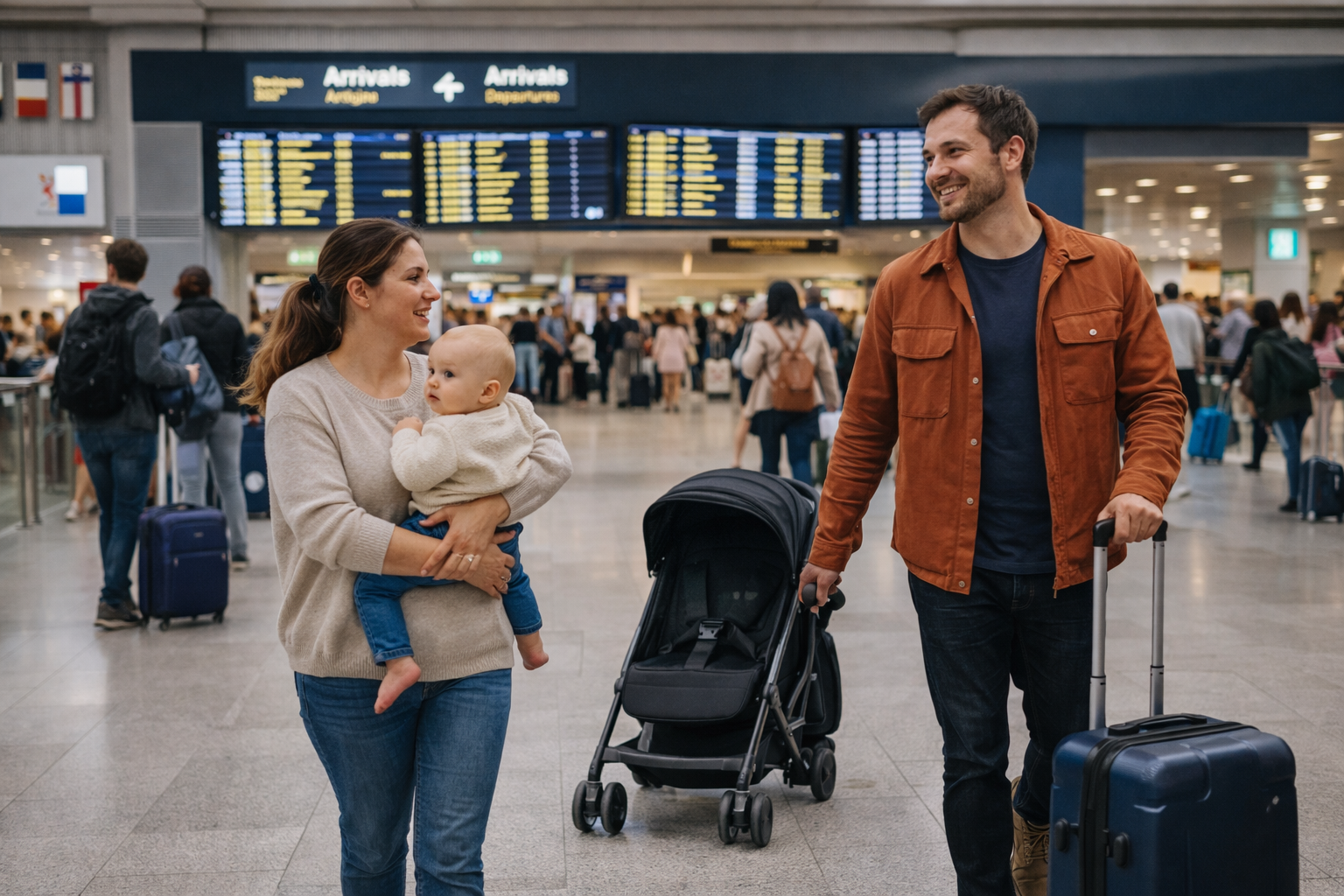
Before You Go: The Admin That Matters
Passports and Documents
Every baby needs their own passport, even for a day trip. Processing times have stretched to 10 weeks or more in busy periods, so apply early — ideally as soon as you know you're travelling. You'll need two photos taken against a plain white background with your baby's eyes open and no other people in frame. A countersignatory is required if the applying parent doesn't hold a valid UK passport themselves.
As well as the passport, bring a copy of your baby's birth certificate (a clear photo on your phone is fine) and any relevant medical documentation if your baby has specific health needs. For car hire, you may need proof of your baby's age to confirm the correct car seat specification.
GHIC and Travel Insurance
If you're travelling within the EU or EEA, apply for a UK Global Health Insurance Card (GHIC) for your baby — it's free, takes minutes, and covers emergency treatment at the same rate as local residents in most European countries. Apply at nhs.uk. The GHIC has replaced the old EHIC for UK residents.
Travel insurance is a separate must. The GHIC won't cover repatriation, cancellation costs, lost luggage, or treatment in private hospitals — which is often what you'll end up in for non-emergency situations. Make sure your baby is explicitly named on the policy; don't assume they're automatically included.
Health and Vaccinations
Check TravelHealthPro for your specific destination at least 6–8 weeks before you travel. For most European holidays, the standard UK vaccination schedule is sufficient. For destinations in parts of Africa, Asia, South America, or the Middle East, additional vaccinations may be recommended — and some aren't appropriate for very young babies, which may affect your destination choice. Your GP or a travel health clinic can advise based on your baby's age.
Packing for Travel Abroad with a Baby
Packing for abroad is more pressured than a UK break because you can't as easily pop out to a local supermarket if you've forgotten something. That said, most baby essentials are available throughout Europe — you're not going entirely off-grid. The table below covers what to prioritise carrying versus what you can pick up on arrival.
| Category | Bring from Home | Can Usually Buy at Destination |
|---|---|---|
| Nappies | Enough for the journey + first 24 hours | Widely available across Europe |
| Formula | Your usual brand for flights; enough for first 2 days | Available across Europe but brands differ; bring starter packs |
| Baby food pouches | A week's supply of familiar flavours | Available but different brands and flavours |
| Medicines | All of it — infant paracetamol, thermometer, etc. | Calpol not sold under that name abroad; don't rely on it |
| Travel cot | Recommended — know it's clean and safe | Available at many holiday lets, but condition varies |
| Sunscreen | SPF 50+ baby sunscreen | Available but expensive at holiday resorts |
| Wipes and muslins | Plenty — these are bulky and cheap | Wipes available; stock up before a long drive from airport |
| Blackout blind | Essential — accommodation rarely has good blackout | Not usually available locally |
For a complete destination-agnostic list, our guide on what to pack for a weekend trip with baby is a useful starting point — scale up the quantities for longer trips abroad.
Navigating the Airport and Flight
📋 Free Baby Holiday Packing Checklist
Enter your email and we'll send the free printable checklist straight to your inbox — every category, ready to tick off before every trip.
Check-in and Security
Arrive early — more than the standard recommendation. With a baby and all your gear, you need buffer time. Use the family lane at security where available; most UK airports have them and they can significantly reduce stress. Pushchairs and car seats go through the scanner separately — you'll need to fold the pushchair at the belt. A baby carrier is often easier here; wear it through the scanner (you may get a pat-down on the carrier itself) and have your baby in it hands-free while you manage bags.
UK security allows formula, expressed breast milk, and baby food in quantities over 100ml without a prescription — but they may be tested. Pour formula powder into labelled bags rather than the original tin if space is tight. Full guidance in our detailed guide to how to pack formula for flights.
On the Plane
Under-2s travel on your lap (unless you've bought them a seat, which many parents do for long-haul). The airline provides a seatbelt loop that attaches to yours for turbulence — always use it. Feeding during takeoff and landing genuinely helps with ear pressure. Breastfeeding works perfectly for this; for formula-fed babies, have a bottle ready to go as the plane begins its climb.
Request a bassinet seat in advance if your airline offers them — these bulkhead seats have a fold-down bassinet for babies under approximately 10–11kg and are invaluable on long-haul flights. They book out quickly, so request at time of booking.
Most airlines with a family seating section will let you board early — take it. Getting settled with a baby before the main rush is significantly calmer than navigating a full aisle with a car seat, changing bag, and carry-on.
Your Pushchair at the Airport
Most parents gate-check their pushchair — you use it right up to the boarding gate, hand it over to be loaded into the hold, and collect it at the gate (or baggage reclaim, depending on the airline) on arrival. For frequent flyers, a compact travel pushchair that qualifies as cabin luggage is worth considering. The Bugaboo Butterfly vs Babyzen YOYO² comparison covers two of the most popular options.
Feeding Abroad
Breastfeeding
Breastfeeding in public is legal across Europe and generally well-accepted in family-friendly holiday destinations. Bring more muslin cloths and nursing pads than you think you'll need — heat increases the likelihood of leaks, and you'll be doing more outdoor feeding than at home.
Formula Abroad
Take enough formula for the journey and at least the first 48 hours. If you need to buy more at your destination, the formula aisle in European supermarkets will look unfamiliar — most European countries don't sell UK brands like Aptamil under the same name, though the European Aptamil formulation is broadly similar. Stage numbers and age ranges also differ between countries, which adds confusion. Bringing enough from home avoids this entirely.
Weaning and Solid Food
If your baby is on solids, pouches are the easiest travel food — no preparation needed and they don't need refrigerating until opened. Bring a good supply of familiar flavours for the first few days. Most destinations will have fresh fruit and soft-cooked vegetables available from local supermarkets if you want to make fresh food once you're settled.
Sleep Abroad
Getting your baby to sleep in an unfamiliar environment is often the thing parents worry most about. The reassuring truth is that babies adapt — usually faster than adults expect. The keys are consistency and preparation.
The Sleep Environment
A portable blackout blind is the single most useful item for sleep abroad. Holiday accommodation — particularly in Mediterranean destinations where shutters are common — can be very bright at nap time and at the early hours when the sun rises. A good portable blind turns any room into a usable sleep space. Pair it with a white noise app and your usual bedtime routine, and most babies will settle within a couple of nights.
Your baby's sleeping bag from home provides a consistent, familiar sleep cue — and means you're not relying on unfamiliar or potentially unsafe bedding at your destination. Adjust tog weight for the destination's temperature: a 0.5 tog is usually right for warm European summers.
Time Zone Adjustment
For short-haul European destinations (1–3 hours ahead of UK time), most babies adjust naturally within 2–3 days. For long-haul, start nudging bedtime 15–30 minutes later (or earlier, depending on direction of travel) in the week before you go. Once there, expose your baby to natural daylight during the day, keep nap times reasonable, and aim for a local-time bedtime from day one. It takes longer, but babies are resilient.


Health and Safety Abroad
Keep your baby's first aid kit in hand luggage, not in the hold. Pack infant paracetamol, infant ibuprofen (for babies over 3 months), a digital thermometer, antiseptic wipes, plasters, rehydration sachets, and any prescription medication. For a full list, see our guide to baby travel first aid kit essentials.
Know the emergency number for your destination — in EU countries it's 112. Identify the nearest hospital or medical centre before you need it. If your baby develops a high temperature (38°C+ under 3 months; 39°C+ in older babies), seek medical attention promptly. Don't wait to see if it settles. For comprehensive holiday safety advice, see our baby holiday safety tips guide.
✈️ Free Baby Hand Luggage Checklist
Never forget the essentials. Enter your email and we'll send the free checklist straight to your inbox — one page, every category, ready before every flight.
Frequently Asked Questions
What documents do I need to travel abroad with my baby?
Your baby needs their own valid passport, with at least 6 months' validity beyond your return date for most destinations. For EU travel, also get a free GHIC for your baby at nhs.uk. Carry a copy of their birth certificate as backup. Travel insurance with your baby named on the policy is essential.
How early should I apply for my baby's passport?
Apply at least 10 weeks before travel — processing times can stretch during school holiday periods. Babies need their own passport at any age and cannot be added to a parent's. You'll need two photos against a white background with your baby's eyes open.
What vaccinations does my baby need before travelling abroad?
Check TravelHealthPro for your specific destination at least 6–8 weeks before departure. European destinations usually require nothing beyond the UK schedule. Tropical or developing-world destinations may need additional vaccinations — some aren't appropriate for young babies. Your GP or travel health clinic can advise based on your baby's age and your exact itinerary.
How do I manage feeding during a flight with a baby?
Feeding during takeoff and landing helps equalise ear pressure. UK security allows formula and breast milk over 100ml without a prescription, though it may be tested. Pack more than you need in case of delays. For formula, pre-measured powder in a dispenser plus a bottle of cooled boiled water is the most practical approach. Read our full guide to how to pack formula for flights for airport-specific tips.
Can you take a pram or pushchair on a plane?
Yes — most airlines allow a pushchair to be gate-checked or hold-checked free of charge. Gate-checking means you use it to the boarding gate and collect it on the airbridge on arrival. Compact strollers like the Babyzen YOYO² may qualify as cabin baggage on some airlines — check dimensions against your specific airline's policy before assuming this.
How do I help my baby sleep in a foreign time zone?
For short-haul (1–3 hours difference), most babies adjust within a couple of days without much intervention. Keep routines consistent, use a portable blackout blind, and get plenty of daylight exposure during the day. For long-haul, start nudging bedtime gradually in the week before you go and aim for local bedtime from day one at your destination.
What should I include in a baby's hand luggage on a flight?
At minimum: one full change of clothes (two if your baby has frequent blowouts), nappies for the flight plus a couple of hours extra, wipes, a changing mat, feeding equipment and food, a dummy or comfort toy, a lightweight muslin, and your first aid essentials. Keep a spare top for yourself too — trust us on this one.
Is travel insurance necessary for a baby travelling abroad?
Yes — travel insurance is essential. Medical treatment for a seriously ill baby can cost tens of thousands of pounds in some countries, and a GHIC only covers emergency treatment in EU countries. Babies need to be explicitly named on the policy. Check the medical cover limit — some budget policies set limits that wouldn't cover a serious incident.
International travel with a baby genuinely gets easier the more you do it. The first trip is the most daunting — once you've done it, you'll have a clear sense of what your baby copes with well and what the real priorities are. Enjoy the adventure.