
Travelling With an 18-Month-Old: Tips, Gear & Destinations (2026)
By BabyTravel UK Editorial Team · Last updated September 2026
The hardest travel age — and how to do it well anyway.
Eighteen months is widely regarded as the most challenging age to travel with. Your toddler is fully mobile, intensely curious, and utterly without impulse control — they will run towards traffic, throw food off restaurant tables, and treat a long car journey as a personal affront. Reasoning doesn't work yet. Bribery only gets you so far.
But here's the thing: plenty of families travel brilliantly at this age, and almost all of them say the same thing afterwards — it was harder than they expected and more fun than they expected, often at the same time. The key is going in with realistic expectations, the right gear, and a plan that works with your toddler's energy rather than against it. This guide covers exactly that, from choosing the right type of holiday to the specific kit that makes the biggest difference. For broader first-trip context, see our first holiday with a baby guide.
Travelling at 18 Months: Key Facts
- Why it's harder than 6 months: fully walking (and running), starting tantrums, peak separation anxiety, zero impulse control
- Best holiday type: self-catering cottage or holiday park with outdoor space — they need room to move
- Avoid if possible: long-haul flights, city breaks without serious planning, destinations with lots of queuing
- Essential gear: a stroller with good recline, reins or a wrist link, portable highchair, familiar snacks
- Sleep: the 18-month sleep regression is real — don't be surprised if the holiday makes it worse before it gets better
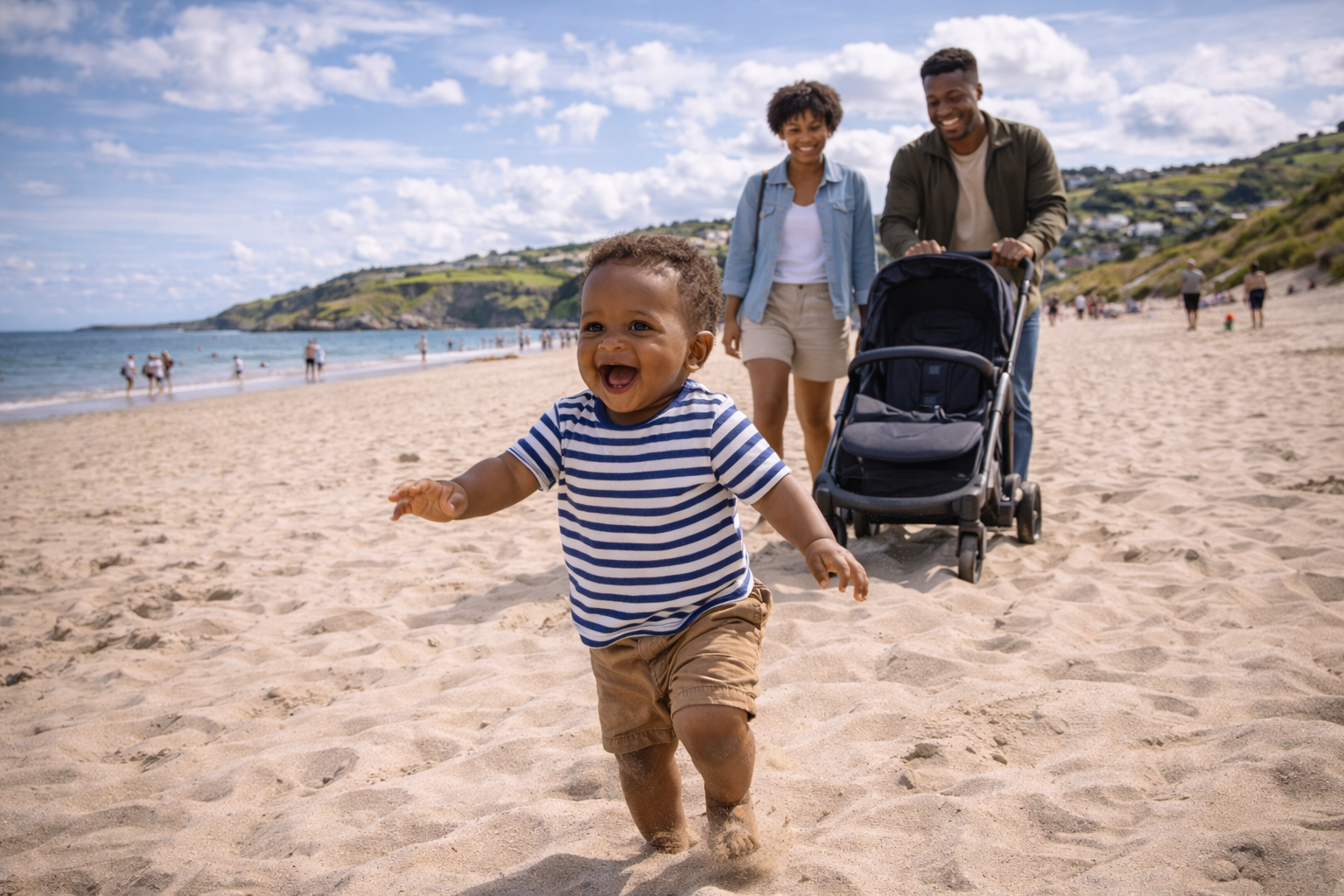
What 18 Months Actually Looks Like (And Why It Matters for Travel)
Understanding the developmental stage helps enormously with realistic planning. At eighteen months, most toddlers are walking confidently, starting to run, and beginning to climb anything within reach. Their vocabulary is usually between 5 and 20 words — enough to communicate hunger and unhappiness, not enough to explain why they're upset or what would help.
Separation anxiety peaks around this age, which means a hotel room they've never seen before can be genuinely frightening at bedtime. Tantrums are beginning — not yet the full theatrical productions of two-year-olds, but real distress responses to frustration, tiredness, or overstimulation. And impulse control? Essentially zero. If they see something interesting on the other side of a road, they go for it. The NHS provides a useful overview of toddler development and behaviour at this stage.
The table below shows how much changes between travelling with a 6-month-old and 18 months — the contrast is significant in almost every category.
| Factor | At 6 Months | At 18 Months |
|---|---|---|
| Mobility | Sitting. Pre-crawling. Stays where you put them. | Walking and running. Climbs furniture. Cannot be left unsupervised for a second. |
| Communication | Babbling. No words yet. | 5–20 words. Understands a lot, expresses little — a frustrating gap. |
| Tantrums | None. | Beginning. Triggered by tiredness, hunger, overstimulation, or an inexplicable grudge against trousers. |
| Sleep | 2–3 naps per day. Usually manageable. | Usually 1 nap per day. 18-month sleep regression common. Separation anxiety at bedtime. |
| Eating | Milk plus early weaning. Mostly compliant. | Peak fussy eating. Will accept 4 foods cheerfully and reject everything else with theatrical disgust. |
| Stroller | Will sit in it. Often naps in it. | May refuse it on principle. Or suddenly insist on it when you've left it at the accommodation. |
| Overall vibe | Portable, curious, relatively compliant. | Hilarious, exhausting, utterly unpredictable, and occasionally wonderful. |
The good news is that 18-month-olds are genuinely curious and engaged. A new beach, a different park, animals they've never seen — all of it lands with genuine excitement. They participate in family holidays rather than just being transported through them. That's a shift from six months, and it matters.
Best Holidays at 18 Months
📋 Free Baby Holiday Packing Checklist
Enter your email and we'll send the free printable checklist straight to your inbox — every category, ready to tick off before every trip.
The golden rule at this age: outdoor space, and lots of it. A toddler who can run around a garden, a beach, or a forest path is a manageable toddler. One who's been cooped up in a car or hotel room for hours is not.
Self-Catering Cottage
A self-catering cottage is the most flexible holiday option at 18 months. You control the food, the schedule, the nap environment, and when bedtime happens. A cottage with an enclosed garden is worth paying extra for — that outdoor space is what makes the difference between a relaxed day and a tense one. Cornwall, the Cotswolds, and the Lake District are all excellent choices for families at this age.
Holiday Parks
Holiday parks suit 18-month-olds well because they combine self-contained accommodation with structured activities and outdoor space. Centre Parcs is genuinely excellent: the forest environment gives toddlers endless space to explore, and the heated indoor pool has a safe shallow section they love. Haven is the best budget alternative, with clean cabin accommodation and typically good outdoor play areas.
Avoid: City Breaks (Unless Very Well Planned)
A city break at 18 months is possible but requires a different mindset. Cobblestones are tricky with a stroller. Restaurants become fraught if your toddler refuses to sit. Queues are pointless. If you're doing a city break, pick one with generous green space (a park to let them run in every day), stay centrally so you can return to the accommodation easily, and keep days short.
Avoid: Long-Haul Flights
A 10-hour flight with an 18-month-old who won't sleep on the plane and considers the seat pocket a toy box is genuinely difficult. Short-haul Europe (2–3 hours) is manageable. Anything longer than 4–5 hours requires very realistic expectations and a co-parent with genuine patience. If you need to go long-haul, wait until they're reliably entertained by a tablet — usually around 2.5–3 years old.
Transport Tips: Flying and Driving
Flying With an 18-Month-Old
The big decision for flying at this age is lap vs own seat. At 18 months, toddlers are approaching the upper limit of what's comfortable as a lap infant — they're heavy, wriggly, and increasingly resentful of being held still. Many families find that buying a seat (and bringing a car seat to use on the plane) makes a 2-3 hour flight significantly more manageable, even though it costs more.
For entertainment, tablets with downloaded content are your best asset — but 18-month-olds have a shorter attention span than you'd hope, so rotate often: snacks, toys, a new book, walking up and down the aisle, stickers. Time the flight around their nap if you possibly can. A tired toddler may actually sleep; a rested toddler almost certainly won't. See our flying with a baby guide for airport strategies and what to pack in your hand luggage.
If you buy a separate seat, check whether your child fits a genuine CARES airplane harness or an aircraft-qualified car seat. An inflatable airplane bed is only a cruise comfort aid and is prohibited by some airlines, while a ride-on case can help in the terminal but does not restrain the child on board.
Pro Tip
Book the window and aisle seat and hope the middle seat stays empty — most airlines won't assign it unless the flight is full. If someone sits there, they'll almost always swap for your aisle seat when they realise what they've landed next to.
Driving With an 18-Month-Old
Car journeys with 18-month-olds go one of two ways: they fall asleep within 20 minutes and you get a blissful few hours, or they protest the car seat for the entire journey. Plan for the second scenario and treat the first as a gift. Time your departure around nap time where possible — many parents leave early morning or just after the midday nap so the journey coincides with sleep.
For journeys over two hours, plan a stop every 60–90 minutes. An 18-month-old cannot safely be in a car seat for four hours without a break — not just for their comfort but for safety reasons. A motorway service with a soft play or even just a grassy area to run around makes an enormous difference. See our car travel guide for more on managing long drives with toddlers.
Gear That Earns Its Place at 18 Months
Your kit list shifts at this age. The swaddles and bouncy chairs are long gone. What matters now is things that contain, entertain, and provide somewhere comfortable to rest a reluctant toddler.
A Lightweight Stroller With a Good Recline
Most 18-month-olds still nap once a day, and on holiday that nap often happens in the stroller rather than a cot. A stroller with a deep recline makes on-the-go napping actually work. For a holiday stroller, you want something compact enough to get into restaurants and on to public transport, but with a decent sun canopy and enough padding that they can genuinely sleep. See our travel stroller reviews and sturdy lightweight stroller guide for current recommendations.

Bugaboo Butterfly (Best All-Round Holiday Stroller)
One of the best holiday pushchairs for toddlers at this age — one-second fold, smooth ride over uneven surfaces, and a generous canopy that provides proper shade. Suitable up to 22kg, so it'll see them well past 18 months. Around £550–£600.
Pros: Genuinely fast fold, excellent ride quality, compact when folded, strong resale value.
Cons: Premium price; accessories add to the cost.
Reins or a Wrist Link
Non-negotiable at this age. An 18-month-old near a road, a harbour, a busy market, or a crowded airport is a genuine safety risk — their impulse control simply isn't there yet. Reins give them the independence of walking while keeping them within arm's reach. A wrist link is the slightly less restrictive alternative for toddlers who resist the harness. Most parents use both — the harness for higher-risk environments, the wrist link for lower-risk settings like parks and beaches.

LittleLife Toddler Wrist Link
A comfortable stretchy wrist link that connects parent and toddler without the restrictive feel of full harness reins. Adjustable cuff, 1.5m maximum length, and available in a range of fun designs. Around £10–£14.
Pros: Lightweight, easy to pack, toddlers accept it more readily than full reins, good for everyday use.
Cons: Less secure than a full chest harness in genuinely high-risk environments — supplement with reins near roads or water.
Portable Highchair
Restaurant highchairs are often occupied, sometimes broken, and occasionally sticky beyond reason. A clip-on portable seat clips directly to any solid table edge and removes all of that uncertainty. The Inglesina Fast Table Chair is the go-to recommendation at this age — it folds flat, fits in a carry bag, and your toddler will be just high enough to feel involved in mealtimes without being able to reach the salt shaker.

Inglesina Fast Table Chair (Portable Highchair)
Clips onto almost any table without straps or screws — just the chair's own clamping mechanism. Works from 6 months to 15kg. Folds into a small shoulder bag. An 18-month-old can comfortably eat three meals a day in this. Around £60–£70.
Pros: Universal compatibility, proper back support, easy to wipe clean, compact when folded.
Cons: Doesn't fit on round pedestal tables; toddlers can occasionally work the tray off if they're determined enough.
Baby Carrier
Still worth packing even though your toddler can walk. For tired legs at the end of the day, airport corridors, cobbled streets where the stroller is useless, and anywhere a sudden meltdown requires quick containment — a structured carrier is incredibly useful. At 18 months, look for one with proper hip and lumbar support; you're carrying a significant weight now. See our carrier guide for travel for models that work at toddler weight.
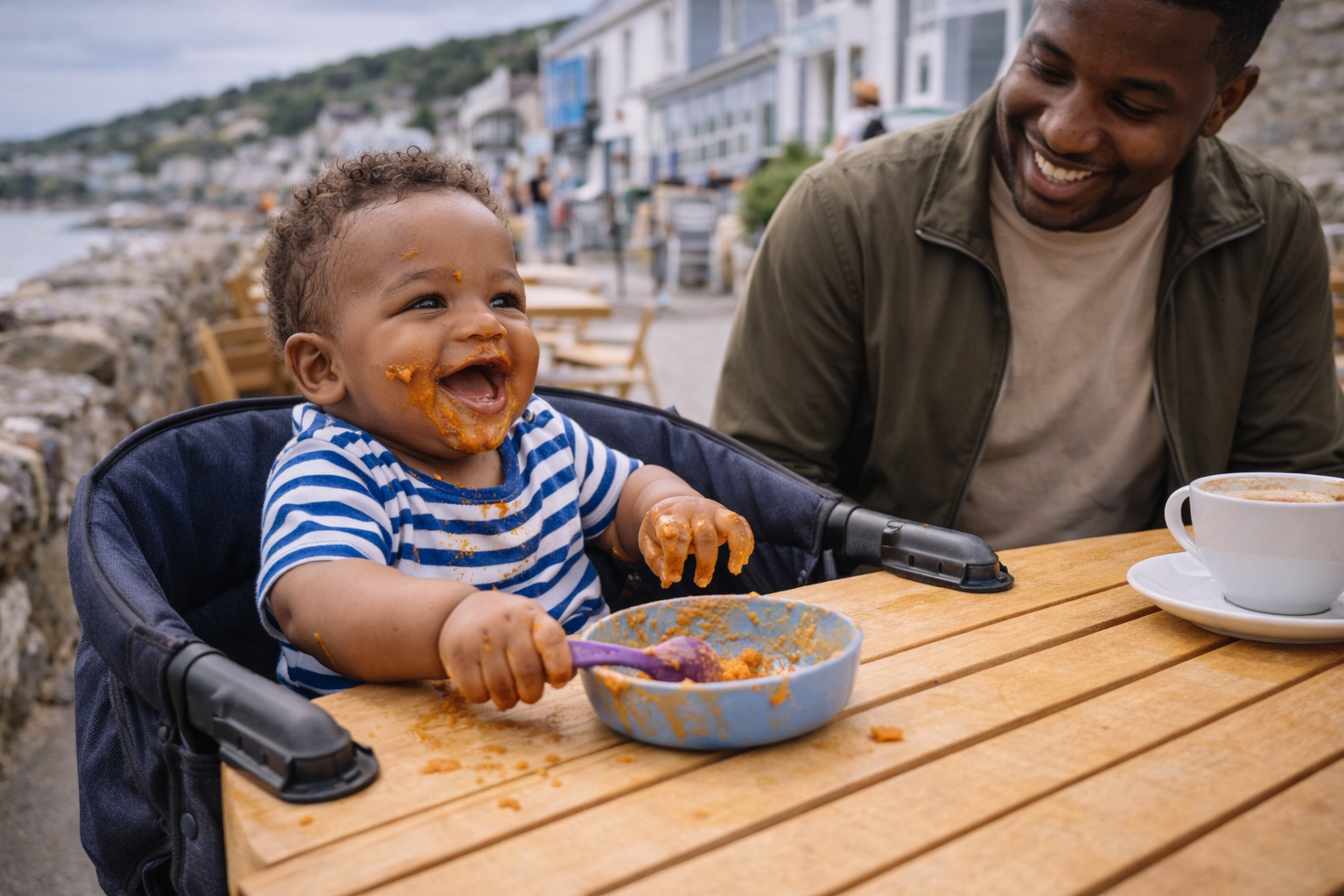
Eating on Holiday With a Toddler
Eighteen months is peak fussy eating for many children. At home you've found the 4–6 foods they'll reliably eat. On holiday, some of those foods won't be available, the plates will look different, and the environment will be new and stimulating. Expect some regression and plan for it.
Strategy: Familiar First
Pack a supply of their reliable foods from home — their usual crackers, their cereal, the fruit pouches they actually eat. These aren't for every meal; they're your backup when the restaurant serves pasta with a sauce they've never seen before and your toddler stages a sit-in. A well-fed toddler is a manageable toddler. A hungry toddler in a restaurant is something else entirely.
Restaurant Strategies
Choose your restaurants with the toddler in mind rather than yourself. Casual, loud, and family-friendly beats romantic and quiet every time. Look for restaurants with outdoor seating — spills and dropped food are less fraught al fresco. Eat early (5:30–6pm beats the evening crowd) and bring your own entertainment: sticker books, a few small toys, or their current favourite car. Order something you know they'll eat alongside whatever you're trying, so there's always a fallback.
Our Tip
The bread basket buys you approximately 10 minutes. Use them to order, secure the highchair, and scout the exit.
Sleep at 18 Months on Holiday
The 18-month sleep regression is well-documented — many toddlers who were sleeping through start waking again, resisting bedtime more than usual, or taking much longer to settle. Holiday adds unfamiliar surroundings, overstimulation, and disrupted routine into that mix. Expect it to be harder than at home, and build that expectation into your plans.
Setting Up a Sleep Environment
Bring all their usual sleep cues: sleeping bag, favourite comforter or toy, a Dreamegg D11 white noise machine, and a portable blackout blind. Holiday accommodation — especially summer cottages — tends to have light, thin curtains that do very little at 5am. A blackout blind is one of the most impactful travel items you can pack at this age.
Follow the Lullaby Trust safe sleep guidance for travel cot setup — a firm, flat surface with a fitted sheet, their sleeping bag, and no loose bedding. The rules don't change in a holiday setting.
Managing the Bedtime Routine
Keep the sequence identical to home: bath (if available), pyjamas, sleeping bag, feed or milk if still having one, a couple of books, white noise on, lights out. The sequence is what your toddler has learned to associate with sleep — not the exact timing, not the exact environment. Consistency in the ritual matters more than any other single factor. For a full approach, see our routine on holiday guide.
If They Won't Settle
In an unfamiliar room, some toddlers genuinely need more reassurance at bedtime. Sitting next to the travel cot until they fall asleep is not spoiling them — it's responding appropriately to a new environment. You can gradually move towards the door over a few nights as they become more comfortable. Accept that the first night or two may be rough, and plan the next day accordingly (a low-key morning is wiser than an early theme park start).
Sample Holiday Day Schedule at 18 Months
This is a realistic template, not a rigid timetable. Build in flexibility — things will run late, naps will be refused, snack emergencies will arise.
| Time | Activity | Notes |
|---|---|---|
| 6:30–7:00am | Wake up, milk/breakfast | Early starts are inevitable. Keep it calm and low-stimulation. |
| 8:00–10:30am | Main activity of the day | Best window: toddlers are rested and cooperative. Beach, park, farm visit — go now. |
| 10:30am | Snack + quiet time | Watch for tiredness cues. Don't push through — a missed nap makes the afternoon very hard. |
| 12:00–12:30pm | Lunch | Eat before they're too tired. Hungry + tired = a very difficult combination. |
| 12:30–2:30pm | Nap (cot or stroller) | Protect this. The whole afternoon depends on it. Cot nap is best; stroller nap is fine. |
| 2:30–5:00pm | Second activity (gentler) | Walk, café stop, soft play. Lower-energy than the morning slot. |
| 5:00–5:30pm | Early dinner | Eating early means less chance of a meltdown. Bring backup snacks. |
| 6:30–7:00pm | Bath and bedtime routine | Keep it identical to home. White noise on, blackout blind down, same sequence. |
✈️ Free Baby Hand Luggage Checklist
Never forget the essentials. Enter your email and we'll send the free checklist straight to your inbox — one page, every category, ready before every flight.
Frequently Asked Questions
Is 18 months the hardest age to travel with?
It's widely considered the most challenging travel age, yes. The combination of full mobility, emerging tantrums, peak separation anxiety, and limited communication creates a genuinely demanding travel companion. That said, the same energy that makes them hard work also makes them wonderful — their delight at new experiences is infectious.
What kind of holiday works best at 18 months?
Self-catering with outdoor space is the strongest choice — a cottage garden or holiday park forest gives your toddler somewhere to run without you having to manage them constantly in a confined space. Avoid anywhere with lots of queuing, confined indoor spaces, or a premium placed on quiet. See our best cottages for babies and Centre Parcs guide for specific recommendations.
Should I buy my 18-month-old their own plane seat?
For flights over 1.5–2 hours, buying a seat is worth serious consideration. An 18-month-old is too heavy and too wriggly to comfortably lap-fly for long — and a separate seat with a car seat or CARES harness means they have their own space. It costs more, but on a 3-hour flight the difference in experience is significant.
Do I still need a stroller at 18 months?
Absolutely. An 18-month-old can walk, but not for half the distances you'll cover on holiday — and they'll need to nap somewhere on longer days out. A stroller with a decent recline that fits easily into restaurants and on public transport is one of the most useful things you can bring. Check our travel stroller guide for what to look for at this age.
How do I handle the 18-month sleep regression on holiday?
Bring all your usual sleep cues, keep the bedtime sequence identical to home, and accept that the first night or two may be harder than usual. The regression is temporary — a week away doesn't make it permanent. Don't be afraid to sit next to the cot until they settle if they need more reassurance in an unfamiliar room.
What do I do if my 18-month-old tantrums in public?
Stay calm, get low to their level, and focus on what they need rather than what they're doing. Tiredness and hunger are behind most public tantrums at this age. Prevention is easier than management: keep to rough nap times, never leave the accommodation without snacks, and don't overschedule. One big activity per day is usually enough.
Should I use reins or a wrist link?
Both have their place. A chest harness with reins gives more secure control near roads and water — places where you can't afford a second's hesitation. A wrist link is better for lower-risk environments where you want to give them more freedom of movement. Most parents use both, depending on the situation.
Is 18 months too young for their own seat on a plane?
Not at all — some airlines require all children over 24 months to have their own seat, but there's nothing stopping you buying one from birth. For 18-month-olds specifically, a seat with a rear-facing car seat or an approved CARES aviation harness is the safest option and makes long-haul significantly more manageable.
You Will Survive This
Travelling with an 18-month-old is not a relaxing holiday in the conventional sense. It's an adventure — loud, physical, occasionally chaotic, and genuinely joyful in ways that a quiet beach week alone never could be. Go in with low expectations for relaxation and high expectations for entertainment. Choose a destination that works with their energy. Pack the reins. Protect the nap.
When you're planning your trip, our first holiday guide covers destination types in more detail, and our baby holiday packing list will make sure nothing essential gets left behind.