
Visiting London With a Baby: A Parent-Focused Survival Guide (2026)
By BabyTravel UK Editorial Team · Last updated July 2026
London is magnificent and genuinely awkward with a pushchair. Here is everything you need to navigate it well.
London is the most searched UK city for family travel, and for good reason — it has more world-class free museums, more park space, and more things to do than any other city in the country. It also has a Tube network that was largely built in the Victorian era, changing facilities that vary wildly by venue, and a scale that makes planning essential. A first visit to London with a baby is not something you want to approach casually.
This guide is specifically for parents — not a list of tourist attractions that happens to mention babies, but a practical breakdown of how to actually get around, where to go, what to avoid, and how to make the logistics work. For general city break planning with a baby, see our UK city breaks guide. For what to pack, see our baby holiday packing list. If you're still choosing between London and other destinations, our free UK destination quiz narrows it down across 15 options in five quick questions.
Visiting London With a Baby: Key Facts
- Transport: The Elizabeth line is your best friend — fully step-free throughout. Buses are better than the Tube for pushchair users in Zone 1.
- Best free attractions: Natural History Museum, British Museum, Tate Modern, South Bank walk, Regent's Park
- Nappy changing: John Lewis and Liberty are your safest bets on Oxford Street. Museum changing facilities are generally good.
- Avoid: Rush hour Tube (7:30–9:30am and 5–7pm), the London Eye with babies under 2, over-scheduling
- Best areas to stay: Bloomsbury, South Kensington, Southwark — all give you walkable access to the best family attractions

Getting Around London With a Baby
This is the section that most London guides gloss over. Getting around London with a pushchair requires a completely different strategy to getting around as a normal adult visitor, and if you don't plan it properly you will spend a significant portion of your trip carrying a pushchair up staircases while a baby screams.
The Tube: Honest Assessment
The honest truth about the London Underground: the majority of stations still do not have step-free access from street to platform. Of the 272 stations on the network, only around 100 are step-free — and many of the ones that aren't are in exactly the areas tourists most want to visit. Leicester Square, Covent Garden, Bond Street (until the Elizabeth line), Piccadilly Circus — all have stairs. Lots of them.
The game-changer for families is the Elizabeth line, which opened in 2022. Every single Elizabeth line station is step-free. Paddington, Bond Street, Tottenham Court Road, Farringdon, Liverpool Street, Canary Wharf — all accessible, all with lifts. If you're planning a London trip with a pushchair, building your itinerary around Elizabeth line stations will save you an enormous amount of effort.
TfL publishes a step-free access guide which is the most reliable current reference — worth bookmarking before you travel, as step-free status changes when lifts are out of service.
Step-Free Routes for Key Tourist Areas
| Destination | Best Step-Free Option | Notes |
|---|---|---|
| British Museum | Tottenham Court Road (Elizabeth line) | 10-min walk. Fully step-free from street to platform. |
| South Bank / Tate Modern | Southwark (Jubilee line) | Step-free. Or walk across Millennium Bridge from St Paul's (St Pauls has no step-free access — take a bus to Tate Modern instead). |
| Borough Market | London Bridge (Jubilee line) | Step-free on Jubilee line. 5-min walk to the market. |
| Westminster / Big Ben | Westminster (Jubilee line) | Step-free on Jubilee. Circle/District line at Westminster has no step-free access. |
| Natural History Museum | Bus from Paddington (Elizabeth line) | South Kensington station has no step-free access. Take the Elizabeth line to Paddington, then bus 70 or 74. Or a black cab direct. |
| Hyde Park / Kensington | Bus from Paddington (Elizabeth line) | Lancaster Gate and Hyde Park Corner both have stairs. Bus or taxi from Paddington is much easier. |
| Greenwich | DLR to Cutty Sark | DLR is largely step-free. Cutty Sark DLR is the closest stop for the park and Maritime Museum. |
| Regent's Park | Bus or black cab | Regent's Park and Baker Street stations both have limited step-free access. The 274 bus from Marble Arch (Bond Street Elizabeth line) is the most reliable option. |
Buses: Better Than You Think
London's bus network is one of the most pushchair-friendly transport systems in any major city. Every bus has a designated pushchair space — you don't need to fold, you just wheel on and lock the brakes. There's a maximum of two unfolded pushchairs per bus, and in practice you'll rarely have a problem outside peak commuting hours.
The important caveat: if the two buggy spaces are occupied, the driver can ask you to fold your pushchair. This is rare but worth knowing. Payment is contactless only — no cash accepted. For routes and real-time status, the TfL journey planner is the most reliable tool, and it shows bus routes and step-free options in one place.
Walking: Often the Best Option in Zone 1
London's tourist core — from Westminster to the City — is roughly 4 miles end to end. Many of the best routes are genuinely pushchair-friendly: the South Bank from Westminster Bridge to Tower Bridge is almost entirely flat and paved, passing Tate Modern, the Globe, Borough Market, and ending at one of the most photogenic bridges in Europe. The same is true of St James's Park, Green Park, and the Embankment.
Walking also solves the step-free problem entirely and gives your baby something to look at constantly — London is relentlessly stimulating at any age. A compact stroller and a willingness to walk 2–3 miles will take you through most of the best of Zone 1 without ever needing the Tube.
Black Cabs
London's licensed black taxis are fully wheelchair and pushchair accessible — the passenger door is wide, the floor lowers hydraulically, and there's dedicated space for a folded or unfolded pushchair. Crucially, children in licensed taxis are not legally required to use a car seat in the UK. For getting from a mainline station to your hotel, or from the hotel to the Natural History Museum, a black cab is often the most practical option — especially with a large amount of luggage. They're more expensive than the Tube but substantially less stressful.
Compare Train Tickets
Compare train fares and book the cheapest tickets — children under 5 travel free.
Compare Train TicketsBest Baby-Friendly Things to Do in London
📋 Free Baby Holiday Packing Checklist
Enter your email and we'll send the free printable checklist straight to your inbox — every category, ready to tick off before every trip.
| Attraction | Cost | Buggy Access | Changing | Step-Free Station |
|---|---|---|---|---|
| Natural History Museum | Free | Excellent | Yes | Bus from Paddington |
| Science Museum | Free | Good (ground floor) | Yes | Bus from Paddington |
| British Museum | Free | Very good | Yes | Tottenham Court Rd (Elizabeth) |
| Tate Modern | Free | Excellent | Yes | Southwark (Jubilee) |
| Diana Memorial Playground | Free | Excellent | Nearby in park | Bus from Paddington |
| South Bank Walk | Free | Excellent | Tate Modern / Festival Hall | Southwark or Waterloo (Jubilee) |
| Coram's Fields | Free | Excellent | Yes (on site) | Russell Square (lift) |
| Greenwich Park & Maritime Museum | Free | Good | Yes (museum) | Cutty Sark (DLR) |
Natural History Museum
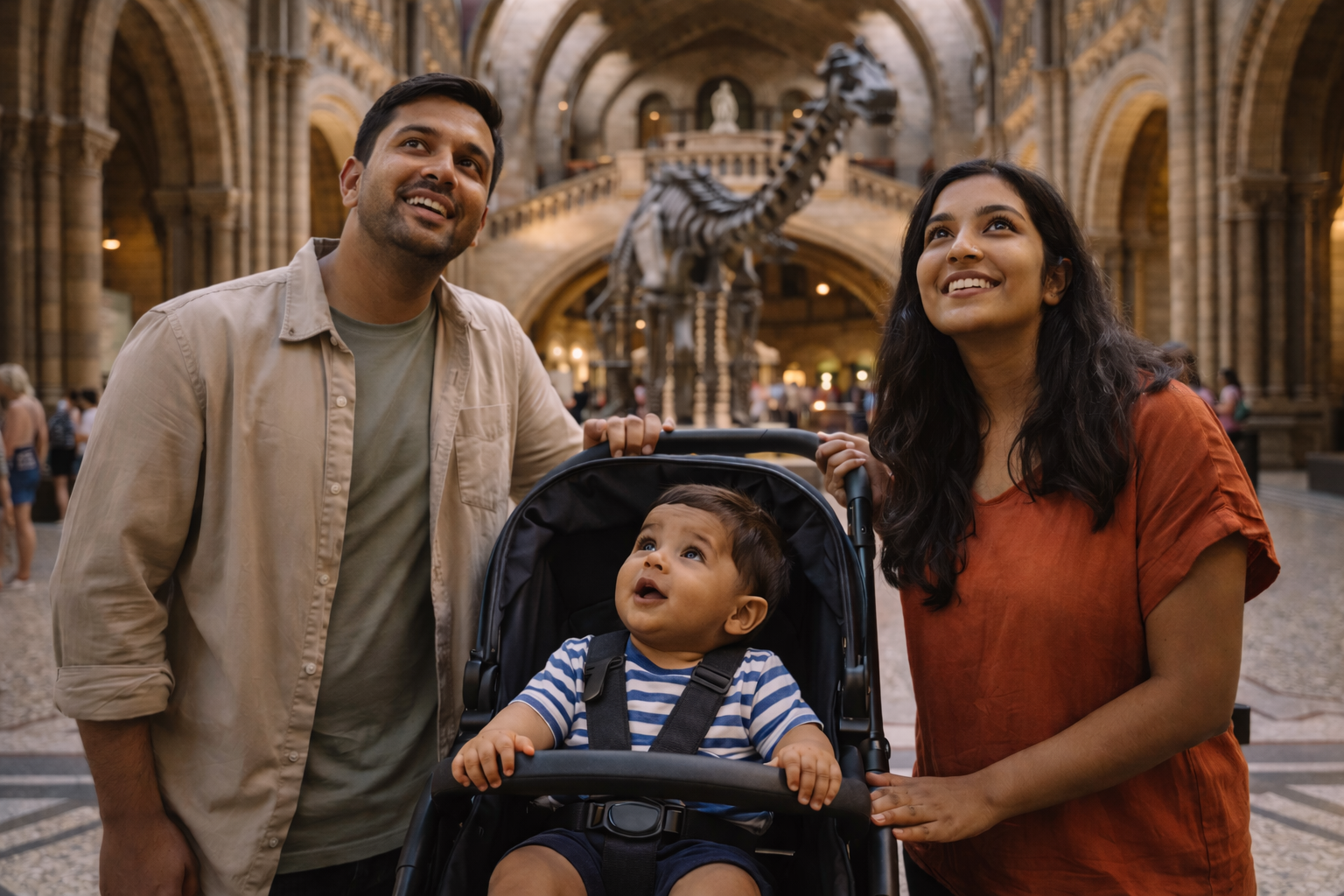
The best single attraction in London for babies and toddlers. The blue whale skeleton suspended in the main hall is genuinely awe-inspiring — even tiny babies stare up at it with wide eyes. The building itself is extraordinary. Entry is free, pushchairs are welcome everywhere, and the changing facilities are good. The main issue is getting there: South Kensington station has no step-free access, so plan to arrive by bus from Paddington or by black cab.
The South Bank
The walk from Westminster Bridge east to Tower Bridge is one of the finest pushchair routes in any city in the world — flat, paved, endlessly interesting, and entirely free. Tate Modern (free, entirely step-free) provides a halfway stop and excellent facilities. Borough Market is a short detour from London Bridge for lunch. The Millennium Bridge across to St Paul's is worth crossing for the view. Allow three hours for the full walk at a relaxed pace; you'll be stopping frequently.
British Museum
The Great Court — the vast glass-roofed central courtyard — is one of the most impressive interior spaces in London, and babies respond to the scale and light immediately. The museum is free, the ground floor is entirely pushchair-friendly, and it's a 10-minute walk from the step-free Tottenham Court Road Elizabeth line station. Don't try to do the whole museum in one visit — pick one or two rooms and spend the rest of the time in the Great Court café.
Coram's Fields
One of London's best-kept family secrets. A seven-acre park in Bloomsbury with a playground, sandpit, duck pond, and farm animals — adults are only admitted if they're accompanied by a child. It's entirely free, the changing facilities are good, and the on-site café is decent. Walking distance from Russell Square (which has a lift) or a short walk from Tottenham Court Road.
Greenwich
Half a day in Greenwich is one of the most rewarding London day trips for families. The park has a huge open hillside (yes, there's a hill — leave the stroller at the bottom and use a carrier for the climb to the observatory), the National Maritime Museum is free with great pushchair access and excellent changing facilities, and the Cutty Sark tall ship (paid entry, around £20 for adults, free under 5s) is visually spectacular. The DLR to Cutty Sark station is step-free throughout.
Find Family Activities
Book skip-the-line tickets and family-friendly tours — free cancellation on most activities.
Browse Family ActivitiesWhere to Change a Nappy in London
Nappy changing in London is inconsistent in a way that will catch you off guard if you haven't planned for it. Train stations range from good (St Pancras, King's Cross) to non-existent (some smaller Zone 1 stations have no facilities at all). The Tube itself has almost no changing facilities on the concourse.
Most Reliable Options
Department stores are your safest bet in the West End. John Lewis on Oxford Street has excellent, regularly maintained changing rooms. Liberty on Great Marlborough Street is smaller but well-equipped and never as crowded. Selfridges also has changing facilities. These are worth knowing the location of before you need them.
Museums generally have very good facilities — the Natural History Museum, British Museum, and Tate Modern all have dedicated family changing rooms that are clean and spacious. Coram's Fields has on-site facilities. The South Bank Centre (Royal Festival Hall) has good facilities near the café level.
For mapping changing facilities across London, the Baby Where app aggregates parent-verified changing locations and is worth downloading before your trip.
Pro Tip
Keep a portable changing mat in your bag at all times. Many London venues technically have a "baby change" that turns out to be a pull-down shelf above a toilet in a cramped cubicle. A changing mat with a wipe-clean surface means you're never entirely at the mercy of the facilities.
Where to Eat With a Baby in London
London has an extraordinary food scene, most of which is entirely compatible with having a baby at the table — as long as you choose the right kind of place.
Reliable Choices
Wagamama is consistently good for families: large tables, high noise levels that mask any baby-related sounds, and staff who are generally very friendly to families. Pizza Express has highchairs in almost every branch and a children's menu. Dishoom is excellent food but comes with a serious queue caveat — the Covent Garden branch can have 90-minute waits at dinner; go at lunch or accept the wait is incompatible with a hungry baby.
The café culture in the museum district (South Kensington and Bloomsbury) is genuinely strong — independent cafés around the Natural History Museum and British Museum tend to have space for pushchairs and are accustomed to families. The South Bank between Waterloo and Borough Market has dozens of casual outdoor options where spills and noise are entirely unremarkable.
Eating in parks is an underrated London option. Regent's Park, Hyde Park, and St James's Park all have decent food kiosks or full cafés with outdoor seating. On a good weather day, a picnic on a park blanket is often more enjoyable — and far less stressful — than any restaurant.
Where to Stay in London With a Baby
London is large enough that the area you stay in materially affects your experience. The wrong location means long journeys on the Tube at the start and end of every day — exactly what you don't want with a baby in tow.
Best Areas
Bloomsbury gives you walking access to the British Museum, Coram's Fields, and the Russell Square step-free Tube station. It's quieter than the West End, has good independent cafés, and feels more residential — which helps when you're up at 6am and need a coffee shop that opens early. South Kensington is ideal if your priority is the Natural History Museum and Science Museum — you'll be on the doorstep, which matters when you want to pop back for nap time. It's one of London's most expensive neighbourhoods, but even a modest hotel here puts you within a few minutes' walk of both museums.
Southwark and Bankside (SE1) is increasingly popular for families — the South Bank walk is literally outside your door, Tate Modern is nearby, and Borough Market is a short walk for breakfast provisions. King's Cross is the best option if you're arriving by train from the north — step-free access is excellent, and the surrounding St Pancras area has good family dining and cafés.
Hotels vs Self-Catering
For London specifically, a hotel is usually more practical than self-catering — the premium London flat prices are high and the properties can be small. What matters in a London hotel with a baby: a cot (confirm before booking, and confirm again closer to arrival), blackout blinds or curtains (London summer mornings are early and light), and enough room to set up the cot without climbing over it to get to bed. For what to look for when booking, see our baby-friendly hotels guide.

Find Baby-Friendly Hotels
Search baby-friendly hotels with free cancellation, cot requests, and family room options.
Search Hotels on Booking.comWhat NOT to Do in London With a Baby
Avoid Rush Hour on the Tube
The Tube at 8am or 6pm with a pushchair is miserable. Platforms are packed, lifts are crowded, and even on step-free stations the experience is stressful. Avoid travelling by Tube between 7:30–9:30am and 5:00–7:00pm if at all possible. London is perfectly navigable outside of those windows.
Don't Book the London Eye
The London Eye is a fine experience. With a baby under two, it's expensive (around £35+ per adult), the queue is long, and the 30-minute rotation doesn't particularly benefit someone who doesn't yet understand what they're looking at. Save the money for a black cab to the Natural History Museum or a nice lunch on the South Bank.
Don't Over-Schedule
London tempts you into too much. One major attraction per day is a realistic target when you're working around nap times and feeding schedules — two is possible if they're close together. Three almost always ends badly. A day that includes the Natural History Museum in the morning, a park lunch, and a gentle stroll back to the hotel via a café is a genuinely good day. A day that tries to fit in Buckingham Palace, the Tower of London, and Borough Market usually isn't.
Don't Assume the Tube Is Step-Free
We've said this already, but it bears repeating: plan every Tube journey in advance and confirm step-free access. TfL's step-free access map is the definitive reference. Build in the assumption that lifts may be out of service and have a bus backup route planned.
What to Bring: Stroller and Carrier
For London, compact fold matters more than almost any other factor in a stroller. You'll be getting on and off buses, navigating museum corridors, fitting through café doors, and occasionally having to fold quickly in a lift. An off-road stroller with fixed chunky wheels is not what you want here.
A carrier is often the better choice for specific London situations — narrow museum galleries, Tube stations without lifts, cobbled areas around markets, and anywhere you want your hands completely free. Bringing both (a compact stroller for longer flat walks, a carrier for museums and narrow streets) is the most flexible approach. See our carrier guide for travel for options that work well in cities, and our travel stroller guide for compact city pushchairs. The Silver Cross Jet is one of the most popular choices for London specifically — compact when folded, smooth on pavements, and a genuinely fast one-hand fold.

Silver Cross Jet (A Solid London Stroller Pick)
A well-designed compact travel stroller from a trusted British brand — one of the most popular choices for UK city use. Lightweight at around 6kg, quick to fold, and narrow enough for museum corridors and bus aisles. Suitable from birth to 25kg. Around £300–£350.
Pros: Compact fold, good canopy, lightweight, trusted brand, easy to find spare parts.
Cons: The recline isn't fully flat — not ideal for very young newborns who need to lie flat; better from around 3–4 months.
London Essentials
London rewards a carrier for the stairs and cobbles, and a few smart pram add-ons for the long flat walks. Here's the kit that makes days across the city more manageable with a baby.

Ergobaby Omni Breeze Carrier
Breathable all-position carrier for stairs, cobbles and no-lift stations.
Check price on Amazon
Universal Stroller Rain Cover
A universal rain cover to keep your baby dry when the weather turns.
Check price on Amazon
Skip Hop Cup Holder
A universal clip-on cup holder to keep your drink to hand.
Check price on Amazon
Diono Buggy Buddy Organiser
A stroller organiser with insulated cup holders and a zip pocket.
Check price on Amazon✈️ Free Baby Hand Luggage Checklist
Never forget the essentials. Enter your email and we'll send the free checklist straight to your inbox — one page, every category, ready before every flight.
Frequently Asked Questions
Is London baby-friendly?
In terms of things to do, absolutely — the free museums, parks, and walkways are outstanding for families. In terms of logistics, it requires more planning than most UK cities. The Tube step-free access is the main challenge; once you've planned your routes around the Elizabeth line, the Jubilee line, buses, and walking, London becomes very manageable.
Which London museums are best for babies?
The Natural History Museum is the single best choice — the scale, the whale skeleton, and the architecture all make an impression even on very young babies. The British Museum's Great Court is similarly impressive. Both are free, both have good changing facilities, and both are large enough that you won't feel rushed.
How do I get around London with a pushchair?
Prioritise the Elizabeth line (fully step-free), the Jubilee line (largely step-free), buses (pushchairs welcome without folding), and walking where possible. Avoid the older deep-level Tube lines (Northern, Central, Bakerloo, Piccadilly) unless you've confirmed step-free access at both ends of your journey. TfL's step-free access map is essential reading. See also our city and public transport guide.
Where are the best baby changing facilities in London?
John Lewis Oxford Street and Liberty are the most reliable West End options. The major museums (Natural History, British, Tate Modern) all have good facilities. Main train stations (St Pancras, Victoria, Waterloo) are generally adequate. Avoid relying on Tube stations — very few have changing facilities on the concourse.
What areas of London are best to stay in with a baby?
Bloomsbury for museum access and a quieter atmosphere; South Kensington for the Natural History and Science Museums; Southwark/Bankside for the South Bank and Tate Modern; King's Cross for rail connections and the Elizabeth line. All are central, family-manageable, and avoid the most frenetic parts of the West End.
Should I bring a stroller or a carrier to London?
Both, if possible. A compact stroller handles long flat walks on the South Bank, bus journeys, and tired legs at the end of the day. A carrier is better for museum interiors, areas with stairs, and anywhere a stroller becomes awkward. The combination gives you full flexibility. See our carrier guide and compact stroller guide for specific recommendations.
Is the London Eye worth it with a baby?
Honestly, no. It's expensive, the queue is significant, and the 30-minute rotation doesn't offer much for a baby or toddler. The view of London is genuinely spectacular, but you get a comparable perspective (free) from the top of the Tate Modern's Blavatnik Building, from Greenwich Hill, or simply walking across Waterloo Bridge. Save the money.
What's the best day out in London with a baby?
For most families, a morning at the Natural History Museum followed by lunch in Hyde Park, then a gentle walk through Kensington Gardens hits the best of West London without over-scheduling. An alternative: take the Elizabeth line to Southwark, spend the morning at Tate Modern, walk the South Bank to Borough Market for lunch, then taxi or bus home. Both are memorable, manageable days that leave room for nap time.
London Is Worth It
London with a baby is not the path of least resistance — that's a cottage in Cornwall or a Centre Parcs lodge. But the free museums, the parks, the South Bank, and the sheer energy of the city make it one of the most rewarding UK trips you can do with a young child. Plan your transport in advance, stay central, and don't try to do too much in a day. The city will do the rest.
For more help planning, our London hotel guide covers what to look for when booking, and our baby holiday packing list will make sure you leave nothing essential behind.
Also worth a read: our guides to rainy day activities with a baby and the best family-friendly restaurants in the UK pair well with any trip here.