
Best UK Road Trips With a Baby: 5 Routes & Itineraries (2026)
By BabyTravel UK Editorial Team · Last updated March 2026
Most road trip content is written for adults who can drive six hours straight and stop wherever takes their fancy. This guide isn't that. These are five routes planned specifically around having a baby in the back — with realistic timings, good stopping points, and the understanding that the 2-hour car seat rule isn't optional. If you've been putting off a road trip because it felt like too much, read this first.
⚡ Quick Answers
- The 2-hour rule: stop every 60–90 minutes — don't push it to the full two hours
- Best first road trip: London to the Cotswolds (1.5–2 hrs, easy motorway, beautiful destination)
- Best long drive: Edinburgh to the Highlands — worth every stop, stunning from Pitlochry onwards
- Best motorway stop in the UK: Tebay Services, M6 (farm shop, outdoor space, excellent facilities)
- Key mindset shift: the journey is part of the holiday, not something to endure
Road Trip Rules With a Baby
Before you plot a single route, three things are worth getting clear in your head.
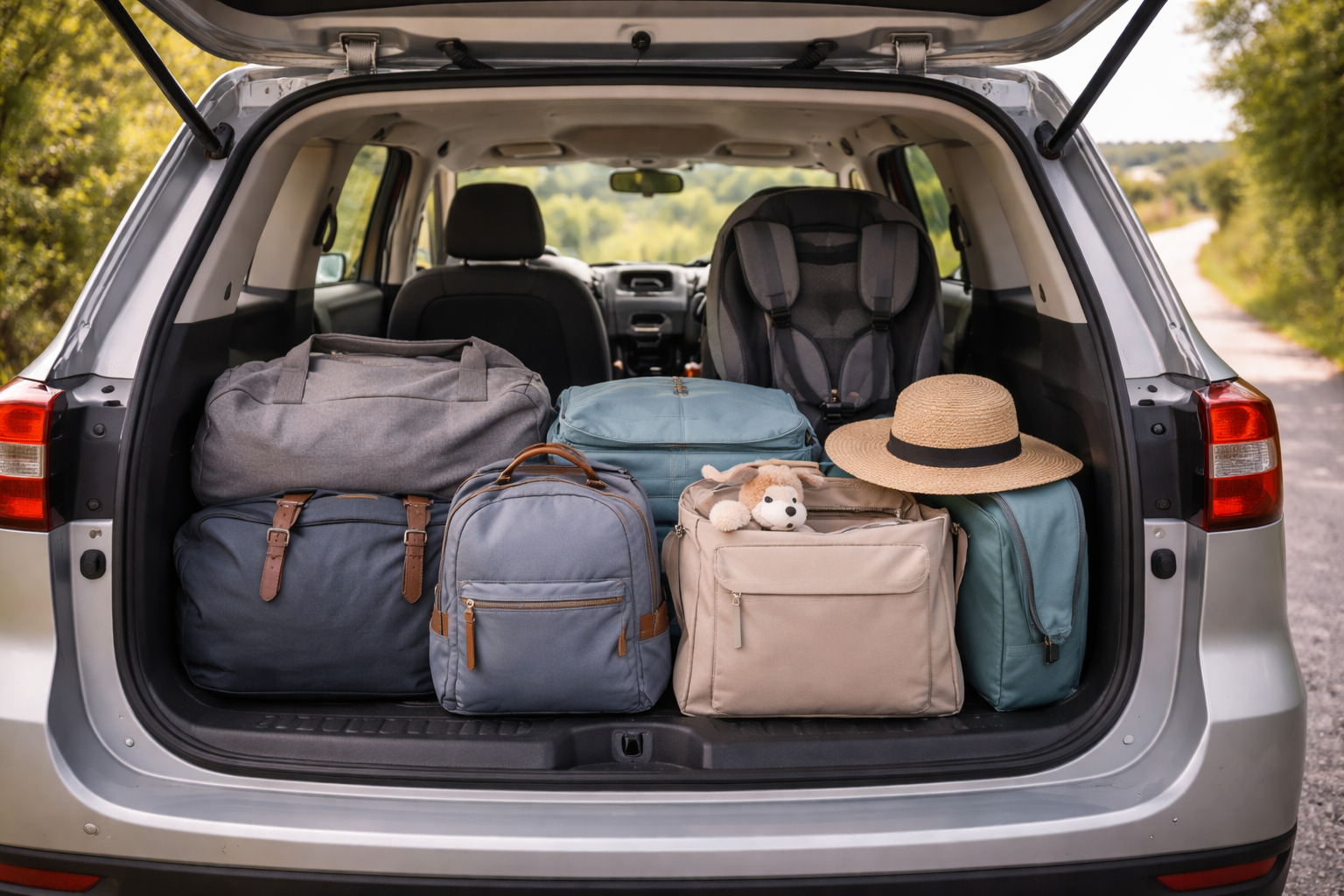
The 2-hour car seat limit. All major child safety organisations recommend no more than two continuous hours in a car seat for babies and young children. In practice, aim for stops every 60–90 minutes — this gives you margin before you hit the limit, and babies tend to get restless well before the two-hour mark anyway. Build your route around this constraint rather than fighting it. A four-hour drive becomes a five-hour journey with stops. That's fine. Accept it and plan for it.
Timing departures around naps. Two approaches work well. The first is the early morning departure — load the car the night before, dress baby in their sleepsuit, and leave at first light. Most babies fall asleep within 20 minutes of setting off and give you a solid first stretch. The second is aligning the drive with a known nap window — if your baby reliably naps at 9am, set off at 8:45am and let the car do the work. Avoid departing at witching hour (roughly 5–7pm). You'll regret it.
Packing the car strategically. The boot is for luggage you won't need until you arrive. The rear footwell and back seat pocket are for everything you need during the drive — nappies, wipes, snacks, a change of clothes, entertainment toys, and a thermos of hot water for bottles. If the rear-seat parent has to excavate the boot at a service station to find a nappy bag, you've packed wrong. For full kit advice, see our guide to entertaining baby on long car journeys.
Pro Tip: The journey IS the holiday, not dead time to endure. Stops at Tebay, a riverside café in Pitlochry, or the Exeter Quay are part of the experience. Build in 15 minutes of unhurried stop time and they stop feeling like obstacles.
5 UK Road Trip Routes With a Baby
📋 Free Baby Holiday Packing Checklist
Enter your email and we'll send the free printable checklist straight to your inbox — every category, ready to tick off before every trip.
Each route below includes a realistic baby-adjusted time, the best stopping points, and what to do when you arrive. They're ordered loosely by length — start with the short ones if this is your first drive with a baby.
Route 1: London to the Cotswolds (M40)
Distance: around 80 miles (London to Bourton-on-the-Water). Drive time without stops: 1.5–2 hours. Baby-adjusted time: 2–2.5 hours — this one is almost short enough not to need a stop at all.
This is the ideal first road trip with a baby. The M40 is a smooth, stress-free motorway, the drive is short enough to do in a single nap cycle, and the Cotswolds are genuinely excellent for families — flat village greens for early walkers, dog-friendly pubs, and baby-friendly accommodation that doesn't cost a fortune.
Best stop: Oxford Services (M40 junction 8A) if you need one — clean, modern, good facilities. Alternatively, skip the services entirely and drive straight through, arriving fresh in the Cotswolds by mid-morning. Burford, Bourton-on-the-Water, and Chipping Campden all have good car parks with pram-friendly village centres nearby.
At the destination: Self-catering cottages dominate here and they work brilliantly with babies — check our Cotswolds with a baby guide for where to stay and what to do. The Cotswolds Water Park near Cirencester is unexpectedly good for babies who like watching ducks.
Route 2: Manchester to the Lake District (M6/A591)
Distance: around 80 miles (Manchester to Windermere). Drive time without stops: 1.5 hours. Baby-adjusted time: 2–2.5 hours.
Another short drive that's almost too easy. From Manchester, take the M6 north and peel off at junction 36 — from there it's the A591 through increasingly beautiful countryside towards Windermere. The scenery picks up dramatically after Kendal, which is useful timing as it tends to coincide with the end of a nap and baby's best awake window.
Best stop: Tebay Services (M6, junction 38). Don't skip this one even if you don't need a break. Tebay is genuinely unlike any other motorway services in the country — a working farm shop, proper hot food, outdoor seating, and one of the most scenic service areas you'll find anywhere. Baby-changing facilities are excellent. It's worth leaving slightly early to stop here. Tebay Westmorland Services is independently run and it shows.
At the destination: The Lake District is one of the best places in the UK for babies and toddlers — flat lakeside walks, boat trips on Windermere, and no shortage of good accommodation. Full details in our Lake District with a baby guide.
Route 3: Birmingham to Pembrokeshire (M5/M4/A40)
Distance: around 165 miles (Birmingham to Tenby). Drive time without stops: 3 hours. Baby-adjusted time: 4–4.5 hours with two stops.
This is a proper day's driving but worth every mile. Take the M5 south to Bristol, join the M4 west, then the A40 through Carmarthenshire into Pembrokeshire. The scenery transforms dramatically once you're past the Brecon Beacons — the last hour through Carmarthenshire and into the National Park is genuinely beautiful.
Best stops: Cardiff Bay makes a good first stop — leave the M4 at junction 33 and spend 20 minutes by the waterfront. Carmarthen is a solid second stop with a good retail park on the A40 (Carmarthen Retail Park) if you need any supplies. From there it's a scenic run to the coast. Link to our Pembrokeshire with a baby guide for the full destination guide.
At the destination: Tenby is the headline destination — one of the most beautiful walled towns in Wales with three beaches within easy walking distance. Broad Haven, Freshwater West, and Barafundle Bay are all exceptional for beach days with a baby.
Route 4: London to Cornwall (A303/M5)
Distance: around 280 miles (London to Padstow). Drive time without stops: 4.5–5 hours. Baby-adjusted time: 6–7 hours — this is a full day's travel, plan accordingly.
The classic British road trip. It requires genuine planning with a baby but it's absolutely doable. Take the A303 west from London through Wiltshire and Somerset, then the M5 south to Exeter before cutting across to North Cornwall.
Best stops: First stop at Countess Services near Amesbury (about 90 minutes from London) — Stonehenge is visible from the road and there's a decent services here. Second stop at Exeter Quay — leave the motorway and spend 20 minutes by the river in one of Exeter's best spots. Good cafés, flat paving for pushchairs, clean toilets. Third stop is optional near Bodmin if needed before the final stretch to the coast. Check our motorway services guide for current baby-changing ratings.
At the destination: Cornwall is superb for families — our Cornwall with a baby guide covers the best beaches, accommodation, and what to do with a young baby across the county. Padstow and Rock are excellent bases for under-ones; Newquay works better for slightly older babies who can handle busier beaches.

Car Seat Activity Arch / Toy Bar
Keep baby entertained in the back
For rear-facing babies, an activity arch clipped to the car seat handle is one of the most useful road trip buys. Crinkle elements, small hanging toys, and mirror attachments provide sensory interest without requiring a rear-seat adult to constantly intervene. Lightweight and easy to attach and remove at stops.
- ✅ Hands-free entertainment for the first 0–10 months
- ✅ Easy to clip on and take off at each stop
- ✅ Washable elements — essential for drool-heavy babies
- ❌ Less useful once baby is forward-facing
- ❌ Some babies lose interest quickly — novelty wears off
Route 5: Edinburgh to the Scottish Highlands (A9)
Distance: around 130 miles (Edinburgh to Aviemore) or 160 miles to Fort William. Drive time without stops: 2.5–3 hours. Baby-adjusted time: 3.5–4 hours.
Arguably the most spectacular drive on this list. The A9 north from Edinburgh climbs through Perthshire before dropping into the Cairngorms and the dramatic landscapes of the central Highlands. There's a real sense of arriving somewhere as you cross into the mountains, and the scenery for the last two hours is genuinely extraordinary — exactly the kind of thing that distracts adults from checking whether baby is still asleep.
Best stop: Pitlochry. Leave the A9 at Pitlochry and spend 20–30 minutes in this charming market town. There's a flat riverside walk along the Tummel that's pushchair-friendly, good cafés along the main street, and a salmon ladder at the hydroelectric dam that's oddly fascinating. It falls at the right point in the drive (about 1.5 hours from Edinburgh) and sets you up perfectly for the final run north.
At the destination: Aviemore is the most family-friendly Highlands base — good amenities, the Cairngorm reindeer herd, and flat lakeside walks at Loch an Eilein. Fort William works better if you want the dramatic western Highlands scenery. Full destination guide at Scottish Highlands with a baby.
5 Routes at a Glance
| Route | Distance | Drive (no stops) | Baby-adjusted time | Best stop | Difficulty | Best season |
|---|---|---|---|---|---|---|
| London → Cotswolds | ~80 miles | 1.5–2 hrs | 2–2.5 hrs | Oxford Services (or skip) | ⭐ Easy | Spring/Summer |
| Manchester → Lake District | ~80 miles | 1.5 hrs | 2–2.5 hrs | Tebay Services (M6) | ⭐ Easy | Spring–Autumn |
| Birmingham → Pembrokeshire | ~165 miles | 3 hrs | 4–4.5 hrs | Cardiff Bay / Carmarthen | ⭐⭐ Moderate | Summer |
| London → Cornwall | ~280 miles | 4.5–5 hrs | 6–7 hrs | Countess Services / Exeter Quay | ⭐⭐⭐ Full day | Summer |
| Edinburgh → Highlands | ~130–160 miles | 2.5–3 hrs | 3.5–4 hrs | Pitlochry town centre | ⭐⭐ Moderate | Spring–Autumn |
Packing the Car for a Road Trip With a Baby
The key principle is accessibility. Everything you'll need during the journey should be within arm's reach of a rear-seat adult. Everything else goes in the boot — out of sight, out of mind until you arrive. See our full holiday packing list for the complete picture; below is the road trip-specific version.
| Zone | What goes there | Why |
|---|---|---|
| Rear footwell / seat pocket | Changing bag, snacks, muslin, spare vest, entertainment bag | Accessible without stopping |
| Centre console / front passenger | Thermos of hot water, snacks for adults, phone mount, traffic app | Driver can reach, co-pilot can manage |
| Entertainment bag (rear seat) | Clip toys, soft book, teething toy, crinkle toy, one secret new toy | Rear-seat parent deploys as needed |
| Boot (top/accessible) | Changing mat, extra nappies, formula refill, first aid kit | Grab at service stops |
| Boot (bottom/buried) | Main luggage, sleeping gear, stroller, holiday kit | Unpacked on arrival only |
For specific products to keep baby entertained in the car, our car entertainment guide has everything from activity arches to the best white noise setups for motorway driving. The holiday travel essentials hub is also worth a scan before you pack.

Baby Rear View Car Mirror
Essential for solo driving with a rear-facing baby
If you're making any part of the trip solo (while a partner catches the train, for example), a rear-facing baby mirror is genuinely important. You can check on baby at a glance without stopping or craning. Wide-angle design shows the full car seat. Clips to the rear headrest in seconds — no tools, no fuss.
- ✅ Instant peace of mind for solo drivers
- ✅ Wide-angle view — see the full seat
- ✅ Easy headrest clip, no installation needed
- ❌ Can cause glare in low winter sun
- ❌ Not needed once baby is forward-facing
✈️ Free Baby Hand Luggage Checklist
Never forget the essentials. Enter your email and we'll send the free checklist straight to your inbox — one page, every category, ready before every flight.
Frequently Asked Questions
How long can a baby be in a car seat on a road trip?
The general guidance is no more than 2 hours at a stretch — commonly called the 2-hour rule. In practice, plan stops every 60–90 minutes to give yourself a comfortable margin. Babies usually signal discomfort well before the two-hour mark, but the physiological reason for the rule (posture and breathing) applies regardless of how content they seem.
What is the best time to start a road trip with a baby?
Early morning works well — load the car the night before, depart at first light with the first feed done. Most babies sleep solidly for the opening stretch. Alternatively, time the departure to coincide with a known nap window. Whatever you do, avoid setting off at witching hour (5–7pm).
Which UK motorway services are best for babies?
Tebay Services on the M6 in Cumbria is widely regarded as the best motorway stop in the UK — farm shop, fresh food, outdoor space, and excellent baby-changing. Gloucester Services on the M5 is also excellent. Most modern Welcome Break and Moto services have dedicated baby-changing rooms. See our full motorway services baby-changing guide for detailed ratings.
Is it worth stopping at Stonehenge on the way to Cornwall?
As a stop on the A303, yes — the Countess Services near Amesbury is a convenient stretch break and Stonehenge is visible from the road. Whether to visit the site itself depends on your baby's age. Under-18-month-olds won't register it much, but the short walk from the car park is manageable with a carrier or stroller. Budget extra time in peak season.
Can you do a UK road trip with a newborn?
You can, but keep total car time short for very young newborns — ideally under two hours. Car seat usage for extended periods isn't recommended for babies under 4 weeks. Once past that stage, a short UK road trip is manageable with frequent stops and ideally a rear-seat adult alongside baby for the journey.
What should I pack for a road trip with a baby?
The key is accessibility: changing bag in the rear footwell, entertainment toys within reach of the rear-seat parent, a thermos of hot water for bottle warming. Main luggage and sleeping gear go in the boot — unpacked only on arrival. Our full packing list has the complete breakdown.
What is the easiest UK road trip for a first drive with a baby?
London to the Cotswolds on the M40 — just 1.5 to 2 hours, motorway most of the way, and the destination is beautiful with excellent baby-friendly accommodation. Short enough to do during a single nap cycle with no major consequences if things don't go perfectly.
Do I need to stop every 2 hours on a road trip with a baby?
Yes — stopping every 60–90 minutes is recommended practice. Stops don't need to be long; 15–20 minutes for a nappy change, a feed, and a leg stretch is usually enough before baby happily goes back in the seat. Build this time into your journey plan from the outset and it stops feeling like a delay.
Ready to Book?
All five routes here are entirely doable with a baby — the key is accepting that they'll take longer than they used to and embracing the stops as part of the trip rather than obstacles to it. Start with a short route if this is your first time, use the accommodation links in each destination guide to find somewhere genuinely baby-friendly, and check the first holiday guide if you want the full planning picture before you set off.