
Taking a Car Seat to Europe: Laws, Safety & Rental Advice (2026)
By BabyTravel UK Editorial Team · Last updated March 2026
Car seat laws vary across Europe — and getting them wrong can mean a roadside fine or, far worse, an unsafe journey. Here's everything UK parents need to know before driving abroad with a baby or toddler.
Driving in Europe with a baby involves a lot of moving parts: the hire car, the right seat, the laws of whatever country you're in, and the logistical challenge of actually getting the seat there in one piece. The good news is that UK car seats are accepted throughout Europe, and the rules — once you know them — are largely consistent across popular family destinations.
This guide covers country-by-country regulations for the six most popular European driving destinations for UK families, the honest pros and cons of bringing your own seat versus renting one, and how to transport it safely. For everything related to flying with your car seat, our car seat on a plane guide has the full detail. If you're still in the planning phase, our baby-friendly European holidays guide is a good starting point.
Quick Answer: Car Seats in Europe
- ✅ UK car seats are valid across Europe — ECE R44/04 and UN R129 i-Size approval are both accepted.
- ✅ Every European country requires child restraints — rules vary slightly by country but the principle is the same.
- ⚠️ Italy has an extra rule: an anti-abandonment alarm device is legally required for children under 4 — many tourists don't know this.
- ✅ Bringing your own seat is nearly always safer than renting, especially for babies under 12 months.
- ✅ Most airlines carry car seats free as essential baby equipment — gate-check or check into the hold.
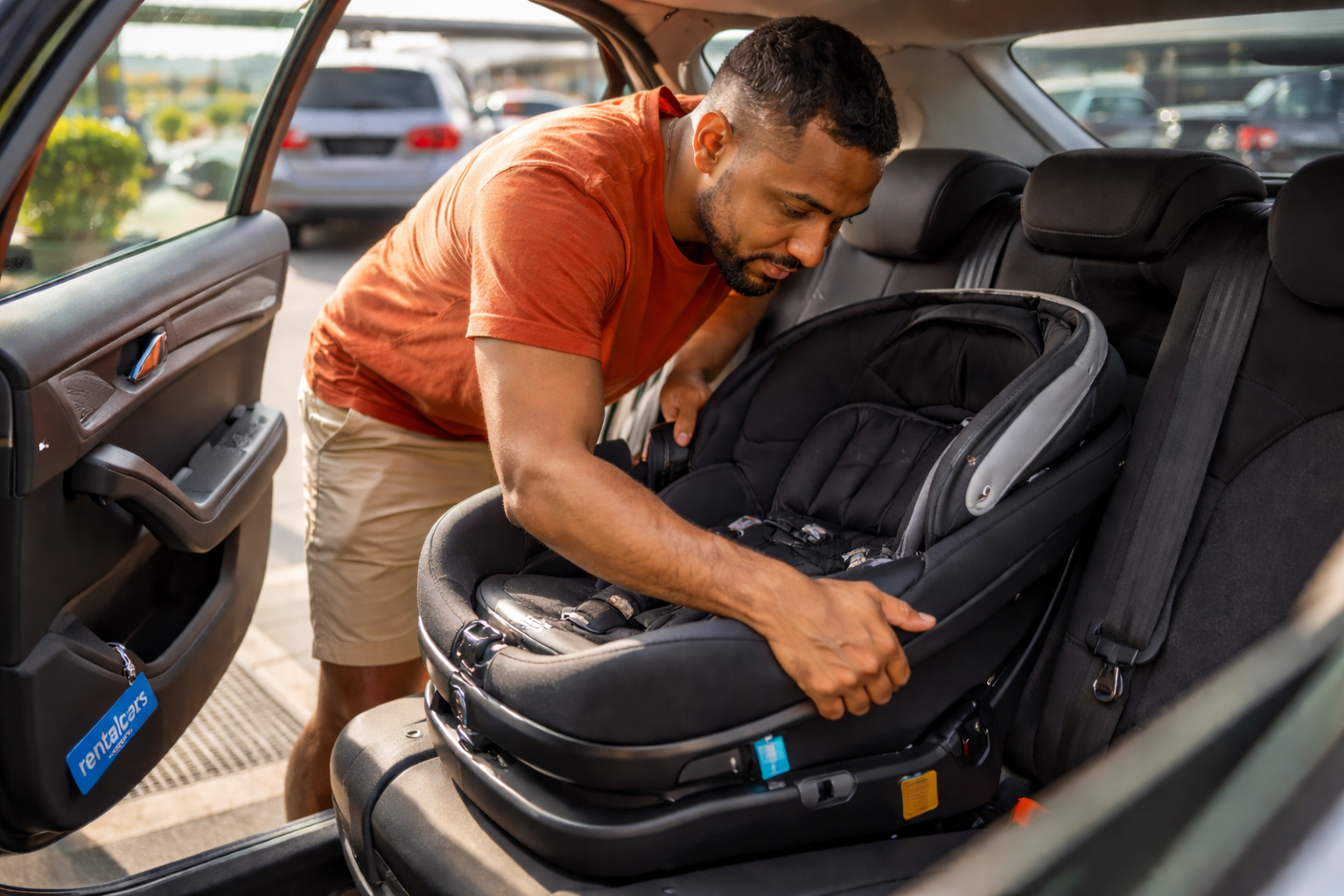
The Basics: What European Law Requires
Every European country requires children to travel in an appropriate child restraint — a car seat or booster appropriate for their age, height, and weight. The specific thresholds vary by country (see the table below), but the principle is universal: children cannot travel unrestrained, and they cannot sit in the front seat until they meet the national age or size requirement.
The good news for UK parents is that your car seat doesn't need to change when you cross a border. Any seat approved under ECE R44/04 or the newer UN R129 (i-Size) standard is legal throughout the EU. If your seat has an orange label (ECE R44/04) or a red label (UN R129), you're covered. If it's an older seat with neither, check the label before you travel.
The one thing that changes after Brexit is that you're now technically driving in a foreign country under a visitor's driving licence rather than within the EU's shared framework — but this makes no practical difference to car seat rules. Your UK seat is still valid, and the laws on child restraints are enforced just as they are at home.
Car Seat Laws by Country: The 6 Most Popular European Destinations
Here's a country-by-country breakdown of the rules most relevant to UK families. Laws are correct as of 2026, but always verify with the FCDO travel advice pages before you travel.
| Country | Rear-facing until | Front seat allowed? | Restraint required until | Watch out for | Fines |
|---|---|---|---|---|---|
| 🇫🇷 France | 15 months (i-Size recommendation) | Under 10s must sit in back (with exceptions) | Until 10 years or 135cm | Hi-vis jacket & warning triangle required in car | Up to €135 |
| 🇪🇸 Spain | 15 months (i-Size recommendation) | Under-12s cannot sit in the front | Until 135cm | Active enforcement, especially on motorways | Up to €200 |
| 🇮🇹 Italy | 15 months (i-Size recommendation) | Not until 150cm | Until 150cm | Anti-abandonment alarm legally required for under 4s | From €83 (alarm) / up to €326 (restraint violation) |
| 🇵🇹 Portugal | 15 months (i-Size recommendation) | Under 12 and under 135cm must sit in back | Until 12 years or 135cm | Rules enforced, especially at toll checkpoints | Up to €300 |
| 🇬🇷 Greece | 15 months (i-Size recommendation) | Under 12 cannot sit in front | Until 135cm or age 12 | Rules less consistently enforced but still the law | Up to €350 |
| 🇭🇷 Croatia | 15 months (i-Size recommendation) | Not until 150cm | Until 150cm | Active policing on coastal roads in summer | Up to approx. €130 |
A few things apply across all six countries: children should always travel in the rear of the vehicle where possible, rear-facing is the safest position for young children regardless of which country's rules you're following, and any seat must be correctly fitted every single time. A correctly fitted forward-facing seat is safer than a poorly fitted rear-facing one.
Italy's Anti-Abandonment Alarm Rule
Italy introduced a legal requirement in 2019 that catches a surprising number of UK tourists: any car seat carrying a child under 4 must be fitted with an electronic anti-abandonment alarm device. The device alerts the driver — via noise, vibration, or a phone notification — if they leave the vehicle with the child still strapped in. It was introduced following a series of tragedies where children were left in hot cars by accident.
Some modern car seats have this feature built in. If yours doesn't, you need a separate device — they're available on Amazon for around £20–£30 and attach to most seats. You can also hire one from some car rental companies in Italy, but availability is patchy, so buying your own before you travel is the safer option. Fines for non-compliance start at €83 for a first offence and can rise to over €300 with licence points in some cases.
If you're driving in Italy with a baby or toddler under 4, this is a non-negotiable. Check whether your seat has the feature built in before you travel.
⚠️ Pro Tip: Check Your Seat Before You Book
If you're driving in multiple countries on the same trip — say, France and Italy — check the specific rules for each country before you go, not just the one you'll spend the most time in. Italy's alarm rule applies the moment you cross the border, not just when you're booking the car.
Bringing Your Own Car Seat vs Renting One
📋 Free Baby Holiday Packing Checklist
Enter your email and we'll send the free printable checklist straight to your inbox — every category, ready to tick off before every trip.
This is the question most parents wrestle with when booking a European driving holiday. The honest answer: for babies under 12 months, we'd strongly recommend bringing your own. For older toddlers in forward-facing seats, renting becomes a more reasonable option.
| Factor | Bring Your Own | Rent Locally |
|---|---|---|
| Safety | ✅ Known history, no crashes, correctly fitted to your child | ⚠️ Unknown age and condition; may have hidden damage |
| Fit for your child | ✅ You know it fits correctly | ⚠️ Group/size may not match your child's weight or height |
| Convenience | ⚠️ Heavy to transport; takes up luggage allowance | ✅ No airport faff; collected at the hire desk |
| Cost | ✅ Free (most airlines carry it free) | ⚠️ Typically €5–€15/day; can add up on longer trips |
| Cleanliness | ✅ Your own, as clean as you keep it | ⚠️ Condition varies widely; can arrive dirty or smelling |
| Peace of mind | ✅ No uncertainty | ⚠️ You won't know the brand or model until you collect it |
| Italy alarm rule | ✅ You can prepare in advance (check or add a device) | ⚠️ Rental seats may or may not have the device fitted |
If you do decide to rent, add the car seat at the time of booking online rather than at the desk on arrival — availability isn't guaranteed. When you collect the seat, check the approval label (it should show ECE R44/04 or UN R129), inspect it for visible damage, and photograph it before fitting. That photograph protects you if the hire company tries to charge you for pre-existing damage on return.
For younger babies, the stakes are higher. Infant seats (Group 0+) and extended rear-facing seats (Group 0+/1 or i-Size) require much more precise fitting than forward-facing seats, and the difference between a seat that's correctly positioned and one that isn't matters enormously in a crash. If you're travelling with a baby under 12 months, bring your own seat. The logistics are manageable — see the transport section below.
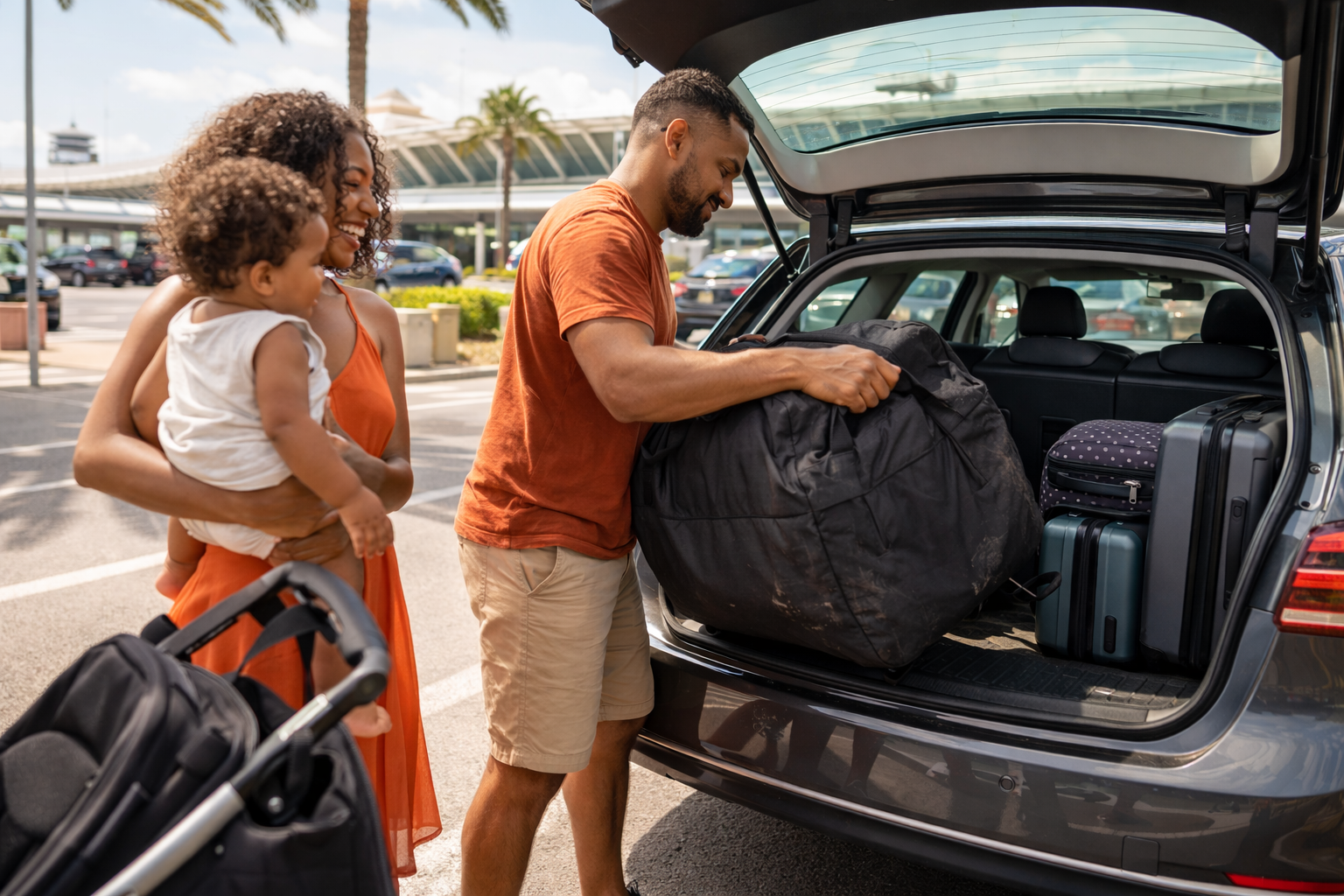
How to Transport Your Car Seat to Europe
Most airlines carry car seats free of charge as essential baby equipment — they don't count against your standard baggage allowance. This applies whether you're gate-checking, checking into the hold, or carrying it through the cabin (though very few seats fit in the overhead locker). Always check your specific airline's policy, but easyJet, Ryanair, British Airways, Jet2 and TUI all permit a car seat as a free extra item.
For full detail on travelling with a car seat by air, including how to gate-check safely and what to do if it arrives damaged, see our dedicated car seat on a plane guide.
Use a Padded Car Seat Travel Bag
Infant seats are often more durable than they look, but they can still arrive in the hold with scratched shells, cracked buckles, or bent adjusters. A padded car seat travel bag protects the seat — and crucially, it protects the harness and buckle mechanism that matters most. It also makes the seat much easier to wheel through the airport rather than lugging it by hand.
Budget around £30–£60 for a decent padded bag with wheels and a shoulder strap. Many bags are universal-fit and will take Group 0+, Group 1, and most infant seat shapes. If you're travelling frequently, it's a worthwhile investment — a good bag pays for itself the first time it saves you from a cracked seat base. Check our baby holiday packing list for other travel gear worth having.
Gate-Checking vs Checking Into the Hold
Gate-checking means you keep the seat with you until the aircraft door and hand it over there. It's convenient — your baby uses the seat right up until boarding — but gate-checked items go through belt loaders and sit loose in the hold. Checking into the hold at check-in means it's logged as a baggage item and handled more consistently. For a valuable or delicate seat, checking into the hold with a protective bag is the better option.
If you gate-check, make sure the seat is in a bag or at minimum wrapped in a muslin or blanket before you hand it over. Note the gate tag number on your phone. And be at the aircraft door early enough to hand it over calmly — not in a rush with a wriggling baby on your hip.
Fitting a UK Car Seat in a European Hire Car
ISOFIX has been mandatory on new cars sold in Europe since 2014, so most hire cars produced in the last decade will have ISOFIX anchor points in the rear seats. That said, "most" is not "all," and the location, orientation, and depth of the anchor points can vary between car models, which matters if you use an ISOFIX base rather than seatbelt-only fitting.
The safest approach: when you book your hire car online, note the car model (or category) and call the rental company before travel to confirm the specific car and ISOFIX points. It takes ten minutes and can save a very stressful moment in a foreign airport car park. Most rental company staff are used to this request from parents.
If ISOFIX fitting turns out to be awkward in the car you're given, the seatbelt method is a perfectly valid and equally legal alternative. Every approved car seat can be fitted using the vehicle's seatbelt as a fallback. It takes slightly longer to fit correctly — consult the seat's instruction manual — but it works reliably across any car. This is worth knowing in advance so you're not trying to read the instructions for the first time in a car park with a tired baby beside you.
Our Tip: Practice the Seatbelt Fit Before You Go
Even if you use ISOFIX every day at home, spend five minutes the week before your trip fitting the seat via seatbelt in your own car. You'll be glad you did when you're standing in a hot Spanish car park at 11am with a toddler who's been awake since 4am.
Renting a Car Seat in Europe: What to Expect
If you've decided to rent, here's what the process actually looks like. You add the car seat at the time of booking (always do this online — don't rely on availability at the desk). At collection, you'll be given a seat from whatever stock the rental company has — you're typically told the group category, but not the brand or model.
Common rental seat groups: Group 0+ or Group 0+/1 for babies (rear-facing), Group 1 for toddlers (15 months–4 years roughly), and Group 2/3 for older children. Rental seats are generally cleaned between uses, but the quality varies significantly between rental companies and locations. Budget car hire companies at busy holiday airports tend to have the most variable stock.
When you collect the seat: check the approval label, check the harness for fraying or stiffness, check the buckle clicks and releases smoothly, and photograph the whole seat including any marks or scratches. Rental staff may not offer this information proactively — you need to ask. If you have concerns about the condition of the seat you're given, ask for a different one. They usually have more than one.
Daily rental costs are typically €5–€10 for Group 1+ seats and up to €15 for infant carriers. On a two-week holiday that adds £130–£200 — which puts the cost of a decent budget forward-facing seat in perspective. For families who travel regularly, owning a dedicated lightweight travel seat is worth considering. Some parents buy a less expensive seat specifically for travel, rather than risk damage to their main seat in transit.
Country-Specific Tips Worth Knowing
France
France requires you to carry a hi-vis jacket and a warning triangle in the car at all times — these are often provided by hire companies, but check when you collect the car. If you're driving your own car to France via ferry or Eurotunnel, buy them before you cross. They're available at most UK motorway services and cost around £5–£10 for a combined pack.
Spain
Spanish motorway police are active and do check car seats — particularly on the AP-7 coastal route in summer. Enforcement is genuine. Rear-facing is strongly embedded in Spanish road safety culture; you'll see it commonly in Spanish hire cars and at petrol stations with families. The under-135cm rule applies regardless of age, so a tall 9-year-old still needs a booster.
Greece
Enforcement of car seat rules in Greece is less consistent than in France or Spain — particularly on smaller islands and rural roads — but the laws are still on the books. Don't take the risk, and particularly don't assume that because you see locals not using them it's acceptable. As a foreign driver, you're more likely to be stopped, not less.
Croatia
Croatia has significantly increased road policing along its busy coastal routes in recent years, particularly during peak summer. Fines are issued on the spot in local currency (kuna/euro), and disputed fines create a significant amount of holiday stress. Get the seat fitted correctly before you leave the airport and it's one less thing to worry about.
✈️ Free Baby Hand Luggage Checklist
Never forget the essentials. Enter your email and we'll send the free checklist straight to your inbox — one page, every category, ready before every flight.
FAQ: Car Seats in Europe
Is my UK car seat legal in Europe?
Yes. Any seat approved under ECE R44/04 or UN R129 (i-Size) is accepted across all EU member states and most European countries outside the EU. Check the label on the underside of your seat — an orange label (R44) or red label (R129) confirms approval. If your seat has neither, it may be too old to be legal.
Do I need to bring a car seat on a European package holiday?
It depends on whether you're planning to drive. If you're flying to a hotel and not hiring a car, you don't need one. If you're hiring a car at any point — including airport transfers — you'll need a car seat for your baby or child. Transfer companies can sometimes supply them, but quality is variable; bringing your own or confirming the specification in advance is safer.
What is the Italy anti-abandonment alarm rule?
Since 2019, Italian law requires any car seat used by a child under 4 to include an electronic alarm that alerts the driver if they leave the car with the child still strapped in. Some modern seats have this built in; if yours doesn't, you need a separate device (around £20–£30 on Amazon). Fines start at €83. It applies to hire cars and your own vehicle equally.
Can I gate-check a car seat for free?
Yes, on most major airlines. Car seats are treated as essential baby equipment and carried free in addition to your standard baggage allowance. This applies to easyJet, Ryanair, British Airways, TUI, Jet2, and most other carriers. Always confirm with your specific airline before travel. See our car seat on a plane guide for full airline-by-airline detail.
What if I'm driving through multiple countries?
Your UK car seat remains valid in all of them. The rules you need to follow are those of whichever country you're driving through at the time — so if you're driving from France into Italy, the Italian alarm rule kicks in the moment you cross the border. Research each country's specific rules before you travel rather than assuming they're identical.
Is it safe to use a hire car's ISOFIX with my own base?
Generally yes, provided the ISOFIX points are compatible with your base. Compatibility isn't universal — some older or non-standard cars have ISOFIX points in positions that don't work with every base. Check your base's instruction manual for compatible car list, and call the rental company before travel to confirm the car model so you can check in advance. Seatbelt-only fitting is always a valid alternative.
How much does it cost to rent a car seat in Europe?
Typically €5–€15 per day depending on the rental company and seat group. Some budget companies include one seat free with family bookings. For a two-week holiday, rental costs can reach £100–£200. You don't know the brand, model, or condition until you collect it, which is why bringing your own is generally preferable for younger children.
What should I do if the rented car seat doesn't fit my child?
Ask the rental company for an alternative immediately — before you leave the car park. Rental desks are staffed specifically to handle requests like this. If no suitable seat is available and you cannot safely travel, document the situation and contact your travel insurer. Do not drive with a child in a seat that doesn't correctly fit them. For peace of mind on future trips, this is exactly why bringing your own seat is the stronger option.
Planning a European road trip with your baby? Our baby-friendly European holidays guide covers the best destinations, and our baby holiday packing list will make sure you've got everything else covered too. For flight prep, our first flight with a baby guide is a good place to start.