
How to Gate-Check a Stroller Safely (and What to Do If It Comes Back Damaged)
By BabyTravel UK Editorial Team · Last updated March 2026
Gate-checking your stroller is standard practice — and the process is straightforward once you know what to expect. Taking five minutes of preparation before you reach the gate can be the difference between a stroller that arrives intact and one that needs a warranty claim.
Gate-checking is when you fold your stroller at the aircraft door, hand it to ground staff, and it travels in the hold beneath you rather than in the cabin. It's free on almost all airlines, it's how most families handle strollers on flights, and it works well the vast majority of the time. The problem is the minority of times when it doesn't — wheels cracked, frames bent, fabric torn. Strollers go through belt loaders, get stacked under other luggage, and sit in holds that may be wet. They're not handled gently.
This guide covers the full process — from check-in to collection — plus what to do if things go wrong. If you're still deciding whether to gate-check or check your stroller into the hold, our packing a stroller for air travel guide covers that decision in full. For airline-specific stroller policies, see our taking a stroller on a plane guide.
Quick Answer: Gate-Checking a Stroller
- 1. Where you hand it over: At the aircraft door (the jetway), not at check-in. You use the stroller until you board.
- 2. Key prep: Fold it and lock the fold, remove all accessories, use a travel bag if you have one.
- 3. Collection: Most airlines return it at the aircraft door on arrival. Some return it at the oversized baggage belt — ask when you hand it over.
- 4. If it's damaged: Report it immediately at the airline desk before leaving the baggage area. Photograph everything. Keep your gate-check tag.
- 5. While it's in the hold: Use a baby carrier. This is the practical answer to the gap between gate and seat.
What Gate-Checking Actually Means: Step by Step
The process varies slightly by airline and airport, but the broad sequence is consistent.
At Check-In
Tell the check-in agent you'll be gate-checking your stroller. They'll note it on your booking and may give you a gate-check tag at this point, or direct you to collect one at the gate. You don't hand the stroller over here — you keep it with you through the airport.
Through Security
You go through security as normal. Fold the stroller for the X-ray belt, put it back together on the other side, and continue to your gate. Baby carriers go through security on your body — you don't need to remove them in most UK airports, though some staff will ask you to unfold the carrier so they can check it. Our first flight guide covers the airport security process in full.
At the Gate
If you haven't already received a gate-check tag, the gate agent will give you one here. Attach it securely to the stroller frame — not to the handle, where it can fall off, but looped through the frame. Write your flight number and seat on the tag if there's space. This is also your last chance to remove any accessories you haven't already taken off.
At the Aircraft Door
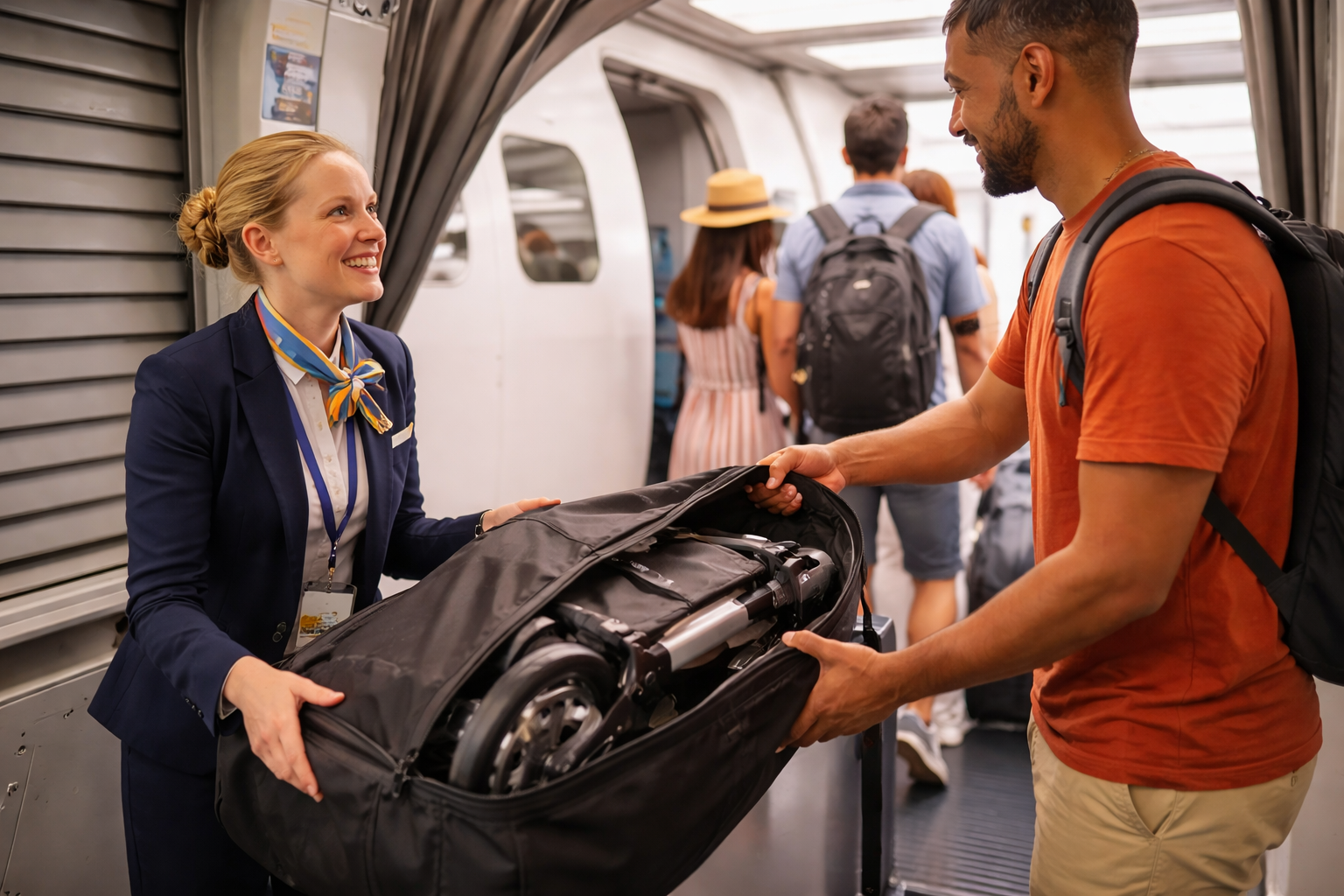
You'll be asked to fold the stroller at the aircraft door (the jetway — the enclosed bridge connecting gate to aircraft). A ground crew member will take it from you. This is when it leaves your hands. From here it goes down to the tarmac via a belt loader and into the aircraft hold. It will not be carried carefully — it will be moved quickly alongside other gate-checked items and hold luggage.
On Arrival
Most airlines return gate-checked strollers at the aircraft door on arrival — you walk off the plane and it's waiting for you in the jetway. Some airlines (particularly at smaller airports, or on services where the aircraft parks remotely) return it at the oversized baggage belt in arrivals. Always ask when you hand it over so you know where to wait, and tell any cabin crew who's in earshot. Arriving parents who don't know to ask often wait at the aircraft door while their stroller is going round the baggage belt.
The Damage Reality
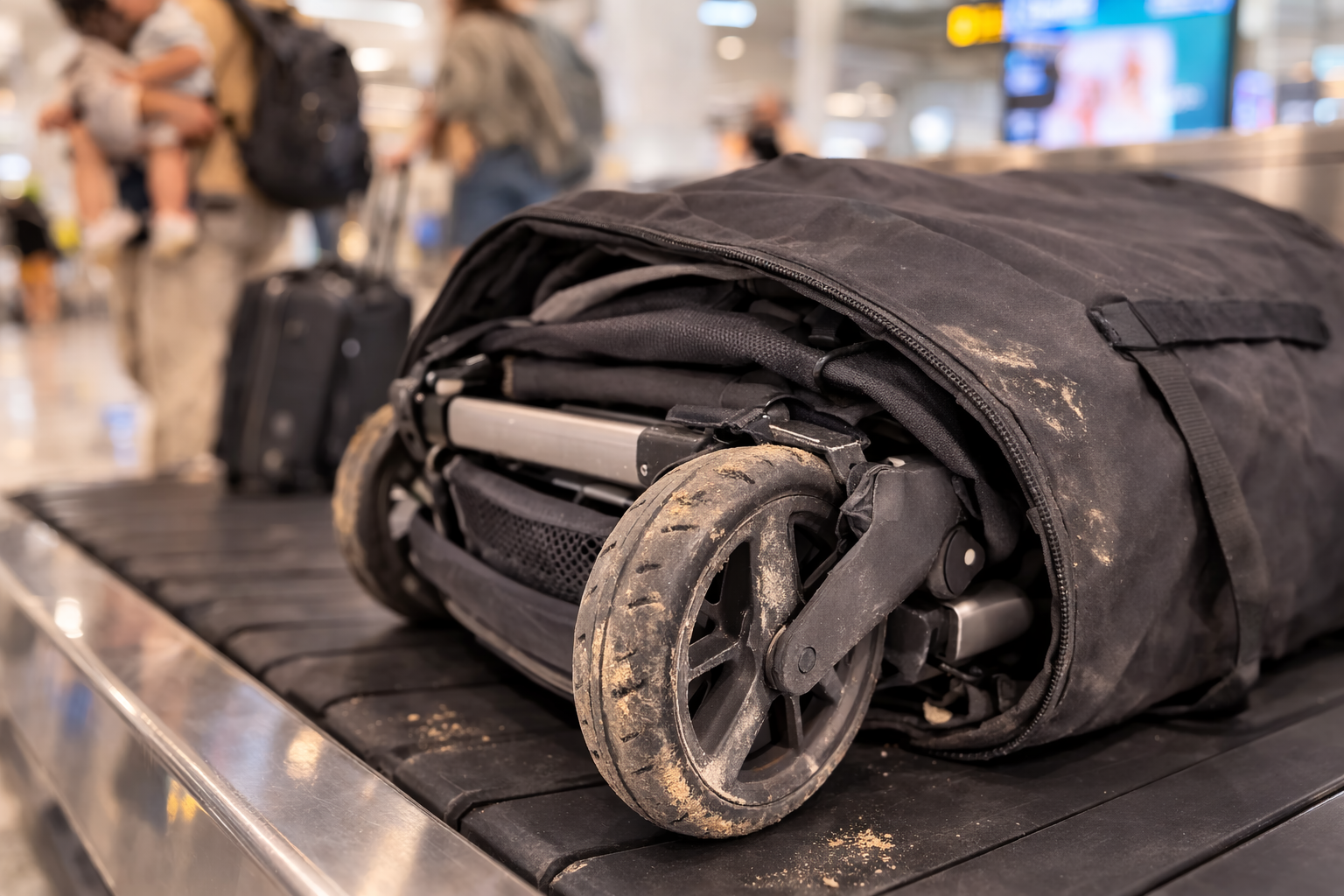
Gate-checked strollers do get damaged. Not every time — most trips go without incident — but often enough that precautions are genuinely worthwhile. The most common damage types are:
- Cracked or broken wheels — the most common. Wheels take the impact of being placed down hard on tarmac or onto belt loaders.
- Bent frames — particularly on lightweight aluminium-framed strollers where something heavy has been stacked on top.
- Torn or damaged fabric — seat fabric or canopy material can snag on equipment or other luggage.
- Lost or broken accessories — cup holders, phone holders, rain covers left attached are frequently lost or snapped off.
- Weather damage — holds are not always fully weatherproof. Strollers can arrive damp or wet, which damages fabrics and can affect folding mechanisms over time.
None of this is meant to discourage gate-checking — it remains the right choice for the vast majority of families. It's meant to motivate five minutes of preparation before you reach the gate.
Important
Never drape a muslin, blanket, or loose item over a folded stroller when gate-checking it. Loose items get caught in machinery and are frequently lost. Remove everything that isn't attached to the frame.
How to Protect Your Stroller
📋 Free Baby Holiday Packing Checklist
Enter your email and we'll send the free printable checklist straight to your inbox — every category, ready to tick off before every trip.
None of these steps guarantee damage-free arrival, but together they significantly reduce the risk.
Fold It and Lock the Fold
Make sure the fold mechanism is properly engaged and locked before handing over. A stroller that comes partially unfolded in the hold is at high risk of frame damage. If your stroller has a fold lock clip or latch, use it. If it self-stands when folded, that's actually helpful — it's less likely to topple.
Remove All Detachable Accessories
Cup holders, phone mounts, pram organisers, toy bars, buggy boards, car seat adapters, footmuffs — take them all off and pack them in your carry-on or check-in luggage. Rain covers are the most commonly forgotten item; remove and bag them. Anything that can come loose, will come loose in the hold.
Tuck the Wheels Inward
If your stroller folds with the wheels tucking inward (as many compact travel strollers do), make sure they're fully folded in rather than protruding. Protruding wheels are the single most vulnerable point during handling.
Use a Stroller Travel Bag
A purpose-made gate-check bag adds a layer of protection against scratches, snags, and weather. Padded bags provide meaningful protection against impact; unpadded bags protect against surface damage only. Whether it's worth investing in one depends on the value of your stroller — for a premium stroller (Bugaboo, Joolz, UPPAbaby), a padded bag is worthwhile. For a budget stroller, an unpadded bag is still better than nothing. We cover the best options below.
Stroller Travel Bags: Which to Choose
| Bag | Padded? | Wheeled? | Fits double? | Approx price | Best for |
|---|---|---|---|---|---|
| Bramble XL Stroller Bag | ✅ Padded | ❌ | ✅ XL fits most | ~£45–£55 | Premium single strollers |
| J.L. Childress Gate Check Bag | ❌ Unpadded | ❌ | ❌ Singles only | ~£20–£30 | Budget strollers, occasional use |
| Gate Check PRO XL | ✅ Padded | ✅ Wheels | ✅ Double size | ~£60–£75 | Double buggies, frequent flyers |
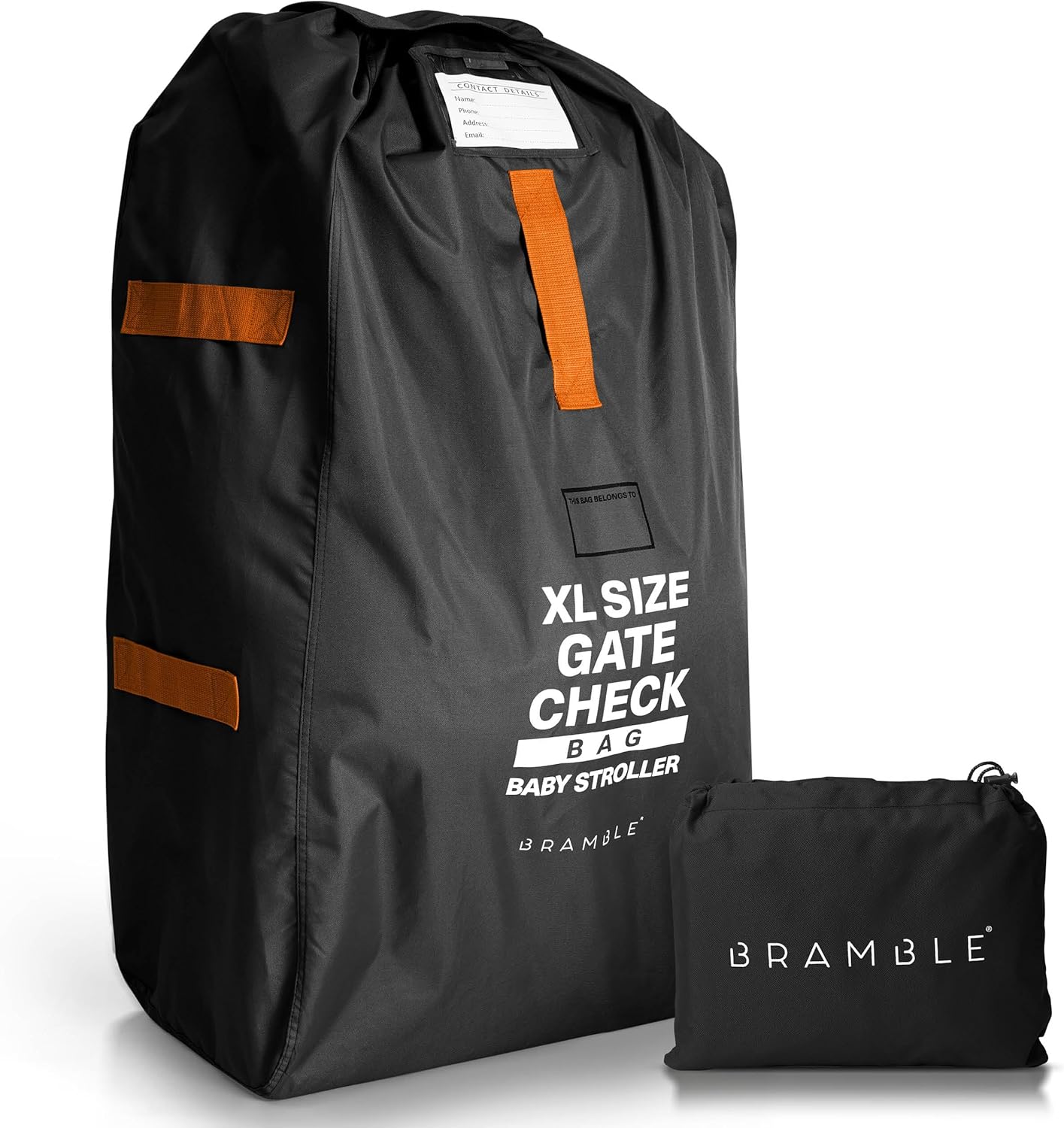
Bramble XL Stroller Bag — Our Top Pick
The best all-round gate-check bag for single travel strollers. The padded construction provides meaningful impact protection beyond basic surface coverage, it has a wide zip opening that makes packing a folded stroller straightforward, and the reinforced handles are robust enough for the bag itself to be carried through the airport if needed. Fits most compact and mid-size single strollers including the Bugaboo Butterfly, Joolz Aer+, and Silver Cross Clic.
✅ Pros
- Padded — actual impact protection
- Wide zip opening, easy to load
- Fits most compact single strollers
- Robust handles for airport carrying
❌ Cons
- No wheels — carry only
- Adds bulk to pack through the airport
- Pricier than basic unpadded options

J.L. Childress Gate Check Bag — Budget Pick
The lightweight, compact option. It's unpadded, so this is surface protection rather than impact protection — but it's better than nothing and considerably better than handing over a bare stroller. Folds down small enough to pack in your check-in luggage when not in use, which is useful if you only need it for the outbound flight and plan to check the stroller on the return. Good for budget strollers where impact protection matters less.
✅ Pros
- Very affordable
- Packs down small when not needed
- Provides surface and weather protection
❌ Cons
- No padding — no impact protection
- Fits singles only, not all sizes
- Less robust for frequent use
The Full Pre-Flight Gate-Check Checklist
| Step | What to do | When |
|---|---|---|
| ☐ Remove accessories | Cup holders, phone mounts, organisers, toy bars, footmuffs, rain cover | Before leaving home |
| ☐ Photograph your stroller | Take clear photos of the frame, wheels, and fabric from multiple angles | Before leaving home |
| ☐ Pack your travel bag | If using a gate-check bag, have it accessible in your hand luggage | Before leaving home |
| ☐ Tell check-in | Inform the check-in agent you're gate-checking the stroller | At check-in desk |
| ☐ Collect gate-check tag | Get the tag at check-in or the gate — attach to the frame, not the handle | At check-in or gate |
| ☐ Fold and lock | Fold the stroller fully and engage any fold lock mechanism | At aircraft door |
| ☐ Place in travel bag | Load into gate-check bag and zip closed at the aircraft door | At aircraft door |
| ☐ Ask where to collect | "Will the stroller be at the aircraft door on arrival or at oversized baggage?" | When handing over |
| ☐ Have carrier ready | Baby carrier accessible in your bag before reaching the aircraft door | Before boarding |
What to Use at the Airport After Gate-Checking
Once you hand over the stroller at the aircraft door, you're without it until arrival — and arrival means walking from the aircraft, through the terminal, collecting bags, and getting to ground transport. That's often 30–60 minutes of carrying or wrangling your baby without a stroller.
A baby carrier is the practical answer. With your baby in the carrier on your chest or back, both hands are free for boarding passes, overhead lockers, bags, and moving efficiently through the aircraft. Most babies settle quickly in a carrier, and for young babies it often means they sleep through the whole boarding-to-cruising altitude period.
Get the carrier out of your bag before you reach the aircraft door — fumbling with a carrier in the jetway with a queue of passengers behind you is stressful and unnecessary. Our carrier for airport travel guide covers the best options specifically for flying — including which carriers get through security most easily and which are comfortable enough for a long haul transfer. See also our baby carriers and slings for travel hub for the full range.
Pro Tip
Bring the carrier out and put your baby into it while you still have a few minutes at the gate — before the boarding queue starts. Trying to fit a carrier with a baby in your arms while passengers push past you in a narrow jetway is one of the more memorable parenting low points. Do it while seated and calm.
If Your Stroller Arrives Damaged
This is where most parents make an expensive mistake: they collect a damaged stroller and leave the airport before reporting it. Once you leave, your claim becomes significantly harder to pursue. Here's the correct sequence:
Step 1: Report It Before You Leave the Baggage Area
If you collect your stroller and it's damaged, go immediately to the airline's baggage services desk — this is usually inside the baggage hall, before passport control, or in arrivals. Tell them the stroller was gate-checked and has arrived damaged. They will complete a Property Irregularity Report (PIR). Get a copy of this document — it's your record of the report and you'll need it for the claim.
Step 2: Photograph Everything
Take clear, timestamped photos of the damage from multiple angles on your phone before leaving the baggage hall. If you photographed the stroller before flying (as recommended in the checklist above), you have a before-and-after record. These photos are your evidence.
Step 3: Keep Your Gate-Check Tag
The gate-check tag attached to your stroller when you handed it over is proof that it was gate-checked. Keep it with your boarding passes and travel documents.
Step 4: Know Your Rights — The Montreal Convention
Airlines are liable for damage to checked items (including gate-checked items) under the Montreal Convention, an international treaty that governs airline liability for baggage. The maximum compensation for baggage damage is approximately 1,288 Special Drawing Rights (roughly £1,300–£1,400 at current rates). File a written claim with the airline within 7 days of the damage occurring. Initial claims are frequently rejected — escalate in writing and reference the Montreal Convention by name.
Step 5: Escalate If Rejected
If your claim is denied, you can escalate through the airline's formal complaints process, and if that fails, through the relevant Alternative Dispute Resolution (ADR) scheme. UK airlines are required to be a member of an ADR scheme. The Civil Aviation Authority (CAA) website has guidance on how to pursue this.
Which Airlines Handle Strollers Best?
Based on parent experience and handling reputation, there's a meaningful difference between carriers. This isn't a scientific ranking, and individual experiences vary — but these patterns are consistent enough to be worth knowing.
Generally Regarded Well
Emirates — family-focused ground handling, dedicated staff for families at many major airports, good track record for returning strollers intact and at the aircraft door. TUI — holiday-specialist carrier with family-oriented ground operations; stroller handling is generally careful. British Airways — broadly good, with professional ground handling at most UK airports. Jet2 — consistently positive feedback from UK family travellers on baggage handling.
More Variable
easyJet — generally fine, though the speed of turnaround at busy airports occasionally results in rough handling. Ryanair — process is clear and the gate-check is free, but handling reputation is more mixed. Their turnaround times are extremely tight, which puts pressure on ground operations. Always use a bag with Ryanair. Vueling, Wizz Air, Transavia — variable depending on the specific airport and route.
The honest truth is that even well-regarded airlines have off days, and damage can happen on any carrier. The preparation advice in this guide applies regardless of which airline you're flying with. Our air travel with a baby hub covers the full picture of flying with young children.
✈️ Free Baby Hand Luggage Checklist
Never forget the essentials. Enter your email and we'll send the free checklist straight to your inbox — one page, every category, ready before every flight.
Frequently Asked Questions
Is gate-checking free on all airlines?
Yes — on virtually all UK and European airlines, prams and pushchairs are carried free of charge as essential baby equipment, whether gate-checked or hold-checked. This is separate from your hold luggage allowance. Always confirm with your specific airline before flying, as policies can change.
Can I gate-check a double stroller?
Most airlines accept double buggies for gate-checking, but the larger size and weight makes handling more difficult and damage risk higher. A padded travel bag (like the Gate Check PRO XL, which is sized for doubles) is worth using. Some families with double buggies prefer to check them into the hold as oversized luggage for better protection. See our double stroller on a plane guide for the specifics.
Will my stroller be at the aircraft door or the baggage belt?
This varies by airline and airport. Many airlines return gate-checked strollers at the aircraft door on arrival — you walk off the plane and it's waiting in the jetway. Others return them at the oversized baggage belt. Always ask the ground crew when you hand it over at boarding. If in doubt, ask a member of cabin crew once you're seated.
Should I gate-check or hold-check my stroller?
Gate-checking means you have the stroller until the aircraft door and get it back immediately on arrival. Hold-checking means it goes with your luggage at check-in, travels separately, and comes back at the baggage belt or oversized luggage collection. Gate-checking is more convenient but exposes the stroller to slightly rougher handling. Our full guide on this decision covers the trade-offs in detail.
What if my stroller is damaged but the airline won't compensate me?
Start by escalating in writing through the airline's formal complaints process, referencing the Montreal Convention by name. If that fails, use their ADR scheme. In the UK, most airlines are members of CEDR or AviationADR. The CAA website lists which scheme each airline belongs to. As a last resort, a small claims court action is possible for damage under £10,000 in England and Wales.
Do I need a travel bag for a budget stroller?
It's less critical — the financial risk of damage to a £150 stroller is lower than to a £700 one. That said, even an unpadded bag (like the J.L. Childress option) provides surface protection and keeps accessories contained. It costs around £20 and is reusable for future trips. For a single use, you can also ask at the gate — some airports have gate-check bags available on request.
Can I claim on travel insurance for a damaged stroller?
Possibly — check your policy for baggage and personal possessions cover. Some policies cover damage to buggies and prams; others exclude items over a certain value or require you to claim from the airline first. Read the policy before you travel, not after. If you do claim on insurance, you'll still need the PIR from the airline and your photos as evidence.
What happens to the stroller between the gate and the hold?
It goes on a belt loader — a mechanised conveyor belt system that feeds luggage up into the aircraft hold. Gate-checked items are typically loaded last and unloaded first, which limits their time in the hold but means they go through the belt loader system. Strollers are generally placed on their side and may have other items stacked on or beside them. This is why the fold lock and removal of protruding accessories matters.
The Verdict
Gate-checking works well when you're prepared. Five minutes at home — remove the accessories, take the photos, pack the bag — means the vast majority of trips go without incident. If something does go wrong, knowing your rights under the Montreal Convention and reporting it immediately in the baggage hall puts you in the strongest possible position. The carrier solves the gap at the gate. The rest is standard airport logistics.