
Is a Double Stroller Necessary for Travel? (UK Parent Advice)
By BabyTravel UK Editorial Team · Last updated September 2026
A double pushchair is bulky, heavy, and expensive. For some families with two young children it's genuinely essential. For others, a smarter combination works better. Here's how to figure out which camp you're in.
The question parents with two young children ask most often — usually while staring at a double stroller that takes up most of the car boot — is whether there's a lighter, easier option for holidays and travel. The honest answer is: sometimes yes, sometimes no. A double stroller for travel is genuinely the right call for some family setups, and completely unnecessary for others. The decision depends on the ages of your children, the type of trip, and how much you're willing to carry.
This guide isn't a product review. It's a decision-support article designed to help you work out which setup actually suits your situation, before you buy anything.
Quick Answer: Do You Need a Double Stroller for Travel?
- Twins or two under 18 months: Yes — a double is almost certainly necessary.
- Baby + toddler (2.5+ who walks well): Probably not — single stroller + carrier or buggy board is usually enough.
- Both children under 2: Likely yes, especially for longer walking days.
- Short trips, holiday parks, cottage with a car: You can often manage without — assess honestly.
- City breaks with a lot of walking: Depends on walking ability of the older child and your stamina for carrying.
The Honest Question: Need vs Want
Many parents buy a double stroller because the idea of managing two children without one feels overwhelming — not because a double is actually the most practical solution for their trips. A double pushchair adds weight, width, and bulk that genuinely complicates travel: it's harder to get through doorways, takes up more boot space, is heavier to lift into overhead luggage areas, and can make narrow pavements or cobbled streets actively difficult.
Before buying, it's worth asking: what specifically are the scenarios where I'd use this? If the honest answer is "long walking days where both children need to be contained and one or both might need to nap," that's a genuine double stroller use case. If it's "I'm worried the toddler won't walk," a buggy board might solve 80% of the problem at a fraction of the cost and weight.
When You Genuinely Do Need a Double
Two children under 2 years old. Neither child can reliably walk significant distances, and attempting to carry one while pushing the other for a full day out is exhausting at best. This is the core use case for a double stroller, and it's a real one. If your gap is under 18 months, plan for a double.
Twins. Non-negotiable. You need two seats from day one. The question for twins is which type of double suits your travel style, not whether you need one at all.
Both children need to nap simultaneously in the stroller. If your day hinges on a synchronised nap — as it does for many families with babies and young toddlers — a double gives you the only reliable way to achieve it on the go. A buggy board doesn't work for a sleeping toddler. A carrier can handle one napping child, but managing two napping children in different devices simultaneously is impractical.
Destinations with a lot of unavoidable walking. A city break with a 20-month-old and a newborn in July heat is a different proposition from a cottage holiday where you're 10 minutes from anywhere. If your itinerary involves long stretches of urban walking with no rest points, a double is the more honest choice.
When You Can Skip the Double
📋 Free Baby Holiday Packing Checklist
Enter your email and we'll send the free printable checklist straight to your inbox — every category, ready to tick off before every trip.
Toddler (2.5+) who walks well + a baby. A child who's nearly 3 can genuinely walk significant distances and handle a decent amount of a full day out on foot. Use the single stroller for the baby, let the toddler walk, and have a buggy board as backup for tired legs. Many families who buy a double for this scenario end up barely using it because the toddler refuses to sit in it anyway.
Short-distance trips. A holiday park, a cottage with a garden, a beach that's 100m from the car park — these don't require the same walking endurance as a city break. If you're not covering significant distances, the single stroller + carrier combo handles most situations well.
Two adults sharing carrying duties. With two adults, one can carry a baby in a carrier while the other pushes a toddler in a single stroller. This is the lightest, most flexible setup available. It only breaks down when you need to separate briefly, or when one adult needs both hands free.
Flying trips where you want the lightest possible setup. Getting a large double stroller through an airport, gate-checked, and then back again at the other end is possible but effortful. Some families deliberately choose to travel with a single + carrier on flights and only use their double at home.
The Five Options Compared
| Setup | Weight to Carry | Both Contained? | Nap-Capable? | Fits Doorways? | Best For |
|---|---|---|---|---|---|
| Side-by-side double | High (12–16kg) | ✅ Yes | ✅ Both seats | ⚠️ Often tight | Two babies; twins; flat destinations |
| Tandem / inline double | High (11–15kg) | ✅ Yes | ✅ Front seat often | ✅ Narrower fit | City use; tighter spaces; toddler + baby |
| Single + buggy board | Low (stroller + board) | ⚠️ Toddler can step off | ❌ Toddler can't sleep | ✅ Narrow | Toddler 2.5+ who rarely naps; short trips |
| Single + baby carrier | Low–Medium (carrier on you) | ✅ Yes | ✅ Baby naps in carrier | ✅ Narrow | Baby + walking toddler; city breaks; flying |
| Two carriers (no stroller) | Low (worn on bodies) | ✅ Yes (2 adults) | ✅ Both can nap | ✅ Excellent | Short trips; confident carriers; two adults |
Side-by-Side Double
Both children sit next to each other, facing forward. The advantages: equal comfort for both children, both seats are usually equivalent in quality, and you can see both children simultaneously. The disadvantage for travel is width — most side-by-side doubles are 75–80cm wide, which means standard shop doorways (typically 75cm clear opening) become a squeeze, and cafés, restaurants, and museum corridors often require folding. On pavements and in parks this is less of an issue. Good for flat, open destinations; more challenging in city centres and older buildings.
Tandem / Inline Double
One child sits in front of the other. Narrower than side-by-side (typically 60–65cm), which means it fits through standard doorways and handles city use better. The trade-off: the rear seat is often smaller, has a more limited recline, and the child at the back has a less interesting view. Older tandem strollers had a notably inferior rear seat; newer designs have improved this but the discrepancy remains. Worth considering if you're planning city breaks or destinations where narrow spaces are likely. Our full tandem stroller guide covers the best current options.
Single Stroller + Buggy Board
A board attached to the back of your single stroller gives a confident older child somewhere to ride when their legs are tired. Standing boards typically cost around £50–£90, while seated versions can reach around £150. They do not provide a reclining nap seat or the containment of a double, and the word “universal” does not guarantee a comfortable fit. Compare our best buggy boards for travel, then use the current fitting guide for your exact pushchair.
For a direct holiday decision using your children’s naps, age gap, airports and walking distance, see our buggy board versus double pushchair comparison.
Single Stroller + Baby Carrier
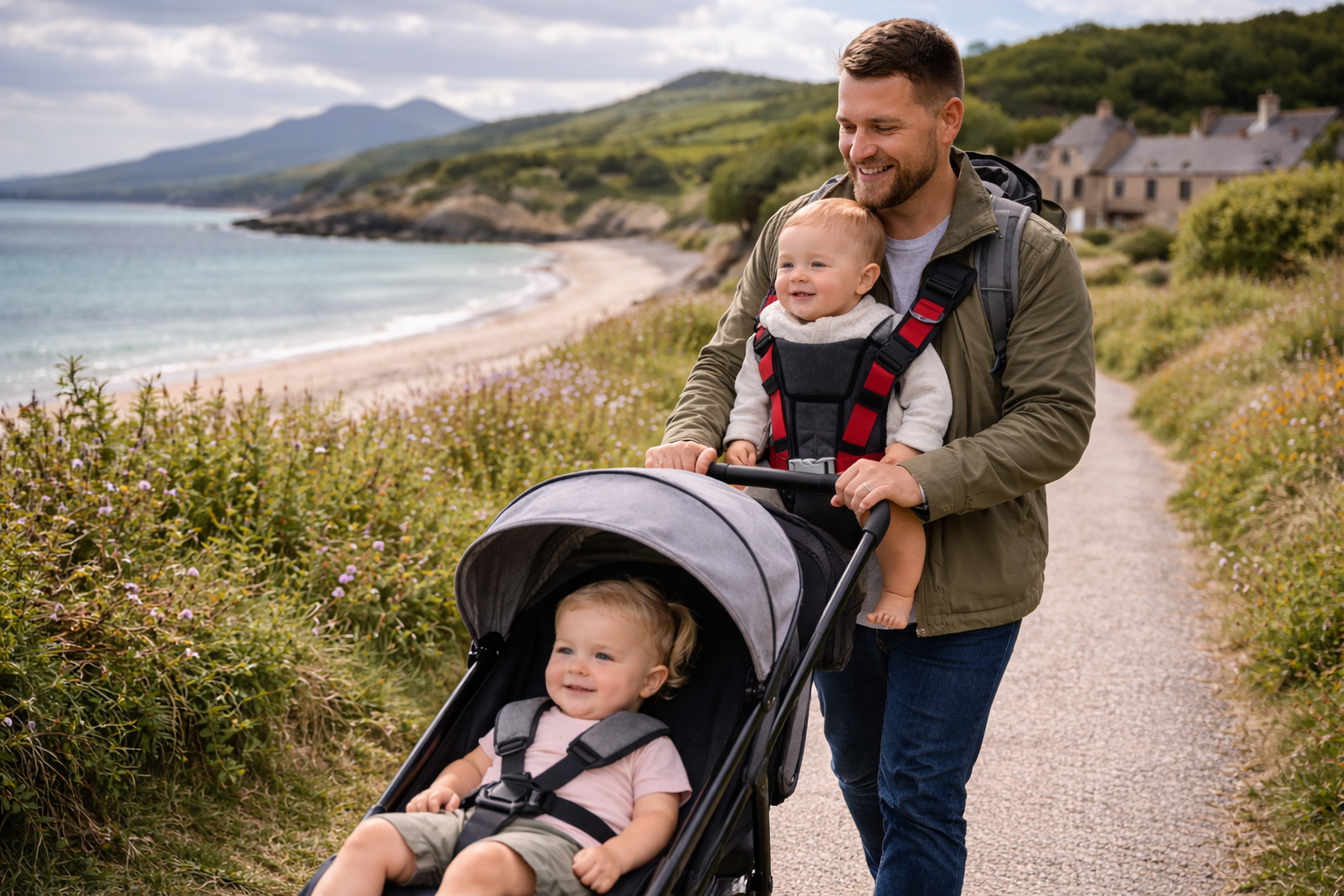
Baby in a carrier on your chest, toddler in the stroller. This is the lightest, most travel-practical setup available — your total pushable footprint is a single stroller, you're not managing extra width, and getting through airport security, into taxis, and onto buses is straightforward. The trade-offs: it's physically demanding over a long day (carrying a baby for 6+ hours is tiring), and it doesn't work if both children need to be contained simultaneously — if the toddler also wants to be carried, you're stuck. For parents with a baby under 8 months and a toddler who walks confidently, this is often the best travel solution available.
Two Carriers, No Stroller
The ultralight option. One adult wears a baby, the other wears a toddler (or vice versa). Works for short trips and confident babywearing parents. Realistically not suitable for a full day out — carrying a 12kg toddler for several hours is extremely tiring, and toddlers often have strong feelings about being carried when they want to run. Good for airport transit or a specific challenging environment (cobblestones, hills, crowded events), less realistic as a primary holiday solution.
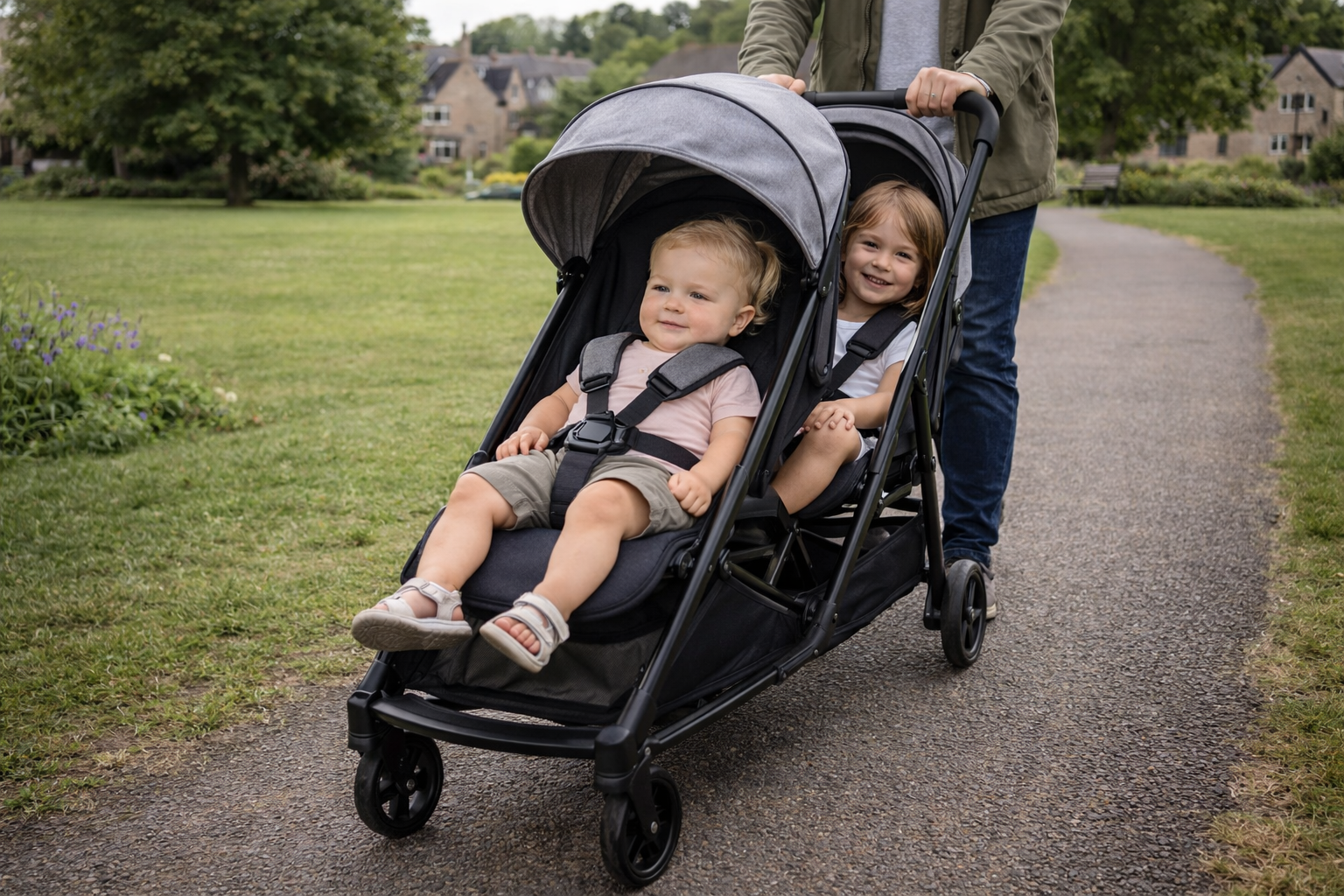
If You Do Choose a Double: Travel-Specific Recommendations
If a double stroller is genuinely the right call for your family, the travel context changes which type to prioritise. At home, a heavier, more comfortable double is manageable. For travel, compact fold and weight become far more important.
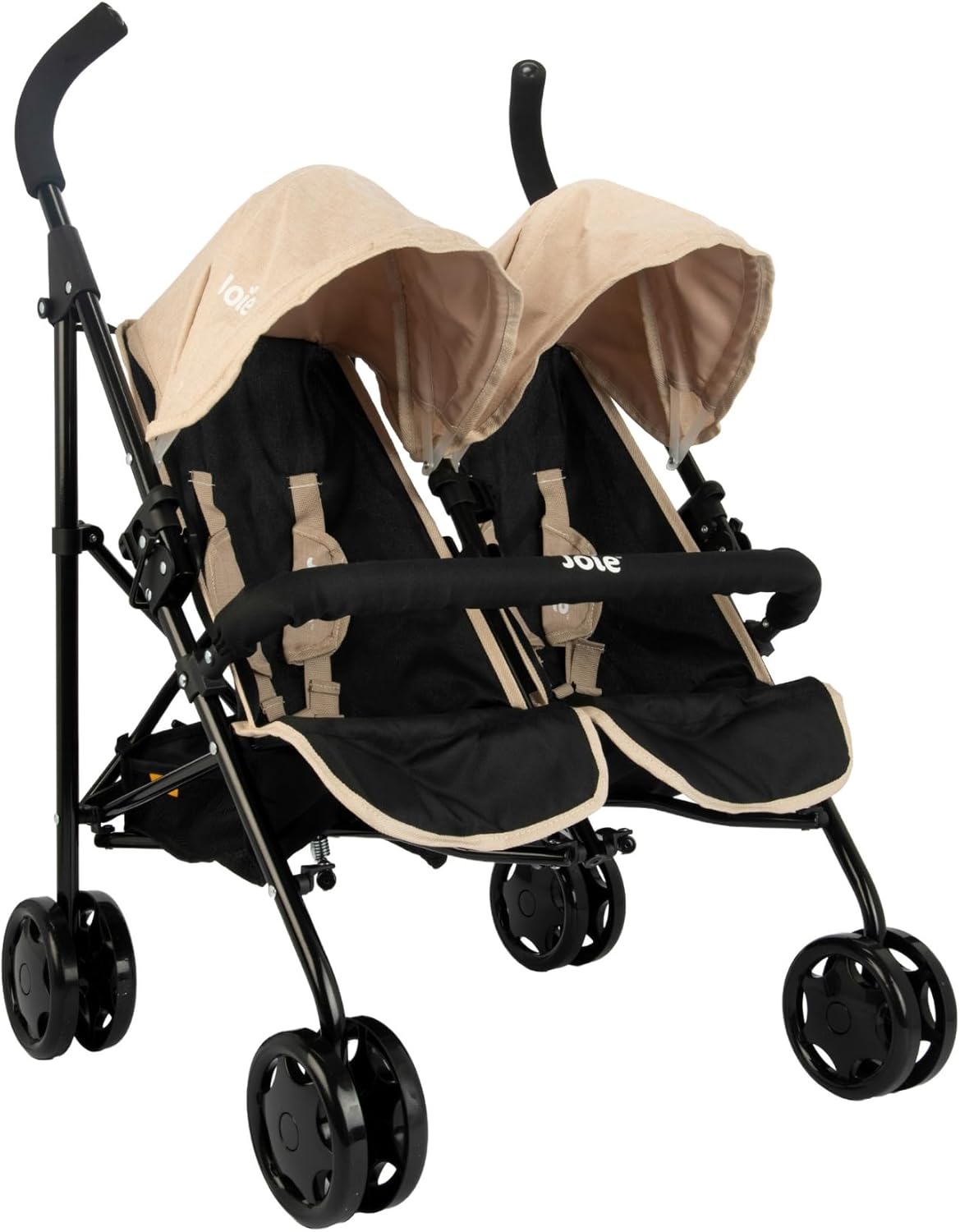
Joie Aire Twin (Best Value Travel Double)
Our take: For families who need a double stroller without the premium price tag, the Joie Aire Twin is a solid choice. Both seats recline independently, the fold is manageable, and it handles everyday travel use — holiday parks, flat destinations, beach promenades — without complaint. At around 11kg it's lighter than many side-by-side doubles. The honest caveat: at 78cm wide it will squeeze through some doorways and not others. Best for open, flat destinations rather than tight city centres.
Key specs: 11kg; both seats to 22kg; independent reclines; side-by-side; 78cm wide. | Price: around £350–£420.

Mountain Buggy Duet (Best Double for City Travel)
Our take: The Mountain Buggy Duet is the narrow side-by-side — just 63cm wide, which means it fits through a standard single doorway. This makes it genuinely useful for city breaks in a way that most side-by-side doubles are not. Both seats are equal (a meaningful advantage over tandems), both recline, and the build quality is excellent. It's more expensive at around £700–£800, but for families who need a double and want to use it in urban environments, the narrower width is genuinely worth it. See our full guide to compact double strollers for more options.
Key specs: 12.7kg; both seats to 25kg; 63cm wide; side-by-side with equal seats; compact fold. | Price: around £700–£800.
Air Travel With a Double Stroller
Most airlines allow you to gate-check a double stroller for free — it goes down with the hold baggage at the gate and comes back to the aircraft door at your destination. Weight and size limits for gate-check items are generally more generous than cabin baggage, but policies vary by airline. Check before you fly. Our guide to taking a double stroller on a plane covers the major UK airline policies in detail.
Getting a double through the airport itself is a different consideration. A 12–16kg double stroller is heavy to lift for security trays, awkward in lifts, and draws attention in narrow airport corridors. Some families with doubles check the double into the hold as oversized baggage and use a cheap lightweight single plus a carrier through the airport instead — collecting the double at baggage reclaim. This adds cost (typically £30–£50 for oversized hold baggage) but meaningfully reduces airport stress.
If you're gate-checking the double, bring a protective bag. A double stroller without a bag can take significant damage in the aircraft hold. Our guide to packing a stroller for air travel covers the bag options and what to do if it arrives damaged.
What to Look for if You Buy a Travel Double
If you've worked through the above and a double is the right call, these are the travel-specific factors to prioritise — different from what matters in a double you'd only use at home:
- Fold size and shape — does the folded stroller fit in your car boot alongside holiday luggage? Test this before buying. A double that doesn't fit in your boot with bags in is useless for travel.
- Weight — every kilogram matters when you're lifting it into a vehicle, carrying it up a flight of stairs, or manoeuvring through a gate. Under 12kg is the target for a travel-viable double; under 10kg is rare but worth seeking.
- Width — 63cm or below gets through standard single doorways. 75–80cm doesn't. Factor in where you're planning to take it.
- Independent reclines — different nap schedules are a reality with two young children. If both seats don't recline independently, one child being awake forces the other to sit upright.
- Airline gate-check dimensions — most airlines have no explicit size limit for gate-check items, but very bulky doubles can cause issues. Check your airline's policy if uncertain.
Decision Guide: Which Setup Is Right for You?
| Your Situation | Recommended Setup | Why |
|---|---|---|
| Twins (any age) | Double stroller | Two equal seats required from the start |
| Two children, both under 18 months | Double stroller | Neither walks reliably; both likely to need simultaneous naps |
| Baby + toddler (18–30 months), city break | Single + carrier | Lightest setup; toddler can walk significant stretches; carrier handles baby naps |
| Baby + toddler (18–30 months), long walking days | Double or single + board | Toddler will tire; depends on whether napping in stroller is still needed |
| Baby + toddler (2.5–3 years), holiday park / cottage | Single + buggy board | Short distances; toddler walks well; double is overkill |
| Flight with two young children | Single + carrier through airport, double at destination | Single is lighter through airport; double gate-checked for destination use |
| Baby + toddler, cobblestones or hilly destination | Two carriers | Neither stroller type handles stairs and cobbles well; carrier pair is most flexible |
Our Tip
Before buying a double, borrow one from a friend for a day trip and see how it actually feels to push it, fold it, and get it in and out of your car. Many parents find the reality of a double stroller — the width, the weight, the boot space it consumes — is different from their mental image of it. A trial run is worth far more than any amount of online research.
✈️ Free Baby Hand Luggage Checklist
Never forget the essentials. Enter your email and we'll send the free checklist straight to your inbox — one page, every category, ready before every flight.
Frequently Asked Questions
Do I need a double stroller if my children are 18 months apart?
At 18 months apart, your older child is probably 18–24 months when the baby arrives — still young enough to need a stroller regularly and unlikely to walk for long stretches. For this age gap, most parents find a double genuinely useful for the first year after the second child arrives. By the time the older child is 3, a single + buggy board setup often takes over for travel. The gap where the double earns its keep is roughly the first 12–18 months post-arrival of the second child.
Can a buggy board replace a double stroller for travel?
For a toddler who walks well and rarely naps in the stroller — yes, often. For a younger toddler who still naps, or one who frequently refuses to cooperate on a board, no. The buggy board is the right answer when your older child needs occasional rest support but doesn't need to be seated and contained for significant periods. Test it with your specific toddler before relying on it for a holiday.
What is the lightest double stroller available in the UK?
Side-by-side doubles rarely go below 10–11kg. The Joie Aire Twin (around 11kg) and the Joie Evalite Duo are among the lighter options at the accessible end of the market. If weight is the absolute priority, the tandem format generally saves a kilogram or two versus side-by-side. Our compact double stroller guide has the current lightweight rankings.
Can you take a double stroller on a plane?
Yes — most airlines allow a double stroller to be gate-checked free of charge. Check your specific airline's policy before travelling; size and folded dimensions matter for some carriers. Our dedicated guide on taking a double stroller on a plane covers all the major UK airline policies in one place.
Is a single stroller and carrier better than a double for city breaks?
For most city breaks, yes — assuming your older child walks reasonably well. The single + carrier setup is lighter, narrower, and far easier to navigate in urban environments. Cafés, museums, public transport, and tight doorways all become more manageable. The double wins when both children genuinely need to be seated and contained for long periods, which is more likely on longer walking days than in a city with frequent café stops and rest points.
At what age can a toddler use a buggy board?
Most buggy boards are suitable from around 18 months (when children can stand independently with reasonable balance) to around 4–5 years or 25kg. The practical limiting factor isn't age — it's whether the child will actually cooperate with standing on it. At 18–24 months, many toddlers need encouragement; by 2.5–3 years most manage it without drama.
Is it worth buying a travel-specific double stroller?
If you travel regularly with two young children, yes. A compact-fold, lighter double designed for travel is meaningfully easier to use than a full-size home double. The Mountain Buggy Duet's 63cm width and the Joie Aire Twin's relatively light weight are both examples of features that specifically help in travel contexts. Don't just bring your home double on holiday and assume it will work — check the folded dimensions against your car boot first.
How long will I need a double stroller?
For most families with a toddler and a baby, the intensive double stroller phase lasts roughly 18–24 months — from when the second child is born until the older child is consistently walking well and no longer needs stroller naps. After that, a single + board or single + carrier setup usually takes over for travel. For twins, the timeline extends — many twin families use a double until around age 4. Factor the likely duration into how much you want to spend.
The Bottom Line
Many families find a single stroller plus a good carrier handles most travel situations well — and discover this after buying a double they rarely used on holiday. Others genuinely need the double and are glad they have it. The difference comes down to your children's ages, how much they walk, whether simultaneous napping in a stroller matters to you, and the type of destinations you tend to visit. Be honest about your specific situation rather than buying the most comprehensive option by default, and you'll end up with a setup that actually makes travel easier rather than heavier.