
Sling vs Pushchair for Travel: When to Use Each (2026 Guide)
By BabyTravel UK Editorial Team · Last updated July 2026
Should you take a sling, a pushchair, or both? The answer depends on where you're going, how old your baby is, and whether you've ever tried pushing a stroller across cobblestones in the rain.
Every travelling parent eventually faces this question — usually while trying to fold a pushchair one-handed in an airport corridor. Should you have just brought the carrier? Or is the pushchair earning its place and you shouldn't second-guess yourself? The sling vs pushchair debate for travel is one of those decisions that feels more complicated than it is, once you understand what each option is actually good at.
The short answer is: take both if you possibly can. They complement each other rather than competing. But if you can only take one — or you're trying to work out which should be your primary travel tool — this guide breaks it down by scenario, destination, and baby age. We also cover what the pushchair websites don't always tell you: the physical reality of carrying a growing baby for extended periods, and how to choose a carrier that won't destroy your back by day three.
Sling vs Pushchair for Travel: Quick Guide
- Best answer: Take both — they solve different problems on the same trip
- Carrier wins: Cobblestones, beaches, hiking, crowded markets, airports (security), public transport
- Pushchair wins: Flat cities, nap management, hot weather, carrying luggage, long days out
- If you can only take one (0–4m): Carrier is usually sufficient — babies are light and sleep constantly
- If you can only take one (4–18m): Pushchair usually wins — nap management becomes critical
- If you can only take one (18m+): Pushchair primary, carrier as backup for specific terrain
When the Pushchair Wins
The pushchair has genuine advantages in specific travel scenarios that a carrier simply can't match. Understanding what it's actually good at helps you stop feeling guilty for packing it.
Flat city breaks
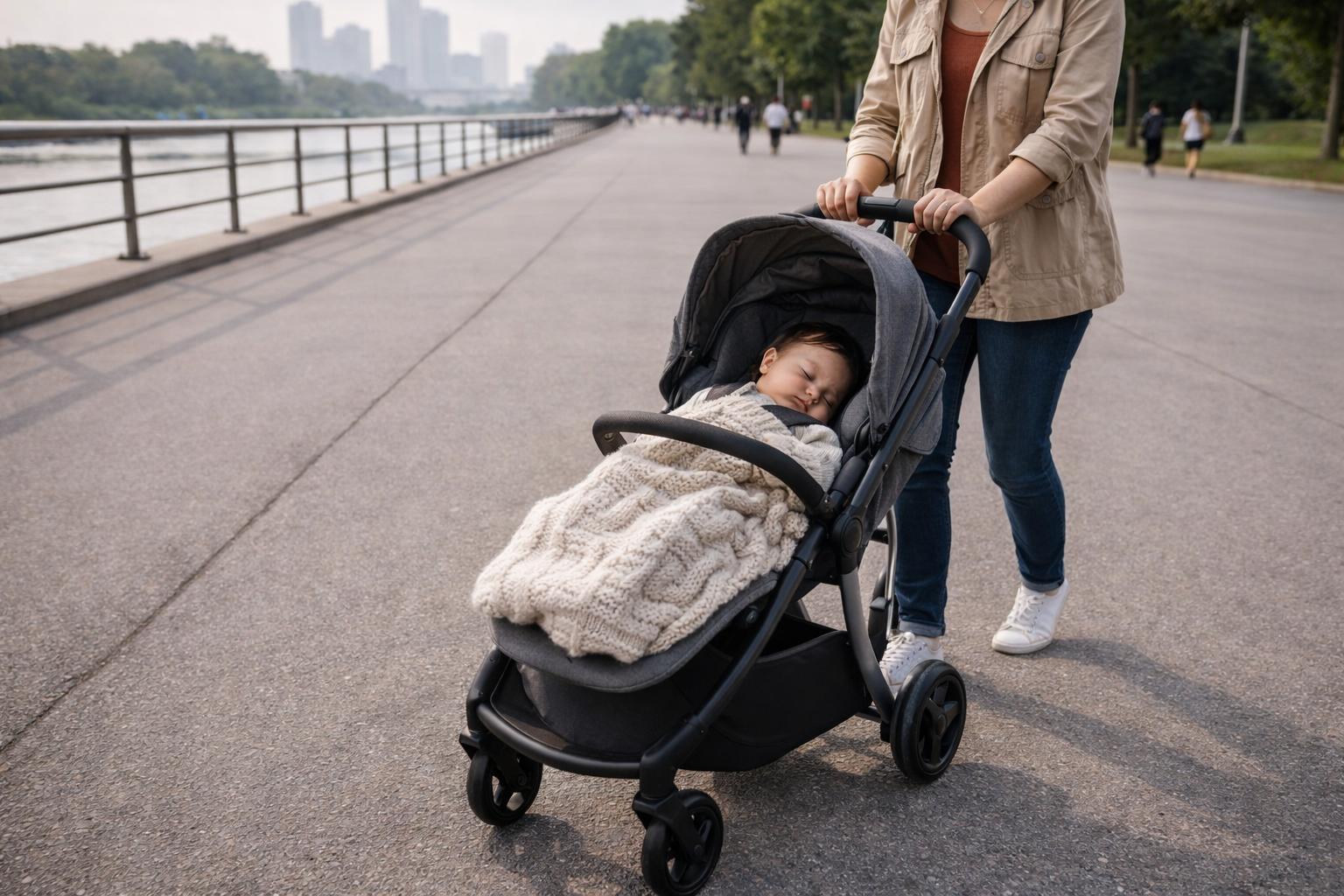
London, Bath, York, Amsterdam, Lisbon's flat waterfront — cities with wide pavements and relatively flat terrain are pushchair territory. The stroller handles the baby, your changing bag hangs on the handles, and you walk freely. A carrier puts all of that weight on your body for a day that might be 6–8 hours of urban exploring. For London specifically, the pushchair is the right primary tool — the parks, the South Bank, and most of the major sights are flat and pushchair-navigable. See our city breaks guide for which cities are most pushchair-friendly.
Nap management
This is the pushchair's strongest card on any trip lasting more than a day. A baby who naps in a properly reclined pushchair naps for longer and wakes better-rested than one who falls asleep in a carrier and then can't be transferred. If you're managing a baby who needs two naps a day and your holiday schedule involves being out for long stretches, the pushchair gives you a mobile sleep environment. A carrier nap is a short nap; a pushchair nap is a proper one.
Hot weather holidays
In 28°C+ heat, having a baby strapped against your body — and vice versa — becomes genuinely uncomfortable for both of you. A pushchair with a good canopy and airflow underneath is significantly more comfortable for the baby than being pressed against a sweaty parent. Our hot weather stroller guide covers which models have proper ventilation for Mediterranean temperatures.
Airports and luggage-heavy days
When you're also managing hand luggage, a car seat bag, and a check-in queue, a pushchair handles the baby while your hands manage everything else. The changeover to carrier happens at security (where a pushchair has to be folded and x-rayed) and then back again immediately after. Having a pushchair that folds in one motion — like the Bugaboo Butterfly or Joolz Aer+ — makes this transition fast enough to not be stressful. See our full flying with a baby guide for the airport logistics in detail.
Long days where baby needs to nap flat
As babies approach 4–6 months and beyond, they increasingly resist being reclined in a carrier and need a proper flat or reclined sleep position. A pushchair with full recline provides this; a carrier doesn't. If your trip involves full-day outings with a baby who still needs a long flat midday nap, the pushchair is doing work a carrier genuinely can't replicate.
When the Carrier Wins
📋 Free Baby Holiday Packing Checklist
Enter your email and we'll send the free printable checklist straight to your inbox — every category, ready to tick off before every trip.
The carrier earns its place on every trip — and in some scenarios it's the only practical option.
Cobblestoned European cities
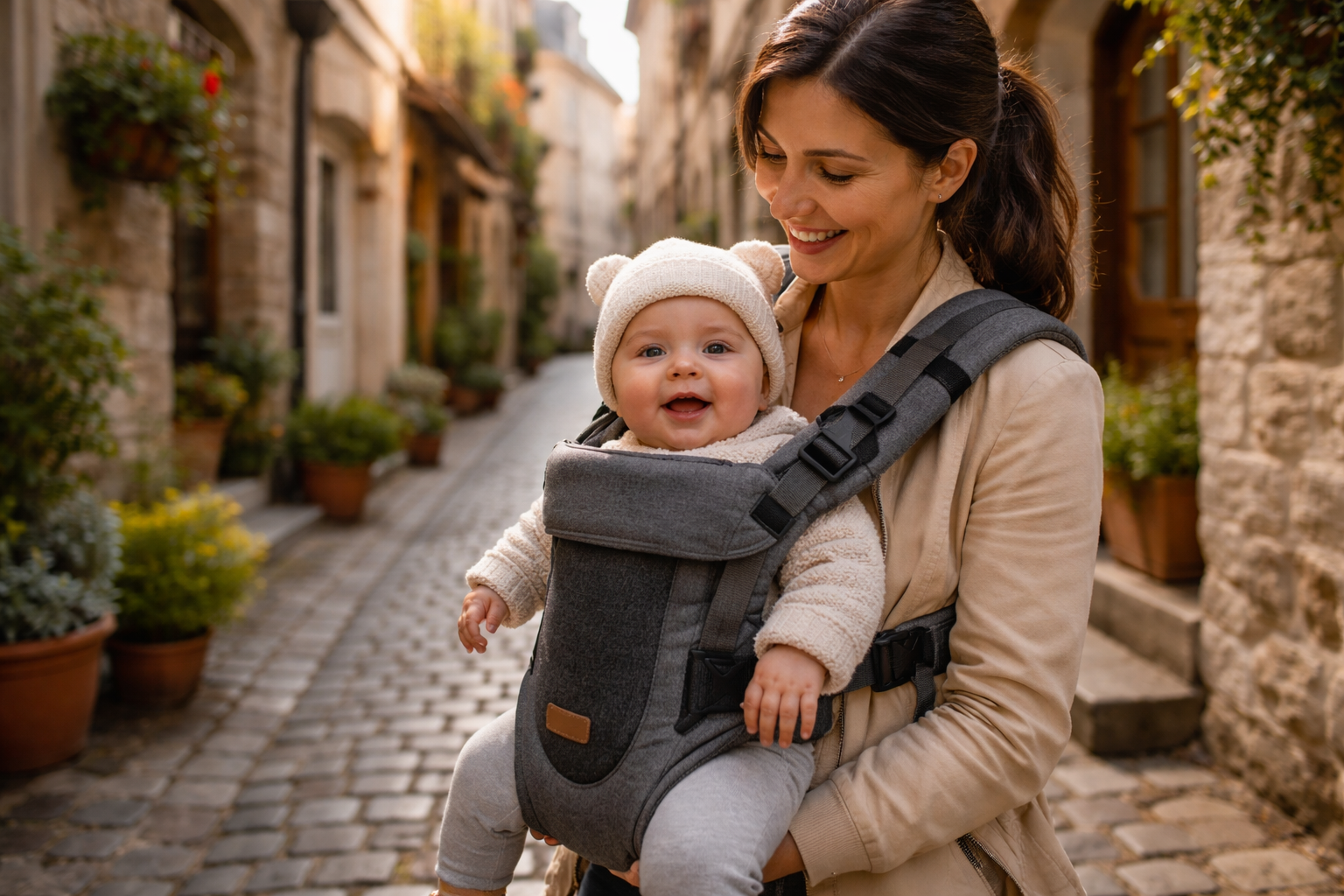
Rome, Prague, Dubrovnik, the old town of virtually any historic European city — cobblestones and pushchair wheels are natural enemies. The vibration alone disturbs sleeping babies; the physical effort of navigating uneven historic surfaces with a loaded pushchair is exhausting. A carrier navigates all of this effortlessly. For Edinburgh's Royal Mile, the steep closes, and the Old Town in general, a carrier is dramatically more practical than a pushchair. Our guide to strollers for cobblestones covers the pushchair options that manage best if you really need to bring one.
Beaches
Pushchair wheels and sand have a relationship best described as hostile. Even the widest-wheeled buggies struggle on soft sand, and carrying a laden pushchair across a beach is one of the less dignified travel experiences available to parents. A carrier lets you walk directly onto the sand, paddle at the water's edge with your baby on your front, and sit down naturally. The pushchair stays on the promenade and earns its place for the walk back. For Cornwall's coastal paths, a carrier is essential — many paths that reach the best beaches involve steps, stiles, or surfaces that simply exclude pushchairs.
Hiking and countryside walks
The Lake District, Snowdonia, Dartmoor — any destination where the landscape is the point and the paths aren't flat tarmac. A specialist hiking carrier (hip-seat frame carriers designed for backpacking) or a well-fitted structured carrier like the Ergobaby gets you and your baby onto terrain that would be inaccessible with a pushchair. This dramatically expands what's available to you as a destination — some of the most extraordinary places in the UK and Europe are only reachable on foot.
Crowded markets and festivals
Christmas markets, street markets, busy festivals — anywhere that crowds dense enough to make pushchair navigation an obstacle course. A carrier navigates all of this effortlessly, keeps your baby at your eye level rather than below adult-crowd height, and frees your hands. As covered in our Christmas markets guide, a carrier at a busy December market is significantly less stressful than a pushchair.
Public transport
The London Underground, buses, trams, and trains with steps — public transport that requires folding the pushchair, carrying it up stairs, and managing it in tight spaces. A carrier sidesteps all of this. For parents planning a city break that relies heavily on public transport, a carrier as the primary tool (or alongside a compact stroller) makes the logistics dramatically simpler.
Airport security
The pushchair has to be folded, placed in a tray or sent through the scanner separately, and reassembled on the other side — all while managing a baby who can no longer sit in it. A carrier means you walk through security with your baby on you, hands free. Many parents use the carrier specifically for the security section and switch back to the pushchair immediately after. See our guide on wearing a carrier through airport security for what to expect.
When You Need Both
Most holidays longer than a weekend benefit from having both available. They're not competing options — they're complementary tools that solve different problems on the same trip. The pushchair handles flat terrain, naps, and the logistics of a full day out. The carrier handles the moments the pushchair can't: the cobbled old town, the beach walk, the crowded attraction, the steep coastal path.
A practical approach many parents settle on: bring the pushchair as the primary tool, with a compact structured carrier in the changing bag as backup. The carrier adds almost no weight or luggage space, and transforms from a backup item into the essential tool the moment you hit terrain the pushchair can't manage. This combination covers almost every travel scenario without compromise.

Ergobaby Omni Breeze — Our Carrier Pick for Travel
From newborn | 4 carry positions | Padded lumbar waistbelt | Up to 20 kg
The carrier we return to most consistently for travel — not because it's the lightest or most compact, but because the padded waistbelt genuinely transfers weight to your hips rather than loading your shoulders. After 90 minutes navigating a cobblestoned old town, that distinction matters enormously. It works from newborn without an insert, adjusts for both parent body sizes, and carries comfortably into toddlerhood. The breathable mesh panel is a significant advantage for warm-weather destinations. See our full carriers and slings for travel guide for how it compares to the full range.
- ✅ Padded waistbelt — weight on hips not shoulders
- ✅ Newborn-ready without a separate insert
- ✅ Breathable mesh — comfortable in warm weather
- ✅ Four carry positions including back carry
- ❌ Bulkier to pack than a wrap or ring sling
- ❌ Premium price — justified if you use it regularly

Bugaboo Butterfly — Our Pushchair Pick for Travel
7.3 kg | One-second fold | Full recline | Cabin-bag eligible on many airlines
The best travel pushchair is the one that gets out of your way fastest when you need the carrier instead — and the Butterfly folds in one motion, one-handed, in under a second. That speed matters at airports, at the beach, and every time you hit a flight of stairs or a rough surface. It's lightweight enough to carry in one hand, has a full recline for naps, and a UPF 50+ canopy for sunny destinations. It earns its place on trips precisely because it doesn't fight you. See our full travel stroller review for the complete comparison.
- ✅ One-second fold — genuinely the fastest available
- ✅ Lightweight at 7.3 kg — easy to carry one-handed
- ✅ Full recline — proper nap capability
- ✅ UPF 50+ canopy for warm destinations
- ❌ Higher price point than budget travel strollers
- ❌ Suitable from 6 months — needs a carrycot from birth
Age Considerations: Which Tool Wins at Each Stage
0–4 months
A carrier is often sufficient as the only travel option for very young babies. They're light (typically 3.5–6 kg), they sleep for most of the journey, and the close contact of a carrier is genuinely soothing for a newborn in an unfamiliar environment. A newborn-suitable carrier or stretchy wrap handles all practical scenarios at this age — airports, cities, restaurants, countryside walks. If you'd like a pushchair as well, a lightweight travel option adds value for nap management, but it's genuinely optional at this stage in a way it isn't later.
Important: ensure any carrier used with a newborn follows NHS baby carrying safety guidelines — baby's chin should be off their chest, airways clear and visible at all times, and the carrier should keep them in an ergonomic "M" position with knees higher than bottom.
4–12 months
Both earn their place. This is typically the age range where nap management becomes most critical — babies are awake for longer stretches, resist short naps, and need a proper reclined sleep environment. A pushchair with full recline handles midday naps far better than a carrier. At the same time, this is also the age of significant weight gain — an 8-month-old is typically 8–9 kg, and a structured carrier with proper hip-belt support carries this weight far more comfortably than a basic wrap or ring sling. If you could only take one tool on a trip at this age, a stroller with full recline usually wins for trips of 3+ nights.
12–24 months
The pushchair becomes the primary tool. Toddlers are heavy (9–13 kg is typical), walk independently some of the time but not reliably enough to do without the stroller, and have strong opinions about being put down and picked up. A carrier is still essential as backup — for terrain where the stroller can't go, for moments when tired legs need carrying and the stroller is folded — but it becomes a supporting role rather than the lead. A hip seat carrier or a structured carrier with good back support is worth the investment at this stage; cheap carriers without lumbar support become genuinely painful with a 12kg toddler.
2 years+
The stroller is primary, the carrier is situational. Most two-year-olds are too heavy for extended carrier sessions, and the stroller handles the day effectively. A carrier remains useful for specific scenarios — a coastal path, a museum where pushchairs are not permitted, a long flight where a tired toddler needs to be held — but the balance has firmly shifted.
The Physical Reality of Carrier Wearing: What Nobody Tells You
Carrier marketing tends to show serene parents striding effortlessly through beautiful landscapes. The reality involves some honest trade-offs that are worth understanding before you commit to a carrier-primary travel approach.
A 5 kg newborn in a well-fitted structured carrier for 2 hours is comfortable for most adults. An 11 kg toddler in a cheap carrier without a hip belt for 3 hours is a different experience entirely — back pain, hip strain, and sweaty contact with a hot small person. The equipment makes a significant difference. A carrier with a wide, padded waistbelt that sits properly on your hip bones transfers weight effectively and makes extended carrying genuinely comfortable. A basic carrier that hangs from your shoulders without waist support concentrates all the weight on your trapezius muscles and becomes painful much faster.
If one parent carries significantly more than the other, ensure the carrier fits them properly — most structured carriers have adjustable torso height settings. An ill-fitting carrier is uncomfortable regardless of quality. Both parents should try the carrier before the trip, ideally with the baby, to identify any fit issues.
Overheating is also a real consideration. A baby worn in a carrier shares your body heat — in 30°C+ weather this can make the carrier significantly less comfortable than a pushchair with ventilation underneath. A breathable mesh carrier (like the Ergobaby Omni Breeze) makes a notable difference in warm weather compared to a padded carrier, and is worth prioritising if you're travelling to warm destinations.
Sling vs Pushchair by Scenario
| Scenario | Pushchair | Carrier | Our Recommendation |
|---|---|---|---|
| Airport transit | Good for check-in queues and baggage | Better for security screening | Both — stroller to security, carrier through, stroller to gate |
| On the flight | Stored in hold or gate-checked | ✅ In-cabin — hands free, baby settled | Carrier |
| Flat city (London, Amsterdam) | ✅ Handles naps, bags, all-day use | Good for underground/buses | Pushchair primary, carrier for public transport |
| Cobblestone old town | Difficult — vibration, effort, frustration | ✅ Navigates all surfaces effortlessly | Carrier |
| Beach holiday | Good on promenade; useless on sand | ✅ Beach access, paddling, sand not an issue | Carrier for beach, pushchair for promenade |
| Hiking / countryside | Limited to pushchair-accessible paths only | ✅ Opens all terrain | Carrier (specialist hiking carrier for longer walks) |
| Holiday park | ✅ Paved paths, pool access, all-day use | Useful for pool sessions | Pushchair primary |
| Christmas / street market | Difficult in crowds, cobblestones | ✅ Navigates crowds, frees hands, baby warm | Carrier |
| Hot weather (28°C+) | ✅ Better ventilation, no body heat sharing | Uncomfortable if not breathable mesh | Pushchair (mesh carrier if carrying needed) |
| Nap management | ✅ Full recline — longer, better quality naps | Short contact naps only | Pushchair |
| Restaurant / eating out | ✅ Baby in pushchair while you eat | Sitting with carrier on is uncomfortable | Pushchair (or transfer to highchair) |
| Baby under 4 months only | Useful but not essential | ✅ Often sufficient as only option | Carrier — consider skipping pushchair entirely |
Destination Quick-Pick: Carrier or Pushchair?
| Destination | Primary Tool | Why |
|---|---|---|
| Cornwall | Both | Pushchair on flat promenades; carrier for coastal paths and beaches |
| London | Pushchair primary | Parks and South Bank are flat; carrier for Tube sections without lifts |
| Lake District | Carrier primary | Lakeside paths suit pushchairs; fells and fell paths require a carrier |
| Edinburgh | Both | Princes Street is flat; Old Town closes and Royal Mile are carrier territory |
| European city break (cobbled) | Both | Pushchair for flat modern areas; carrier for historic cobbled zones |
| European beach resort | Both | Pushchair on resort promenade; carrier for beach itself |
| Holiday park (Centre Parcs, Haven) | Pushchair primary | Paved paths throughout; carrier useful for pool visits |
| Snowdonia / hiking destination | Carrier primary | Only way to access the terrain that makes these destinations worth visiting |
| Cotswolds village break | Both | Village centres are narrow and often cobbled; pushchair fine on main roads |
| North Norfolk / flat coast | Pushchair primary | Flat terrain throughout — one of the UK's most pushchair-accessible coastlines |
Pro Tip: Keep the Carrier in the Changing Bag
A compact structured carrier folds small enough to live in the bottom of a larger changing bag — meaning you always have it available without committing to wearing it from the start. The moment you hit cobblestones, a steep path, or a crowded market, it's there. This "carrier as backup" approach is how most experienced travelling parents end up using both tools on the same trip without the planning overhead of deciding in advance.
✈️ Free Baby Hand Luggage Checklist
Never forget the essentials. Enter your email and we'll send the free checklist straight to your inbox — one page, every category, ready before every flight.
Frequently Asked Questions
Can I take just a carrier on a city break with a baby?
Yes — especially for babies under 6 months, or for short city breaks of 1–2 nights. A newborn or young baby in a carrier is genuinely all you need for a weekend in a city: you navigate freely, hands are available, and they sleep happily in contact with you. For longer trips or older babies who need proper reclined naps, a compact travel stroller alongside the carrier gives you more options without much extra effort.
What's the best carrier for travel specifically?
A structured carrier with a padded hip waistbelt — the Ergobaby Omni Breeze or similar. For travel specifically, you want something that: adjusts for both parents, works from newborn without extra accessories, is breathable enough for warm weather, and doesn't take significant time to put on and take off. Our full carriers and slings for travel guide covers the options across different ages and budgets.
Can I take a carrier through airport security?
Yes — you wear the carrier through the metal detector (with baby removed and placed in a tray or held by your travel companion). Most carriers have minimal metal hardware that doesn't trigger detectors. The TSA and UK airport guidance is to remove baby from carrier during screening. See our dedicated guide on wearing a carrier through airport security for the full process.
Is a sling or a structured carrier better for travel?
For most travel situations, a structured carrier (with a frame, padded waistbelt, and buckle closures) is more practical than a ring sling or stretchy wrap. Structured carriers are quicker to put on and take off, adjust for multiple users easily, and distribute weight more effectively for extended carrying. Ring slings and wraps have their place — particularly for younger babies and for parents who find the fit more comfortable — but for the variety of situations you encounter on a trip, the structured carrier's speed and versatility wins.
How do I decide which pushchair to take on a trip?
Match the pushchair to the primary terrain. For European city breaks and beach resorts, a compact lightweight stroller (under 7 kg, one-motion fold) is the right tool — see our travel stroller review. For UK countryside breaks where you might occasionally want to use it on grass or gravel, a slightly sturdier option with bigger wheels handles the terrain better. For hot weather specifically, check the canopy UPF rating and whether the seat has ventilation — see our hot weather stroller guide.
Can I gate-check a pushchair at the airport?
Yes — most airlines allow you to use your pushchair all the way to the aircraft door, where it's taken from you, tagged, and loaded into the hold. You collect it at the aircraft door on arrival. This means you have the pushchair for the full airport experience and only lose it for the flight itself. Our guide on gate-checking a stroller covers the process, airline policies, and how to protect the pushchair during hold handling.
Is a carrier or pushchair better for a very young baby on their first holiday?
For a first holiday with a baby under 3 months, a carrier is often the more versatile and calming option. Very young babies respond well to the close contact, warmth, and heartbeat proximity of being worn. A pushchair is useful for nap management and carrying supplies, but many families do their first short trip with carrier only and find it works well. See our first holiday with a baby guide for the full picture on what to expect.
What if my back can't manage a carrier for long periods?
The single biggest factor in carrier-related back pain is the waistbelt. A carrier where the waistbelt sits properly on the top of your hip bones — not around your waist like a rucksack — transfers the load to the strongest part of your core rather than hanging from your spine. If you've tried a carrier and found it painful, try adjusting the waistbelt position before assuming all carriers will feel the same way. A proper fitting session from a babywearing consultant (available in most UK cities, often free through sling libraries) makes a significant difference. If back issues are ongoing, a pushchair as the primary tool with the carrier used only for short terrain-specific stretches is entirely reasonable.
Is a baby carrier or stroller better for travel?
Neither is objectively better — they're complementary tools. A compact travel stroller handles long days, naps, and flat terrain; a carrier handles cobblestones, steps, queues, and every situation where a pushchair becomes more hassle than help. The ideal travel setup is usually both: a lightweight stroller under 7kg as your primary, and a structured carrier for the moments when the stroller can't go.
Should I take a carrier or stroller to the airport?
Both if possible. Use the pushchair to carry your bags and let your baby rest through the terminal, then gate-check it at the aircraft door. Wear your baby in the carrier during boarding and the flight. If you can only bring one, a compact stroller gives more flexibility for long airport days; a carrier alone works well for shorter haul trips with mobile babies or toddlers who'll happily walk stretches themselves.
Is a sling or pushchair better for sightseeing?
It depends on the destination. For city sightseeing with smooth pavements, a compact pushchair lets your baby nap properly and carries your bags. For cobblestones, hills, steps, or crowded markets, a carrier is often more practical. Many parents switch between the two depending on the day's plan — carrier in the morning for active exploration, stroller in the afternoon when everyone needs a rest.
The Bottom Line
For most trips with a baby, the ideal setup is a compact travel pushchair as your primary tool and a structured carrier as your always-available backup. The pushchair handles flat terrain, naps, hot weather, and the logistics of a full day out. The carrier handles cobblestones, beaches, hiking, crowded markets, and every scenario where the pushchair would be more hassle than help. They're different tools for different situations — not competing choices. See our travel stroller guide and carriers for travel guide for detailed recommendations on both sides of this pairing.