
Pushchair Travel in Rural Areas UK: Choosing the Right Buggy for the Countryside
By BabyTravel UK Editorial Team · Last updated March 2026
Taking your baby into the UK countryside is one of the genuinely lovely parts of the first year — fresh air, a change of scenery, and the kind of long gentle walks that send babies to sleep. But the difference between a great countryside day out and an exhausting struggle often comes down to one thing: whether you've got the right pushchair for the terrain. This guide will help you choose wisely.
Quick Answer: Pushchairs for Rural Areas
- Standard compact travel strollers are not suitable for most countryside paths
- Look for: large wheels (25–30cm+), suspension, foam or air-filled tyres
- Check trail accessibility before you go — many paths marked on maps are not pushchair-friendly
- A baby carrier is often better on steep, narrow, or very rough terrain
- Budget pick: Joie Pact Pro. Premium pick: Bugaboo Butterfly
Why Most Travel Strollers Struggle in the Countryside
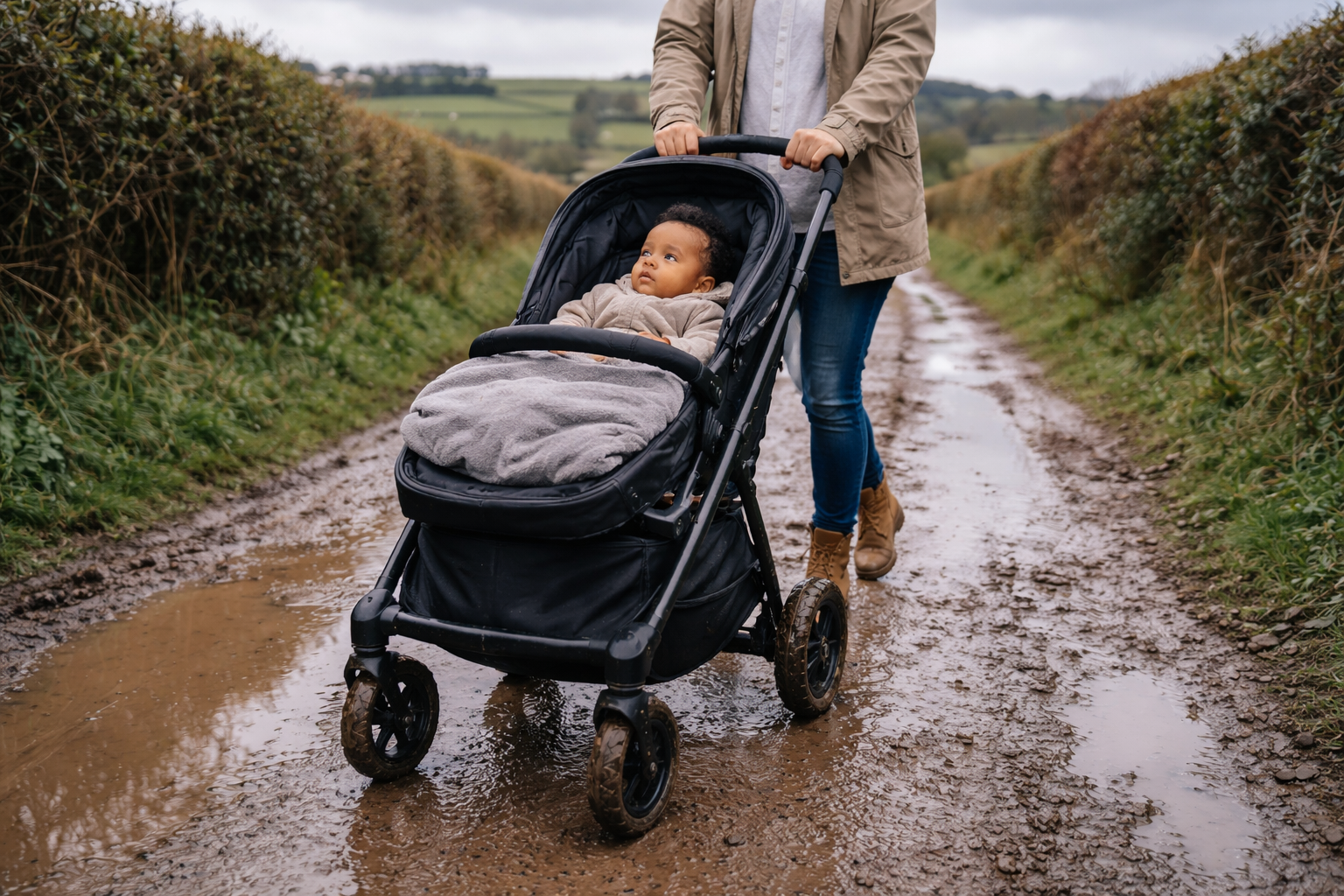
The UK countryside is not kind to small wheels. Gravel paths, compacted mud tracks, tussocky grass, tree roots, and cattle grids are all common features of even the most visitor-friendly rural routes. Standard lightweight travel strollers — the kind designed for airports and city pavements — have small, hard plastic wheels and minimal suspension. They're not built for this environment.
On rough terrain, a poorly-matched pushchair creates two problems simultaneously: your baby gets a jarring, uncomfortable ride, and you're fighting the pushchair every step of the way. What should be a relaxing walk becomes hard work. Before you pack the pushchair, it's worth spending five minutes understanding whether your model is appropriate for where you're heading.
UK Terrain Types and What Each Demands
| Terrain | Examples | Pushchair Suitability | Recommended Approach |
|---|---|---|---|
| Paved country lanes | Cotswold village paths, canal towpaths | Any pushchair | Travel stroller fine |
| Compressed gravel | National Trust estates, country parks | Most pushchairs | Medium wheels + suspension ideal |
| Grassy paths | Park walks, lowland meadows | All-terrain preferred | Large foam-filled wheels recommended |
| Muddy tracks | Forest trails, field edges after rain | All-terrain only | Air-filled tyres, robust suspension |
| Rocky/steep paths | Lake District fells, Snowdonia, Dartmoor | Not suitable for pushchairs | Use a carrier or sling |
What to Look For in a Rural-Ready Pushchair
📋 Free Baby Holiday Packing Checklist
Enter your email and we'll send the free printable checklist straight to your inbox — every category, ready to tick off before every trip.
Wheel size
This is the single most important factor. Small wheels get stuck; large wheels roll over obstacles. For countryside use, aim for at least 25cm diameter wheels, and 30cm+ for anything muddier than a dry gravel path. The diameter determines whether the wheel rolls over a stone or gets stopped by it.
Tyre type
Hard plastic wheels are fine for smooth surfaces and terrible for anything else — they transmit every vibration directly to your baby. Foam-filled tyres are better: they absorb more shock without the maintenance overhead of air-filled tyres. Air-filled (pneumatic) tyres give the best ride quality on rough ground but require pressure monitoring and occasional puncture repair. For genuinely muddy or uneven terrain, foam or air is the right choice.
Suspension
Front and rear suspension makes a meaningful difference on uneven paths. It absorbs the jolts before they reach your baby and reduces the effort of pushing. Not all pushchairs that claim "suspension" have meaningful amounts of it — look for models that specifically reference independent wheel suspension rather than just flexible frame construction.
Wheelbase width and stability
A wider wheelbase is more stable on camber (paths that slope sideways) and less likely to tip on uneven ground. The trade-off is that wider buggies can be trickier to manoeuvre on narrow paths. For general countryside use, a moderate wheelbase with good anti-tip geometry is the target.
Weight
Countryside walking often involves lifting your pushchair over gates, styles, and the occasional muddy stretch. A lighter pushchair is significantly easier to handle in these situations. Under 10kg is the practical target for parents who anticipate regular lifting.
Rain cover
Non-negotiable for UK countryside walking. UK weather is genuinely unpredictable and rural areas tend to be wetter than cities. A well-fitted rain cover that clips on quickly is worth prioritising — fiddling with a poorly-fitted cover in the rain with a screaming baby is not a good experience.
Comparing All-Terrain Pushchair Options
| Pushchair | Weight | Wheel Type | Price | Best For |
|---|---|---|---|---|
| Joie Pact Pro | 7.4kg | Foam-filled, rear suspension | ~£200–£250 | Budget all-rounder for countryside + travel |
| Bugaboo Butterfly | 6.9kg | Elastomer suspension, larger wheels | ~£500–£600 | Premium compact with best-in-class terrain performance |
| Baby Jogger City Tour 2 | 6.4kg | Standard wheels, basic suspension | ~£200–£250 | Travel and smooth country lanes — not muddy terrain |
| Thule Urban Glide 2 | 10.4kg | Air-filled, full suspension | ~£500–£600 | Serious off-road capability, running buggy |
| Mountain Buggy Nano | 6.4kg | Medium wheels, limited suspension | ~£250–£300 | Compact fold with better-than-average terrain handling |

Pushchair-Friendly Routes in Popular UK Destinations
Lake District
The Lake District has some accessible lakeside routes — the path around Windermere at Waterhead to Brockhole is largely flat and paved or well-surfaced. Around Coniston Water and Ullswater there are accessible stretches too. Avoid anything marked as a fell path or bridleway without checking it first — many Lake District paths that look flat on a map involve significant steps, rocky sections, or boggy ground. Our guide to the Lake District with a baby covers the most accessible routes in detail.
Peak District
The Monsal Trail and the Tissington Trail are both surfaced and genuinely pushchair-friendly — these old railway lines have been converted to smooth multi-use paths. Around Chatsworth the estate paths are well-maintained and accessible. The rugged moorland sections (Stanage Edge, Kinder Scout) are entirely unsuitable for pushchairs. See our Peak District with a baby guide for specific family-friendly routes.
Cotswolds
This is one of the most pushchair-accessible countryside areas in England. Many of the villages have well-maintained paths connecting them, and the terrain is gentler than northern England. Bourton-on-the-Water and Bourton-on-the-Hill are particularly accessible. Even here, crossing fields or using Public Footpaths can involve stiles and muddy sections — stick to signposted accessible routes.
Snowdonia and Scottish Highlands
Most paths in these areas are not pushchair-friendly. The terrain is simply too steep, rough, and unpredictable. A carrier or sling is the right tool for serious hill walking in Wales and Scotland. Our guide to Snowdonia with a baby gives honest advice on what's actually accessible versus what the map suggests.
Pro Tip
Before any countryside trip, search the destination's name plus "pushchair accessible routes" or "buggy walks" — many National Trust properties, country parks, and tourism bodies publish specific buggy-friendly trail maps. The National Trust family walks search lets you filter by accessibility. It takes two minutes and can save you a deeply frustrating day.
When to Use a Carrier Instead
For some countryside walks, the honest answer is that no pushchair will do the job adequately — and the right call is a baby carrier or structured backpack carrier. This applies to:
- Any path described as "rocky," "steep," or a "fell path"
- Paths with stiles that cannot be bypassed
- Beach walking on soft sand (wheels sink in)
- Anywhere with significant elevation change in a short distance
- Very narrow paths where a pushchair cannot safely pass
Many parents find the best approach for countryside days is to bring both — a pushchair for the flatter, accessible stretches where the baby can be in the seat and you can use the basket for your bags, and a carrier for any section that requires hands-free movement. Our article on slings versus pushchairs for travel covers the trade-offs in detail.
Looking After Your Pushchair After Countryside Walks
Mud, grit, and countryside debris are significantly more damaging to pushchair mechanics than city use. Mud packs into wheel bearings and degrades them faster; grit accelerates wear on the fold mechanism; wet fabric left uncleaned can develop mould. A post-walk routine matters:
- Hose or brush mud off wheels before it dries
- Check that no grit has entered the fold mechanism joints
- Leave the pushchair open to dry in a garage or porch rather than folded up damp
- Wipe down the frame and seat fabric with a damp cloth
For detailed cleaning guidance, our article on cleaning travel stroller wheels covers the full process, including removing caked-on mud from axle housings.
Essential Kit for Countryside Walks with a Baby
| Item | Why It Matters in the Countryside |
|---|---|
| Rain cover (pushchair) | UK weather is genuinely unpredictable — always pack it |
| Extra layers for baby | Rural areas are colder and windier than city centres |
| Footmuff or cosy toes | Babies cool quickly when stationary in a pushchair |
| Nappies (double what you'd bring) | Facilities are sparse or non-existent in rural areas |
| Carrier/sling (backup) | For sections where the pushchair cannot go |
| Fully charged phone | Signal can be poor — download maps offline beforehand |
| Water and snacks | Rural cafes and shops are far between |
| Muslin/blanket | For impromptu feeds or shade from unexpected sun |
Safety in Rural Areas
Countryside walking with a baby involves a few safety considerations that don't apply in urban settings. Livestock is the most significant — never approach cattle (even without calves) with a baby in a pushchair, and if cattle approach you on a path, stay calm, move to the edge, and let them pass. The Countryside Code advises keeping a safe distance from all livestock.
Sun exposure is another underestimated risk — open countryside provides far less shade than urban environments, and UV exposure at altitude is higher. An extendable canopy with UPF protection is worth having, and NHS guidance on sun safety for babies recommends keeping babies under six months out of direct sun entirely.
Finally, tell someone your planned route and expected return time before any significant countryside walk — mobile signal is often poor in rural areas, and knowing someone has your plans provides a useful safety net.
✈️ Free Baby Hand Luggage Checklist
Never forget the essentials. Enter your email and we'll send the free checklist straight to your inbox — one page, every category, ready before every flight.
Frequently Asked Questions
What type of pushchair is best for countryside walks in the UK?
An all-terrain pushchair with large wheels (25–30cm+), rear suspension, and foam or air-filled tyres handles UK countryside paths best. The Joie Pact Pro is a solid mid-range option; the Bugaboo Butterfly is the premium choice. Standard compact travel strollers are not designed for rough terrain and will struggle on anything beyond smooth paths.
Can I take a travel stroller on countryside walks?
On flat, paved, or smooth gravel paths — yes. On anything muddier, grassier, or more uneven — no. A compact travel stroller's small wheels and minimal suspension make rough-terrain walking genuinely difficult for both you and your baby. A carrier or sling is often a better choice for anything off the beaten track.
Are UK National Trust and countryside paths pushchair-friendly?
Many National Trust properties have specific pushchair-friendly routes — always check the property website before visiting. General countryside footpaths and bridleways are not designed with pushchairs in mind. The most accessible areas for buggy walking are the Cotswolds, lowland canal towpaths, and converted railway trails like the Monsal and Tissington trails in the Peak District.
What wheel size do I need for countryside paths?
25cm+ for grassy paths and light gravel; 30cm+ for muddy trails and forest tracks. Wheel material also matters — foam or air-filled tyres absorb vibration far better than hard plastic. Larger wheels roll over obstacles; smaller wheels get stopped by them.
How do I clean mud off pushchair wheels after a countryside walk?
Hose the wheels down before the mud dries if you can. Use a stiff brush with warm soapy water for caked mud, paying attention to axle areas where mud compacts and causes bearing damage. See our stroller wheel cleaning guide for a full walkthrough.
Is a baby carrier better than a pushchair for countryside walks?
On genuinely rough terrain — steep, rocky, very narrow paths — yes, a carrier is better. Many parents use both on a countryside day: pushchair for the accessible sections, carrier for the trickier parts. A well-fitted structured carrier lets you go places no pushchair can reach.
What should I pack for a countryside walk with a baby?
Rain cover for the pushchair, extra layers for your baby, more nappies than you think you'll need, a carrier as backup, fully charged phone with offline maps, water, and snacks. Rural facilities are sparse — overpacking is always better than the alternative.
Which UK countryside destinations are best for pushchair walks?
The Cotswolds has the most accessible countryside paths overall. The Lake District has good lakeside accessible routes. The Peak District's converted railway trails (Monsal Trail, Tissington Trail) are specifically surfaced for pushchairs. Snowdonia and the Scottish Highlands are largely unsuitable for pushchairs — a carrier is the right choice for most paths in these areas.
For more practical advice on travelling across the UK with a baby, our guide to 10 things nobody tells you about travelling with a baby covers gear decisions, planning, and what to do when things don't go to plan.