
Stroller Weight Comparison Chart UK (Practical Parent Guide)
By BabyTravel UK Editorial Team · Last updated July 2026
Stroller weight matters — but weight alone is a poor buying metric. Carry balance, fold shape, and real-world handling often matter more than small kilogram differences.
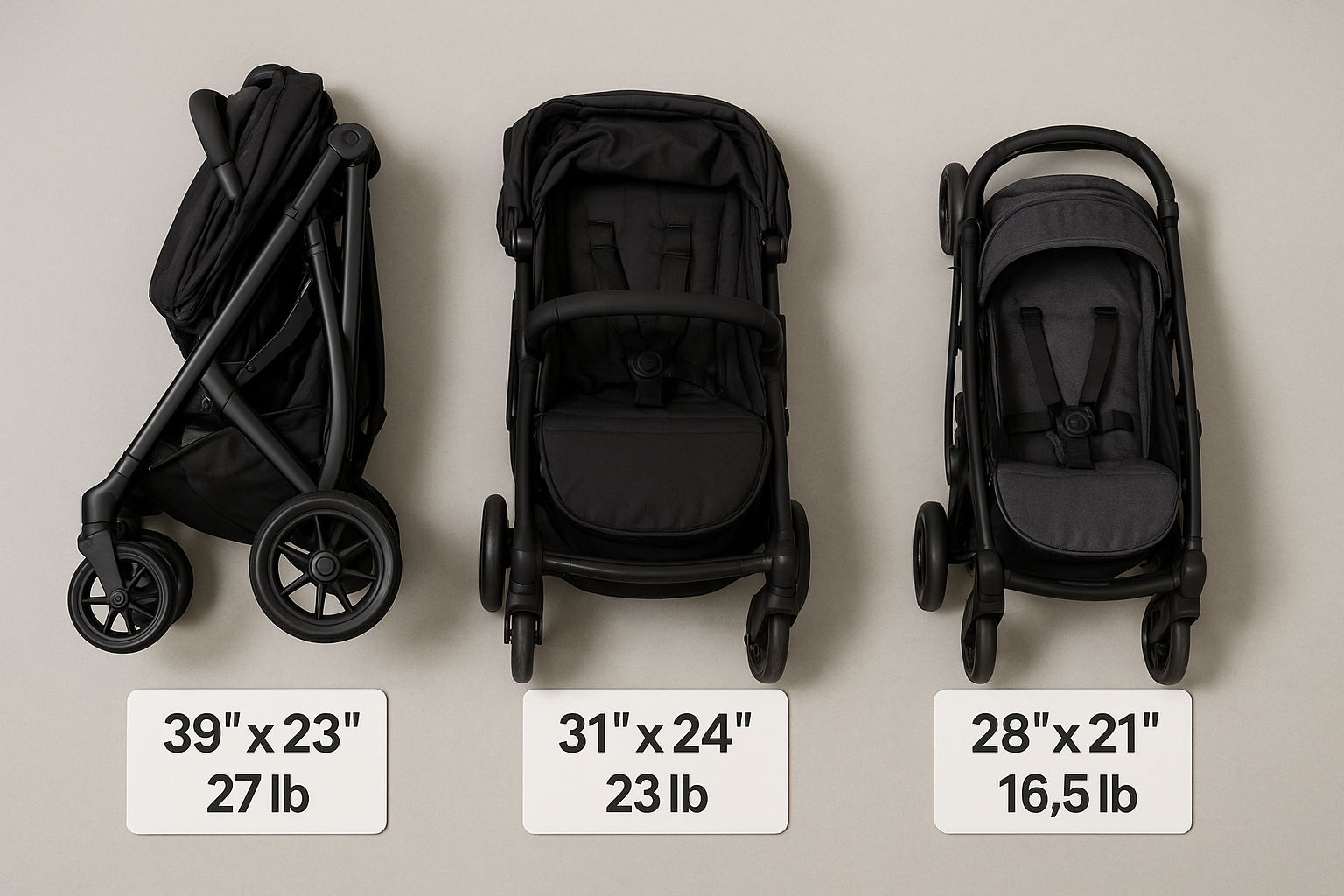
This page gives you a practical comparison method so you can choose by routine, not guesswork.
Quick chart: popular travel-capable options
| Model | Approx listed weight | Weight class | Best for | Link |
|---|---|---|---|---|
| Maxi-Cosi Lara2 | ~5.6 kg (5600 g / 12.3 lbs) | Ultra-light | Featherweight cabin carry | Check price on Amazon |
| GB Pockit+ All-City | ~5.7 kg (5700 g / 12.6 lbs) | Ultra-light | Smallest fold, lightest overall | Check price on Amazon |
| Graco Myavo | ~5.8 kg (5800 g / 12.8 lbs) | Ultra-light | Budget ultra-light travel | Check price on Amazon |
| Silver Cross Clic | ~5.9 kg (5900 g / 13.0 lbs) | Ultra-light | Tiny self-standing fold | Check price on Amazon |
| Joolz Aer+ | ~6.0 kg (6000 g / 13.2 lbs) | Ultra-light | Frequent stairs/transit carry | Check price on Amazon |
| Joie Pact | ~6.1 kg (6100 g / 13.4 lbs) | Ultra-light | Portability on a budget | Check price on Amazon |
| Babyzen YOYO² | ~6.2 kg (6200 g / 13.7 lbs) | Ultra-light | Compact city + travel use | Check price on Amazon |
| Cybex Libelle | ~6.2 kg (6200 g / 13.7 lbs) | Ultra-light | Ultra-compact holiday fold | Check price on Amazon |
| Nuna TRVL | ~6.4 kg (6400 g / 14.1 lbs) | Light | Smooth ride, travel-system ready | Check price on Amazon |
| Bugaboo Butterfly | ~7.3 kg (7300 g / 16.1 lbs) | Light-mid | Premium daily handling | Check price on Amazon |
| Baby Jogger City Tour 2 | ~6.5 kg (6500 g / 14.3 lbs) | Light | Value + comfort balance | Check price on Amazon |
| Silver Cross Jet | ~7.5 kg (7500 g / 16.5 lbs) | Mid | UK travel-focused setup | Check price on Amazon |
| Chicco Echo | ~7.5 kg (7500 g / 16.5 lbs) | Mid | Low-cost everyday runaround | Check price on Amazon |
Weights are typical listed stroller-only weights and can vary slightly by production run, accessories, or retailer specs.
What actually makes a stroller feel light
Two buggies with the same figure on the box can feel worlds apart the moment you lift them. A handful of design details matter more than the raw number:
- Where the weight sits. A frame that balances around a central carry handle feels lighter than one that is nose- or tail-heavy at the same weight.
- Fold footprint. A small, tidy fold is far easier to carry up stairs or swing into a boot than a light-but-bulky one — the lightest pushchairs for air travel win on fold size as much as kilos.
- A one-hand, self-standing fold. If you can collapse it with a baby on your hip and it stands up on its own, you will carry it far more happily than a two-hand fold that flops over.
- A confident fold lock. A fold that stays shut when you lift it feels secure; one that threatens to spring open feels heavier and more stressful than it really is.
Always pair the number on the chart with a real carry test — it exposes these differences within seconds.
Weight class guidance (with useful ranges)
📋 Free Baby Holiday Packing Checklist
Enter your email and we'll send the free printable checklist straight to your inbox — every category, ready to tick off before every trip.
Ultra-light: under 6.5 kg (under 6500 g / under 14.3 lbs)
Best for frequent carrying, stairs, and transport-heavy routines. Trade-off can be reduced plush comfort on long days.
Light: 6.5 to 7.5 kg (6500–7500 g / 14.3–16.5 lbs)
Best all-round class for many families. You usually get a good balance between carry ease and daily comfort.
Mid: 7.5 to 9.0 kg (7500–9000 g / 16.5–19.8 lbs)
Often stronger for comfort and stability, but can feel heavier on stairs and transport transfers.
Heavy: above 9.0 kg (above 9000 g / above 19.8 lbs)
Can be useful for sturdier comfort-focused setups, but usually less convenient for frequent carry-heavy city movement.
The two-minute carry test before you buy
- Lift folded stroller one-handed for 20 seconds.
- Carry up/down one flight segment.
- Fold/unfold three times under mild time pressure.
- Load into boot with normal family bag setup.
This test reveals whether weight is truly manageable in your routine.
When a heavier stroller is the smarter choice
If you do long outings and rough pavements often, slightly heavier models can still win due to comfort and steering stability. Do not over-prioritise low weight if it harms your main use case.
Match the weight class to how you'll use it
The right weight depends far more on your routine than on chasing the lowest number. Use this to make the trade-offs on purpose rather than by accident:
| If this is your priority | Then look for | Trade-off to accept |
|---|---|---|
| Stairs, buses and train platforms | An ultra-light frame with a balanced carry point and a quick one-hand fold | A slightly less plush ride on long days |
| Long days and all-day comfort | A stable frame and a supportive, well-padded seat | A little more to carry when folded |
| Mixed city life and holidays | A balanced light-to-mid model with a compact, transport-ready fold | Not the very smallest fold or the very lightest weight |
| Use from birth | A full or near-flat recline, or carrycot and car seat compatibility | Usually a little heavier than a seat-only travel buggy |
Weight by everyday scenario
Lots of stairs and public transport: put carry balance and fold speed first. An ultra-light buggy you can lift one-handed onto a train is worth more than the odd fraction of a kilo saved elsewhere.
Mostly car and road trips: weight matters far less here. Prioritise a comfortable seat, steady steering, and a fold that drops into your boot without a wrestling match. Our guide to what to look for in a travel stroller covers the rest.
City living plus the odd holiday: a light-to-mid buggy with a genuinely compact fold handles both without forcing a compromise. The city pushchair guide goes deeper on day-to-day urban handling.
✈️ Free Baby Hand Luggage Checklist
Never forget the essentials. Enter your email and we'll send the free checklist straight to your inbox — one page, every category, ready before every flight.
FAQ
What is the lightest travel stroller available in the UK?
The lightest widely available travel stroller in the UK is the GB Pockit+ All-City at around 5.7 kg, which also folds smaller than any rival — small enough to slot under an aeroplane seat. Among more conventional everyday strollers, the Joolz Aer+ (around 6.0 kg) and the Joie Pact (around 6.1 kg) are the lightest picks.
What is the best stroller weight for travel?
Usually light to ultra-light, but only if fold/carry remains reliable and comfort acceptable.
Is the lightest stroller always best?
No. Balance and usability matter as much as raw weight.
How do I compare weight across brands fairly?
Use class ranges plus real carry tests.
Should I prioritise weight for city life?
Yes, especially if stairs/transit are frequent — but never ignore steering and fold quality.
Can one stroller handle travel and daily life?
Yes, if it balances carry ease, comfort, and fold speed for your routine.