
Top 5 Long-Haul Destinations With a Baby (Under 10 Hours from the UK)
By BabyTravel UK Editorial Team · Last updated September 2026
Long-haul with a baby is possible — and for the right destination, genuinely worth it. Here are the five best options under 10 hours from the UK, ranked honestly by baby infrastructure, flight experience, climate, and whether the destination justifies the journey.
There's a version of this conversation that ends with someone telling you long-haul travel with a baby is fine, and another version that ends with someone telling you it's a terrible idea. The honest answer sits somewhere in the middle. The flight is harder than short-haul — there's no way around that. But the destinations on this list offer things that European breaks simply can't: guaranteed warmth in winter, different cultures, quieter resorts, and experiences that are worth the extra hours in the air. The question isn't whether it's possible. It's whether it's right for your family right now.
All five destinations on this list are under 10 hours direct from a UK airport. That's the realistic ceiling for most families with babies — long enough to require genuine preparation, short enough that you're not facing a full transatlantic or long-haul Asia flight. If you're newer to flying with a baby, our flying with a baby guide and first flight guide cover everything you need before you get to the airport.
Quick Answer: Best Long-Haul Destinations With a Baby
- 1. Dubai / Abu Dhabi (UAE) — 7 hrs. Best baby infrastructure in the world. Winter sun from October to March. Outstanding hotels.
- 2. Canary Islands (Spain) — 4–4.5 hrs. Year-round warm, excellent family resorts, GHIC healthcare cover. The easiest long-haul step up.
- 3. Cape Verde — 6 hrs. Warm year-round, good value, quieter than the Canaries, beaches excellent for young families.
- 4. Marrakech (Morocco) — 3.5 hrs. Cultural richness, riads with pools, brilliant for autumn or spring. Requires more planning than a resort destination.
- 5. The Azores (Portugal) — 4 hrs. Stunning nature, mild climate, extremely quiet. Ideal for adventurous parents who want space over sun loungers.
Is Long-Haul Worth It With a Baby?
That depends on what you're hoping to get from the trip — and on being honest with yourself about what the flight will actually be like. Here's the straightforward version:
| Consider long-haul if… | Stick to short-haul if… |
|---|---|
| You want guaranteed winter sun and warm temperatures | You're already anxious about flying short-haul |
| Your baby is 3+ months and settled in their feeding routine | Your baby is under 8 weeks or has an ongoing health concern |
| There are two of you and you can take shifts on the flight | You're travelling solo with a baby — long-haul solo is very demanding |
| You're staying a minimum of 10 nights (the flight cost is the same) | You're going for less than a week — not worth the time adjustment |
| The destination has good private healthcare or GHIC equivalent | You're uncomfortable with healthcare being further from home |
| You have comprehensive travel insurance covering the baby | Budget is the primary concern — long-haul costs more across the board |
Jet lag is real and it will affect your baby. The destinations under 4 hours on this list (Marrakech, Azores) involve minimal time difference and aren't truly long-haul in the jet-lag sense. Dubai and Cape Verde involve 3–4 hours of time difference, which most babies adjust to within 2–3 days. Plan a slower first two days on arrival and don't try to force UK nap times on a different time zone immediately.
How to Survive a Long-Haul Flight With a Baby
The full detail is in our flying with a baby guide, but the key points for longer flights specifically:
- Book a bassinet seat early — bulkhead seats with a sky cot are limited. Request one when booking, not at check-in.
- Time the flight around sleep — overnight or late-evening flights work well for babies who sleep on the move. Day flights are harder but manageable.
- Take shifts — if you're travelling as a couple, agree who's "on" for each hour of the flight. Don't both try to settle the baby at once.
- Feed on take-off and landing — the swallowing motion helps babies manage ear pressure changes.
- Pack more than you think you need — nappies, changes of clothes, snacks. Our baby hand luggage checklist is worth working through in full before you pack.

The Full Comparison
📋 Free Baby Holiday Packing Checklist
Enter your email and we'll send the free printable checklist straight to your inbox — every category, ready to tick off before every trip.
| Destination | Flight time | Best season | Avg winter temp | Healthcare | Baby infrastructure | Overall rating |
|---|---|---|---|---|---|---|
| Dubai / Abu Dhabi | ~7 hrs | Nov–Feb | 22–28°C | Excellent (private, expensive) | ⭐⭐⭐⭐⭐ | ⭐⭐⭐⭐⭐ |
| Canary Islands | ~4–4.5 hrs | Year-round | 20–24°C | GHIC accepted ✅ | ⭐⭐⭐⭐⭐ | ⭐⭐⭐⭐⭐ |
| Cape Verde | ~6 hrs | Year-round | 24–28°C | Limited — insurance essential | ⭐⭐⭐⭐ | ⭐⭐⭐⭐ |
| Marrakech | ~3.5 hrs | Mar–May, Sep–Nov | 18–22°C (spring) | Moderate — insurance recommended | ⭐⭐⭐ | ⭐⭐⭐⭐ |
| The Azores | ~4 hrs | May–Oct | 17–22°C | GHIC accepted ✅ | ⭐⭐⭐ | ⭐⭐⭐⭐ |

Find Baby-Friendly Hotels
Search baby-friendly hotels with free cancellation, cot requests, and family room options.
Search Hotels on Booking.com#1 — Dubai and Abu Dhabi (UAE): ~7 Hours
The top spot here is deserved. Dubai has built some of the best family-facing infrastructure anywhere in the world — hotels that provide sterilisers, bottle warmers, and cots as standard; malls with dedicated nursing rooms on every floor; beaches that are calm, flat, and lifeguarded. The flight with Emirates is particularly well set up for babies, with bassinets in economy and baby meals on request.
The non-negotiable: visit between November and February only. Summer temperatures in Dubai are genuinely dangerous for babies. Visit in winter and you'll find 22–28°C sunshine, dry skies, and a city that makes daily life with a baby remarkably easy. Abu Dhabi, 90 minutes from Dubai, is quieter and slightly less resort-heavy — worth considering if you prefer a calmer pace. We cover everything you need to know in our full Dubai with a baby guide.
One thing to know: private healthcare in Dubai is world-class but expensive. Comprehensive travel insurance covering your baby is essential — don't cut corners here.
Our Tip
Emirates allows you to request a bassinet sky cot when booking — do this immediately, as they're allocated on a first-come basis and bulkhead seats go fast on popular routes. A baby without a bassinet on a 7-hour night flight is a different experience entirely.
#2 — The Canary Islands (Spain): ~4–4.5 Hours
Tenerife, Lanzarote, Gran Canaria, and Fuerteventura are technically Spain — which means your Global Health Insurance Card (GHIC) covers you for emergency medical treatment, the same as anywhere in the EU. For families with babies, that peace of mind is significant. The flight is just over 4 hours — genuinely manageable even for a baby on their first flight.
Year-round warmth is the Canaries' biggest draw. Even in January, Tenerife's south coast sits at 20–22°C. The resort areas (Playa de las Américas in Tenerife, Puerto del Carmen in Lanzarote, Maspalomas in Gran Canaria) are heavily developed for families — flat promenades, calm beaches, good supermarkets stocking UK formula and nappies, and plenty of all-inclusive hotels that take a lot of the daily logistics off your plate. There's no jet lag to speak of — the Canaries are only 1 hour behind the UK.
Best island for babies: Fuerteventura for its calm, shallow beaches; Lanzarote for its quieter pace and manageable resort areas. Tenerife offers the most variety but its larger size means more driving between areas. If Tenerife is your likely choice, compare cots, kitchens, pools and airport journeys in our Tenerife family hotel guide; our Bahia Principe Fantasia baby guide covers the all-inclusive option in more detail.
One thing to know: Some of the older resort areas have cobbled streets and stepped paths that are tricky with a pushchair. The newer resort developments are much better. Check your accommodation's accessibility before booking if this matters to you — our stroller guide for cobblestones and uneven terrain covers what to look for.
#3 — Cape Verde: ~6 Hours
Cape Verde sits in the Atlantic off the west coast of Africa — closer to the UK than Dubai but significantly further than the Canaries, with a journey time of around 6 hours. It's warm year-round (typically 24–28°C), consistently sunny, and considerably less crowded than the Canaries. If you want proper warm-weather resort life without the package holiday feel of Tenerife in August, Cape Verde is worth serious consideration.
The most family-friendly islands are Sal and Boa Vista — both flat, sandy, and built around calm Atlantic beaches with excellent water for young families. Sal has the better-developed resort infrastructure; Boa Vista is quieter and feels more remote. Both have seen significant hotel development over the past decade, and good family-focused all-inclusives are now well-established on both islands.
Best time to visit: Year-round, though November to June is generally considered the better season (less wind, calmer seas). July to October brings Harmattan winds, which can make beach days sandier than expected.
One thing to know: Healthcare in Cape Verde is limited compared to Spain or the UAE. Private clinics exist on the main tourist islands but they're basic compared to what you'd find in Dubai or the Canaries. Comprehensive travel insurance including emergency repatriation cover is essential — not optional. Check that your policy specifically covers your baby. The FCDO travel advice for Cape Verde covers healthcare detail in full.
#4 — Marrakech (Morocco): ~3.5 Hours
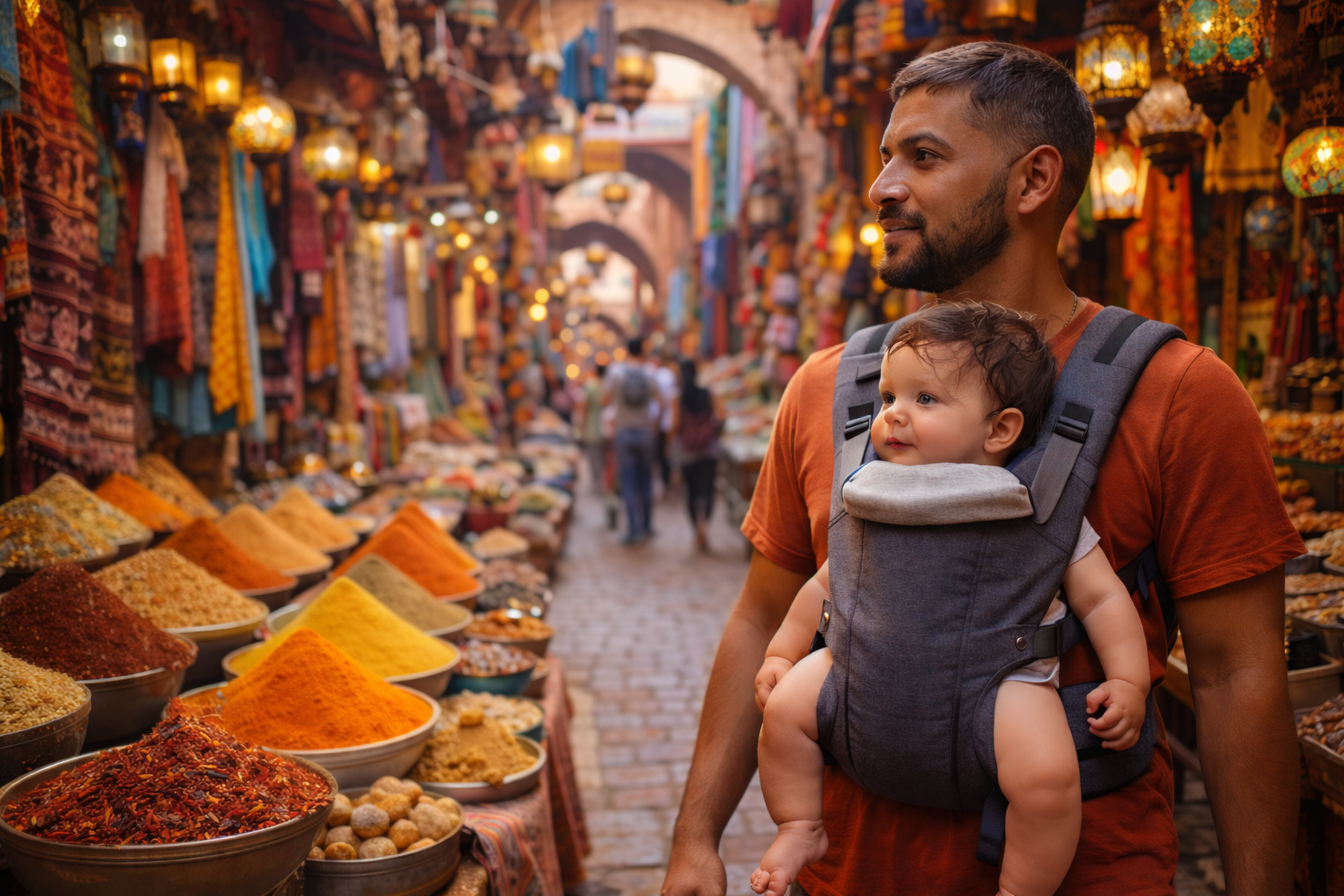
Technically the shortest flight on this list — just 3.5 hours from London — Marrakech earns its place here because of the cultural distance rather than the physical one. This is genuinely different travel: the medina's winding alleyways, the souks, the call to prayer, the extraordinary food. For some families with babies, that richness is exactly what they're looking for. For others, it's genuinely overwhelming.
The practical case for Marrakech with a baby centres on the riad experience. Traditional Moroccan riads — courtyard townhouses converted to guesthouses and boutique hotels — are often baby-friendly in a specific way: calm, quiet interior spaces with a pool or fountain, rooms opening onto a central courtyard, and very attentive, personalised service. Outside, the medina is chaotic and the narrow alleys are almost impossible with a pushchair. A good carrier — see our carrier for travel guide — is non-negotiable for exploring the old city.
Best time to visit: March to May and September to November. Summer in Marrakech is extremely hot (regularly 38–42°C) and not suitable for babies. Spring and autumn offer 20–26°C temperatures — warm enough for pool days, cool enough for the medina.
One thing to know: Marrakech is not a beach destination. It's a city experience. If your holiday vision is beach days and pool time, the Canaries or Cape Verde will serve you better. If you want cultural immersion from a beautiful riad base — with the medina as something to dip into rather than spend all day in — Marrakech is genuinely rewarding. Check the FCDO Morocco travel advice for current entry requirements and health recommendations.
#5 — The Azores (Portugal): ~4 Hours
The Azores are having a moment. This Portuguese archipelago in the mid-Atlantic — volcanic, dramatic, impossibly green — has emerged as one of Europe's most distinctive nature destinations over the past few years. It's 4 hours from London, GHIC healthcare applies (it's part of Portugal and therefore the EU), and it's about as uncrowded as a popular destination gets. The main island of São Miguel offers whale watching, crater lakes, thermal pools, and black-sand beaches within a relatively small area.
The case for the Azores with a baby: it's calm, spacious, and not built around nightlife or busy beach resorts. You won't be navigating packed tourist promenades with a pushchair. The natural attractions are beautiful and accessible. Hotels and guesthouses are attentive and well-priced compared to similarly scenic destinations in mainland Europe.
Best time to visit: May to October. The Azores are mild year-round (rarely below 15°C even in winter) but the summer months bring more reliable sunshine and calmer seas. The landscape is green throughout the year due to Atlantic rainfall — don't expect the Canaries' guaranteed sun.
One thing to know: The Azores isn't a beach destination in the traditional sense. Beaches exist but the water is Atlantic-cold for much of the year, and they're primarily volcanic black-sand rather than the white sandy bays you'd find in Cape Verde or the Canaries. Come for the scenery and the experience, not the swimming. The FCDO Portugal travel advice covers the Azores specifically.
Managing Jet Lag With a Baby
Destinations 1–3 on this list involve meaningful time differences (Dubai is 4 hours ahead of UK; Cape Verde is 1–2 hours behind; Canaries are 0–1 hour behind). Marrakech and the Azores are within 1 hour of UK time and involve no meaningful adjustment.
For the destinations with genuine time differences, the same principles apply as for any jet-lag management: expose your baby to natural daylight during waking hours at your destination, don't try to rigidly maintain UK nap and feed times from day one, and accept that the first 2 days will likely involve some disruption. Most babies adjust to a 3–4 hour time difference within 2–3 days — often faster than adults. Our holiday routine guide covers this in more detail, including how to gradually shift sleep times in the days before you travel.
Need a Hire Car?
Compare car hire from all major providers — most include free cancellation and baby seat options.
Compare Car HireBefore You Go: Practical Checklist
- Travel insurance: Book it before you book anything else. Make sure your baby is explicitly named on the policy and that medical coverage and repatriation are included. Don't use the cheapest comparison-site option for long-haul with a baby. Holiday Extras lets you filter for family policies that include infants and clearly show medical coverage limits.
- Check NHS travel health advice: Some destinations require or recommend vaccinations — visit the NHS travel vaccinations page for up-to-date guidance for your specific destination. For most destinations on this list, standard UK vaccinations are sufficient, but always check.
- GHIC for European destinations: Apply for your baby's Global Health Insurance Card at nhsbsa.nhs.uk — it's free and covers emergency medical treatment in EU countries (including the Canaries and Azores).
- Stroller choice: For most of these destinations, a compact travel stroller is the right call — light enough to manage through airports and fold into taxis. Our travel pushchair review covers the best options. A good baby carrier is worth packing alongside it for markets, old towns, and anywhere your stroller can't go.
- Packing list: Our baby holiday packing list covers everything, with sections specific to warm weather, flights, and different accommodation types.
Long-Haul Essentials
The kit that earns its place on a longer trip — sun safety for warm destinations, a carrier for airports and old towns, and the sleep gear that helps a baby settle through jet lag in an unfamiliar room.

Childs Farm SPF 50+ Sunscreen
Fragrance-free SPF50+ made for babies' delicate skin (6 months+).
Check price on Amazon
Splash About UV All-in-One Swimsuit
UPF50+ all-in-one covering shoulders to knees for pool and beach.
Check price on Amazon
Splash About Happy Nappy (Reusable Swim Nappy)
Reusable swim nappy that meets most pools' double-nappy rule.
Check price on Amazon
SkyGenius Clip-On Fan
Rechargeable clip-on fan to keep the pram cool in the heat.
Check price on Amazon
Tommee Tippee Sleeptight Blackout Blind
Suction-fit blackout blind for dark naps in bright hotel rooms.
Check price on Amazon
SlumberPod
A dark, private sleep canopy over the travel cot — great for jet lag.
Check price on Amazon
Yogasleep Hushh White Noise
Rechargeable pocket white noise to mask unfamiliar hotel noise.
Check price on Amazon
Ergobaby Omni Breeze Carrier
Breathable all-position carrier for airports, old towns and stairs.
Check price on Amazon
Travel Cot Fitted Sheets
Soft fitted sheets sized for travel cots — familiar bedding helps babies settle.
Check price on Amazon
Don't Forget Travel Insurance
Compare family travel insurance policies — covers medical emergencies, cancellations, and lost luggage.
Compare Travel Insurance✈️ Free Baby Hand Luggage Checklist
Never forget the essentials. Enter your email and we'll send the free checklist straight to your inbox — one page, every category, ready before every flight.
Frequently Asked Questions
What is the best age to take a baby on a long-haul flight?
Most families wait until their baby is at least 3 months old before attempting long-haul. By this point, the newborn period's intensity has eased slightly, feeding routines are more established, and the risk of early respiratory illness is lower. There's no hard rule — some families fly earlier, many prefer to wait until 6 months. Speak to your GP or health visitor if you have concerns about your baby's specific situation.
Do babies fly free on long-haul flights?
On most airlines, infants under 2 travel as lap babies on international routes at a reduced fare — typically 10% of the adult fare plus taxes, which on long-haul routes can still add up to £100–£200 return. Some airlines charge more. If you want to book a separate seat for your baby (to use a car seat or for more space), you'll pay full child fare. Always check the specific airline's infant policy before booking.
Is the Canary Islands really long-haul?
Technically no — the Canary Islands are an autonomous Spanish territory and the flights are classified as intra-European by most airlines. But at 4–4.5 hours and with year-round warm weather, they sit in the same mental and practical bracket for most families. We've included them here because they serve the same purpose as long-haul for UK winter-sun seekers, without the jet lag or the longer flight.
Which destination has the best beaches for babies?
Cape Verde (Sal and Boa Vista) and the Canary Islands (Fuerteventura in particular) have the best shallow, calm Atlantic beaches for young children. Dubai's JBR and La Mer beaches are excellent and highly managed. Marrakech has no beach access. The Azores has beaches but the water is Atlantic-cold for much of the year.
Do I need travel vaccinations for these destinations?
For most of the destinations on this list — Dubai, Canaries, Azores, and Marrakech — no additional vaccinations beyond standard UK immunisations are required or recommended for short tourist stays. Cape Verde is the exception: hepatitis A vaccination is recommended for travel to Cape Verde. Always check the NHS travel vaccinations page before you travel, as guidance can change.
Is travel insurance different for babies on long-haul trips?
Your baby should be named on your travel insurance policy as a covered traveller. Check that the policy covers babies specifically for medical treatment, emergency repatriation, and trip cancellation. Some cheap comparison-site policies have exclusions or very low medical coverage limits — for long-haul destinations without GHIC cover (Dubai, Cape Verde, Morocco), you want a minimum of £5 million medical cover in the policy.
How do I manage nap times across time zones?
The most effective approach is to shift your baby's bedtime by 30 minutes per day in the run-up to travel, moving it in the direction of your destination's time zone. On arrival, prioritise outdoor natural daylight during waking hours (light is the strongest regulator of circadian rhythm) and accept that the first couple of days will be imperfect. Don't force UK timings on your baby from day one — let them adjust at their own pace. Our holiday routine guide goes into more detail on this.
Which airlines are best for long-haul with a baby?
Emirates is consistently rated the best for the Dubai route — bassinets available in economy, baby meals on request, good cabin crew experience with young children. For the Canaries and Azores, scheduled carriers (British Airways, Iberia, TAP) tend to have better family policies than budget charter flights. For Marrakech, Royal Air Maroc and easyJet both operate the route — the service difference is significant. Cape Verde is served primarily by TUI and similar package carriers, which are well set up for families.
The Verdict
If you want a guarantee of warm weather, excellent baby facilities, and a holiday that feels genuinely different from a UK break, the Canary Islands and Dubai are the two easiest places to start. Cape Verde is the choice if you want something slightly more adventurous without the price tag of Dubai. Marrakech rewards the right kind of family — those who want culture over resort — and the Azores is for those who want extraordinary scenery and genuine quiet. All five are worth it if the timing and expectations are right.