
Sun Safety for Babies on Holiday: Guide & Gear (2026)
By BabyTravel UK Editorial Team · Last updated July 2026
Sun safety guidance for babies tends to be scattered across NHS leaflets and generic parenting sites, rarely brought together in the context where you actually need it — on a beach holiday, at a Mediterranean pool, or at a summer festival wondering whether the hat you packed is actually doing anything. This guide covers the rules clearly, explains the gear that works, and gives you the practical knowledge to keep your baby safe without spending the whole holiday in a darkened room.
⚡ Key Rules
- Under 6 months: no direct sun at all — shade, hat, and clothing only. No sunscreen.
- 6 months+: SPF 50+ broad-spectrum sunscreen, applied 20 minutes before exposure and reapplied every 2 hours
- All ages: avoid the sun between 11am and 3pm regardless of sunscreen, hats, or cloud cover
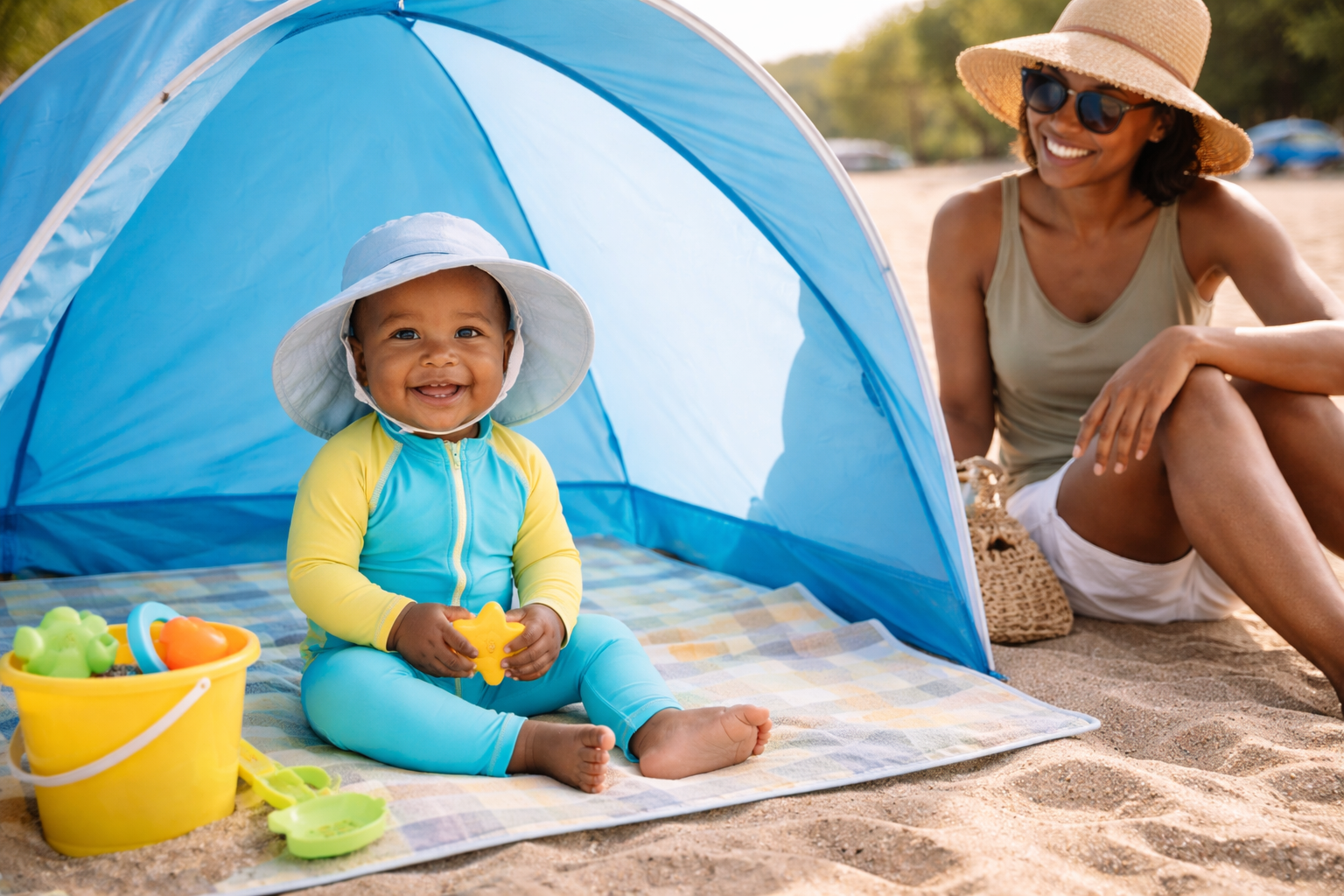
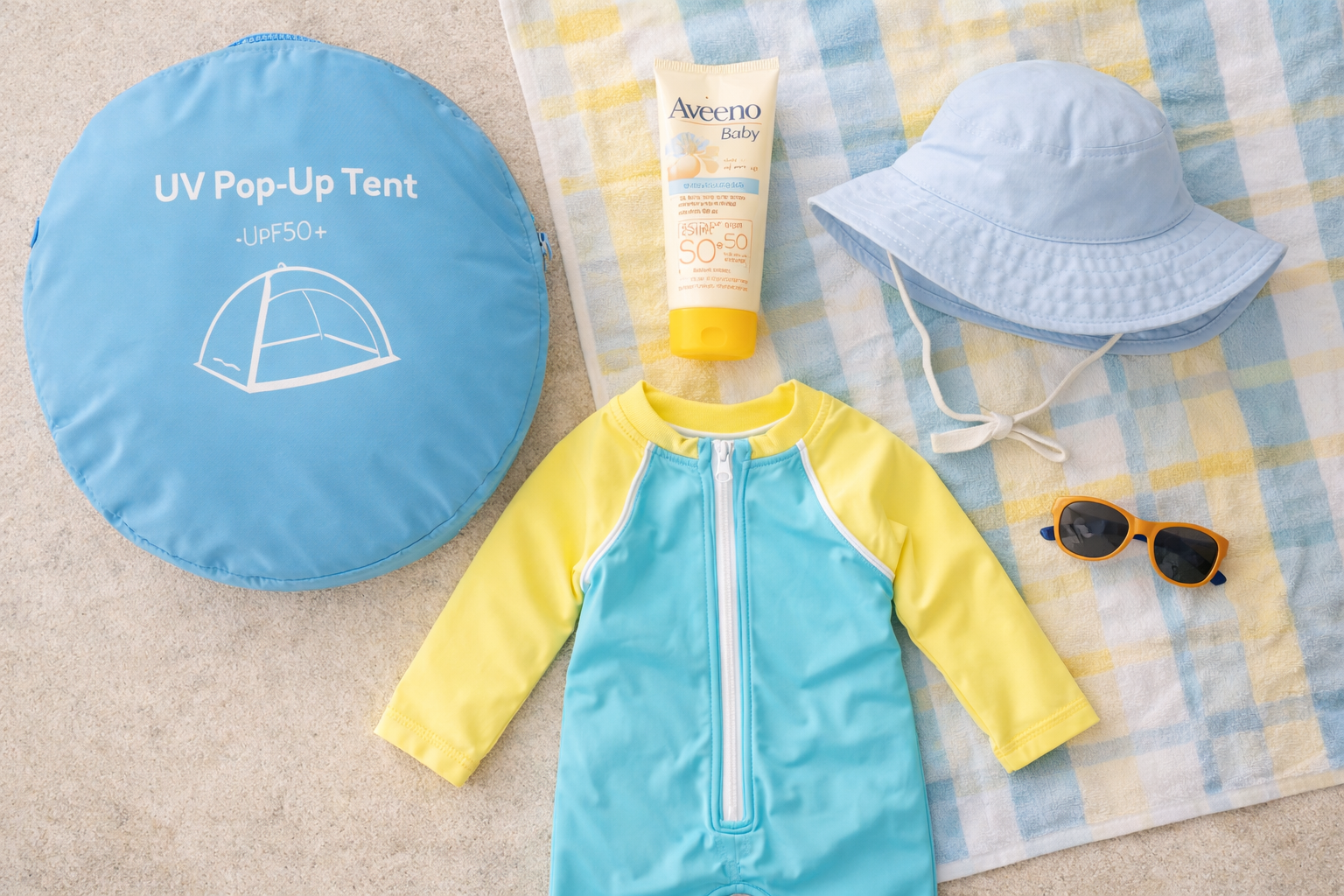
- Essential gear: UV pop-up tent, wide-brim hat with chin strap, UPF 50+ swim suit
- Best strategy: beach before 11am, shade or indoors 11am–3pm, beach after 3pm
The Key Rules — Stated Clearly
These rules come from NHS sun safety guidance and are worth knowing upfront rather than piecing together from multiple sources.
Babies under 6 months should be kept out of direct sunlight entirely. Their skin is thinner, more sensitive, and absorbs more through its surface than adult skin. Sunscreen is not recommended at this age — the chemicals can be absorbed in ways that are poorly understood. The protection for under-6-month babies is shade, lightweight clothing that covers arms and legs, and a wide-brim hat. That's it. A UV pop-up tent on the beach, an extendable stroller canopy, and careful timing covers virtually every beach scenario.
From 6 months, sunscreen is appropriate. Use SPF 50+, broad-spectrum (covering both UVA and UVB), designed for babies or sensitive skin. Apply it 20 minutes before going outside — not as you're heading out the door. Reapply every two hours, and after every swim or towel-dry regardless of the elapsed time.
Avoid the midday sun (11am–3pm) at all ages. This is the rule that matters most. Cloudy days are not safe days — up to 80% of UV penetrates cloud cover. At a UV index of 6 or above (standard for a UK summer, significantly exceeded in the Mediterranean), even brief unprotected exposure causes skin damage. Plan your day around this window rather than fighting it: beach before 11am, shade or indoors 11am–3pm, back outside after 3pm. This pattern also happens to align well with the post-lunch nap, which is a genuine bonus.
Understanding the UV Index
📋 Free Baby Holiday Packing Checklist
Enter your email and we'll send the free printable checklist straight to your inbox — every category, ready to tick off before every trip.
The UV index tells you how strong the sun's ultraviolet radiation is at a given time and location. It's the most useful tool for planning outdoor time with a baby, and it's worth knowing what the numbers mean for different destinations.
| UV Level | Risk | Action needed | Example destinations |
|---|---|---|---|
| 1–2 | Low | Sunscreen optional; hat recommended for under-6-month babies | UK winter, cloudy UK days |
| 3–5 | Moderate | Sunscreen on exposed skin, hat, limit 11am–3pm sun | UK spring/autumn, Ireland |
| 6–7 | High | SPF 50+ essential, seek shade 11am–3pm, UV clothing for babies | UK summer, northern France |
| 8–10 | Very High | SPF 50+ + UV clothing + shade midday; under-6-months indoors 10am–4pm | Spain, Italy, Greece, Portugal in summer |
| 11+ | Extreme | Full sun protection at all times; babies in shade or indoors during daylight peak hours | Dubai, Canaries (summer), tropical destinations |
Check the UV forecast for your holiday destination before you travel — the Met Office UV index forecast covers the UK; most holiday weather apps show UV index for international destinations. If you're travelling with a baby under 3 months to a UV 8+ destination, it's worth discussing timing with your health visitor or GP before booking. See our destination guides for European beach holidays with a baby and Dubai with a baby for more specific advice.
Shade Strategies
Shade is your primary defence — sunscreen and hats supplement it, they don't replace it. Four practical approaches for a beach or pool holiday:
UV Pop-Up Tent
The most useful sun safety purchase for beach holidays with under-2s. A UPF 50+ pop-up tent creates an instant shaded zone that blocks over 98% of UV radiation. Baby can play, nap, and feed inside it while you're at the beach. Most fold back into a carry bag the size of a large pizza box. Worth every penny for a Mediterranean or tropical trip — and increasingly useful for UK summer beaches too. Compare the top options in our best baby beach tent reviews.
Stroller Canopy
The stroller canopy is the most-used sun protection on any holiday. An extendable, UPF-rated canopy covers significantly more than a standard hood. Check your pushchair's canopy coverage before a hot-weather trip — some travel strollers have minimal canopies that leave legs and feet exposed. Our hot weather stroller guide covers the best canopy coverage options.
Timing
The simplest shade strategy is not being outside when the sun is most dangerous. A morning session at the beach (8–10:30am), a return for lunch and nap, then an afternoon session (4–7pm) gives you substantial outdoor time while avoiding the worst of the UV. This pattern also aligns naturally with a baby's nap schedule — not a coincidence.
Restaurants and Outdoor Eating
Choose tables with umbrellas or overhead canopies. If no shade is available outside, eat inside. In Mediterranean countries, outdoor restaurant shade is usually generous — the locals have been managing this for generations.
Pro Tip: Sand and water both reflect UV radiation significantly — up to 80% reflection from water and 15% from dry sand. This means UV exposure at the beach is higher than elsewhere even in shade, because reflected rays reach underneath umbrellas and canopy edges. Keep this in mind particularly for fair-skinned babies.
Sun Protection Gear
Sunscreen (6 Months+)
The key criteria: SPF 50+ minimum, broad-spectrum (both UVA and UVB protection — check the label), fragrance-free, and formulated for sensitive or baby skin. Water resistance is important for beach and pool days. Three well-regarded UK options (we rank them all in our best baby sun cream guide):
- Childs Farm SPF 50+ Sunscreen Lotion. Made in the UK, developed for sensitive and eczema-prone skin, fragrance-free. Available in most UK supermarkets and pharmacies. Widely recommended by NHS paediatric teams for babies. Around £7–£9 for 100ml. View on Amazon
- La Roche-Posay Anthelios Baby SPF 50+. French pharmacy brand with a strong dermatology reputation. Fragrance-free, highly water-resistant, gentle formula. The go-to recommendation from many dermatologists for baby skin. Around £18–£22 for 100ml — more expensive but a firm favourite. View on Amazon
- Soltan Kids Sensitive SPF 50+. Widely available, affordable, water-resistant. A solid choice if you prefer to buy at the destination rather than packing it. Around £8–£12 for 200ml.
Apply sun cream generously — most parents under-apply. For a baby, roughly a 5p-coin-sized amount for the face and a similar amount for each limb is the right scale. Don't forget ears, the back of the neck, and the tops of feet.
UV Suits and Swimwear
A UPF 50+ all-in-one swim suit is the most practical UV protection for beach and pool time. Long sleeves cover the arms, and most designs reach mid-thigh. Look for lightweight, quick-drying fabric and a good range of sizing — babies grow fast and a suit that's tight across the shoulders won't protect properly. See our best baby UV swimsuit reviews for our top picks.
- Splash About UV All-in-One Suit. UK brand, widely available, UPF 50+, good sizing range from 0–4 years. Machine washable. Around £18–£25. View on Amazon
Sun Hats
The hat has to stay on. A beautiful wide-brim sun hat that gets pulled off immediately and discarded in the sand is not protection. The most reliable designs for babies:
- Legionnaire style — a cap with an extended neck flap that covers the ears and back of the neck. Harder to pull off than a standard brim hat, covers the most vulnerable areas (ears, neck), and stays put better in a breeze. This is the most practical beach hat for under-18-months.
- Wide-brim with chin strap — for older babies who tolerate a hat better, a structured wide brim provides full-face and shoulder coverage. The chin strap is non-negotiable — without it, the hat is off in 90 seconds.
Look for UPF 50+ rated fabric and a snug but comfortable fit. Pack one in your hand luggage for the travel day — airports and plane windows let through more UV than most people realise.
Baby Sunglasses
Baby sunglasses exist, and some babies tolerate them. Most don't — they come off immediately and with great enthusiasm. If your baby will wear them, CE-marked lenses with UV400 protection are the standard to look for. But be realistic: shade and hats are more reliable protection for most babies, and a baby who keeps pulling off sunglasses is better served by a deeper hat brim.

Babymoov Anti-UV Sun Protection Tent
Essential for any beach holiday with under-2s
UPF 50+ rated, pop-up in seconds, and folds back into a carry bag small enough to fit at the bottom of a beach bag. Ventilation panels prevent heat build-up while maintaining shade. Fits one to two young children comfortably — big enough to play and nap in, light enough not to be a burden to carry. One of the best-value sun safety purchases for a Mediterranean trip.
- ✅ UPF 50+ — blocks over 98% of UV radiation
- ✅ Pop-up and pack-down in seconds
- ✅ Ventilation panels — keeps the interior cool
- ✅ Ground pegs included — stays put in coastal breezes
- ❌ Not large enough for parents to sit inside with baby — shade zone only for baby
- ❌ Some practice needed to fold back down the first time
Sun Protection Gear Checklist
| Item | Purpose | Age range | Our pick |
|---|---|---|---|
| UV pop-up tent | Shaded zone at beach/garden | All ages | Babymoov Anti-UV Tent |
| Baby sunscreen SPF 50+ | Protect exposed skin | 6 months+ | Childs Farm or La Roche-Posay Baby |
| UV swim suit (UPF 50+) | Full-body UV protection for pool/beach | All ages | Splash About UV All-in-One |
| Wide-brim hat / legionnaire hat | Protect face, ears, neck | All ages | Legionnaire style with chin strap for under-18-months |
| Stroller with UPF canopy | Shade on the move | From birth | See hot weather stroller guide |
| Reusable swim nappy | Pool access for pre-potty-trained babies | Birth to potty trained | Splash About Happy Nappy |
| After-sun / aloe vera | Soothe minor sun exposure | All ages | Pure aloe vera gel (fragrance-free) |

Splash About Happy Nappy (Reusable Swim Nappy)
Pool and beach access from birth — leak-proof and reusable
The gold standard for UK swim nappies — neoprene construction, secure leg seals, and multi-award winning design that's trusted at swimming pools and holiday resorts across the country. Reusable and machine washable, it pays for itself compared to disposable swim nappies within a single week's holiday. Pairs well with a UV swim suit for full beach coverage. See how it compares in our reusable vs disposable swim nappy guide.
- ✅ Leak-proof — accepted at virtually all UK public and hotel pools
- ✅ Reusable and machine washable — cost-effective for regular use
- ✅ Neoprene provides some thermal insulation in cooler UK waters
- ✅ Available in a wide range of sizes and prints
- ❌ Can be tricky to get a perfect size between growth spurts
- ❌ Takes longer to dry than disposable alternatives
Dealing With Sunburn
Despite the best precautions, sunburn can happen. If it does:
- Move baby out of the sun immediately and keep them in shade or indoors for the rest of the day
- Cool the skin with damp cloths — cool water, not ice or ice-cold water
- Apply fragrance-free after-sun or pure aloe vera gel to affected areas. See our guide to the best baby after-sun for options that soothe without irritating delicate skin
- Keep baby well hydrated — extra milk feeds or water if 6 months+
- Give infant paracetamol or ibuprofen (age-appropriate) if baby is in discomfort
- Dress in loose, soft, breathable fabrics — nothing tight over burned skin
Seek medical attention if: baby has severe sunburn with blistering, shows signs of heatstroke (high temperature, rapid breathing, listlessness, hot dry skin, no tears when crying), is under 1 year old with any significant burn, or if you're at all concerned. Heatstroke is a medical emergency — call 999. Cancer Research UK has detailed guidance on sun damage in children.
Managing Heat Beyond Sun Exposure
Sun safety and heat management overlap but they're not identical. A baby in full shade can still overheat. Our guide to keeping your baby cool in hot weather covers heat management in more depth, but a few things are worth knowing here too:
Car seats absorb significant heat. A car parked in direct sun for 30 minutes can reach temperatures that make the seat fabric and metal clips dangerous. Always check the seat temperature before putting baby in, run air conditioning for a few minutes before loading, and park in shade wherever possible. Never leave a baby in a hot car.
Dress baby lightly. A vest and a nappy is perfectly fine in 30°C heat. Overdressing is one of the main causes of overheating in babies. If you're hot, baby is hotter — they regulate temperature less efficiently. A clip-on fan attached to the pushchair frame can help keep air moving on very still, hot days too. See our roundup of the best clip-on pram fans for models that attach securely.
Watch for overheating signs: flushed face, rapid breathing, hot to the touch (check the back of the neck, not the hands), unusual irritability. A mildly overheated baby needs cooling, shade, and a feed. These signs overlapping with listlessness or very high temperature are an emergency — see above.
Air conditioning transitions. Moving a baby repeatedly between 35°C and 18°C can cause respiratory irritability and discomfort. Keep air conditioning at a moderate temperature (22–24°C is reasonable) rather than maximally cold, and have a light cotton layer for indoor environments.
For full hot-weather holiday planning, our hot weather carrier guide covers breathable carrier options and our holiday travel essentials hub has the broader kit picture.
✈️ Free Baby Hand Luggage Checklist
Never forget the essentials. Enter your email and we'll send the free checklist straight to your inbox — one page, every category, ready before every flight.
Frequently Asked Questions
Can babies under 6 months use sunscreen?
No. Keep babies under 6 months out of direct sunlight entirely — shade, hat, and UV-protective clothing are the only recommended protections. Sunscreen is appropriate from 6 months, using SPF 50+ broad-spectrum formulas designed for baby skin. See the NHS sun safety guidance for full detail.
What SPF sunscreen should I use on a baby?
SPF 50+, broad-spectrum (UVA + UVB), fragrance-free, and formulated for sensitive skin. Apply 20 minutes before sun exposure and reapply every 2 hours — more often after swimming or towelling. Good UK options: Childs Farm SPF 50+, La Roche-Posay Anthelios Baby, Soltan Kids SPF 50. Don't skimp on quantity — generous application matters as much as SPF number.
What time should babies be kept out of the sun?
11am to 3pm is the high-risk window — UV is strongest at this time regardless of temperature or cloud cover. Plan beach and outdoor time for before 11am and after 3pm. This pattern also naturally aligns with the post-lunch nap, which is no coincidence — the hottest part of the day is also the most natural rest time.
What is a UV pop-up tent and do I need one?
A UPF 50+ pop-up shelter that creates instant shade at the beach or in the garden. For any beach holiday with a baby under 2, it's one of the most useful sun safety items you can pack. It pops up in seconds, provides over 98% UV block, and gives baby a cool, safe play and nap space. The Babymoov version (above) is our recommendation — solid quality and a sensible price.
What should babies wear at the beach for sun protection?
A UPF 50+ all-in-one UV swim suit covering arms and legs, a legionnaire or wide-brim hat with chin strap, and sunscreen (SPF 50+) on any exposed skin for babies 6 months+. Under 6 months: no direct sun — UV suit, hat, and shade only. Reapply sunscreen every 2 hours and after every swim.
How do I keep a baby cool in the heat on holiday?
Dress lightly (a vest and nappy is fine in 30°C heat), offer extra feeds and water for 6 months+, park in shade and check car seat temperature before loading, and avoid moving baby repeatedly between extreme heat and strong air conditioning. Signs of overheating: flushed face, rapid breathing, hot to the touch — cool with shade, damp cloths, and a feed.
What are the signs of heatstroke in a baby?
High temperature, hot and dry skin, rapid breathing, listlessness, no tears when crying. This is a medical emergency — move to shade, remove excess clothing, cool with damp cloths, and call 999 immediately. Don't wait to see if it improves. Heatstroke progresses quickly in babies.
What is the UV index and why does it matter for holidays?
The UV index measures radiation strength — from 1 (low) to 11+ (extreme). UK summer reaches 6–7 (high); Mediterranean reaches 8–10 (very high). At UV 6+, brief unprotected exposure causes skin damage. Check the forecast on the Met Office UV page before travelling, especially if your baby is under 3 months.
The Bottom Line
The rules are simple: under 6 months means no sun at all; 6 months plus means SPF 50+ applied properly; 11am–3pm means shade or indoors for all ages regardless of sun cream or cloud cover. The gear that makes a hot holiday genuinely manageable — a UV tent, a good hat that stays on, a UV swim suit, and reliable sunscreen — is a modest investment that makes an enormous practical difference. For the full holiday planning picture, see our first holiday guide and the complete packing list.
Shop Our Recommended Sun Protection
We have tested and ranked the sun protection gear that genuinely earns its place in a baby's beach bag. Here are our full buying guides: