
Travelling With a 3 Month Old: What You Need to Know (2026)
By BabyTravel UK Editorial Team · Last updated March 2026
Three months is often when parents first allow themselves to think about a trip. The relentlessness of the early newborn weeks is easing, feeding is starting to feel manageable, and there may be the first hints of a routine taking shape. The question that follows — is it too soon? — is one we hear constantly. The honest answer is: probably not. The question that matters more is whether you feel ready.
This guide is specifically about travelling with a 3 month old — what this age looks like in practice, why it's actually one of the easier ages to travel with, what types of trip suit it best, and exactly what you need to pack. It's part of our age-specific series alongside our guides for newborns, 6 months, and 1 year old.
Quick Answer: Travelling With a 3 Month Old
- ✅ Is it too soon? No — for most healthy full-term babies, 3 months is fine. First vaccinations are done, feeding is more settled, you know your baby now.
- 🏡 Best first trip: a quiet self-catering cottage within 1–2 hours of home. Familiar exit route, your own kitchen, minimal logistics.
- 😴 Travel advantage: they sleep 14–17 hours in 24, can't roll or move, don't eat solids, and are light enough to carry for hours. This is actually an easy age.
- 🍼 Feeding: breastfeeding is the simplest it will ever be for travel. Bottle feeding needs pre-sterilised bottles, pre-measured formula, and a thermos.
- ⚠️ Health watch: any fever over 38°C in a baby under 3 months is urgent. Know where the nearest A&E is before you need it.
Is 3 Months Too Soon?
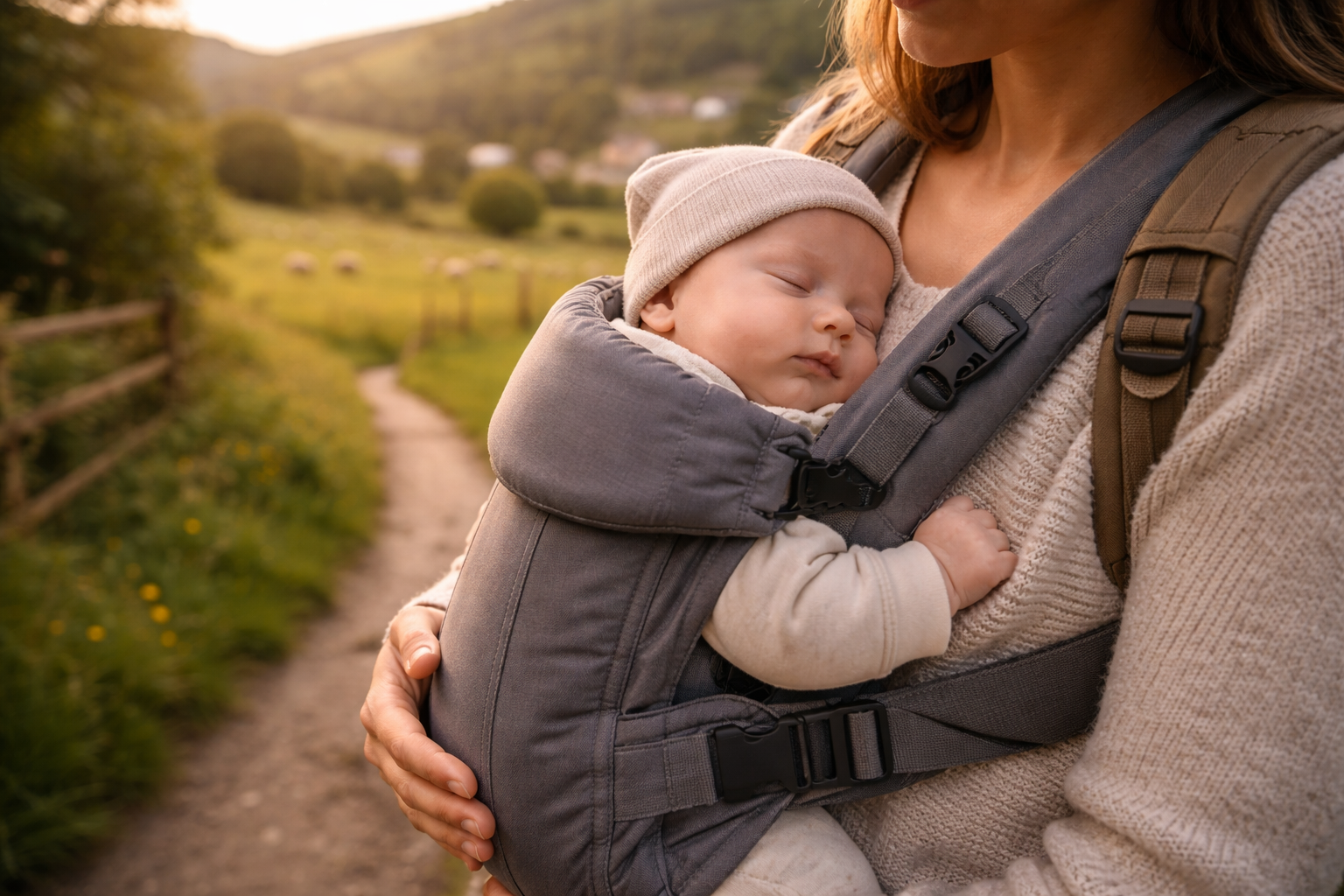
The honest answer: no, for most healthy full-term babies. By 3 months, the umbilical stump has long healed, the first round of vaccinations is complete (given at 8 weeks), feeding is typically more predictable than in the early weeks, and your baby is more alert and interactive. Some parents travel earlier; some wait until 6 months. Neither is wrong. There's no medical threshold that makes 3 months the magic safe date.
What changes at 3 months isn't your baby's readiness — it's yours. You know your baby now. You understand their cues, you know how they feed and sleep, and you've had enough practice at nappy changes and night feeds that doing them somewhere unfamiliar feels less daunting than it would have at 6 weeks. That confidence matters more than any developmental milestone.
The one caveat worth being clear about: if your baby was premature or has had any health complications, speak to your GP or health visitor before planning any trip. For healthy, full-term babies with no complications, 3 months is a perfectly reasonable time to travel.
What 3 Months Looks Like
Before planning anything, a quick developmental snapshot helps — because a 3-month-old is a significantly different travel companion to a newborn, and understanding that changes how you approach the trip.
Smiling and starting to laugh. Social smiling arrives around 6 weeks and is fully established by 3 months. Your baby is now responding to faces, voices, and stimulation in a way that makes them genuinely engaging company. They will smile at strangers in cafés, which makes you instantly forgiven for taking up three extra seats with your travel gear.
Improving head control. Not yet holding their head independently for extended periods, but getting there. A carrier or sling with good head support is appropriate; check the manufacturer's guidance on positioning for this age.
Feeding every 3–4 hours (roughly). Not yet on any rigid schedule for most babies, but the feeding pattern is more predictable than in the newborn weeks. For breastfed babies, this is important for travel planning — you need to be somewhere you can feed comfortably every few hours.
Not mobile. They stay where you put them. They cannot roll, crawl, or reach for objects reliably. From a travel logistics perspective, this is an enormous practical advantage that disappears by 6 months and doesn't return for several years.
The 3-Month Travel Advantage
📋 Free Baby Holiday Packing Checklist
Enter your email and we'll send the free printable checklist straight to your inbox — every category, ready to tick off before every trip.
This is the point most parenting guides don't make clearly enough: in many respects, 3 months is easier to travel with than 9 or 12 months. It feels counterintuitive, but consider what you don't need:
- No solid food — no puréed pouches, no baby spoons, no highchair, no restaurant negotiations about what's on the menu
- No baby-proofing — they don't move, so hotel rooms and cottages need no safety sweep beyond the basics
- No entertainment — they don't yet need toys, activities, or things to do. The ceiling is interesting enough.
- No opinions — they cannot tell you they hate the car seat, object to the accommodation, or demand to go home
- Still lap-flyable at 4–6kg — light enough that a long journey with them in your arms is manageable
They sleep 14–17 hours in 24, which means a significant chunk of any journey passes with them asleep. The engine noise of a car or plane is typically soothing rather than stimulating. They are, in the most practical sense, as portable as they're going to be for the next two years.
Best Trips at 3 Months
A Quiet Cottage Within 1–2 Hours of Home
The classic first trip, and for good reason. A self-catering cottage within a short drive of home gives you your own kitchen (for feeds, for sterilising, for middle-of-the-night bottle prep), your own space (no shared walls, no other guests to disturb), and a quick exit route if things don't go to plan. You don't need to be brave on the first trip — you just need to do it.
Visiting Family
Often underestimated as a holiday, but genuinely valuable at this age. Familiar faces your baby has already met, extra hands to hold them while you shower, someone else cooking at least some of the meals, and a support structure that doesn't exist in a rental property. If grandparents are involved, even better — they get time with the baby, you get rest.
A Gentle Holiday Park
A Centre Parcs or similar park is a surprisingly good choice at 3 months — not for the activities (your baby can't use any of them) but for the facilities. Everything is on-site, the accommodation is comfortable and self-catering, and the pools are warm enough for a 3-month-old's first water experience if you want it. No planning required beyond booking.
A Short Domestic Flight
Edinburgh, Belfast, the Channel Islands — a short domestic flight to a simple destination is absolutely manageable at 3 months. More on flying below.
What to Avoid at This Age
- Long-haul flights — not medically prohibited, but very hard work with a feeding baby and no seat of their own
- Very hot destinations — babies cannot regulate their temperature efficiently at this age; direct strong sun and high heat are genuinely risky
- Remote locations without medical facilities — know where the nearest GP or A&E is wherever you go
- Activity-heavy itineraries — this is not the age for sightseeing marathons. One thing per day is plenty.
Driving With a 3 Month Old
The 2-hour car seat rule applies strictly at this age. A 3-month-old should not be left in a semi-reclined car seat for more than 2 hours at a stretch — the slightly reclined position of a car seat can restrict breathing over longer periods. Plan stops to take your baby out, feed them, and give them time lying flat.
Timing the drive around a feed is the most effective tactic: a full, sleepy baby often drops off within minutes of the car moving and sleeps for the first leg of the journey. When they wake hungry, that's your service station stop. For the detailed breakdown, our car travel with a baby guide covers the logistics fully.
One practical note: when you arrive at your destination after a long drive, move your baby to a flat surface even if they're still sleeping. Do not leave them sleeping in the car seat once the journey has ended.
Flying With a 3 Month Old
Most airlines accept babies from 2 weeks old. At 3 months, your baby weighs roughly 4–6kg — genuinely light on your lap for a short flight, manageable on a medium-length one. The engine noise on a plane is often surprisingly soothing; many 3-month-olds sleep for most of a domestic flight.
The main challenge isn't the flight itself — it's getting through the airport. You have a car seat, a stroller, a nappy bag, your own carry-on, and a baby who needs to be held or worn through security. A carrier or sling is worth its weight in gold for the airport: it keeps your hands free, your baby is secure and calm against your chest, and you move through the terminal without negotiating the stroller through every barrier.
Feed during takeoff and landing — the swallowing motion equalises ear pressure. Breastfeed, offer a bottle, or use a dummy. Most 3-month-olds handle the pressure change without obvious discomfort. Our flying with a baby guide and first flight guide cover the airport and boarding logistics in full. For what to pack, see the hand luggage checklist.
Feeding on the Go at 3 Months
Breastfeeding at 3 months is the simplest it will ever be for travel. No equipment. No temperature. No sterilising. Always available, always the right amount. Feed anywhere — a carrier, a café bench, a train seat, the back of a car. The practical freedom this gives you on a trip is significant. Most cafés and restaurants in the UK are welcoming; if you prefer privacy, a feeding cover gives you options.
Bottle feeding requires more preparation but is entirely manageable. What you need:
- Pre-sterilised bottles (sterilise at home, seal with the teat inverted, bring enough for the journey plus a couple of spares)
- Pre-measured formula in a powder dispenser (more accurate than loose formula in a bag)
- A good-quality thermos of hot water (keeps water hot enough to make formula for several hours)
- Cold-water sterilisation tablets (Milton or equivalent) — essential for trips over one night; they require no boiling, work in any clean container, and are the most practical sterilisation method for travel
For longer stays, a small microwave steriliser is worth packing if the accommodation has a microwave. Most self-catering cottages do.
Sleep at 3 Months
Sleep at 3 months is still variable — some babies have a rough but identifiable routine, others remain entirely unpredictable. The key travel sleep advice at this age is simpler than at 6 or 9 months: you're not "ruining" a routine that's still forming. Flexibility is genuinely your friend.
That said, the basics apply: bring their familiar sleeping environment wherever possible. The same sleeping bag (smell is a powerful comfort signal at this age), the same swaddle if they're still being swaddled, the same white noise if you use it. A portable blackout blind helps, though 3-month-olds are less sensitive to light than older babies who have more established sleep cycles.
Follow Lullaby Trust safer sleep guidance for any new sleep environment — the same principles apply on holiday as at home. See our travel cots and sleep solutions hub for what to look for in a travel cot at this age.

BabyBjörn Travel Cot Light — Best Travel Cot From Birth
Best for: from birth to 3 years | Folds flat in one movement | Around £200–£230
The BabyBjörn Travel Cot Light earns its premium price in two ways: it folds flat in a single movement (no leaning on it, no wrestling with poles), and the mattress is thick enough to use directly as the sleep surface without an additional insert. At 3 months, a flat, firm sleep surface is what you need — and the BabyBjörn delivers it with the minimum of setup faff at the end of a long travel day. The mesh sides give good visibility and airflow. It's heavy relative to budget travel cots at around 11kg, but the fold is so straightforward that most parents find it worth it.
- ✅ Folds flat in one movement — genuinely the simplest setup of any full-size travel cot
- ✅ Thick mattress included — no need for a separate mattress insert
- ✅ Mesh sides — good airflow and you can see your baby from across the room
- ✅ Suitable from birth — flat sleep surface, safe for a 3-month-old
- ❌ Around 11kg — heavier than budget alternatives, noticeable in a car boot
- ❌ Premium price — costs significantly more than a basic travel cot
What to Pack for a 3 Month Old
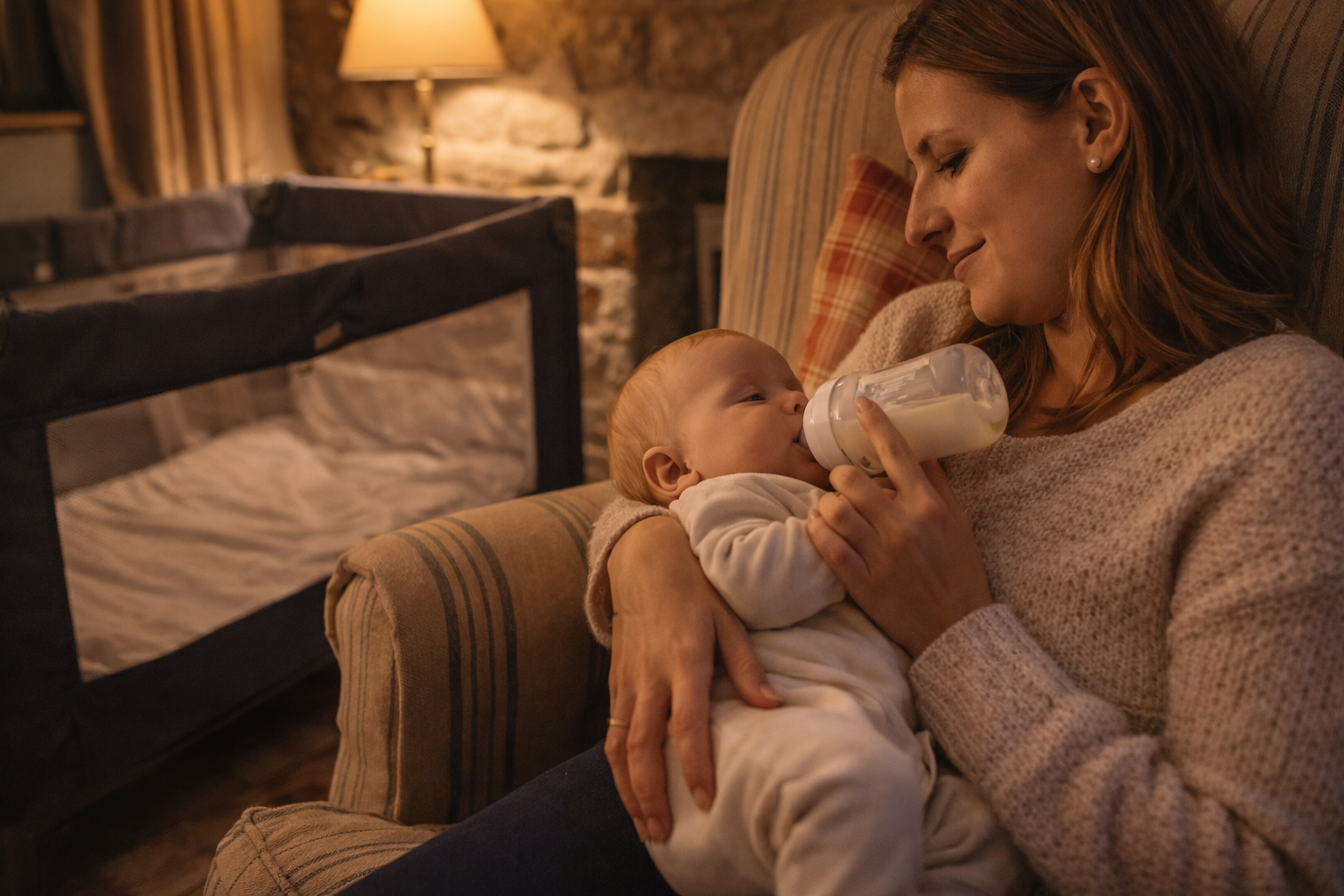
The packing list at 3 months is genuinely shorter than most parents expect — because your baby doesn't eat solids, doesn't need toys, doesn't need baby-proofing equipment, and doesn't have preferences about activities. Here is what you actually need for a short UK trip:
| Category | What You Need | Notes |
|---|---|---|
| Feeding | Breast: nursing pads, feeding cover if preferred. Bottle: pre-sterilised bottles, formula dispenser, thermos, Milton tablets | Breastfeeding needs almost nothing extra. Bottle feeding needs preparation but is very manageable. |
| Nappies & changing | Nappies (more than you think), change mat, wipes, nappy bags, barrier cream | A 3-month-old goes through 8–10 nappies per day. Pack generously. |
| Sleep | Travel cot, sleeping bag (appropriate tog), blackout blind, white noise device or app, familiar swaddle if still using one | The sleep kit is the most important thing to get right. Don't rely on what the accommodation provides. |
| Clothing | 3–4 complete outfit changes per day (vests, sleepsuits, cardigans). Hat if outdoors. Scratch mitts. | 3-month-olds go through more clothing than you'd imagine. Err on the side of too many. |
| Transport | Car seat (essential), carrier or sling, stroller or pram | The carrier is especially valuable for airports and anywhere the stroller can't go easily. |
| Health | Thermometer, infant paracetamol (Calpol — check age guidance), any prescription medicines, GP contact details | Know the address and postcode of your accommodation before you need to call 999. |
| You don't need | Toys, highchair, weaning equipment, baby-proofing kit, sun tent (unless very hot) | Resist the urge to over-pack. The baby doesn't need most of what you're tempted to bring. |
For a fuller list by trip type and duration, our ultimate baby holiday packing list has a dedicated section for babies under 6 months. And for more on setting up travel sleep specifically, see the travel cots and sleep solutions hub.

Dreamegg D11 — Portable White Noise for Any Sleep Environment
Best for: masking unfamiliar sounds in new accommodation | All ages | Around £25–£35
The Dreamegg D11 is compact enough to slip into a changing bag pocket, USB rechargeable (no hunting for batteries at midnight), and produces a consistent loop of white noise that genuinely helps babies sleep in unfamiliar environments. At 3 months, many babies are already conditioned to white noise from use at home — taking the same device on holiday means one continuous audio cue in a new room. The clip attachment works well hooked to a travel cot frame or a curtain rail near the sleeping area. One of the most consistently recommended travel sleep items by parents across all ages.
- ✅ Compact and lightweight — negligible in a nappy bag or suitcase
- ✅ USB rechargeable — no batteries to run out mid-trip
- ✅ Clip attachment — hooks to a travel cot frame or nearby furniture
- ✅ Multiple sound options including fan noise, rain, and heartbeat
- ❌ Volume ceiling is moderate — some noisy environments (road noise, bar beneath the room) may break through
- ❌ No built-in nightlight — if you want that feature too, consider a combined device
3 Months at a Glance — Travel Snapshot
| Factor | Reality at 3 Months |
|---|---|
| Feeding | Every 3–4 hours. Breastfeeding is simplest ever for travel. Bottle feeding needs preparation but is very manageable. |
| Sleep | 14–17 hours in 24. Still variable but typically 2–3 longer stretches. Sleeps well in cars and on planes. |
| Mobility | None. Stays where you put them. Cannot roll, reach, or move independently. Maximum travel convenience. |
| Entertainment needs | Minimal. Faces, voices, gentle movement. No toys needed. No screens. The ceiling is interesting enough. |
| Packing complexity | Low. No solids, no highchair, no baby-proofing. Feeding kit + sleep kit + clothing + car seat = that's it. |
| Best trip type | Quiet cottage nearby, visiting family, gentle holiday park, short domestic flight. Not long-haul or activity-heavy. |
| Health caution | Fever over 38°C needs prompt medical attention. Know where the nearest GP/A&E is. Travel insurance sensible. |
What to Watch for Health-Wise
A 3-month-old is robust compared to a newborn, but still young enough that illness needs to be taken seriously. The most important rule: any temperature over 38°C in a baby under 3 months needs urgent medical attention. Don't take a wait-and-see approach. At exactly 3 months the threshold is slightly less urgent but the principle is the same — consult a GP same day for any fever at this age.
Before you travel, note the address and postcode of your accommodation somewhere accessible on your phone — not just in a confirmation email you'll have to search for while panicking. Know where the nearest GP surgery and A&E is at your destination. The NHS guidance on when to seek urgent help for babies is worth reading before you go.
Travel insurance is sensible for any trip with a baby this age — not because anything is likely to go wrong, but because you may need to cancel at short notice due to illness, and the financial protection is worth the cost. This applies even for UK trips, where cancellation fees on accommodation can be significant.
Pro Tip
The most common first-trip mistake isn't packing too little — it's over-planning the itinerary. A 3-month-old doesn't need to see the castle, the harbour, the famous café, and the beach in one day. One thing per morning. Then feed, nap, and repeat. The holiday is for you as much as for them — build in time to actually sit down.
✈️ Free Baby Hand Luggage Checklist
Never forget the essentials. Enter your email and we'll send the free checklist straight to your inbox — one page, every category, ready before every flight.
Frequently Asked Questions
Is 3 months too young to travel with a baby?
No — for most healthy, full-term babies, 3 months is a perfectly reasonable time to travel. First vaccinations are done by 8 weeks, feeding is usually more established, and the worst of the newborn fog has lifted. Many parents find 3 months easier to travel with than 9 or 12 months — they're portable, they sleep a lot, and they don't yet have opinions. The real question is whether you feel ready.
What type of holiday is best for a 3 month old?
A quiet self-catering cottage within 1–2 hours of home is the classic first trip. Your own kitchen, your own space, and a quick exit if needed. Visiting family is equally valid — extra hands and a familiar environment. A gentle holiday park works well for facilities. Avoid long-haul, very remote locations, very hot destinations, and anything requiring heavy-duty activity planning.
Can a 3 month old fly?
Yes — most airlines accept babies from 2 weeks old. At 3 months they're light, they feed frequently (which helps with ear pressure), and they tend to sleep well on planes. The main challenge is getting through the airport — a carrier is invaluable for keeping your hands free through security and boarding. See our flying guide and first flight guide for full details.
How do I manage feeding while travelling at 3 months?
Breastfeeding is the simplest it will ever be for travel — no equipment, always available, always right. For bottle feeding: pre-sterilised bottles, pre-measured formula in a dispenser, a good thermos of hot water, and Milton cold-water sterilisation tablets for overnight trips. Most self-catering properties have everything you need for bottle prep once you arrive.
What should I pack for a 3 month old on holiday?
Less than you think. Feeding supplies (breast or bottle), nappies and changing kit (pack more than you think), sleep setup (travel cot, sleeping bag, blackout blind, white noise), 3–4 outfit changes per day, a carrier, and a car seat. They don't eat solids, don't need toys, and don't need baby-proofing equipment. For the full list see our packing guide.
How far should I drive with a 3 month old?
Follow the 2-hour rule — babies should not stay in a car seat for more than 2 hours at a stretch. Plan your journey in 2-hour legs with stops in between to take the baby out, feed, and let them lie flat. Time the first leg around a feed for the best chance of a sleeping baby on the road. Full details in our car travel guide.
When should I seek urgent help with a 3 month old on holiday?
Any fever over 38°C in a baby under 3 months is a medical emergency — go straight to A&E. At exactly 3 months, any fever above 38°C warrants same-day GP contact. Also seek help immediately for: difficulty breathing, a rash that doesn't fade under pressure, excessive drowsiness or difficulty waking, or any symptom that feels seriously wrong to you as the parent. Trust your instincts. Know where the nearest A&E is before you travel — check the NHS urgent help guidance.
Travelling with a 3-month-old is more manageable than it sounds from the outside, and more rewarding than many parents expect. The first trip — even a quiet weekend in a nearby cottage — tends to do something important for confidence: it proves to you that you can do this, that your baby is portable, and that the world outside your front door is still there and still welcoming. That's worth something. Take the trip.