
Holiday With a 1 Year Old: The Complete Guide for 2026
By BabyTravel UK Editorial Team · Last updated September 2026
One year old sits at a fascinating point in babyhood — not quite a baby, not yet a toddler, but thoroughly engaging, endlessly curious, and genuinely interactive in a way that makes a holiday feel like a real shared experience for the first time. If you've been putting off your first proper trip, this age is an excellent moment to stop waiting.
This guide covers everything you need to know about a holiday with a 1 year old — the developmental reality of 12 months, the best types of trip for this stage, how to handle the nap transition, feeding on the go, and all the gear that genuinely matters. It's part of our age-specific travel series, sitting alongside guides for 6 months, 9 months, 18 months, and 2 years.
Quick Answer: Holiday With a 1 Year Old
- 🏖️ Best holiday type: beach holiday or holiday park — sand is the best sensory toy ever invented, and pools are endlessly entertaining at this age.
- 😴 Biggest challenge: the nap transition. Many 1 year olds are moving from two naps to one, and missing the single nap ruins the day. Protect it.
- 🍝 Feeding: dramatically easier than at 9 months — they eat what you eat. Finger foods, pasta, bread. Order off the regular menu.
- ✈️ Flying: still lap infant until their second birthday — last year of free flights, so worth doing if the destination justifies it.
- 🎒 Non-negotiables: portable highchair, blackout blind, familiar sleeping bag, white noise. Those four things make or break the sleep situation.
What 12 Months Actually Looks Like
Before planning the trip, it helps to have a clear picture of what your child is actually capable of at this age — because 12 months is a wide developmental range. The NHS 1-year health review gives you a good clinical snapshot, but for travel purposes here's what you're working with.
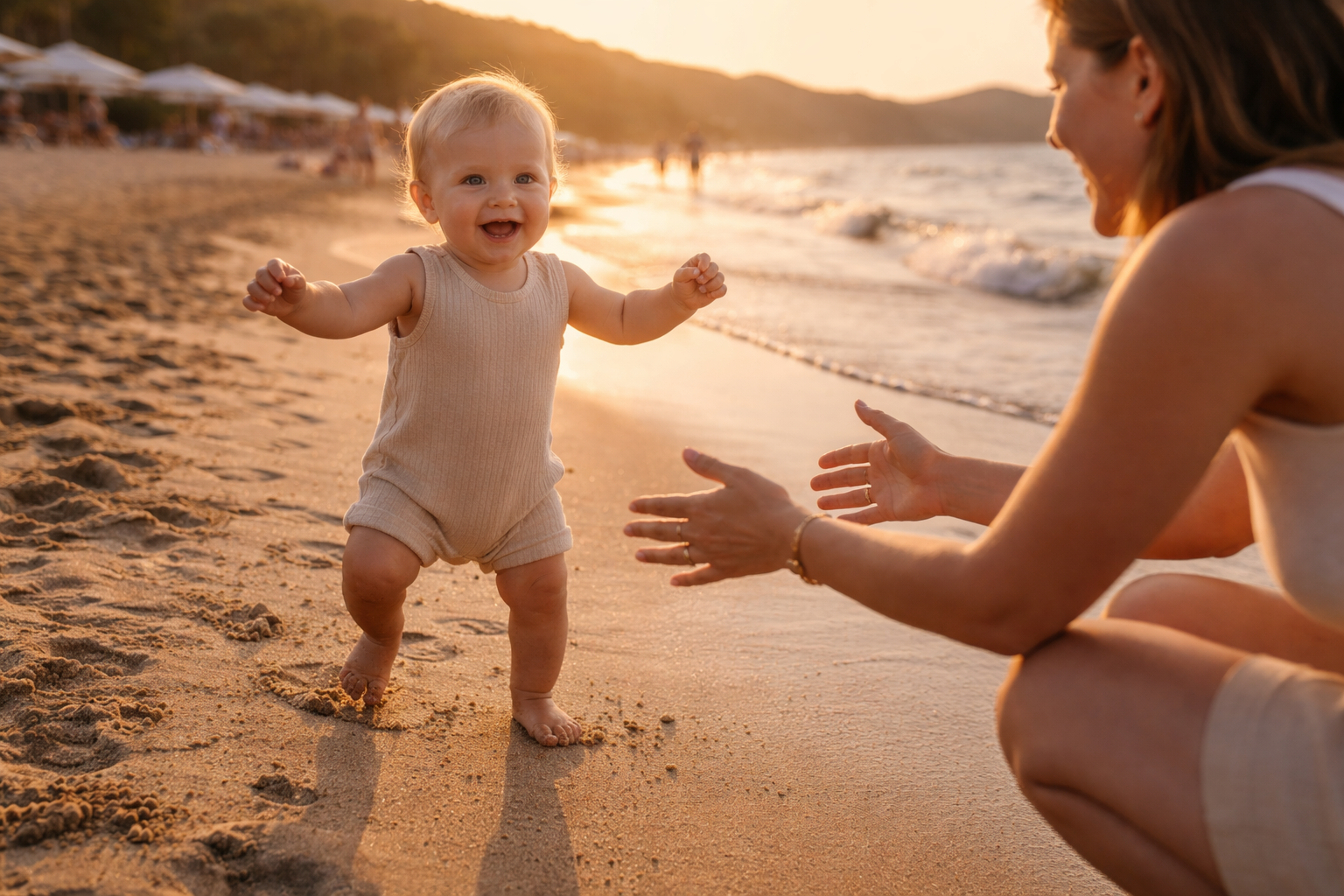
Mobility: most 1 year olds are cruising confidently (walking while holding furniture) and some are taking their first independent steps. Those who aren't walking yet typically are by 15–18 months — no two babies are identical here, and earlier walkers are not more advanced. Either way, they're not yet running, which works in your favour on holiday.
Food: well established on three meals a day plus milk, with a wide range of textures. Most are managing soft finger foods, lumpier purées, and increasingly eating what the family eats. The NHS guidance on feeding young children is a useful reference if you're unsure about specific foods.
Sleep: typically 11–14 hours in 24, split between night sleep and one or two daytime naps. The transition from two naps to one often begins around 12–15 months — more on this below, as it's the main travel complexity at this age.
Social: pointing at everything, waving, clapping, starting to say first words (mama, dada, and whatever they've decided is the most important noun in their life). Stranger awareness is present but less acute than it was at 9 months — they're curious rather than alarmed by new people. They will melt hearts in restaurants by waving at everyone.
Why This Is a Brilliant Holiday Age
One year old is, in many ways, the sweet spot for a first proper holiday. They're old enough to engage meaningfully with the world but not yet old enough to have opinions about where you're going, to demand specific foods, or to run in the opposite direction every time you let go of their hand.
They are genuinely delighted by new environments. The sea, sand between fingers, an animal encountered in a field, a different ceiling to stare at from their pushchair — all of it is completely absorbing. You don't need to arrange activities. You just need to put them somewhere interesting and let them look at things.
They eat what you eat now, which transforms restaurant visits. Gone are the days of packing puréed pouches and sterilised spoons. Order pasta, bread, cheese, banana — they'll eat happily from your plate. Meals out are slow and messy but genuinely enjoyable rather than stressful.
They nap in the buggy, which gives you actual structured downtime during the day. A well-timed push around a pretty harbour town at 1pm can give you 90 minutes of co-parenting peace. This is not to be underestimated.
Best Types of Holiday for a 1 Year Old
📋 Free Baby Holiday Packing Checklist
Enter your email and we'll send the free printable checklist straight to your inbox — every category, ready to tick off before every trip.
Beach Holidays — the Clear Favourite
Sand is quite possibly the greatest sensory toy ever invented for a 1 year old. The texture, the way it pours, the way it sticks, the way everything disappears into it — they will spend hours in happy exploration. Shallow water at the shoreline is equally captivating. A UK beach holiday at this age — Cornwall, Pembrokeshire, Norfolk, Dorset — is genuinely magical and low-effort. They don't need to swim or paddle; they just need to sit near the water and be fascinated.
Holiday Parks — the Practical Choice
If you want a relaxed trip with maximum facilities and minimum planning, a Centre Parcs or Haven holiday park delivers reliably at this age. Pools are well-suited to 1 year olds (shallow areas, gentle water features), soft play is a godsend on rainy days, and the self-contained nature of the site means you don't need a car once you're there. It's not the most exciting environment, but it's the least stressful.
Cottages With Gardens — the Sleep-Friendly Option
Self-catering gives you control over the things that matter most at this age: mealtimes, bedtime, naps, and that 4am feed without waking any other guests. An enclosed garden is invaluable once your baby starts cruising — a safe outdoor space where they can pull up on walls and practise walking without you following them every step. See our guide to the best cottages for babies for what to look for when booking.
City Breaks — Doable, But Paced Carefully
One attraction per morning, then park or play area in the afternoon. That's the city break formula at this age. Museums, galleries, and historic sites are fine if they have accessible paths and a decent café — but your 1 year old will likely be equally engaged by a pigeon on a pavement, so don't over-schedule.
The Nap Transition Challenge
This is the practical complexity that catches most parents out on a 12-month holiday. Many babies begin dropping from two naps to one somewhere between 12 and 18 months — and holidays have a way of accelerating this transition, for better or worse.
If your baby is mid-transition (some days they seem to need two naps, some days they make it through on one), the best holiday strategy is: offer the morning nap opportunity but don't force it, and protect the lunchtime nap fiercely. The lunchtime nap is the anchor — if they only get one sleep in the day, let it be that one.
If your baby has already consolidated to one nap, you're in a simpler position. That single nap is everything. An overtired 1 year old who has missed their one nap is one of the more challenging parenting experiences on offer. Plan your day around it: do the activity in the morning, come back for the nap, go out again in the afternoon. Holiday parks and beach trips fit this rhythm naturally.
Buggy naps are your backup plan. If circumstances prevent the cot nap, a push around a flat seafront path can work well for many babies. It won't give the same quality of sleep, but it takes the edge off and buys you an afternoon. Keep a familiar nap routine even when the environment changes.
Feeding a 1 Year Old on Holiday
The feeding picture at 12 months is genuinely more straightforward than it was six months earlier, and it's worth appreciating that before you start packing pouches you don't need.
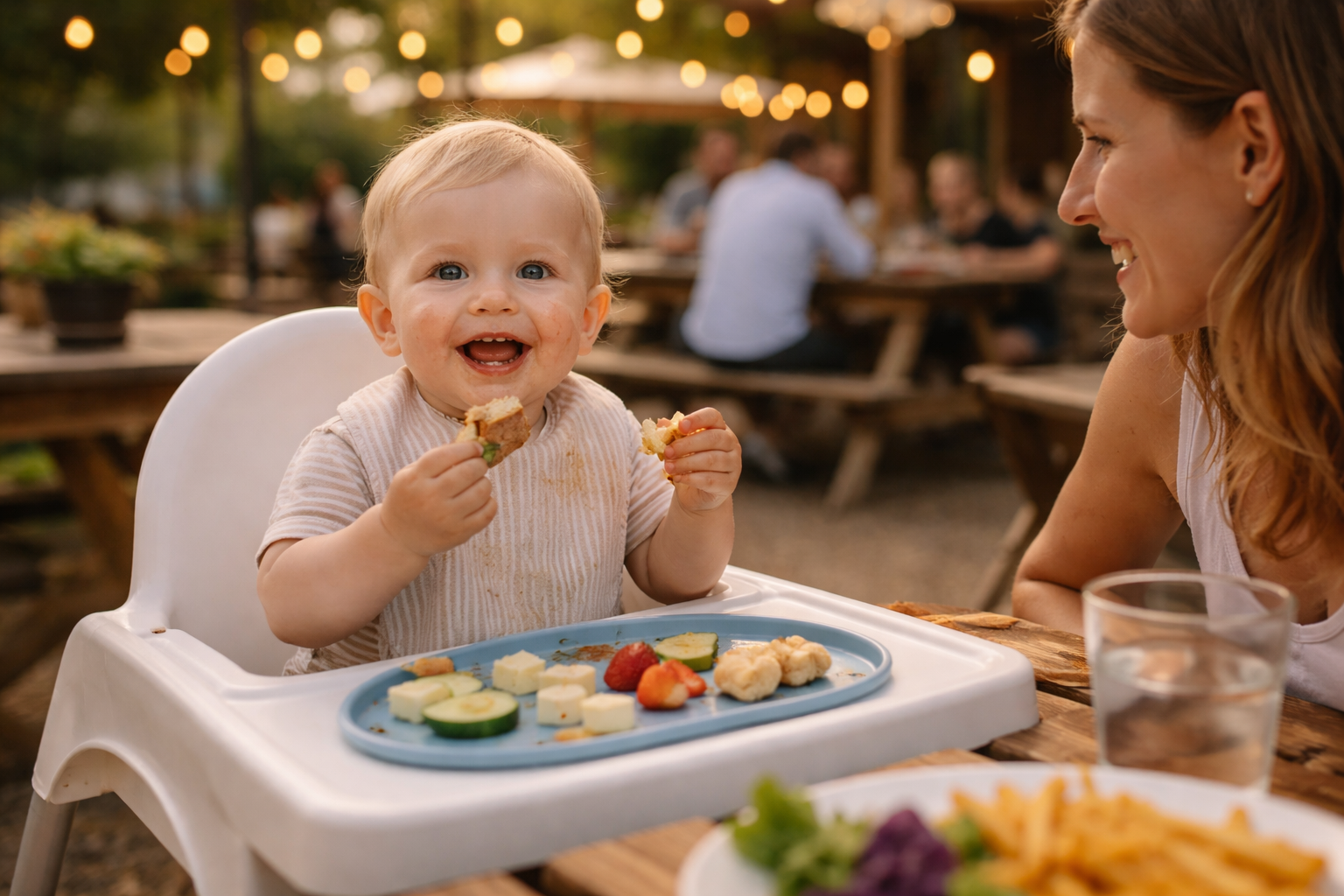
In restaurants: order from the regular menu. Soft pasta, bread, mashed potato, steamed vegetables, soft pieces of chicken, banana, cheese — these are all restaurant-menu items that work perfectly. You don't need a children's menu, though one helps. A 1 year old can share your meal comfortably. The main logistics are: arrive early (before they're hungry and tired), ask for the highchair immediately, and accept that the floor beneath their chair will need attention.
Cow's milk: if the 12-month transition to whole cow's milk is happening during or around the holiday, the good news is that whole milk is universally available in the UK. UHT cartons in small sizes are ideal for travel — no refrigeration needed until opened, available from most supermarkets and petrol stations.
A portable highchair is still worth packing even at this age. Not every restaurant has a suitable highchair, not every rental property has one, and your 1 year old cannot yet sit unassisted at a table for a whole meal. The Inglesina Fast Table Chair clips onto almost any table, weighs under 1kg, and folds flat into a carry bag — the single most useful piece of kit we'd recommend packing alongside the nappies.

Inglesina Fast Table Chair — Best Portable Highchair for Travel
Best for: restaurants, café stops, rental properties | 6 months to 3 years (up to 15kg) | Around £55–£70
The Inglesina Fast clips directly to any table edge — no legs, no straps under the chair, no bulk. At under 1kg it weighs almost nothing in a holiday bag, and the carry pouch means it's always with you. This is the highchair solution for families who eat out regularly on holiday, don't want to rely on whatever the restaurant offers, and are tired of wrestling with highchair straps designed by someone without a baby. The fabric is machine washable for post-holiday clean-up.
- ✅ Under 1kg — negligible weight in a changing bag or beach bag
- ✅ Clips to almost any table — restaurant, café, holiday cottage dining table
- ✅ Machine-washable seat pad — essential for a baby at peak messiness
- ✅ Folds flat into included carry pouch
- ❌ Not suitable for tables without a solid edge to clip onto (glass tops, round pedestal tables)
- ❌ Baby needs reasonable head and trunk control — check the 6-month minimum guidance
Flying at 1 Year Old
Your baby flies as a lap infant until their second birthday on almost all airlines — meaning they travel free on the same ticket as you (you typically pay a small tax, but no seat cost). At 12 months they're heavy — typically 9–11kg — which makes a long flight genuinely tiring on your lap and arms. But this is the last year of free flights, and if the destination justifies it, it's absolutely worth doing.
Entertainment at 12 months on a plane: board books (sturdy, chewable, familiar from home), stacking cups (pack them nested, they give you 20 minutes), snack rotation (offer something new every 30–45 minutes), walks up and down the aisle (they love this, other passengers are approximately 50% charmed and 50% not — accept both reactions), and peek-a-boo with whoever is sitting in the row behind. At 12 months they don't yet understand screen content meaningfully, so save your data.
Feeding during takeoff and landing helps equalise ear pressure — breastfeed, bottle feed, or offer a dummy during ascent and descent. See our complete guide to flying with a baby and first flight guide for full airport logistics and what to put in your hand luggage.
A one-year-old must have their own booked seat to use a child restraint or comfort device. The standard CARES harness starts at 10kg and also requires the child to sit upright unaided, while an airplane bed can only be used during cruise where the airline allows it. For many children at this age, an exact aircraft-qualified car seat is the more supportive option.
Sleep on Holiday at 12 Months
Most 1 year olds are comfortable in a travel cot and sleep well in one — especially if you've been using one at home or for visits to family. The main challenges at this age are specific to 12 months:
Standing up in the cot. If your baby has recently learned to pull themselves to standing — and many do around this age — they will do it in an unfamiliar room at 2am and then not know how to get back down. The solution is the same as at home: go in, put them back down gently, minimal interaction. They learn quickly. The first night is often the hardest.
Early morning waking. Holiday accommodation has thinner curtains than your blackout nursery. A sunrise in July comes at 4:30am in many parts of the UK, and your 1 year old has not signed up to ignore it. A portable blackout blind is genuinely non-negotiable — it's the single cheapest and most effective sleep investment you can make for holiday travel. Follow Lullaby Trust safe sleep guidelines for any new sleep environment.
The sleep sequence. Keep bedtime as close to home as possible: the same order of events (bath if available, milk feed, sleeping bag, dark room, white noise if you use it), the same timing, the same comforter or toy if they have one. The environment is unfamiliar; everything else should be identical. See our travel cots and sleep solutions hub for more on setting up sleep away from home.

Tommee Tippee Grobag Dreamsack — Holiday Sleep Non-Negotiable
Best for: consistent sleep cue across any environment | 6–18 months and 18–36 months sizes | Around £25–£35
A sleeping bag does two things on holiday: it keeps your baby at the right temperature in a new environment where you can't always control the heating, and — crucially — it acts as a powerful sleep cue. Your baby already associates the feeling of being zipped into their sleeping bag with sleep. Taking it on holiday means one familiar sensory signal in an unfamiliar room. The Grobag range covers every tog from 0.5 (hot summer nights) to 3.5 (cool UK cottages in May) — pack the tog appropriate for your destination and the time of year.
- ✅ Familiar sleep cue — the smell and feel of home in an unfamiliar cot
- ✅ No loose blankets — safer and simpler than trying to tuck sheets into a travel cot
- ✅ Machine washable — handles holiday laundry without fuss
- ✅ Available in multiple togs for different temperatures
- ❌ Pack the right tog — arriving with a 2.5 tog in an August heat wave is uncomfortable for everyone
- ❌ Size up if your baby is tall — a too-small sleeping bag restricts leg movement and disrupts sleep
Gear That Actually Matters at 12 Months
The packing list at 12 months is longer than at 3 months (because they're more active) but shorter than it will be at 18 months (because they're not yet running away from you). Focus on the items that genuinely change the experience:
- Stroller with recline — the nap stroller. You need a seat that reclines close to flat, because mid-day buggy naps are your backup plan. See our stroller reviews for options at every budget.
- Portable highchair — see above. Non-negotiable.
- Travel cot — your baby should sleep in their own sleep space. Check our travel cots hub for options.
- Blackout blind — essential. The single most impactful sleep item you can pack.
- Sleeping bag — familiar sleep cue, right temperature in any room.
- Carrier — at 12 months they're heavier, so a structured carrier with waist support becomes more important than a simple ring sling. See our carrier guide for options that work for this weight range.
- A few favourite books and toys — they have clear preferences at 12 months. Pack two or three items they reliably engage with. Leave the rest at home.
For the full checklist approach, our ultimate baby holiday packing list covers everything by age and trip type.
Our Tip
The four things most parents wish they'd packed: a portable blackout blind (not the same as a muslin over a curtain rail), a white noise machine (or a reliable app), a portable highchair, and a familiar sleeping bag. Get those four right and the rest is manageable.
First Birthday on Holiday
Some families plan the first birthday as a destination — a holiday trip that marks the milestone. If this is you, a few gentle notes worth keeping in mind.
Your baby will not remember this birthday. That's not a sad thing; it's a liberating one. It means a cake on the beach, a candle in a pub garden, or a single photograph of them eating cake in the travel cot at 6:30am is genuinely more than enough. You don't need to arrange anything elaborate.
Grandparent expectations may differ. If grandparents were hoping for a first birthday party at home, a holiday trip on the same weekend might require some communication. Most grandparents, when they understand you're all going somewhere lovely together, are enthusiastic. Manage the expectation ahead of time rather than as a surprise.
And practically: stick to your baby's normal day structure as much as possible on their birthday. An over-stimulated, exhausted, missed-nap baby on their birthday makes for memorable photographs but a fairly grim afternoon.
How 12 Months Compares: Age at a Glance
| Factor | 6 Months | 12 Months | 18 Months |
|---|---|---|---|
| Mobility | Sitting up, static | Cruising, early walking | Walking confidently, some running |
| Naps | 2–3 per day | 1–2 (transitioning) | 1 per day (post-transition) |
| Food | Starting solids, mostly milk | 3 meals + milk, family food | Full family meals, opinions forming |
| Restaurant ease | Moderate | Easier — eats from menu | Hardest — mobile and opinionated |
| Flying difficulty | Moderate (sleeping mostly) | Active but manageable | Most challenging age on a plane |
| Engagement | Sensory, limited | Actively exploring everything | Engaging but exhausting |
| Best trip type | Quiet cottage, short drive | Beach, holiday park, cottage | Wide open spaces, active parks |
Sample Holiday Day at 12 Months
Every baby is different and every holiday is different, but this is roughly what a well-managed beach or holiday park day looks like at this age.
| Time | Activity | Notes |
|---|---|---|
| 6:00–6:30am | Wake, milk feed | Early wake almost guaranteed — blackout blind helps push this later |
| 6:30–8:00am | Breakfast, get dressed | Self-catering earns its keep here — cook at your own pace |
| 8:30–11:30am | Beach, playground, pool, or outdoor activity | Best part of the day — they're fresh and the weather is usually best |
| 11:30am–12:30pm | Lunch | Back to accommodation or café; portable highchair earns its keep |
| 12:30–2:30pm | NAP — protect this | Cot nap if possible; buggy nap as backup. The day depends on this. |
| 2:30–5:00pm | Second outing, pool, play | Calmer second activity — they're well rested but not as energetic |
| 5:00–5:30pm | Dinner | Eat early — don't push to 7pm when they're tired and hungry |
| 6:30–7:00pm | Bath, milk, sleep routine | Same sequence as home — same sleeping bag, same songs |
| 7:00–7:30pm | Bedtime | Your evening starts here — which is why self-catering is so useful |
✈️ Free Baby Hand Luggage Checklist
Never forget the essentials. Enter your email and we'll send the free checklist straight to your inbox — one page, every category, ready before every flight.
Frequently Asked Questions
Is a 1 year old too young for a holiday?
Not at all — one is actually one of the most rewarding ages for a holiday. They're engaged, delighted by new environments, eating real food, and still portable enough that you're in control. They can't yet run in the opposite direction consistently, they nap in the buggy, and they find sand, water, and animals genuinely thrilling. Most parents who've done it say they wished they'd gone sooner. If you've been waiting for the right time, this is it.
What type of holiday is best for a 1 year old?
Beach holidays and holiday parks are the sweet spots at this age. Sandy beaches are extraordinary sensory environments for a 1 year old — the texture, the water, the sounds all hold attention for hours without any effort from you. Holiday parks offer pools, soft play, and enclosed outdoor space. Self-catering cottages with gardens are also excellent. City breaks are doable but exhausting — limit to one attraction per morning and have a park planned for the afternoon.
How do you manage naps on holiday with a 1 year old?
Protect the single main nap above almost everything else. Plan your holiday day around it — activity in the morning, nap after lunch, second outing in the afternoon. If the cot nap isn't possible, a buggy nap works as backup. Keep the nap-cue sequence identical to home: sleeping bag, blackout blind, white noise if you use it. At 12 months, a missed nap means a difficult afternoon and an early difficult bedtime.
What do you feed a 1 year old on holiday?
The good news is they eat what you eat now. Order off the regular restaurant menu — soft pasta, bread, cheese, steamed veg, banana are all easy finds. Finger foods work brilliantly for café stops and snacks. Pack a portable highchair as backup. If the cow's milk transition is happening around the holiday, whole milk is universally available in the UK and UHT cartons in small sizes are ideal for travel without refrigeration.
Can a 1 year old fly as a lap infant?
Yes — children fly free as lap infants until their second birthday on most airlines. At 12 months they weigh 9–11kg typically, which makes a long flight tiring on your arms, but it's the last year of free flights so worth taking advantage of. Entertainment on the plane: board books, stacking cups, snack rotation, aisle walks, and peek-a-boo with fellow passengers. Feed during takeoff and landing to help with ear pressure. Full details in our flying with a baby guide.
Is the 12-month sleep regression real?
It's less documented than the 4-month or 18-month regressions, but some babies do experience disrupted sleep around their first birthday — linked to developmental leaps rather than a clinical regression. On holiday, keep the bedtime sequence identical to home, use a blackout blind, run white noise overnight, and don't be surprised if the first night or two is unsettled. Most babies settle within 2–3 nights in a new sleep environment.
What stroller is best for a 1 year old on holiday?
You need a stroller with a good recline — a fully upright seat won't work if you're relying on mid-day buggy naps. A lightweight model with a decent canopy suits most beach and holiday park trips. For destinations with gravel paths, country parks, or mixed terrain, a model with some suspension (like the Joie Pact Pro) handles the surfaces more comfortably. See our full travel stroller reviews.
Should I plan a holiday for my baby's first birthday?
A first birthday holiday can be genuinely lovely — a cake on the beach or a candle in a pub garden is more than enough to mark the day. Your baby won't remember it, which is liberating rather than sad. Manage grandparent expectations ahead of time if they'd hoped for a party at home, and keep the day itself as close to normal routine as possible. An overtired, over-stimulated baby on their birthday makes for a difficult afternoon regardless of how beautiful the location.
A holiday with a 1 year old is genuinely one of the most rewarding travel experiences in early parenthood. They bring so much joy — to you, to other people, to everyone in the restaurant who gets waved at — and they ask so little back from the holiday itself. A stretch of sand, a shallow pool, an enclosed garden, and their normal bedtime is all they need. The rest is for you to enjoy. Take the trip.