
Travelling With a 9 Month Old: 2026 Guide to the Crawling Stage
By BabyTravel UK Editorial Team · Last updated March 2026
No longer a portable bundle — but not quite the running toddler of next year. Here's how to travel with a baby who's just discovered what their legs are for.
Nine months is a threshold moment. Your baby has left the portable, sleeping-through-anything newborn phase behind, but they haven't yet reached the full chaos of toddlerhood. What you have now is something in between: a curious, opinionated, newly mobile little person who wants to explore every surface, put everything in their mouth, and absolutely will not sit still on your lap for a two-hour flight without putting up a fight.
Travelling with a 9 month old is entirely doable — many families have brilliant holidays at this age. But it does require a different mindset to the 6-month sweet spot, and a few specific bits of kit that earn their place. This guide covers everything you need to know: what the developmental stage means for your trip, where to go, how to handle flying and car journeys, and how to keep feeds and sleep on track when you're away from home. For a broader picture, see our first holiday with a baby guide.
Travelling With a 9 Month Old: Key Points
- Mobility: most babies are crawling; many are pulling to stand — accommodation needs a quick safety sweep on arrival
- Feeding: three meals a day plus milk — a kitchen or at least a kettle is non-negotiable
- Best trip type: self-catering cottage with an enclosed garden, or a holiday park where the environment is already contained
- Biggest challenge: everything goes in the mouth — you'll spend the holiday scanning the floor within a two-metre radius
- Flying: harder than at 6 months (they want to crawl); easier than at 18 months (they can't run yet)
What Does Travelling With a 9 Month Old Actually Look Like?
Nine months is a significant developmental leap. According to NHS developmental milestones, most babies at this age are crawling or commando-crawling, pulling up to standing using furniture, and developing their pincer grip — meaning they can pick up tiny objects with alarming precision. They're babbling with what feels like genuine intent, they recognise their name, and stranger anxiety is starting to emerge. That last point matters for travel: the waitress trying to coo over your baby at breakfast may get a very different response than she did three months ago.
They're also on three meals a day (typically), still taking breast or formula milk, and usually sleeping in two naps — morning and afternoon. Bedtime tends to settle around 7pm at this age. The routine is more established than it was at 6 months, which is both a help (predictability) and a constraint (less flexibility).
Compared to travelling with a 6-month-old, the biggest difference is mobility. A 6-month-old stays where you put them. A 9-month-old does not.
| Factor | 6 Months | 9 Months | 12 Months |
|---|---|---|---|
| Mobility | Sitting (with support). Stays put. | Crawling, pulling to stand. Will explore any space. | Cruising furniture, first steps. Unstoppable. |
| Communication | Babbling, smiling. Generally sociable. | Babbling with intent. Stranger anxiety begins. | First words. Pointing. Strong opinions. |
| Sleep | 2–3 naps. Flexible timing. | 2 naps. More structured schedule. | Transitioning to 1 nap. Disrupted travel sleep. |
| Feeding | Milk-led. Early solids optional. | 3 meals + milk. Kitchen essential. | Family meals possible. Still needs highchair. |
| Travel difficulty | Moderate. The sweet spot. | Moderate–hard. Manageable with planning. | Hard. Worth it — but prepare yourself. |
| Best holiday type | Cottage, hotel, holiday park. | Self-catering. Enclosed garden a bonus. | Holiday park, cottage. Avoid city breaks. |
The "Contamination Stage": Everything Goes in the Mouth
📋 Free Baby Holiday Packing Checklist
Enter your email and we'll send the free printable checklist straight to your inbox — every category, ready to tick off before every trip.
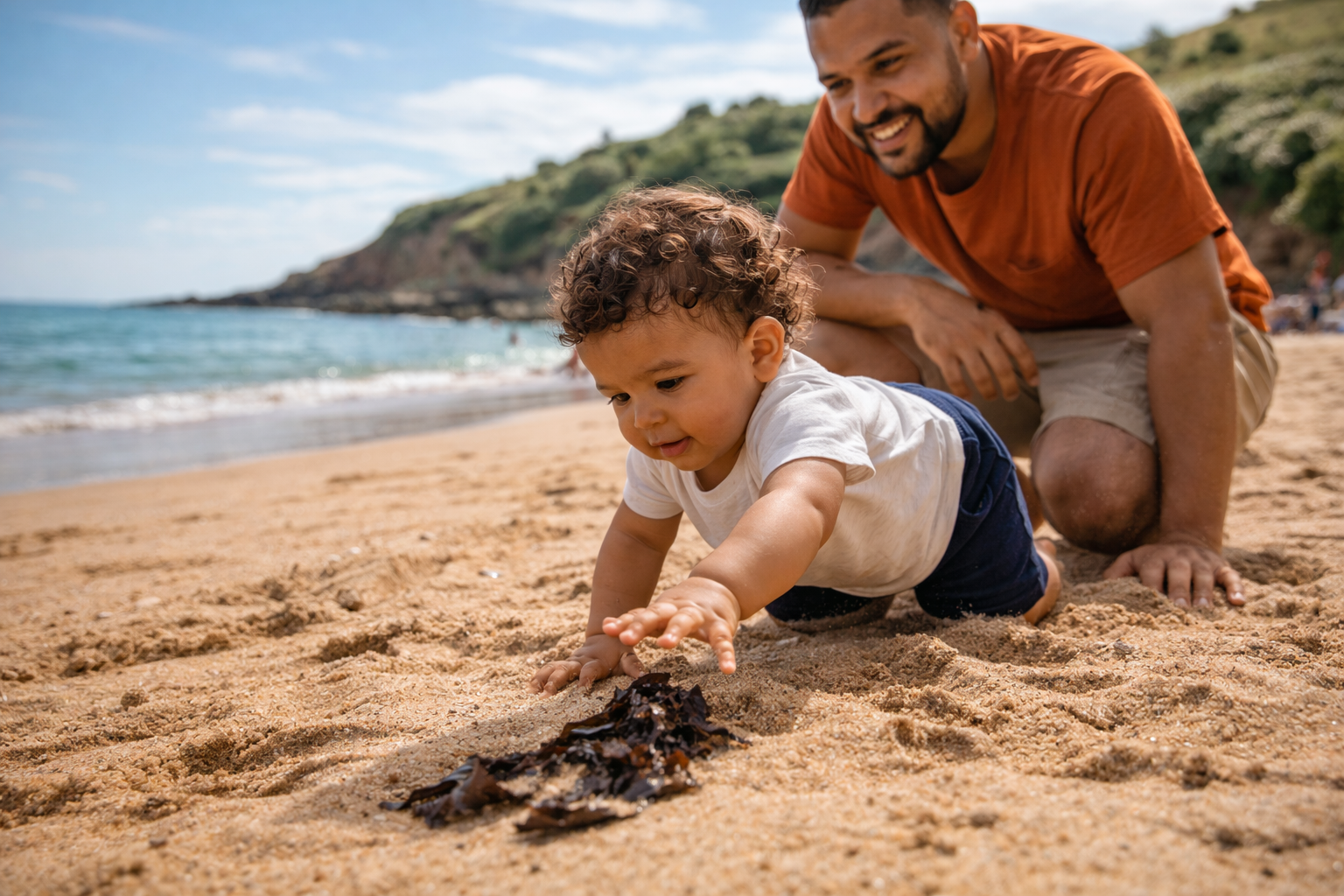
Nine months has an unofficial nickname among parents who've been through it: the contamination stage. This isn't about cleanliness anxiety — it's about the developmental reality that your baby is using their mouth as the primary tool for exploring the world. Sand, leaves, stones, restaurant floor crumbs, other children's toys at the holiday park, the TV remote in the hotel room. All of it goes in.
This is completely normal behaviour, and developmentally healthy. It helps babies build their immune system and understand texture and taste. But it does change how you travel. You're constantly scanning the ground within their crawling radius. You'll find yourself fishing unidentified objects out of their mouth several times a day. The beach is joyful and chaotic in equal measure.
A few things that help: keep wipes within immediate reach at all times (not buried at the bottom of your changing bag), do a quick floor sweep of any accommodation on arrival, and try to relax about the small stuff — a bit of sand won't hurt them. Save your energy for the genuinely hazardous things.
Pro Tip
Pack a small muslin or soft cloth bib that stays around their neck throughout the day — not just for meals. At this age, the drool-to-meal ratio is roughly equal, and having something to wipe their face and hands quickly makes the contamination stage considerably more manageable on holiday.
The Best Holidays for a 9 Month Old
Self-catering wins at this age, and it's not particularly close. You need a kitchen to prepare three meals a day, a cot or somewhere suitable for the travel cot, and ideally a contained outdoor space where your baby can crawl on grass without you chasing them into a car park. That combination makes a UK cottage or lodge with an enclosed garden the gold-standard choice.
Self-Catering Cottages
A baby-friendly self-catering cottage is the most practical option at 9 months. You have a kitchen for meals and bottle prep, space to set up the travel cot in a separate room, and the flexibility to eat whenever your baby's schedule demands it. A garden makes a genuine difference — at this age, letting them crawl on grass while you have a cup of tea is basically the definition of a successful holiday moment.
Holiday Parks
Holiday parks are excellent for 9-month-olds for one key reason: the environment is already set up for families. Haven and Centre Parcs both offer baby-friendly lodges or chalets, on-site restaurants with highchairs, and grounds that are pleasant for buggy walks. The contained, traffic-free layout is a particular relief when you have a newly mobile baby who needs floor time.
Beach Holidays
Sand is a sensory paradise for a 9-month-old. They'll pat it, taste it (see above), crawl through it, and be endlessly fascinated by the texture. A sandy beach is genuinely one of the better natural environments for this developmental stage — low-hazard, endlessly interesting, and forgiving if they fall. British beaches in summer can be brilliant. Cornwall, Devon, and the North Norfolk coast all work well.
City Breaks: Harder Than You'd Think
City breaks at this age are harder. Hotel rooms rarely have much clean floor space for crawling, they're not baby-proofed, and the combination of prams on cobblestones, busy restaurants, and limited outdoor space can make what should feel like a treat feel like an endurance event. If a city break is on the cards, an Airbnb with a living room gives you considerably more space than a standard hotel room.
Baby-Proofing Your Holiday Accommodation
Your home is (probably) baby-proofed. Your holiday accommodation is not. A newly mobile 9-month-old will find every plug socket, every trailing cable, every table corner, and every small object on the floor within about three minutes of arriving. Do a quick safety sweep before you unpack.
The basics to address on arrival: move small objects (TV remotes, coasters, decorative items) out of reach; check for plug sockets at crawling height and use the socket covers you packed; look for trailing cables; and if there are stairs, position your portable pressure-fit stair gate — the Lindam Portable Pressure Fit Stair Gate is a solid pick that needs no tools and works in most doorways. This sweep takes about five minutes and makes the rest of the holiday considerably more relaxed.
Corner protectors are optional — most parents find that supervising closely is enough, and packing foam corner guards is one more thing to carry. But if your baby is particularly adventurous (and some 9-month-olds absolutely are), a few stick-on protectors weigh almost nothing. For a full guide to safety-checking holiday rentals, our Airbnb with a baby guide has a detailed arrival checklist that applies to any self-catering accommodation.
Flying With a 9 Month Old
Your baby is still a lap infant at 9 months and will remain so until their second birthday. That's financially useful (they typically fly free or at a reduced infant fare on domestic and European routes) but logistically interesting — an aircraft seat is not designed for a baby who wants to crawl.
Managing the flight comes down to a few strategies that experienced parents swear by. First, try to time the flight around a nap. A baby who sleeps through the first hour of a two-hour flight makes everything more manageable. Second, bring a set of completely novel toys — things they've never seen before — and introduce them one at a time to buy 15 minutes of engagement each. Third, feeding during ascent and descent helps with ear pressure; breastfeeding, a bottle, or even a pouch works. Fourth, walking up and down the aisle is not only permitted, it will make you extremely popular with the other passengers.
Our Tip
When booking flights, request a bulkhead seat (the front row of a cabin section) — these have the most floor space, and some airlines provide a bassinet mount for infants. Call the airline after booking to add an infant to your booking and request the bassinet at the same time. It won't hold a 9-month-old, but the extra legroom for crawling matters.
A 9-month-old flight is harder than at 6 months (they want to move) but easier than at 18 months (they can't run yet, and the concept of negotiation is still ahead of you). For full flying guidance, see our flying with a baby guide and the baby hand luggage checklist.
Feeding a 9 Month Old on Holiday
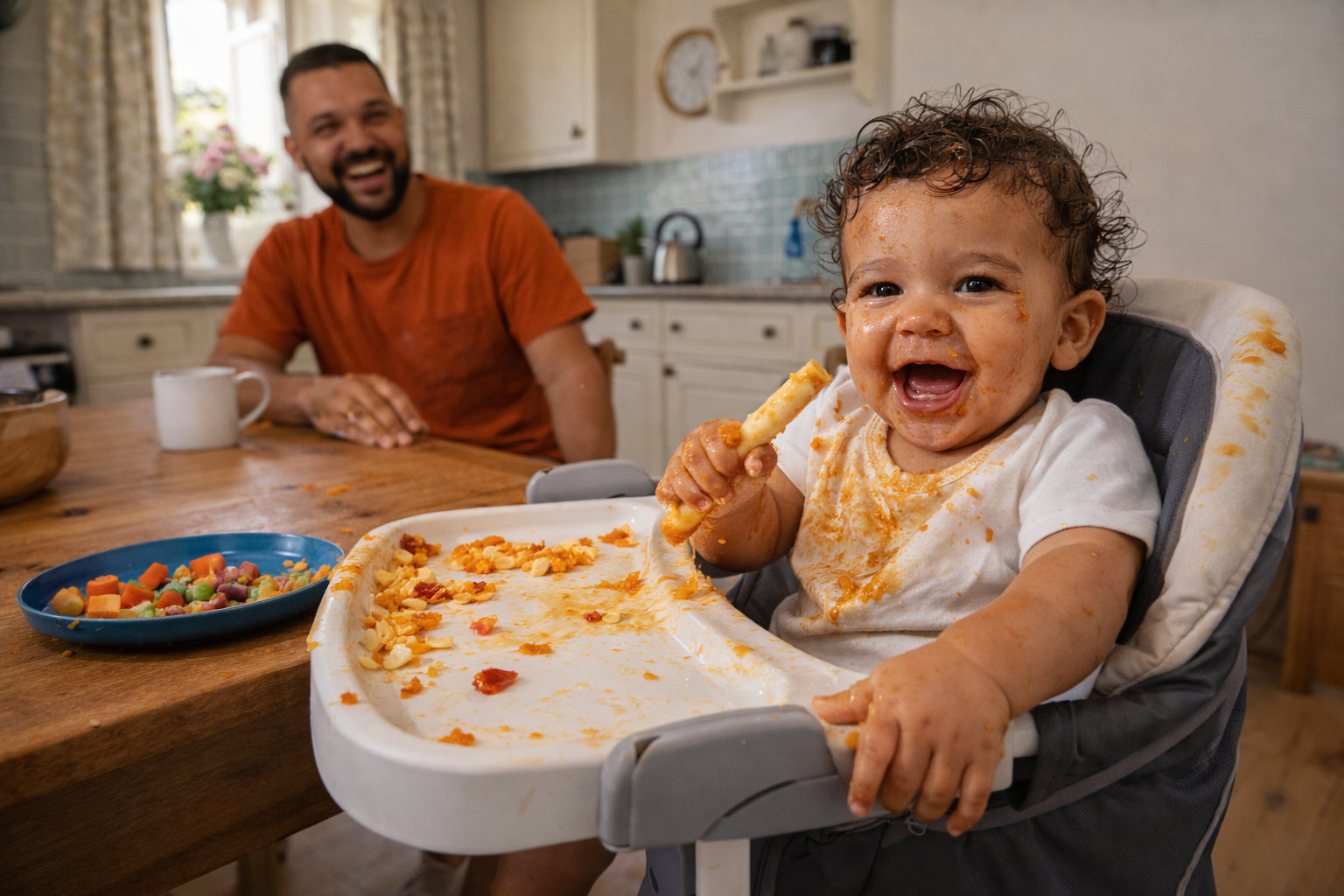
At nine months, you're firmly in the weaning phase — three meals a day plus milk feeds, according to NHS weaning guidance. This makes a kitchen genuinely essential rather than a nice-to-have. You need somewhere to heat purees, mash bananas, cook pasta, and store opened pouches. Self-catering accommodation is the clear winner for this reason alone.
For restaurants, order from the regular menu rather than hunting for a children's menu — soft mashed potato, plain pasta, ripe banana, avocado, toast, and soft-cooked vegetables are available almost everywhere and work perfectly as finger foods. Pouches are a brilliant backup: light, shelf-stable, and able to keep a hungry baby happy while you wait for food to arrive.
Mess management on holiday deserves its own paragraph. A 9-month-old eating is an exercise in chaos management. Pack a handful of large muslins or a splash mat, bring multiple bibs, and make peace with the fact that the floor under their highchair will need cleaning after every meal. A portable travel highchair earns its place enormously at this age — it attaches to any solid table, and means you're not dependent on the restaurant or accommodation having one that's clean and suitable.

Inglesina Fast Table Chair — Our Pick for Holiday Dining
The Inglesina Fast Table Chair clips directly onto any solid table edge, weighs under 1kg, and folds completely flat for packing. It's the portable highchair we rate most highly for travel — particularly at the 9-month mark when sitting independently in a highchair makes mealtimes dramatically easier for everyone. Suitable from 6 months to around 3 years (up to 15kg).
Pros: incredibly compact and light; no suction cups or floor contact needed; secure on most table edges; easy to wipe clean after the inevitable mess.
Cons: won't work on tables without a solid lip to grip; not suitable for tables with pedestal bases. Check the table type before you commit. Typically around £60–£70.
View on AmazonSleep on Holiday With a 9 Month Old
At nine months, most babies have two naps a day — a morning nap (typically 9–10am) and an afternoon nap (1–3pm) — plus a night sleep starting around 7pm. The morning nap is the one to protect. Miss it and you'll spend the rest of the day dealing with a baby who's overtired and increasingly hard to settle. The afternoon nap is more flexible and can happen in the buggy if needed.
The first night in a new place is almost always the hardest. Separation anxiety is starting to emerge at this age, and being in an unfamiliar room without the usual sleep cues can result in unsettled settling — even in babies who are usually good sleepers. Don't panic if night one is rough. By night two or three, most babies adapt. Bring every sleep cue you use at home: their sleep sack, white noise, the blackout blind.
A travel cot in a separate room (or at least a screened-off area) makes a significant difference to everyone's sleep. Babies at this age are more aware of their surroundings, and a travel cot in the same room as you can mean every parental movement wakes them. If you can position the travel cot in a hallway or adjoining room, do it.
For detailed guidance on keeping naps and bedtime on track away from home, our routine on holiday guide covers this in depth. For safe sleep away from home, the Lullaby Trust has clear guidance on travel cot safe sleep practices that's worth reading before you go.

Tommee Tippee GroAnywhere Portable Blackout Blind — Worth Every Penny
Holiday cottage bedrooms are rarely as dark as the one at home. The Tommee Tippee GroAnywhere Portable Blackout Blind sticks to any window with suction cups, blocks out effectively, rolls up into a compact carry case, and comes off without marking the glass. At nine months, when your baby is sleeping in an unfamiliar room and every environmental variable matters, a proper blackout makes a real difference.
Pros: genuinely blocks light rather than just reducing it; fits most window sizes; easy to put up and take down; reusable across many trips.
Cons: suction cups can lose grip on very smooth or cold glass — press firmly and recheck after 10 minutes. Typically around £20–£25.
View on AmazonGear That Matters at 9 Months
Nine months shifts the gear equation noticeably. Your baby now wants to look at the world (not just be carried through it), they need feeding equipment everywhere you go, and they're heavy enough that a carrier-only approach to a full day out is genuinely tiring. Here's what earns its place:
The Stroller
At 9 months, your stroller needs to work in two modes: reclined for naps on the move (the afternoon nap in the buggy is a staple of this age), and upright so your curious, alert baby can see what's happening around them. A travel stroller that only lies flat or only sits fully upright is a compromise — the best picks at this age offer both positions. See our travel pushchair reviews for the options we rate most at this stage.
The Carrier
A carrier remains essential at 9 months for the terrain no stroller can manage: beaches with soft sand, cobbled streets, steep paths, and anywhere with steps. At this age, the hip carry position works brilliantly — your baby is facing outward, seeing the world, and you have both hands free. The Ergobaby Omni Breeze handles all carrying positions and is worth considering if you're investing in a carrier for travel specifically.
Portable Highchair
Non-negotiable at this age. Three meals a day means three opportunities for the accommodation or restaurant to not have a suitable highchair. Bring your own. The Inglesina Fast Table Chair (see above) is our top pick for travel.
Travel Cot and Blackout Blind
Both reviewed above. The travel cot is standard kit; the blackout blind is the one item that surprises parents with how much it improves holiday sleep. Don't leave home without either.
White Noise
A portable white noise machine travels well and recreates one of the key sleep cues from home. The Dreamegg D11 (around £25, available on Amazon) is compact, runs on USB, and has a volume that cuts through surprisingly noisy holiday environments.
9-Month Travel Gear Checklist
| Item | Why It Matters at 9 Months | Priority |
|---|---|---|
| Travel stroller | Reclines for naps; sits upright for an alert, curious baby | Essential |
| Baby carrier | Beach, cobblestones, anywhere the buggy can't go | Essential |
| Travel cot | Safe, familiar sleep environment away from home | Essential |
| Portable highchair | Three meals a day — don't rely on accommodation/restaurants | Essential |
| Blackout blind | Holiday bedrooms are rarely dark enough; transforms sleep quality | Essential |
| White noise machine | Recreates home sleep cues; drowns out unfamiliar sounds | Highly recommended |
| Portable stair gate | Multi-storey accommodation with a crawler = essential safety kit | If stairs present |
| Socket covers | Your baby will find every plug socket within minutes of arriving | Recommended |
| Food pouches (x6–8) | Backup meals for travel days and restaurant waits | Recommended |
| Extra muslins / bibs | You need significantly more than you think you do | Recommended |
| Sleep sack / grobag | Familiar sleep cue; don't use loose blankets in a travel cot | Essential |
For the complete packing list — including nappies, change bag contents, and medication — see our baby holiday packing list and holiday travel essentials guide. If you're travelling by car, our car travel guide covers journey planning, stop frequency, and how to manage naps on long drives.
✈️ Free Baby Hand Luggage Checklist
Never forget the essentials. Enter your email and we'll send the free checklist straight to your inbox — one page, every category, ready before every flight.
Frequently Asked Questions
Is 9 months a good age to travel?
Yes — it's harder than 6 months but very manageable with the right preparation. Your baby is engaged and curious about new environments, and they're not yet running (which comes later). The main considerations are their mobility (they'll crawl everywhere), their feeding schedule (three meals a day means you need a kitchen), and their sleep routine (protect the morning nap). Many families have brilliant trips at this age.
What type of holiday works best with a 9 month old?
Self-catering accommodation with a kitchen — a cottage, lodge, or holiday park chalet — is the most practical choice. You need to prepare three meals a day, and the flexibility of your own space makes routines far easier to maintain. A beach holiday or countryside cottage with an enclosed garden suits the crawling stage particularly well. City breaks with hotel rooms are harder but doable if you book somewhere with decent living space.
How do I manage a 9 month old on a flight?
Time the flight around a nap where possible, feed during ascent and descent to help with ear pressure, and pack a set of novel toys you introduce one at a time. Walking up and down the aisle is entirely reasonable and usually earns you goodwill from other passengers. Short-haul European flights (under 3 hours) are very manageable at this age. Request a bulkhead seat when booking for extra legroom. See our full flying with a baby guide for more detail.
How do I keep my 9 month old's sleep routine on holiday?
Bring all your sleep cues from home — the sleep sack, a blackout blind, and a white noise machine are the three that make the biggest difference. Protect the morning nap even if it means staying at the cottage while your partner goes out. Expect the first night to be unsettled; most babies adapt by night two or three. A travel cot in a separate room (where possible) helps considerably. Our keeping routine on holiday guide covers this in detail.
What should I feed my 9 month old on holiday?
At 9 months, you're offering three meals a day of soft solids plus milk feeds. Self-catering accommodation makes this straightforward — you can cook or prepare whatever you'd make at home. For restaurants, order plain soft foods from the main menu: mashed potato, pasta, ripe banana, soft-cooked vegetables. Food pouches are invaluable as backup for travel days. According to NHS weaning guidance, by 9 months babies should be eating a wide variety of flavours and textures — so don't be afraid to try the local food.
Is a portable highchair worth it for holiday travel?
Absolutely — at 9 months it's one of the most useful items in your bag. Three meals a day means three opportunities for the accommodation or restaurant to not have a suitable highchair available. A table-clip portable highchair like the Inglesina Fast Table Chair weighs under 1kg and clips to almost any solid table. It removes an enormous amount of mealtime stress on holiday.
How do I baby-proof holiday accommodation at 9 months?
Do a five-minute safety sweep on arrival: move small objects out of reach, check for accessible plug sockets (bring socket covers), look for trailing cables, and position a portable stair gate if there are stairs. Corner protectors are optional — most parents find close supervision is sufficient. Our Airbnb with a baby guide has a detailed arrival checklist that works for any self-catering accommodation.
How does travelling with a 9 month old compare to 6 months or 12 months?
At 6 months, babies largely stay where you put them — it's often called the travel sweet spot. At 9 months, they're mobile and into everything, which adds challenge but also genuine delight as they interact with new environments. At 12 months, they may be taking first steps, have stronger opinions, and be transitioning to one nap — which brings its own complications. Nine months sits in the middle: more effort than 6 months, but with the joy of a baby who's truly engaged with the world around them. See our 18-month travel guide to see what's coming next.
The Verdict
Travelling with a 9 month old is genuinely rewarding — this is an age where your baby is curious, engaged, and visibly excited by new environments, and that makes the effort feel worthwhile. The keys are choosing the right accommodation (self-catering, kitchen included, enclosed outdoor space if possible), protecting the morning nap, doing a quick safety sweep on arrival, and bringing the gear that actually moves the needle: a portable highchair, a blackout blind, white noise, and a good travel cot. With those in place, a week away at nine months is less a holiday from normal life and more an adventure in it — messy, occasionally tiring, and surprisingly lovely.