
Travelling With a Teething Baby: How to Cope on Holiday (2026)
By BabyTravel UK Editorial Team · Last updated March 2026
You've planned the holiday for months. Then the day you arrive, your baby's first tooth decides it's ready. Here's how to handle it without losing your mind.
Teething has impeccable timing. It does not care that you've just checked into your holiday cottage, that you have a long flight in the morning, or that your baby slept beautifully for three consecutive nights before you left home. A baby in active teething can go from cheerful to inconsolable in minutes, refuse food they normally love, and wake four times a night in an unfamiliar environment where the sleep props you rely on at home simply aren't available.
The reassuring truth is that teething on holiday is manageable — it just requires a bit of extra preparation and realistic expectations about what the first night or two might look like. This guide covers what to pack, how to tell teething from illness (they can look deceptively similar abroad), how to handle the flight, and when to stop googling and see a doctor. For everything else you need for your trip, see our complete baby holiday packing list and our first holiday with a baby guide.
Travelling With a Teething Baby: Key Points
- Pack both: Infant paracetamol (Calpol) and infant ibuprofen (Nurofen) — you can alternate them for continuous coverage
- Teething ≠ illness: A slightly raised temperature and irritability is usually teething; above 38°C with rash or refusal to drink is not
- On the flight: Feed during takeoff and landing — sucking helps both ear pressure and teething discomfort simultaneously
- Sleep will be disrupted: Expect more night wakings for 2–5 nights. Respond quickly — this is not the time for sleep training.
- Eating may drop: Cold, soft foods work best. Don't stress about nutrition for a few days — milk intake stays stable
- Always bring your GHIC: If you're travelling in Europe and symptoms escalate, you want access to healthcare without the bill
When Teething Typically Happens (and Why It Always Seems to Coincide With Your Holiday)
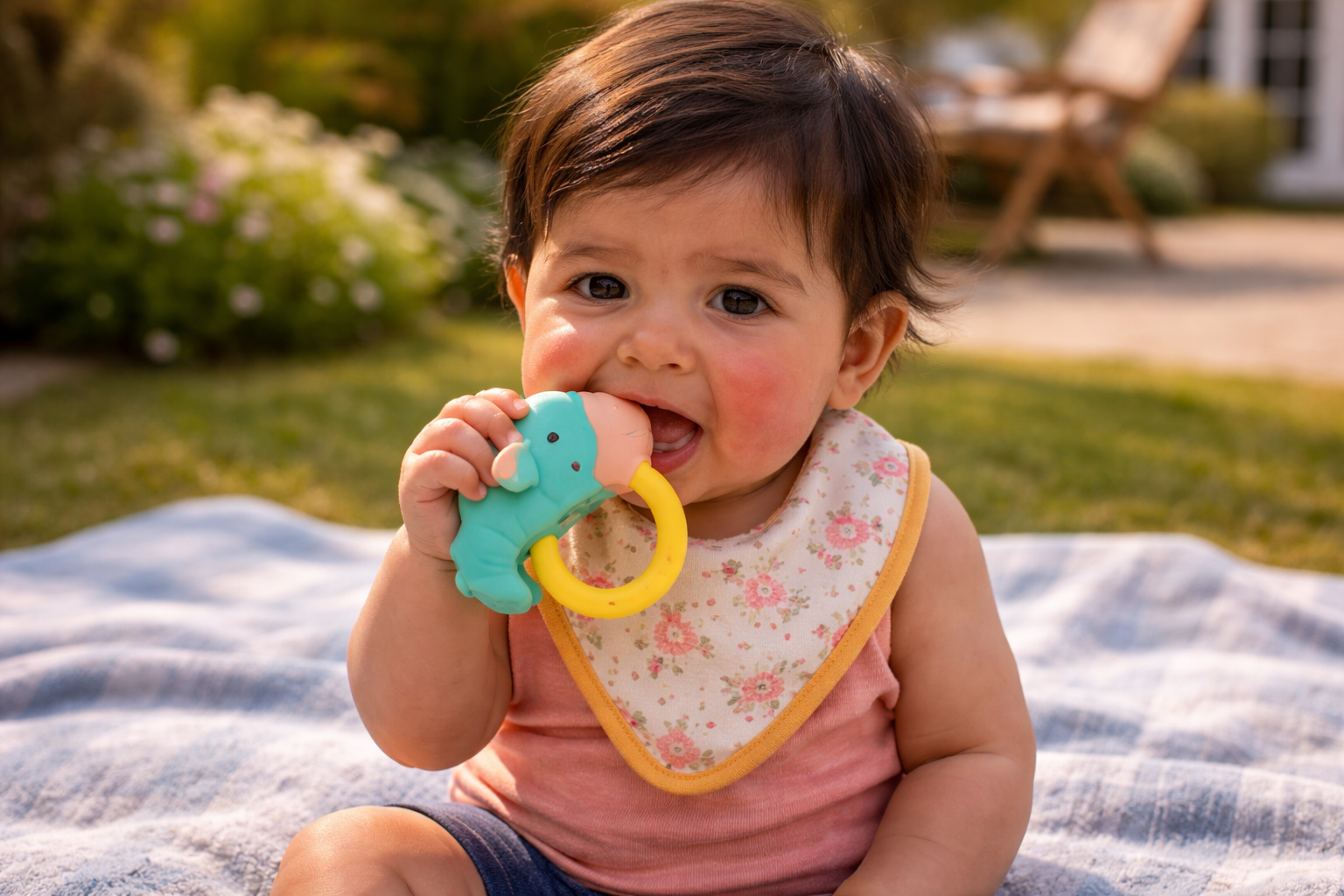
Most babies cut their first tooth somewhere between 4 and 7 months, though the range is wide — some babies arrive with teeth already appearing, others don't cut their first until 12 months, and all of this is normal. The 6–12 month window is the most active period for teething, which unfortunately coincides precisely with the age many parents plan their first proper family holiday.
Crucially, teething pain can begin weeks before a tooth actually breaks through the gum. You might spend several days managing a miserable baby convinced they're about to cut a tooth, only for the gum to settle down again. This pre-eruption phase can repeat multiple times before a tooth appears. The lower front teeth (central incisors) come first, followed by the upper front teeth, then working outwards and back. The second molars, which arrive somewhere around 18–24 months, tend to cause the most discomfort of all.
There's no way to reliably predict when a tooth will arrive, which means the honest advice for any holiday with a 4–18 month old is: assume teething might happen, pack accordingly, and treat it as a manageable event rather than a disaster if it does.
Recognising Teething vs Illness on Holiday
📋 Free Baby Holiday Packing Checklist
Enter your email and we'll send the free printable checklist straight to your inbox — every category, ready to tick off before every trip.
This matters more on holiday than at home because the stakes feel higher. A symptom you'd dismiss as teething in your living room at 9am feels more worrying at 2am in a Portuguese villa. Knowing the difference between teething and something that needs medical attention reduces the anxiety significantly.
| Symptom | Likely Teething | See a Doctor |
|---|---|---|
| Temperature | Slightly raised — 37.5°C or below | 38°C or above in a baby under 3 months; 39°C+ in any baby |
| Drooling | Excessive drooling — often soaks bibs and clothing | Not a concerning symptom on its own |
| Red cheeks | One or both cheeks flushed and warm | Rash spreading across body or face — see a doctor |
| Irritability | Grumpy, unsettled, hard to comfort — but responsive | Unusually lethargic, unresponsive, or a high-pitched cry |
| Chewing | Chewing everything — hands, toys, your finger | Not a concerning symptom |
| Sleep disruption | Waking more at night, difficult to settle | Not a concerning symptom alone |
| Nappy changes | Slightly looser nappies — some babies, not all | Vomiting + diarrhoea together, or refusal of fluids for 8+ hours |
| Feeding | May eat less solids; milk intake usually stays stable | Refuses all fluids for more than 6–8 hours — always seek advice |
The rule of thumb is: if it's teething, your baby is miserable but manageable. If your gut tells you something is wrong beyond discomfort — if they're unusually quiet, not making eye contact, or have any symptom that doesn't fit the teething pattern — trust that instinct and get them seen. A false alarm with a doctor abroad is always better than waiting. See the NHS teething guidance for a full symptom overview.
The Travel Teething Kit: What to Pack
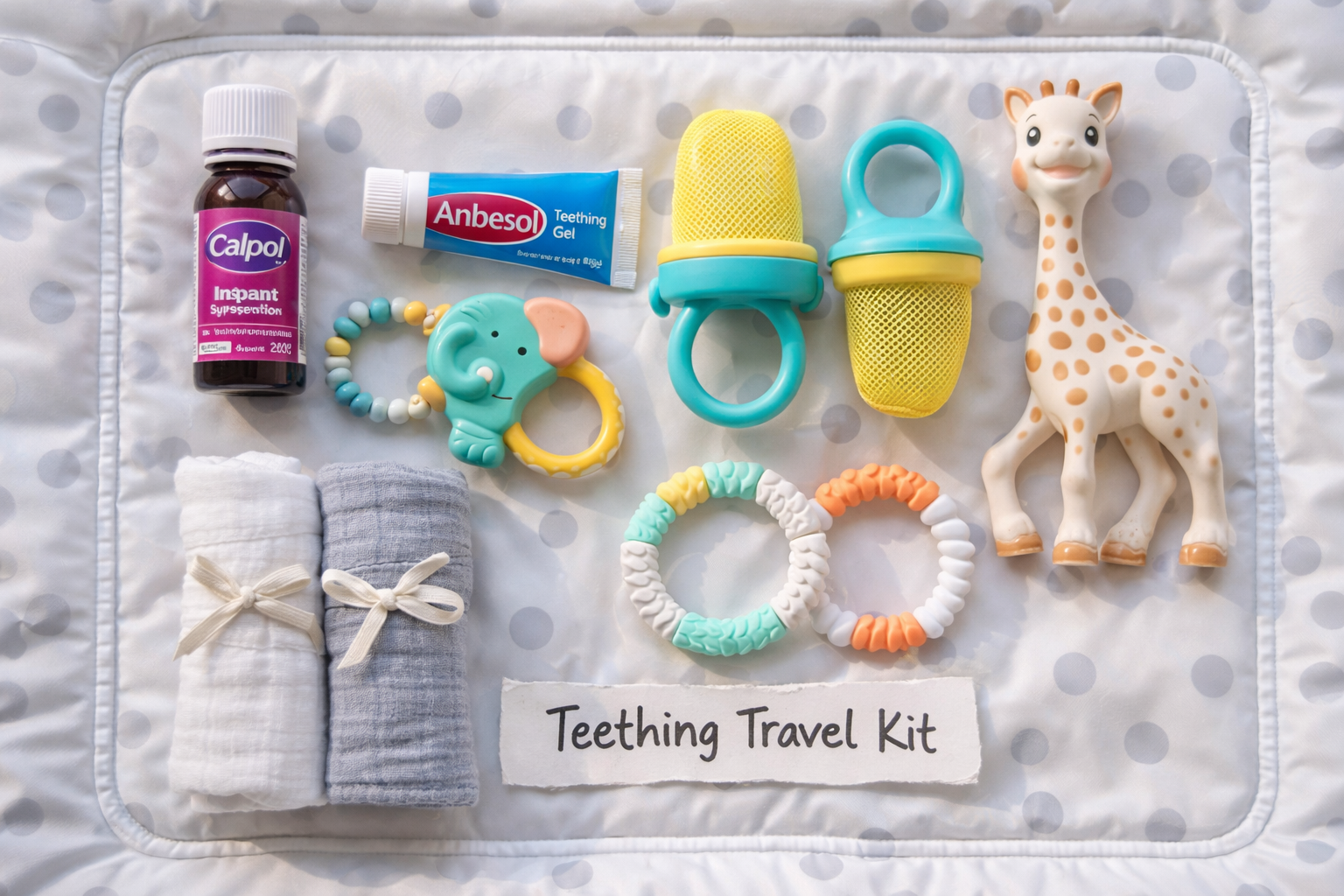
Your regular nappy bag already has most of what you need. For a teething baby on holiday, add these specific items on top of your usual hand luggage essentials:
| Item | Why It's Useful | Notes |
|---|---|---|
| Infant paracetamol (Calpol) | Most effective teething pain relief — works within 20–30 minutes | Check correct dose for your baby's weight before travelling. Passes airport security in baby quantities. |
| Infant ibuprofen (Nurofen for Children) | Anti-inflammatory action — better for gum swelling specifically | Can alternate with paracetamol for continuous coverage. Not for babies under 3 months or under 5kg. |
| Teething gel (Bonjela) | Mild numbing relief directly on the gum | Results vary — some parents swear by it, others find it useless. Worth having in the kit anyway. |
| Teething toy (textured rubber) | Satisfying to gnaw on; textures provide counter-pressure on sore gums | Bring one familiar toy from home — novelty helps, but familiar comfort is more reliable when they're unhappy. |
| Teething ring (chillable) | Cool temperature provides numbing relief on the gum | Impossible to keep cold in transit, but pop in the hotel mini-fridge or cottage fridge on arrival. Use chilled rather than frozen — too cold can damage gum tissue. |
| Mesh fruit feeder | For babies 6m+ — frozen fruit provides cold relief and nutrition simultaneously | Buy fruit at destination. Frozen banana or mango works brilliantly. |
| Teething mittens | For babies 3–5 months who chew their fists but can't hold a teether | Silicone texture on the palm — safer than loose mittens which can come off. |
| Extra muslins (×4 minimum) | Drooling dramatically increases during teething | Pack at least double your usual number — you'll soak through them faster than you expect. |
| Bibs with waterproof backing | Keeps clothing dry from drool — reduces extra outfit changes | Bandana-style bibs are easiest to keep on a wriggling baby. |
Our Tip: Dosage Before You Go
Check the correct paracetamol and ibuprofen dosages for your baby's current weight before you travel — not at 3am in a dark unfamiliar room when you're exhausted and panicking. The NHS paracetamol dosage guide is the definitive reference. Screenshot it and keep it somewhere you can find it offline.

Sophie la Girafe
Natural rubber | Multiple textures | Lightweight | Dishwasher-safe
The original teething toy for good reason — Sophie is made from natural rubber with a textured surface that satisfies gnawing at every angle. The long neck and legs reach back gums, while the head and ears target the front. Lightweight enough that a 4-month-old can grip and bring it to their mouth independently. Its soft squeak provides extra sensory distraction when discomfort peaks. Familiar from home, it provides genuine comfort in an unfamiliar holiday environment.
- ✅ Natural rubber — no harsh plastics
- ✅ Reaches all gum positions (front and back)
- ✅ Suitable from birth
- ✅ Universally beloved — familiar from home
- ❌ Premium price point
- ❌ Do not submerge in water — interior can develop mould

Haakaa Baby Fruit Food Feeder
Suitable from 4–6m+ | Food-grade silicone | Chokesafe mesh | Easy to clean
A mesh feeder lets weaning babies gnaw on whole chunks of frozen fruit safely — the mesh allows flavour and cold relief through while preventing chunks reaching the throat. At a holiday destination, fill with frozen banana, mango, or melon (bought locally) and your baby gets simultaneous cold gum relief and genuine nutrition. Far more effective for teething discomfort than most dedicated teethers, and doubles as a useful weaning tool throughout the trip.
- ✅ Cold relief and nutrition in one
- ✅ Food-grade silicone — no BPA
- ✅ Eliminates choking risk from whole fruit pieces
- ✅ Easy to clean and dishwasher-safe
- ❌ Messier than a standard teether — keep bibs close
- ❌ Best for babies who have started weaning (6m+)
Managing Sleep Disruption From Teething on Holiday
Teething plus an unfamiliar environment is a genuine double hit on sleep. Your baby was starting to find their rhythm in the travel cot, and then their gums start hurting. The first two or three nights of active teething on holiday are the hardest — expect more night wakings than usual, and plan your own rest accordingly (split the night shifts if you can).
What actually helps: maintain the bedtime sequence regardless of where you are. The specific sequence (bath, feed, story, sleeping bag, dark room) matters more than the time on the clock — babies recognise the pattern as a cue for sleep even in an unfamiliar setting. Bring all of your usual sleep kit: the Tommee Tippee Portable Blackout Blind for the window, and a white noise machine like the Dreamegg D11 to mask unfamiliar holiday park or cottage ambient sound. Both are genuinely high-impact for sleep in new environments, teething or not.
If your baby seems uncomfortable at bedtime, give pain relief 20–30 minutes before starting the sleep routine — this is the single most effective thing you can do. Don't wait until they're already distressed to administer Calpol. Proactive pain management at bedtime prevents the overtired spiral that makes resettling so difficult. See our holiday routine guide for the wider picture on sleep away from home.
One honest note: this is not the time for sleep training or enforcing new habits. If your baby needs to be picked up and held, do it. A few nights of extra contact isn't going to create permanent habits — it's what they need while they're in pain and disoriented. You can return to boundaries once the acute phase passes.
Teething and Flying: The Connection Most Parents Don't Know About
There's a physiological reason why teething babies often seem more distressed on flights, particularly during ascent and descent. The jaw and the ear canal share nerve pathways — ear pressure changes during altitude shifts can worsen the perception of gum pain, and vice versa. A baby who was managing their teething discomfort fairly well on the ground may become significantly more upset as the cabin pressure changes.
The good news is that the action that helps ear pressure — sucking — also helps teething. Feed during takeoff and landing (breast or bottle, or a dummy if they use one). A chilled teething ring during the flight can soothe between feeds, and gives them something purposeful to gnaw on rather than just being distressed. If you know your baby is in active teething before a flight, infant paracetamol given 30 minutes before boarding is a legitimate option — discuss with your pharmacist or GP before travelling.
Our flying with a baby guide covers the full picture of flight logistics. For the teething-specific element, the key message is: you're not imagining it — flights genuinely can be harder on teething babies, and having pain relief ready is sensible preparation rather than overreaction.
Teething and Eating on Holiday
Many babies in active teething reduce their solid food intake. Pressing food they're not interested in typically makes things worse — they'll often bat the spoon away before it reaches their mouth. This is temporary, usually lasting 3–5 days per tooth, and it doesn't mean they're not getting adequate nutrition. Milk intake (breast or formula) generally stays stable even when solids drop, which means their nutritional baseline is covered.
What tends to work: cold foods, soft textures, and lower pressure. Yoghurt straight from a cool fridge, mashed banana, chilled cucumber sticks for babies old enough to manage them, ice lolly-style frozen fruit in a mesh feeder. Cold provides both relief and appetite — babies who refuse a warm purée will often accept the same purée served cold from the fridge. At restaurants, ask for cucumber sticks rather than breadsticks — the cool temperature does more than a starchy snack.
For older babies on a self-catering holiday, the flexibility of cooking your own food helps enormously — you can serve exactly what they'll accept at exactly the right temperature. In restaurants, don't stress about a reduced appetite over a few days. Order simply, accept that meals may be short, and carry a banana in the bag as backup. See our holiday essentials hub for portable feeding kit recommendations.
When to See a Doctor Abroad
If you're travelling in Europe, make sure every family member — including your baby — has a valid GHIC card. This gives you access to state healthcare in EU countries on the same basis as a local resident. It doesn't cover private hospitals or repatriation, but it removes the financial barrier to getting your baby seen if you need to.
The symptoms that mean you should stop wondering and get medical advice regardless of where you are:
- Temperature consistently above 38°C (or any fever in a baby under 3 months)
- Refusal of all fluids for more than 6–8 hours
- A rash you can't explain — especially any non-blanching rash (press a glass against it; if it doesn't fade, seek emergency help immediately)
- Unusual lethargy — baby won't respond normally to you, not making eye contact
- A high-pitched or unusual cry, particularly if continuous
- Any symptom that your parental instinct tells you isn't normal
For finding a doctor abroad: your hotel or villa reception is usually the fastest route — they have relationships with local GPs and can make a call you can't. Most European pharmacists speak some English and are an excellent first port of call for assessment before committing to a GP visit. Travel insurance is non-negotiable — make sure it covers your baby from birth and includes medical repatriation. See our European holidays guide for destination-specific healthcare notes.
✈️ Free Baby Hand Luggage Checklist
Never forget the essentials. Enter your email and we'll send the free checklist straight to your inbox — one page, every category, ready before every flight.
Frequently Asked Questions
Can I take Calpol through airport security?
Yes. Infant paracetamol (Calpol) and infant ibuprofen (Nurofen for Children) are exempt from the 100ml liquid restriction when travelling with a baby, provided you carry them in your hand luggage in quantities consistent with your baby's needs for the journey. Declare them separately at security. Most airports are straightforward about this. See our baby hand luggage checklist for the full picture on liquids.
How do I keep a teething ring cold on a flight?
You can't reliably keep one cold on a long flight — ice packs from the airport café melt, and the flight environment doesn't lend itself to refrigeration. A more practical approach: pack a teething ring that's already chilled from home, and use it in the first hour of the flight. For longer journeys, focus on textured teethers at room temperature plus feeding for comfort. At the destination, put the ring in the hotel mini-fridge immediately on arrival.
Does teething cause a high temperature?
Teething can cause a slight elevation in temperature — typically below 38°C — due to the mild inflammation of the gum tissue. It does not cause a genuine fever of 38°C or above. If your baby's temperature reaches 38°C or above, treat it as a fever with a separate cause and seek advice if it persists. The NHS is clear on this distinction: a high temperature during teething needs the same attention as a high temperature at any other time.
My baby won't take a teether — what else can I try?
Clean finger pressure on the gum directly can work well for some babies — apply firm, consistent pressure with a clean fingertip. Chilled (not frozen) cucumber sticks for weaning babies are often better accepted than rubber teethers. A cold wet muslin twisted into a rope and held against the gum is an old-school approach that many parents find genuinely effective. Teething gel applied directly with a clean finger before offering the teether can make the teether more tolerable once the initial numbing takes effect.
Should I postpone our holiday if my baby is teething?
No. Teething is a continuous process from roughly 4 months to 2.5 years — postponing holidays around it isn't practical. With the right kit and realistic expectations, a teething baby on holiday is entirely manageable. The acute discomfort of each tooth typically peaks for 2–5 days and then subsides. Most holidays last longer than that, which means you're likely to have more settled days than difficult ones even if a tooth arrives at the worst possible moment.
Can I alternate Calpol and Nurofen for a teething baby on holiday?
Yes, and this is one of the most effective strategies for managing significant teething pain — particularly at night. Paracetamol can be given every 4–6 hours; ibuprofen every 6–8 hours. Because they work through different mechanisms, you can alternate them to maintain more consistent pain coverage than either drug alone provides. Ibuprofen has an anti-inflammatory action that's particularly useful for gum swelling. Always follow the dosage instructions for your baby's weight, and confirm the approach with your pharmacist before travelling if you're unsure.
Are teething symptoms worse in hot weather?
There's no direct evidence that heat worsens teething pain, but heat does increase general irritability in babies — which can amplify how distressing the teething symptoms feel to everyone involved. Keeping your baby cool and well-hydrated in hot weather reduces the baseline discomfort level and makes teething episodes feel slightly less overwhelming. Avoid peak sun hours, offer extra milk feeds, and use a breathable carrier or shaded pushchair rather than tight swaddling.
What if I can't find Calpol abroad?
Most European countries have equivalent infant paracetamol products available at pharmacies — ask for "infant paracetamol" or "paracetamol pour nourrissons" (French) or "Kindersaft Paracetamol" (German). The dosage is based on weight, not brand. That said, always bring enough from home to last the trip — don't rely on finding exactly the right formulation and dose at an unfamiliar foreign pharmacy while managing a distressed baby.
The Bottom Line
A teething baby on holiday is harder than a non-teething baby on holiday — but it's not a reason to cancel, reschedule, or spend the whole trip in the accommodation. Bring both pain relief medications, pack a teething kit before you leave home, protect one nap a day and the bedtime routine, and accept that a few nights may be rough. For the vast majority of families, the active phase of any single tooth passes within 3–5 days — which means you'll almost certainly come out the other side with some good holiday days ahead of you. See our first holiday guide and the complete packing list for everything else you need.