
I Took My Baby on a Plane at 3 Months: Here's What Happened
By BabyTravel UK Editorial Team · Last updated March 2026
The honest version. Not the one where everything goes perfectly and you land feeling like a seasoned travel parent. The one where you spend the fortnight before the flight convinced you're making a catastrophic mistake, pack enough hand luggage for a week in the wilderness, and spend the actual flight oscillating between "this is totally fine" and "why did we do this." And then land, retrieve the buggy from the door, and think: we're doing that again.
The Short Version
- Flying with a 3-month-old is completely doable — harder in your head than in reality
- The carrier is the single most useful thing through the airport
- Feed on take-off — it actually works
- The nappy situation on a plane is exactly as cramped as you imagine
- The biggest obstacle is your own anxiety, not your baby
The Decision
We booked the flights when our baby was six weeks old. It felt audacious at the time — possibly delusional. We were still learning to leave the house with everything we needed; adding an airport, a plane, and a foreign country seemed like a logical escalation that would absolutely end in disaster. But we'd been looking at the same four walls for two months, and the idea of sitting on a terrace somewhere warm with a cold drink and a sleeping baby felt worth the risk.
The research spiral began immediately. I read every forum thread, every travel blog, every parent's account I could find. The verdict was usefully split: some said it was easy, some said it was traumatic, all of them said something different about what to pack. After three weeks of this I was more confused than when I started. Eventually we just decided to go and find out for ourselves. We were heading to Mallorca. Two and a half hours. Short enough to be survivable; warm enough to feel like it mattered.
If you're at this decision point right now, our guide to travelling with a 3-month-old covers what this stage actually involves — the logistics, the timing, and what to realistically expect.
The Packing
📋 Free Baby Holiday Packing Checklist
Enter your email and we'll send the free printable checklist straight to your inbox — every category, ready to tick off before every trip.
The packing list started reasonably. Nappies, wipes, formula, spare vests, sleepsuit, muslin. Then it expanded. Then it became something else entirely. By the night before the flight, our hand luggage weighed more than our hold bag. We had four muslin squares, two full changes of clothes (baby), one emergency change (me, optimistically), enough formula for a transatlantic crossing, a changing mat, a travel first aid kit, a dummy, a backup dummy, and a selection of toys that a three-month-old cannot yet operate.
I had also, at the last minute, added a portable white noise machine. This was the correct decision. Everything else was negotiable. Our baby hand luggage checklist will save you from a version of this evening.
The Morning Of
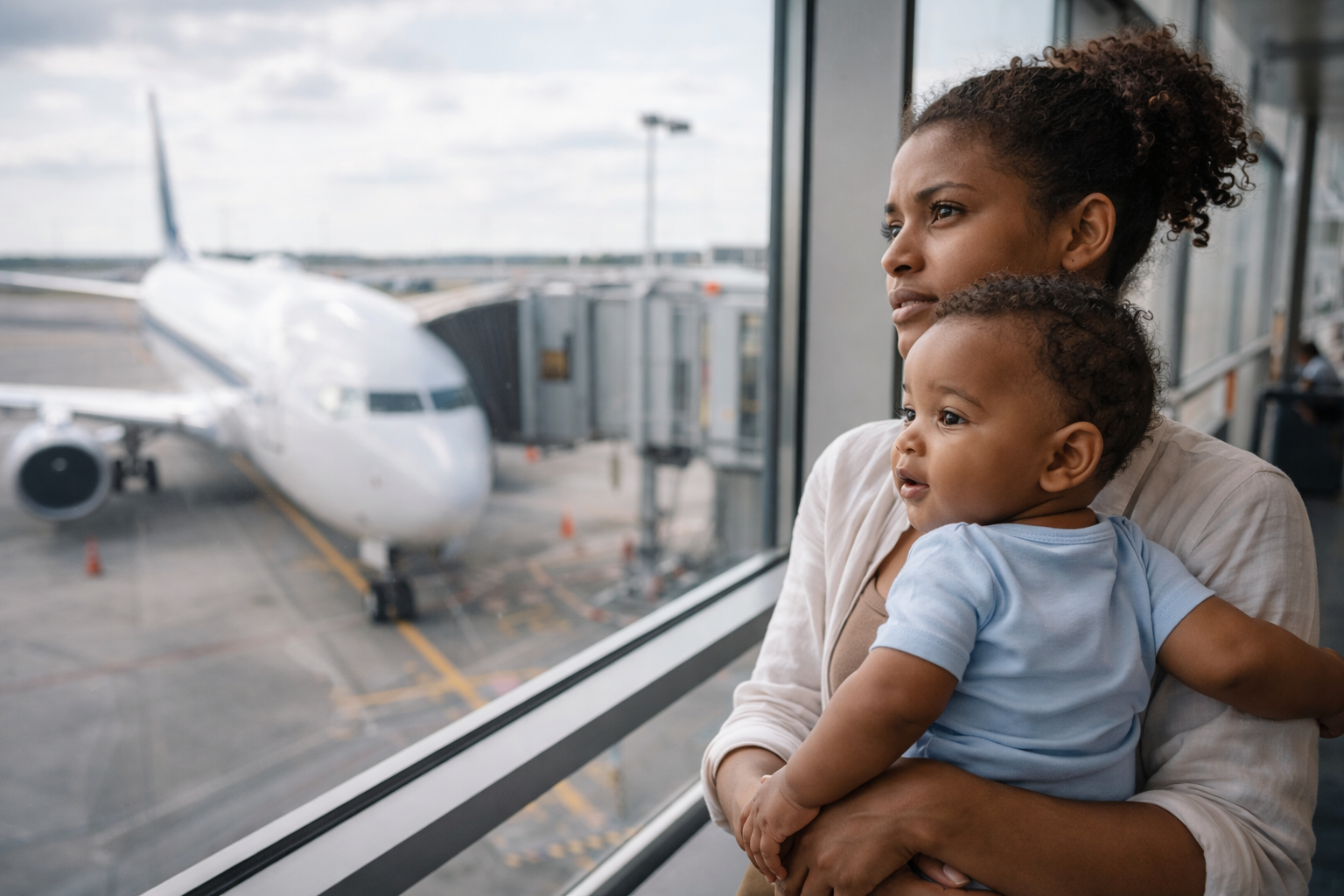
The alarm went off at 4am. We had an 8am flight, which meant a 5:30am taxi, which meant a 4am alarm, which meant we had both been awake since 3am lying in the dark catastrophising. The baby, meanwhile, slept peacefully until 4:15, fed cheerfully, and seemed entirely unbothered by the fact that we were about to do something terrifying.
The taxi driver was a grandfather. He asked how old the baby was, said "they're brilliant at this age, they sleep through everything," and drove us to the airport in companionable silence while we gripped our respective door handles and tried to remember if we'd packed the travel documents. (We had. We'd packed them in the special organiser we'd bought for this exact purpose and then spent twenty minutes convincing ourselves we'd left at home.)
Check-In and Security
Check-in was where the pushchair question got interesting. We'd decided to gate-check it — meaning it travels in the hold but is returned to you at the aircraft door rather than the baggage carousel. This is almost always the right call with a small baby. The desk staff were efficient and unbothered, tagging the pushchair and waving us through. What we hadn't fully anticipated was the distance between check-in and security, walked with a baby in arms, a changing bag on one shoulder, and the quiet knowledge that the pushchair was now someone else's problem until Mallorca.
Security is where a carrier earns its place permanently. We'd strapped the baby in before leaving the car park, and that decision paid dividends the moment we hit the security queue. Shoes off, laptop out, liquids bag in the tray — all done with a sleeping baby against my chest and both hands free. The formula went in a separate tray without complaint from the security staff; declaring it at the desk made the process smooth. Our breast milk and formula at airport security guide covers exactly what to expect so you're not fumbling at the scanner.
The carrier through airport security guide is also worth reading before you go — there's a specific process for going through the scanner with a baby in a carrier, and knowing it in advance saves a stressful conversation at the gate.
The Gate and Boarding
Priority boarding is one of the genuine perks of flying with an infant, and we used it without embarrassment. The extra ten minutes to find your seats, stow the bag, set up the feeding position, and settle in before the rest of the plane boards is genuinely useful. We walked onto the plane to find it largely empty, chose our spots near the bulkhead, and got ourselves organised in a way that would have been impossible in the boarding scrum.
I am aware that some passengers watched us board and mentally reassigned us to "source of possible noise." I chose not to make eye contact. The baby chose this moment to be extremely cute, which helped.
The pushchair was gate-checked and waiting at the aircraft door at the other end — the correct outcome, and the one our guide to flying with a baby and stroller explains how to ensure.
Take-Off
We'd read about the feeding-on-take-off trick — the idea being that swallowing during ascent helps a baby's ears equalise to the pressure change in the same way that yawning or swallowing does for adults. We had a bottle ready. The engines spooled up, the plane began its roll, and we offered the bottle. The baby fed. The ears, presumably, equalised. The passenger in the seat next to us visibly unclenched. I watched the altimeter on the screen in front of me tick upwards and thought: we're doing this. We're actually doing it.
If you want to understand more about what's actually happening with your baby's ears at altitude and whether specialist ear protection is worth considering, our guide to ear protection on planes for babies has the detail.
The Flight Itself
Two and a half hours is a sprint in flying terms. In baby-on-a-plane terms, it contains multitudes.
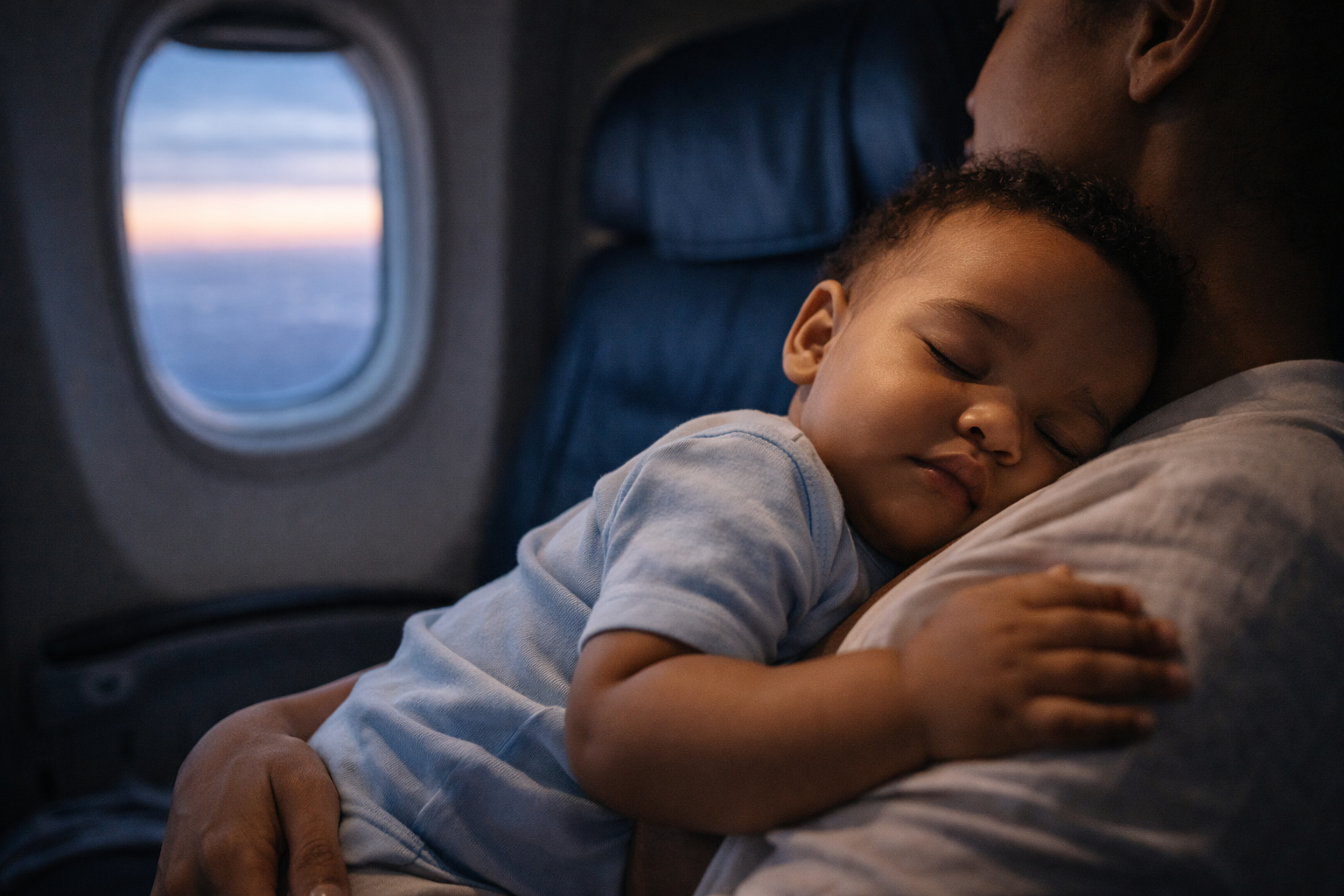
The first forty minutes: bliss. The baby fed, drowsed, and fell asleep against my chest in the carrier. The person next to us read their book. I ate a sandwich. This was going fine. This was, genuinely, fine.
The second forty minutes: a nappy situation. Not a dramatic one — nothing that required a change of everyone's clothes — but one that required the world's smallest changing table in a toilet the size of a generous wardrobe. The changing table folds down from the wall. It is approximately the length of a baby. You operate it with one hand while holding the baby with the other and trying not to rest anything on the toilet seat behind you. It is manageable. We managed it. It took six minutes and a new respect for the phrase "controlled environment."
The third forty minutes: a more vocal period. The baby was awake, fed, changed, and apparently unconvinced that this was an adequate plan for the afternoon. We walked the aisle twice, did a circuit of the galley, accepted the offer from one of the cabin crew to hold the baby while we had a drink (we almost cried with gratitude), and waited it out. It lasted perhaps twenty minutes. It felt longer. Nobody complained. One elderly gentleman smiled and said "my daughter used to do exactly that." This was very helpful.
Landing
The descent announcement came and we prepared for the landing equivalent of take-off: bottle ready, baby positioned, ears crossing fingers. Descent feeding worked less cleanly than take-off — the baby was tired and mildly grumpy and showed limited interest in cooperating — but there were no obvious signs of ear distress, no more crying than there'd been at 30,000 feet, and when the wheels touched down, a small cheer went up from somewhere near the back of the cabin that I chose to believe was for us specifically.
The pushchair was at the aircraft door. We loaded up, walked through arrivals, stepped out into the warmth of a Majorcan afternoon, and looked at each other. We'd done it. Three months old, first flight, entirely survivable. We felt, in a completely disproportionate way, like we'd climbed something.
Looking Back
The flight wasn't easy, exactly. It required attention and organisation and a tolerance for the specific anxiety of doing something new with a tiny human depending on you. But it was completely, entirely doable — and the baby handled it better than we did. The crying spell was short. The logistics were manageable. The fellow passengers were kind. The biggest obstacle the whole time was the version of it we'd constructed in our heads in the two weeks before we flew.
We did it again three months later. That one was easier. Not because the baby was dramatically different, but because we were. We knew what to pack, what to skip, how the airport worked with a small human in tow, and that the worst-case scenario we'd been imagining bore no relation to the actual experience.
If you're thinking about doing this and feeling like it might be catastrophic: it probably won't be. Our first flight with a baby guide covers the practical preparation in detail, and our first holiday with a baby guide helps you build the rest of the trip around this stage. Go. Find out. Come back and tell someone else it was fine.
What I'd Do Differently
- Pack half the hand luggage. We brought far more than we needed. Two nappy changes' worth of supplies is enough for a short flight; I had twelve.
- Put the carrier on before leaving the car park. We wasted ten minutes at check-in faffing with it. It should have been on from the door.
- Request the bulkhead seat at booking, not at check-in. By the time we thought about it, it was gone. A bulkhead seat gives you more floor space and access to the bassinet on longer flights.
- Accept help when it's offered. The cabin crew offered to hold the baby and we hesitated for an embarrassing amount of time. They're trained for this. Let them.
- Have the bottle ready before take-off, not during. Fumbling with formula while the engines are going is entirely avoidable.

Boba Air Ultra-Lightweight Carrier
The carrier that made the airport manageable
The carrier we used through security and the airport — and the piece of kit we'd most recommend for any family flying with a young baby. The Boba Air weighs under 500g and folds into a pouch smaller than a water bottle, so it takes up almost no space in your hand luggage when not in use. Suitable from birth to around 20kg, it keeps your hands free through check-in, security, and the gate — which is exactly when you need them most.
- ✅ Under 500g — genuinely doesn't add to your carry-on weight
- ✅ Folds flat into its own pouch for stowing in the overhead bin
- ✅ Works from birth with the newborn position
- ❌ Less structured than full carriers — not ideal for very long carries
- ❌ Limited lumbar support on hips for extended use
Around £60–£70 on Amazon

Family Travel Document Organiser
For the moment at check-in when you can't find anything
The item that would have saved us the twenty minutes of convincing ourselves we'd left the travel documents at home. A dedicated family document organiser keeps passports, boarding passes, insurance documents, and vaccination records in one place — accessible in seconds at check-in and security without having to open every compartment of the changing bag. With a baby on one arm and a queue behind you, this is not a small thing.
- ✅ Multiple passport slots — fits a family of four
- ✅ Boarding pass pocket accessible without opening the whole thing
- ✅ RFID blocking for added security
- ❌ Bulkier than a standard passport holder — takes up space in the bag
- ❌ Some find the zips stiff initially
Around £15–£20 on Amazon
✈️ Free Baby Hand Luggage Checklist
Never forget the essentials. Enter your email and we'll send the free checklist straight to your inbox — one page, every category, ready before every flight.
Frequently Asked Questions
Is it safe to fly with a 3-month-old baby?
Yes, flying with a 3-month-old is generally safe for healthy, full-term babies. Most airlines allow infants from 2 weeks old, though some require a doctor's note for babies under 4 weeks. Check your airline's specific policy. If your baby was premature or has any health concerns, speak to your GP before flying.
What do I do if my baby cries the whole flight?
Feed on take-off and landing to help ears equalise. If crying continues mid-flight, try walking the aisle, a dummy, skin-to-skin in the carrier, or simply waiting it out. Most crying spells on planes are short. The fellow passengers are more sympathetic than you expect — almost every adult on that plane has been a baby on a plane.
Should I take a pushchair or just a carrier for a short flight?
For a short flight under 3 hours, many parents find a carrier-only approach easiest — no pushchair to gate-check, no assembly on the other side, and total hands-free freedom through the airport. For longer trips where you'll need the pushchair at the destination, gate-checking is the best option. Our guide to flying with a baby and stroller covers the logistics.
Can I take breast milk or formula through airport security?
Yes — breast milk and formula are exempt from the 100ml liquid rule at UK airports. You can bring as much as you reasonably need for the journey. Declare it at security and be prepared for it to be tested. Our breast milk at airport security guide explains the process in detail.
Do babies need ear protection on a plane?
Babies' ears are sensitive to pressure changes during take-off and landing. Feeding or using a dummy during ascent and descent helps by encouraging the swallowing that equalises ear pressure. Specialist baby earmuffs designed for flying are also available. See our guide to ear protection for babies on planes for more detail.
What should I pack in my hand luggage for a flight with a 3-month-old?
The essentials: more nappies than you think you need (at least one per hour plus a few extra), wipes, two full changes of clothes for the baby and one for you, feeding supplies, a muslin or two, and a familiar sleep item. Our baby hand luggage checklist covers everything and helps you avoid overpacking.
How do I change a nappy on a plane?
Most aircraft have a fold-down changing table in the toilet — usually at the rear of the plane or in the accessibility toilet. It's small and awkward but manageable. Pre-fold your nappy and have wipes accessible before you go in. Bring a travel changing mat to go on top of the table.
Is it worth flying with a baby under 6 months?
Many parents find the under-6-months window surprisingly manageable — babies sleep a lot, aren't yet mobile, and feed on demand. The main challenge is the admin rather than the baby's behaviour. If you want to travel, don't wait: early trips are often easier than you expect.
The Bottom Line
Before you book, it's worth checking your specific airline's infant policy — fees, nappy bag rules, and what goes in the cabin vary more than you'd expect. Our guides to Ryanair, easyJet, and British Airways cover all the details so there are no surprises at check-in. For longer European trips, see our Jet2 and TUI guides too.
Three months old, two and a half hours, one nappy change, one crying spell, one incredible act of cabin crew kindness, and a landing that felt like an achievement out of all proportion to what we'd actually done. The flight was fine. We were fine. The baby was fine — better than fine. Go and find out for yourself.