
Parent-Facing vs World-Facing Pushchair for Travel
By BabyTravel UK Editorial Team · Last updated September 2026
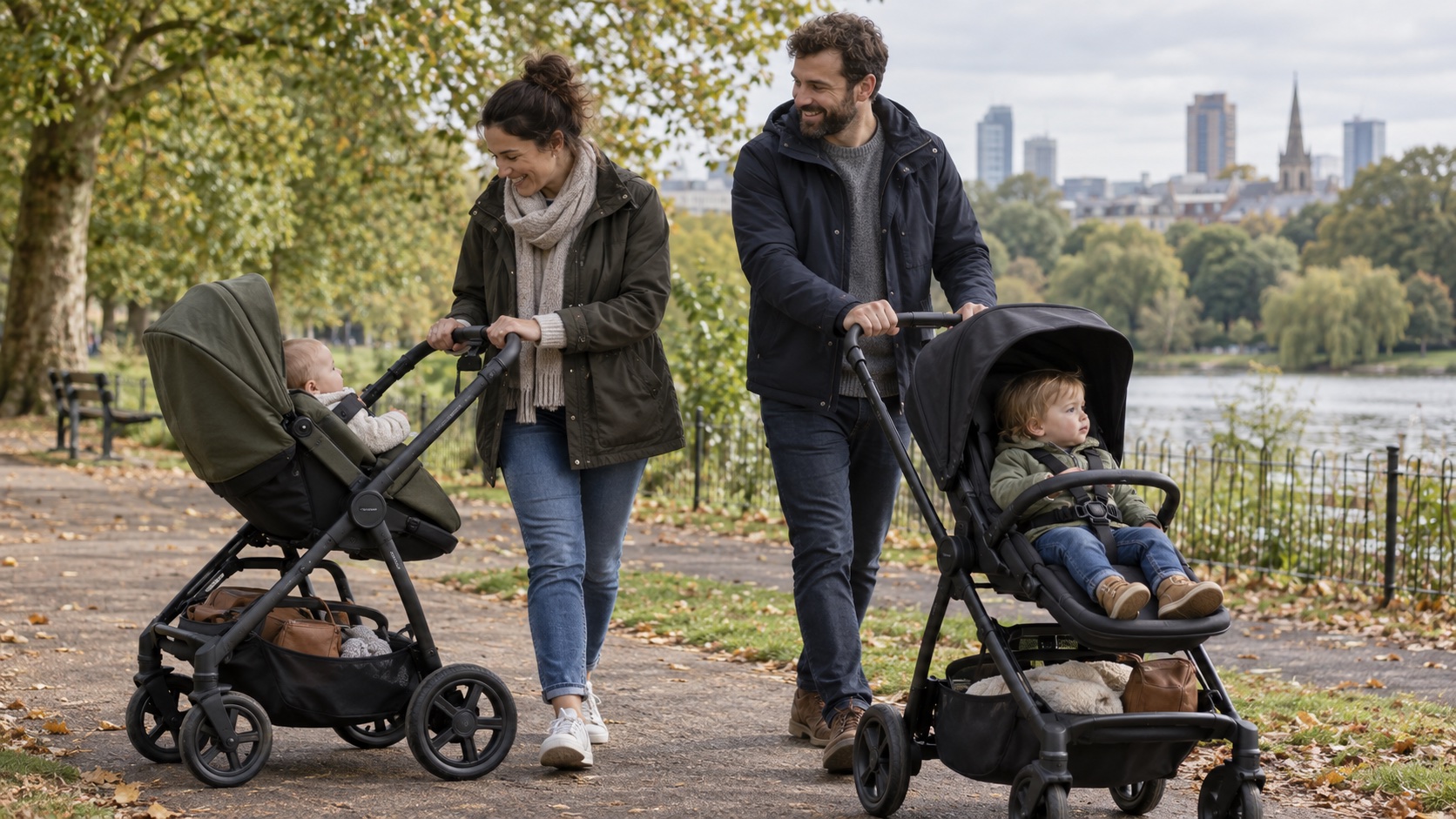
Parent-facing lets your baby see you. World-facing lets them watch where you are going and usually comes in a lighter, smaller pushchair. Neither direction is automatically better for every journey, and many babies are content with both at different times.
The practical choice depends on your child’s stage and the equipment you can carry. This guide compares communication, naps, busy places, folding and flights. If you already know you want a reversible seat, see the best parent-facing travel pushchairs in the UK.
Quick answer
- Parent-facing: useful for eye contact, quick responses and a younger baby who seeks reassurance.
- World-facing: useful for curious older babies and toddlers, and common on light cabin strollers.
- Reversible seat: gives the choice but normally adds weight and folded bulk.
- For a newborn: approved lie-flat support matters more than which way the pushchair points.
- For flights: decide whether cabin size is more valuable than a reversible toddler seat.
Parent-facing and world-facing compared
| Consideration | Parent-facing | World-facing |
|---|---|---|
| Communication | Easy eye contact and conversation | You may use a hood window or stop beside the seat |
| Baby’s view | Mainly the parent and surroundings to the side | Clear view of the route ahead |
| Pushchair choice | Usually reversible travel systems | Almost all compact and cabin strollers |
| Typical weight | Often heavier because of the seat mounting | Lightest strollers are usually fixed world-facing |
| Fold | May vary with seat direction | Often simpler on fixed-seat models |
| Newborn use | Only with an approved lie-flat seat, cot or newborn pack | Same rule; direction alone proves nothing |
| Best travel strength | Reassurance in unfamiliar places | Smaller equipment and visual interest |
What parent-facing changes during a journey
Face-to-face positioning makes small interactions easy. You can see whether your baby is awake, notice early tiredness and respond before a whimper turns into full crying. In a loud station or unfamiliar street, your expression and voice remain close.
It can also make feeding or comfort stops more obvious. A dropped dummy, twisted hat or sun reaching the seat is easier to spot. This is particularly useful when the route is new and your attention is divided between signs, tickets and luggage.
The benefit is not a promise that every baby will stay calm. Some older babies become frustrated when they cannot see forward, while others prefer looking at a familiar adult for much longer. Watch your own child rather than changing direction because of a fixed age mentioned online.
What world-facing changes during a journey
📋 Free Baby Holiday Packing Checklist
Enter your email and we'll send the free printable checklist straight to your inbox — every category, ready to tick off before every trip.
World-facing gives the child an open view of trains, trees, people and vehicles. A curious baby or toddler may stay occupied for longer without needing toys. On a slow sightseeing walk, the shared experience can be enjoyable even though you are speaking from behind.
It also opens the largest choice of travel pushchairs. Most cabin-fold models use a fixed forward-facing seat because it simplifies the frame and fold. A stroller around 6–7kg is much easier to carry through a station than a 12kg reversible system.
You can still communicate. Stop beside the buggy, use the hood’s viewing panel when appropriate and talk as you walk. The difference is that you cannot read every expression continuously, which may matter more with a younger or easily overwhelmed baby.
For newborns, position is only one part of safety
A newborn needs the lie-flat support or approved newborn configuration stated by the manufacturer. A seat facing you is not necessarily suitable from birth, and a world-facing stroller may have an approved lie-flat position. Read the manual for the exact model and do not infer suitability from the direction or marketing photographs.
A carrycot usually faces the parent and provides a dedicated flat space for the early months. Some travel strollers use a newborn pack, cocoon or compatible infant carrier. Car seats are designed for vehicle safety and short transfers; they are not a general replacement for a flat pram surface during long walks.
If your baby was premature or has medical needs, ask your health professional about the planned setup. The NHS explains general newborn care, while the pushchair manufacturer remains the source for product limits and fitting.
Is there a correct age to switch world-facing?
No single birthday suits every child or pushchair. Some families switch once the baby has strong head control and meets the seat’s instructions. Others keep parent-facing through the toddler stage and turn the seat only for busy or interesting outings.
Look for the child’s response. Leaning and twisting to see ahead may mean they want a wider view. Becoming unsettled or struggling to sleep in a busy place may suggest that facing you remains helpful. A reversible seat lets you change the arrangement without buying another pushchair.
Follow the minimum age and recline rules in both directions. Some seats allow different positions depending on which way they face. Harness fit must remain correct after every change.
Which direction is better for naps?
Seat support, recline, hood coverage, noise and timing affect naps more than direction alone. A baby who settles through eye contact may fall asleep more easily facing you. A toddler accustomed to a world-facing buggy may sleep perfectly well with the hood extended.
Check whether the recline works equally in both directions and whether you can operate it without removing bags. A deep recline that changes abruptly can wake the child. The hood should provide shade while allowing ventilation; never cover the entire seat with a blanket.
If naps are essential to the day, test the intended setup before travelling. A new direction, new stroller and unfamiliar hotel routine introduced at once create unnecessary uncertainty. Our guide to helping a baby nap on the go has more practical sleep planning.
Busy stations, airports and city centres
Parent-facing can feel reassuring when crowds pass close to the seat. You notice discomfort quickly and the baby has a familiar focal point. A reversible seat can also keep direct wind away from the child if the frame and hood permit a safe change of direction.
World-facing lets an older child see what is happening and may reduce attempts to twist around. In queues, park the pushchair where the child is not staring directly into other passengers or bright display lights. Move beside them when you need to explain what happens next.
Direction does not replace supervision. Use the harness exactly as instructed, apply the brake whenever stationary and keep the pushchair handle in your control. Avoid hanging heavy luggage from the handle, particularly on a light world-facing stroller.
The weight and fold trade-off
A reversible seat needs a connection that supports it securely in two directions. Many models also accept a carrycot and infant seat. These features produce a versatile travel system, but they add hardware and folded volume.
The Nuna IXXA next is an unusual light reversible option at a listed 6.1kg without armbar and insert. The Nuna TRIV next is 8.72kg on the same basis. Fuller choices such as the Mamas & Papas Vardo and Joie Finiti move above 11kg. Compare these with fixed-seat cabin strollers around 6–7kg.
A pushchair may fold with the reversible seat attached in both directions, one direction only or neither. Practise the complete sequence, including closing the hood and emptying the basket. A compact folded number is not helpful if you must carry the seat as a second loose item.
Flying: cabin stroller or reversible seat?
Most parent-facing toddler seats are found on pushchairs that need to be gate-checked. This can be perfectly manageable for occasional flights: use the buggy through the airport, remove loose accessories and hand it over in a labelled travel bag.
A fixed world-facing cabin stroller reduces the chance of waiting for a pushchair at reclaim and is easier on connections. Acceptance is never automatic; compare the folded dimensions with the operating airline’s current limit and expect staff to make the final decision.
For a young baby, one practical compromise is a compact stroller with its approved parent-facing newborn solution, followed by the world-facing main seat later. Another is a reversible everyday pushchair plus a carrier for the airport. See our airplane stroller guide before buying specifically for flights.
Trains, buses and car holidays
Train travel
Weight, standing fold and access to lifts often decide the train experience. Parent-facing helps you interact during a long journey, but a lighter fixed-seat stroller may be easier when changing platforms. Keep the basket clear enough to fold at short notice.
Bus travel
A compact footprint matters in the shared accessible space. You must be ready to fold if the space is needed by a wheelchair user. Plan how you will hold the baby while folding, regardless of seat direction.
Car holidays
A reversible travel system is easiest to justify when the car handles most transfers. Measure the boot with luggage and the parcel shelf in place. Check whether wheels can be removed quickly and whether the folded seat needs a particular direction.
Should you buy a reversible pushchair?
A reversible model is worth considering when you are buying from birth, expect to use one pushchair daily and value the freedom to respond to your child. It is also useful when different carers prefer different positions or when the route changes between calm parks and crowded streets.
A fixed world-facing stroller is often the better second pushchair for holidays. It costs less, weighs less and may fold much smaller. If your baby is already content facing forward, paying for a reversible seat that makes every staircase harder may not improve the trip.
Try both directions with your child if possible. Check the handle height, basket access and fold with the seat attached. Product specifications narrow the shortlist, but the way the pushchair fits your body and child decides whether it is pleasant to use.
Practical scenarios
A four-month-old on a first city break
Choose the manufacturer-approved lie-flat newborn arrangement, usually parent-facing. A reversible travel system or suitable newborn pack makes it easy to monitor the baby. Build the itinerary around feeding and flat-rest opportunities rather than maximising sightseeing.
A ten-month-old on a train holiday
Either direction may work. A reversible seat gives flexibility, but check the station lifts and your safe carrying weight. If the child already enjoys world-facing walks, a lighter compact stroller can simplify transfers.
A two-year-old flying to a resort
A world-facing compact stroller is normally the easiest travel tool. The toddler gains a clear view and the pushchair is easier to carry. Prioritise recline, hood and seat size over a direction they may no longer use.
A baby who becomes overwhelmed in crowds
A parent-facing seat can reduce visual intensity and make reassurance immediate. A reversible model lets you turn the child towards you in stations, then forward on a quiet promenade.
✈️ Free Baby Hand Luggage Checklist
Never forget the essentials. Enter your email and we'll send the free checklist straight to your inbox — one page, every category, ready before every flight.
FAQ
Is parent-facing better for a baby’s development?
Regular responsive interaction matters, but a pushchair’s direction is only one small part of the day. Talk and respond in either setup, and choose the position in which your child is comfortable.
Can a baby face forward at six months?
Only if they meet the pushchair’s age, posture and seat instructions. Read the exact manual; readiness and approved use matter more than a general online age.
Why are cabin strollers usually world-facing?
A fixed seat uses fewer moving parts and can fold into a smaller, lighter package. Reversible mounting systems need extra structure and space.
Can a newborn use a world-facing pushchair?
Only when that model has an approved lie-flat newborn setup in that direction. Facing forward does not make an upright seat suitable for a newborn.
Do babies sleep better parent-facing?
Some settle better when they can see a parent; others sleep equally well facing forward. Recline, familiarity, timing, shade and noise usually have a greater effect.
Is a reversible pushchair harder to fold?
It can be. Some modern models fold with the seat in either direction, while others need it turned or removed. Try the fold rather than relying only on dimensions.
Which direction is better in strong sun?
Use the hood and a breathable approved shade, and change the route or seat direction only if the manufacturer allows it safely. Never cover the whole pushchair with a blanket.
Can I turn the seat during an outing?
Yes on a reversible model, but remove the child first, apply the brake and follow the stated release and refitting steps. Check that the seat locks securely before continuing.
Our verdict
Parent-facing is valuable for communication and reassurance, while world-facing offers more lightweight travel choices and a wider view for an interested older child. A reversible pushchair buys flexibility at the cost of extra weight. For flights and frequent stairs, choose the lightest setup your child is genuinely comfortable using; for everyday newborn-to-toddler use, the reversible seat may earn its space.