
Best Airplane Beds for Toddlers UK 2026: Airline Rules Compared
By BabyTravel UK Editorial Team · Last updated September 2026
The best toddler airplane bed is the one your operating airline will actually let you use. For a long-haul flight, the Flyaway Kids Bed is our strongest dedicated sleep option, Plane Pal is the lightest simple leg-rest design and the Stokke JetKids BedBox makes most sense when you also want a ride-on case. On a two-hour flight, none is essential.
Acceptance differs sharply. British Airways currently names Flyaway Kids Bed, Plane Pal and JetKids BedBox among its permitted comfort aids, with seat and cabin restrictions. Emirates and TUI prohibit seat-extension beds during their flights. A product being described as "airline approved" does not override the operating carrier's policy or the cabin crew's instructions.
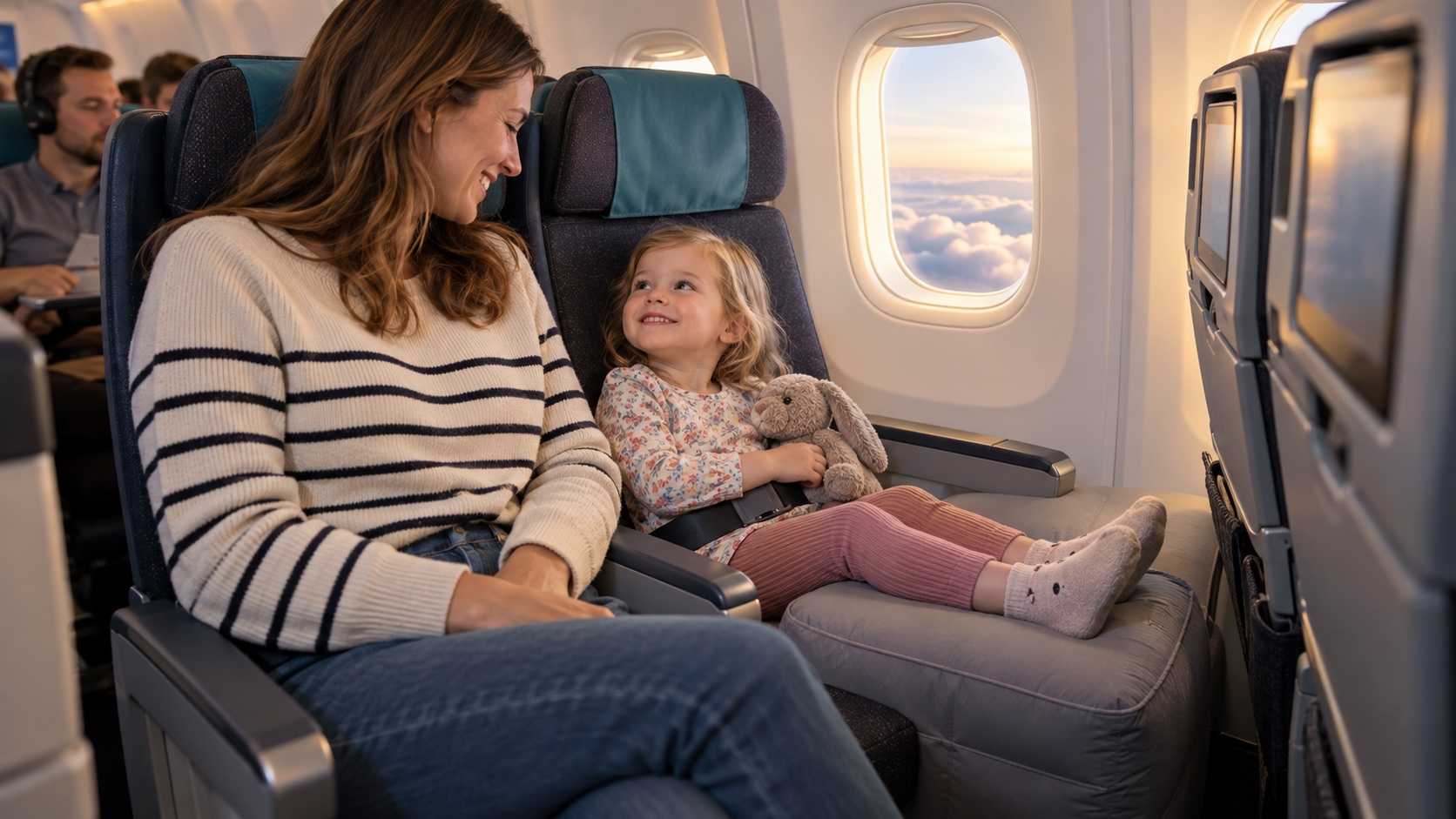
Quick picks
- Best dedicated toddler airplane bed: Flyaway Kids Bed.
- Best compact inflatable leg rest: Plane Pal.
- Best bed and ride-on suitcase: Stokke JetKids BedBox.
- Best for short-haul: usually no bed; pack a neck pillow, layers and familiar comfort item instead.
- Do not buy before checking: the policy of the airline operating every flight on your booking.
Toddler airplane beds compared
| Product | Suggested age or limit | Pack size and weight | Cabin-bag effect | Best use |
|---|---|---|---|---|
| Flyaway Kids Bed | Recommended from 2 to 7; manufacturer limit 50kg and 130cm | 1.3kg; deflated footprint about 25 × 25cm | Needs space inside, or may count as, cabin baggage | Long-haul sleep and play |
| Plane Pal | Designed mainly for ages 2 to 8 | Original kit 1.3kg; bag about 40 × 16 × 10cm | Easier to fit inside a larger cabin bag | Long-haul leg support |
| Stokke JetKids BedBox | Sleep function marketed for young children; ride-on use from 3; 35kg ride-on limit | About 46 × 20 × 36cm and 3.3kg | Normally becomes the child's main cabin case | Airport ride plus long-haul bed platform |
| Generic inflatable seat extender | Varies by product | Often 1kg or less, plus a pump | Small, but exact dimensions matter | Only when the airline confirms the exact type |
Sizes and airline policies change. Measure the packed product rather than relying on the word "portable", and leave room for nappies, medicine, food and spare clothes in your baby hand-luggage allowance.
1. Flyaway Kids Bed: best dedicated airplane bed

Flyaway Kids Bed creates a flat, wipe-clean surface across the child's seat and the footwell. Raised sides help contain small toys, and the child can keep the aircraft lap belt fastened low around the hips. The included hand pump inflates it in about 90 seconds once the seatbelt sign is off.
At 1.3kg it is not heavy, but it still occupies useful hand-luggage space. The packed footprint is about 25 × 25cm, so it works best when one adult has enough cabin allowance for the bed, pump and the items needed during the flight.
- Good for: overnight and long daytime flights where a two- to seven-year-old may sleep for several hours.
- Less useful for: short-haul sectors where set-up and packing time take a large part of the cruise.
- Key restriction: cruise only, in a permitted seat, with the child supervised and belted.
The manufacturer recommends use from age two, although a younger child with their own seat may be able to use it where the airline agrees. It gives a maximum bearing weight of 50kg and maximum height of 130cm, but seat pitch decides whether a taller child can lie straight or must curl up.
2. Plane Pal: best compact inflatable leg rest
📋 Free Baby Holiday Packing Checklist
Enter your email and we'll send the free printable checklist straight to your inbox — every category, ready to tick off before every trip.

Plane Pal is a shaped inflatable cushion that fills the footwell rather than covering the complete seat. The original kit, pump and bag weigh about 1.3kg; the deflated bag is listed at roughly 40 × 16 × 10cm. It can be turned to suit different economy-seat gaps.
The design is most helpful for dangling legs. A child can sit normally, stretch out or curl towards the window without the hard edge of the seat cutting behind the knees. The child’s head should remain on the aircraft seat, not on the cushion, and the lap belt must stay correctly positioned.
- Good for: parents who want a smaller, simple leg-rest rather than a ride-on case.
- Less useful for: short flights or airlines that prohibit inflatable footrests.
- Key restriction: only inflate after take-off when permitted, and deflate whenever crew instruct.
The newer self-inflating version removes the separate hand pump and is listed at about 1kg. That is convenient, but check rules for rechargeable devices and keep the inflation unit protected. Plane Pal says the product is designed mainly for ages two to eight; comfort depends more on leg length and seat pitch than the birthday alone.
3. Stokke JetKids BedBox: best multipurpose choice

The JetKids BedBox is a hard ride-on case with a top-opening storage compartment and a mattress that extends over the aircraft seat and case. It avoids carrying a separate inflatable bed, and the swivelling front wheels can make a long terminal walk more manageable.
The trade-off is weight and size. At about 3.3kg and 46 × 20 × 36cm, it is far larger than an inflatable cushion and can exceed a low-cost airline's free personal-item dimensions. Treat it as the child's cabin suitcase, not as a free extra.
- Good for: long-haul families who will use the ride-on function before and after the flight.
- Less useful for: restricted free-bag fares, stairs and airlines that prohibit bed boxes.
- Key restriction: Stokke says not to use it during taxi, take-off, turbulence or landing.
Children under 36 months should not ride on the BedBox according to its user guide, even though the sleep function is marketed for younger children. The ride-on maximum is 35kg. Our ride-on suitcase comparison looks at the BedBox beside lighter and cheaper cases.
4. Generic Amazon airplane beds: the budget alternative

Amazon has many lower-priced inflatable seat extenders. They can look similar to named comfort aids, but similar dimensions do not mean an airline has assessed or accepted them. British Airways, for example, publishes a named list rather than a blanket approval for every inflatable bed.
A generic product is only a sensible alternative when the airline confirms that this type is allowed and the design leaves access to safety equipment clear. Check rapid deflation, pressure relief, material quality and whether the child can remain correctly belted.
- Good for: occasional use where the operating airline has given a clear answer.
- Less useful for: families changing airlines or relying on a named-product policy.
- Key restriction: a marketplace description is not an airline approval.
Airline acceptance: what UK families need to know
| Airline | Current position | Practical implication |
|---|---|---|
| British Airways | Names Flyaway Kids Bed, Plane Pal and JetKids BedBox as permitted comfort aids, subject to cabin and seat-position rules | Check the exact product, cabin and allocated seat before travel |
| easyJet | Flyaway lists easyJet among accepting airlines, but the carrier's general family page does not promise every comfort device | Obtain current confirmation for the product and flight |
| Ryanair | Flyaway records acceptance as crew-dependent rather than guaranteed | Do not buy on the assumption it will be usable; the packed item must also fit paid baggage |
| Jet2 | No clear public approval for the named beds was found on the family baggage page | Ask Jet2 about the exact device before buying or packing it |
| TUI Airways | Prohibits flight hammocks, inflatable bed platforms and named products including BedBox and Plane Pal | It may travel only under the applicable baggage rules, not be used as a seat extension |
| Emirates | Prohibits leg rests and seat-extension devices including BedBox and Plane Pal | Ride-on cases may be carried if within baggage limits but cannot be used as a leg rest |
Read the operating airline's current page, not only the airline whose code appears on the booking. British Airways explains its named products and seating limits on its family seating page. TUI publishes a direct comfort-device prohibition, while Emirates lists prohibited leg rests, ride-on cases and sleepers.
Seat-position restrictions
Comfort devices usually belong at a window seat or in the centre of a middle block where they do not obstruct another passenger. They should not be placed in an emergency-exit row. A bulkhead may work for some inflatables but not every rigid box, and premium cabins with unusual seat shells can have their own restrictions.
Set-up normally waits until the aircraft is in cruise and the seatbelt sign is off. The item must be stowed for taxi, take-off and landing, and often during turbulence. Practise rapid deflation or folding at home so you can clear the footwell promptly.
Cabin-bag implications
The sleep aid does not normally create an extra baggage allowance. BA explicitly says a comfort aid carried separately counts as one of the passenger's two cabin pieces. A BedBox can consume the child's larger cabin allowance, while an inflatable bed and pump reduce the space available inside an adult's bag.
On a basic Ryanair fare, the free personal item is far smaller than a BedBox. easyJet says a standard Trunki can fit under the seat, but its large cabin-bag rules and booking conditions still matter for larger cases. Compare your exact fare, not just the aircraft overhead-bin dimensions.
Keep medicine, nappies, food and one change of clothes independent of the bed in case the case is gate-checked. Our baby hand-luggage checklist helps separate essential items from optional comfort gear.
Is an airplane bed worth it for short-haul?
Usually not. Once boarding, taxi, climb and descent are removed, a two-hour flight may offer less than an hour of useful bed time. A toddler who is interested in the cabin may never settle before it is time to deflate the product.
For short-haul, spend the space on snacks, a quiet activity, spare layers and a familiar comforter. Our 18-month-old travel guide and holiday guide for two-year-olds have age-specific ideas that work without a seat extender.
Is an airplane bed worth it for long-haul?
It can be, particularly on an overnight sector where the child already has their own seat and the airline confirms use. Supporting the legs can make it easier to find a stable sleeping position and can stop toys falling into the footwell. It cannot guarantee sleep, and a tired child may reject unfamiliar equipment.
Try the basic routine before departure: explain that the bed appears after take-off, practise sitting and lying on it if the manufacturer allows ground use, and keep the normal bedtime cues. See our long-haul flight guide for timing, food and sleep planning.
Airplane bed or CARES harness?
They do different jobs. A bed or leg rest is a comfort aid used during cruise. The genuine AmSafe CARES harness is an approved child aviation restraint designed to add upper-body support to the aircraft lap belt and can be used during taxi, take-off, landing and turbulence where the airline accepts it.
A seat extender is not a safety restraint. If restraint is your priority, read our child airplane harness guide and compare a genuine CARES with an aircraft-qualified car seat.
✈️ Free Baby Hand Luggage Checklist
Never forget the essentials. Enter your email and we'll send the free checklist straight to your inbox — one page, every category, ready before every flight.
Frequently asked questions
Are toddler airplane beds allowed on UK airlines?
Some are, but there is no universal UK rule that makes every product acceptable. British Airways names three approved comfort aids; TUI Airways and Emirates prohibit seat extensions. Check the operating carrier before buying.
Can an airplane bed be used during take-off?
No. Comfort devices must be stowed for taxi, take-off and landing. They may only be set up during the permitted part of the flight and must be removed when crew instruct.
Does my toddler need their own seat?
Yes, the device fills the footwell in front of a separate aircraft seat. A child travelling on an adult's lap has no seat space for it.
Can the aircraft seatbelt stay fastened?
It should. Follow the product instructions and keep the lap belt low across the child's hips. Do not place it around the chest or on top of bulky bedding.
Can I use a toddler airplane bed in an aisle seat?
Usually not. An aisle device can obstruct an escape path. Window seats and certain centre seats are the normal permitted positions, but the airline controls the final allocation.
Will a BedBox count as cabin luggage?
Plan for it to be the child's main cabin case. At roughly 46 × 20 × 36cm it is too large for several free personal-item allowances, even though it can fit many larger cabin-bag limits.
Are cheap inflatable airplane beds the same as Flyaway or Plane Pal?
No. Similar appearance does not prove the airline has assessed the product. Where an airline publishes a named list, an unlisted copy may be refused.
What can I use if the airline bans airplane beds?
Use the ordinary seat with the approved restraint, comfortable layers, a small neck pillow if age-appropriate, a familiar comfort item and a realistic sleep routine. Never attach a hammock or strap to the tray table when the carrier prohibits it.
Our verdict
Choose Flyaway Kids Bed for a confirmed long-haul flight where a dedicated flat surface is worth the cabin space. Choose Plane Pal for a simpler inflatable leg rest, or JetKids BedBox when the airport ride and suitcase functions justify its extra 3.3kg. For short-haul, or for Emirates and TUI flights, keep the money and hand-luggage space for items your child can use throughout the journey.