
Best Child Airplane Harness UK 2026: CARES Rules Explained
By BabyTravel UK Editorial Team · Last updated September 2026
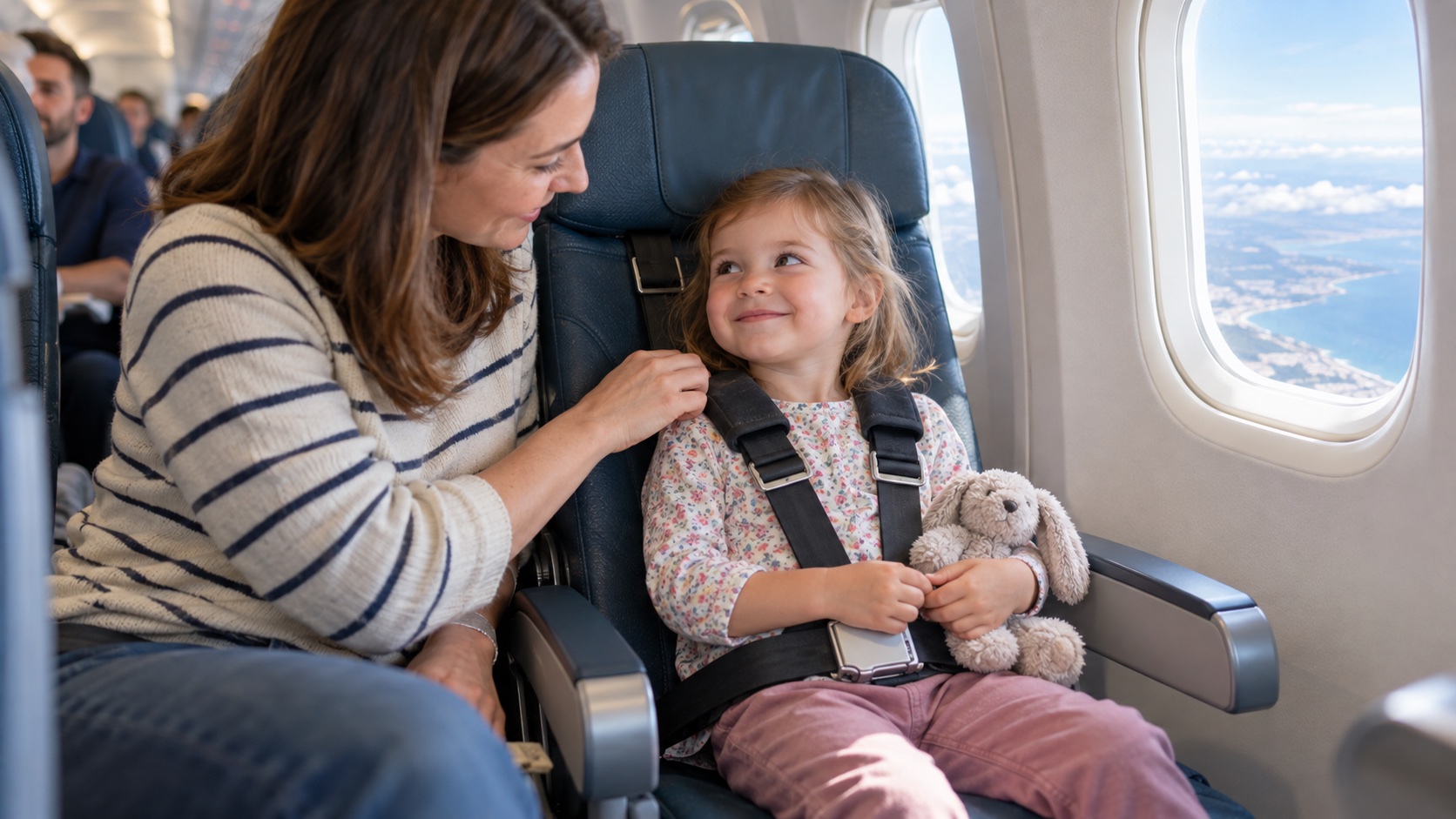
For a normally developing child who fits the limits, the only airplane harness we recommend buying is a genuine AmSafe CARES Child Aviation Restraint System. The standard CARES is FAA-certified for a child who can sit upright unaided, is no more than 100cm tall and weighs 10 to 20kg. It weighs roughly 500g and packs much smaller than a car seat.
Cheap harnesses that look similar are not automatically certified. The FAA specifically warns about CARES counterfeits sold online. Check the label, manufacturer and airline policy, and do not use a walking rein, car travel vest or generic "airplane safety harness" as a substitute.
Quick answer
- Best child airplane harness: genuine AmSafe CARES.
- Child range: 10–20kg, up to 100cm, able to sit upright unaided in a forward-facing seat.
- Best for: a toddler or young child with their own seat when you do not need a car seat at the destination.
- Not for: car, taxi or coach journeys.
- Best alternative: an exact aircraft-qualified child car seat accepted by the operating airline.
Child airplane restraints compared
| Option | Child suitability | Approximate travel weight | When it protects | Main limitation |
|---|---|---|---|---|
| Genuine AmSafe CARES | 10–20kg, up to 100cm, sits upright unaided | About 500g | Taxi, take-off, flight, turbulence and landing where accepted | Aircraft only; airline and seat rules apply |
| Special CARES | For travellers with additional postural-support needs, assessed individually | Compact, version dependent | As approved for the passenger and flight | Requires advance airline and sometimes authority approval |
| Aircraft-qualified car seat | Exact height and weight limits of the seat | Commonly 4–9kg | All permitted flight phases when correctly installed | Bulky; exact model and airline acceptance matter |
| Aircraft lap belt only | Airline's normal child-seating rules | No item to carry | All required flight phases | No upper-body straps |
| Generic lookalike harness | Claims vary | Usually light | Do not assume certification | May be counterfeit, unapproved or refused |
1. Genuine AmSafe CARES: the recommended harness

CARES adds two shoulder straps and a chest clip to the aircraft's existing lap belt. A horizontal strap passes around the aircraft seat back, then the shoulder loops connect to the lap belt. It is designed for a forward-facing child who can remain upright without support.
Its main advantage is portability. A roughly 500g harness fits into hand luggage and removes the need to carry a hard car seat solely for the flight. It is also quick to remove after landing once you have practised the fitting sequence.
- Pros: certified for aviation use, tiny compared with a car seat, usable during turbulence and all flight phases where accepted.
- Cons: narrow child-size range, aircraft only, no sleep recline and airline-specific seat restrictions.
Amazon's product title may describe it simply as a "child car seat", but CARES is not a car seat and is not approved for road vehicles. Confirm that the item is made by AmSafe and carries the required approval statement on the restraint itself.
2. Special CARES: for additional support needs
📋 Free Baby Holiday Packing Checklist
Enter your email and we'll send the free printable checklist straight to your inbox — every category, ready to tick off before every trip.
Special CARES uses longer straps for older or larger passengers who need upper-body support because of a disability or medical condition. It is not a larger off-the-shelf version for a child who has outgrown standard CARES. Approval can be passenger-specific and may require an airline assessment, medical information or an authority exemption.
Contact the operating airline well before booking or at least before the carrier's assistance deadline. Give the exact restraint model, passenger measurements and journey, including codeshare sectors. British Airways, Ryanair and Emirates publish information about supported seating devices, but their placement and approval processes differ.
3. Aircraft-qualified car seat: the practical alternative
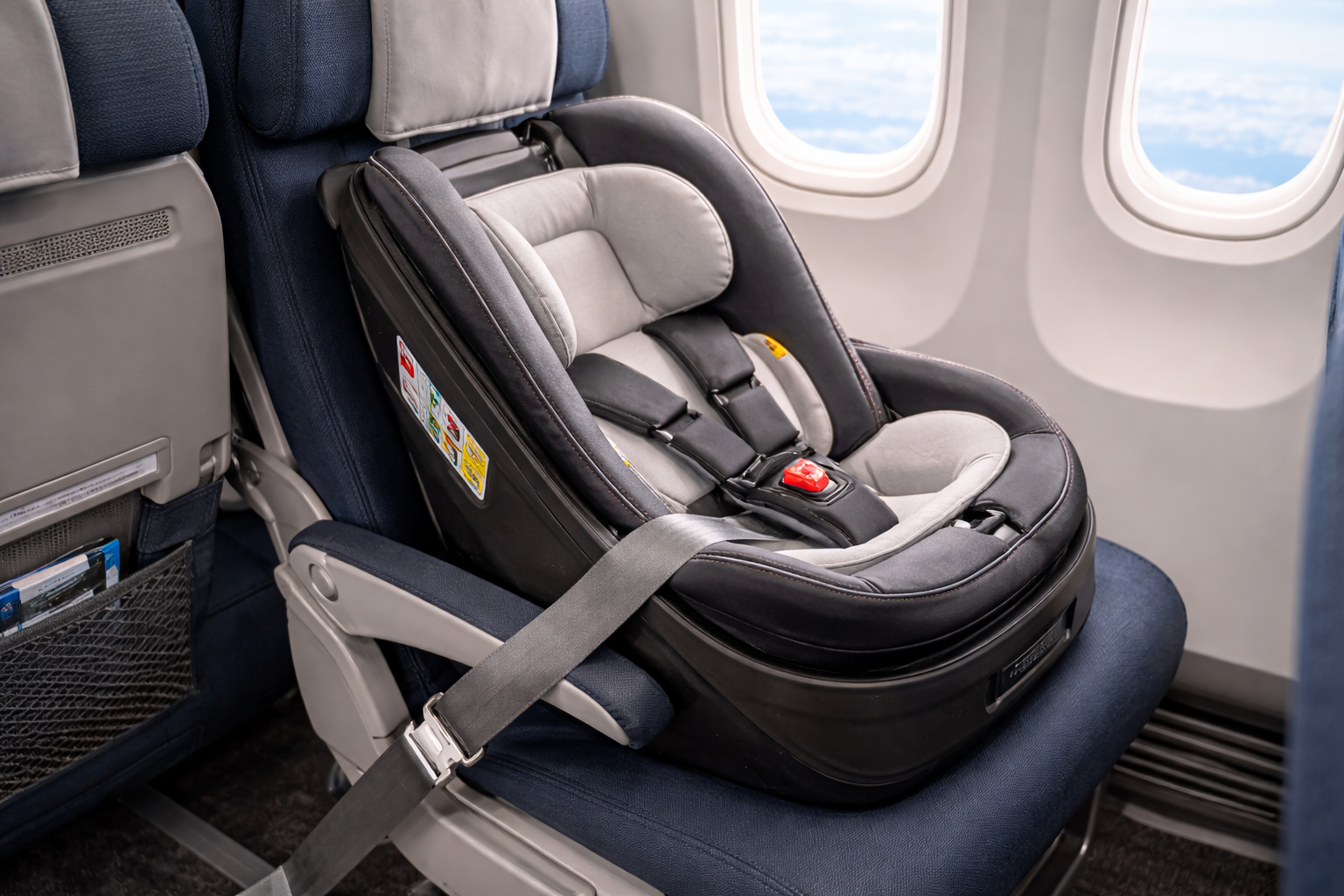
A hard-backed car seat is the better choice when you will also use it in a hire car or taxi. It can support a smaller baby, provide a familiar shell for sleep and cover children who do not fit the CARES range, provided the exact seat is aircraft-qualified and accepted.
The price is bulk. You need a separate aircraft seat for the child, must carry the restraint through the airport and may be limited to a window position. An R129 road approval alone does not prove the seat is approved for aircraft use.
- Pros: useful at the destination, supportive shell, options for babies and children outside CARES limits.
- Cons: much heavier, awkward in the aisle and dependent on exact aircraft certification.
How to identify a genuine CARES harness
Look for AmSafe as the manufacturer and the permanent label stating that the restraint is approved for aircraft use. The FAA accepts wording that refers to approval under 14 CFR 21.8(d), or the earlier 14 CFR 21.305(d) wording. A seller merely using "CARES-style" or "aviation harness" in a title is not enough.
The FAA advises buying direct from the manufacturer because it is aware of reproductions that resemble CARES but have not been engineered or certified in the same way. If a price appears unusually low, the brand is missing or the listing shows several unrelated seller names, choose the manufacturer or an established retailer.
Do not replace CARES with a walking harness, feeding-chair strap, motorcycle belt or wearable travel vest. Those products have different loads and attachment points and may interfere with the aircraft belt.
Airline acceptance for UK departures
| Airline | Published CARES position | Action before travel |
|---|---|---|
| British Airways | Permits CARES for 10–20kg children in economy and premium economy, fitted in the last row of the cabin; not Club World or First | Select or confirm the required seat and avoid emergency-exit areas |
| easyJet | Published family guidance permits passenger-supplied CARES for a child in the manufacturer's range | Confirm the current procedure and board early enough to fit it |
| Ryanair | Lists AmSafe CARES among accepted postural supports for 10–20kg children, but says it cannot be used for children under two | Contact assisted travel at least 48 hours before departure |
| Jet2 | No detailed public CARES rule was found in the current family baggage guidance | Ask Jet2 for written confirmation with the exact model |
| TUI Airways | Names CARES among devices that may be accepted as a special seat for a child with disabilities | Do not assume ordinary use; contact the airline about the child and booking |
| Emirates | Accepts AmSafe CARES and Special CARES in Economy, Premium Economy and Business, not First | Contact Emirates at least 48 hours before travel for an approved position |
British Airways gives unusually specific placement rules on its seat-support page. Ryanair asks families to contact assisted travel and lists CARES on its approved postural-support page. Emirates requires at least 48 hours' notice through its restraint-device guidance.
Policies can differ on a codeshare. The rules of the aircraft operator apply, even when another airline sold the ticket. Keep the airline's written response, CARES instructions and approval label available at boarding.
Age, height and weight suitability
The standard CARES range is defined by size and ability, not age alone. The child must weigh 10 to 20kg, be no more than 100cm tall and be able to sit upright alone in a forward-facing aircraft seat. That commonly covers part of the one-to-four-year age range, but many children will enter or leave the limits earlier.
Weigh and measure your child near the travel date. A child over 20kg or 100cm is outside the standard certified range even if the harness seems to buckle. A child under 10kg or unable to sit upright also needs a different arrangement agreed with the airline.
Some carriers add their own minimum age. Ryanair's current postural-support page says it cannot permit these aids for children under two. The manufacturer's range never overrides a stricter airline rule.
Cabin-bag implications
CARES is one of the easiest child restraints to pack. At roughly 500g, it can sit near the top of an adult's cabin bag without using the space of a car seat. Keep it in its pouch with the instruction card and the label easy to reach for the gate team.
Do not pack it in checked luggage if the child will use it on board. A delayed suitcase would leave you without the restraint. Place it with passports and essential medicine rather than in a child's bag that may be volunteered at the gate.
Its small size is most valuable on hand-luggage-only trips. Our baby hand-luggage checklist shows how to divide essentials between adults so one bag being moved does not remove everything the child needs.
Is CARES useful on short-haul flights?
Yes, when the child fits and your aim is consistent restraint rather than sleep. Unlike an inflatable airplane bed, CARES can remain fitted during take-off, landing and turbulence. The short sector means there is little benefit in carrying a large comfort device, so a 500g harness is relatively efficient.
It may be unnecessary for an older child who sits comfortably in the normal aircraft belt and does not meet the CARES limits. It is also poor value for a single return trip if the airline cannot confirm acceptance.
Is CARES useful on long-haul flights?
The low packing weight is attractive, but think about sleep. CARES holds the child's upper body upright and is not a lie-flat product. A toddler who slumps when asleep may be more comfortable in a suitable aircraft-qualified car seat, while a child who sleeps upright may manage well with CARES and a small neck pillow approved for their age.
A comfort aid and CARES are separate categories. A carrier may accept the harness but prohibit a seat-extension bed, as Emirates does. Read our toddler airplane bed guide before trying to combine products, and follow crew instructions if the comfort aid must be cleared during turbulence.
How CARES is fitted
- Tell cabin crew before fitting it and use the seat position allocated by the airline.
- Lower the tray table of the seat behind, pass the red seat-back strap around the child's aircraft seat, then return the tray table to its normal position.
- Position the shoulder straps over the child and pass the aircraft lap belt through the two lower loops.
- Fasten the aircraft belt low and snug across the hips, then adjust the shoulder straps and chest clip according to the AmSafe instructions.
- Check that the seat behind can still be used normally and that no strap crosses the passenger's tray or screen incorrectly.
Practise with the official video or instructions, but do not improvise on a dining chair because the seat-back shape is different. The FAA child-safety page shows the approval label and fitting approach.
✈️ Free Baby Hand Luggage Checklist
Never forget the essentials. Enter your email and we'll send the free checklist straight to your inbox — one page, every category, ready before every flight.
Frequently asked questions
Is CARES approved in the UK?
The genuine AmSafe CARES has UK aviation acceptance, but each airline controls whether and where it can be used. Obtain the operating carrier's confirmation.
Can a child under two use CARES?
The standard manufacturer range can include some children under two, but the child needs their own seat and the airline may impose a higher minimum age. Ryanair, for example, says it does not permit its listed postural supports for under-twos.
Can CARES be used in a car or taxi?
No. CARES is approved for aircraft use only. Arrange a suitable child car seat separately for road journeys.
Can my child sleep in a CARES harness?
They can sleep upright while correctly restrained, but CARES does not provide the side and head support of a car seat and must not be altered to create a bed.
Can I use CARES during take-off and landing?
Yes, genuine CARES is designed for all flight phases where the airline accepts it. This is a major difference from comfort devices that must be stowed.
Does CARES require a separate aircraft seat?
Yes. It attaches to the child's own forward-facing aircraft seat and uses that seat's lap belt.
Are Amazon CARES copies safe?
Do not assume so. The FAA warns of counterfeit products. Only buy a genuine AmSafe restraint with the correct permanent approval label.
What should I use after my child reaches 20kg?
Do not extend the standard CARES range. Ask the airline whether the normal lap belt, an aircraft-qualified car seat or an approved support for a specific additional need is appropriate.
Our verdict
A genuine AmSafe CARES is the clear choice when a 10–20kg child fits the height limit, can sit upright and has their own seat. It is light enough for a hand-luggage-only trip and can be used when it matters most, including take-off, landing and turbulence. Buy by manufacturer and approval label, not by appearance. If you need a restraint for road transfers or more sleep support, take an exact aircraft-qualified car seat instead.